-
-
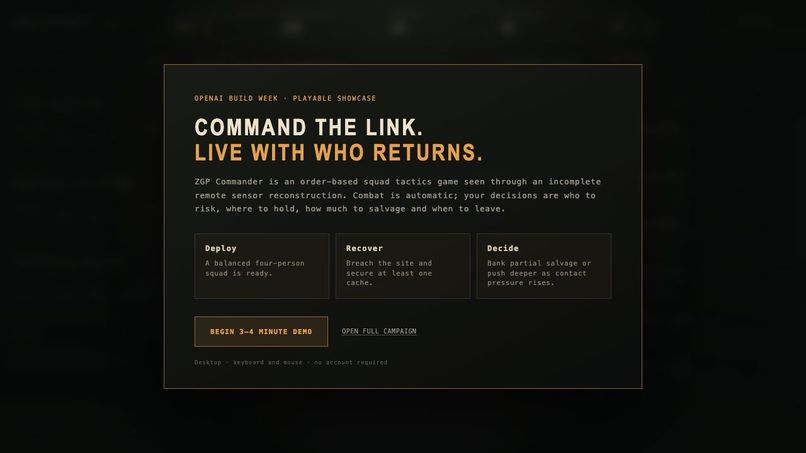
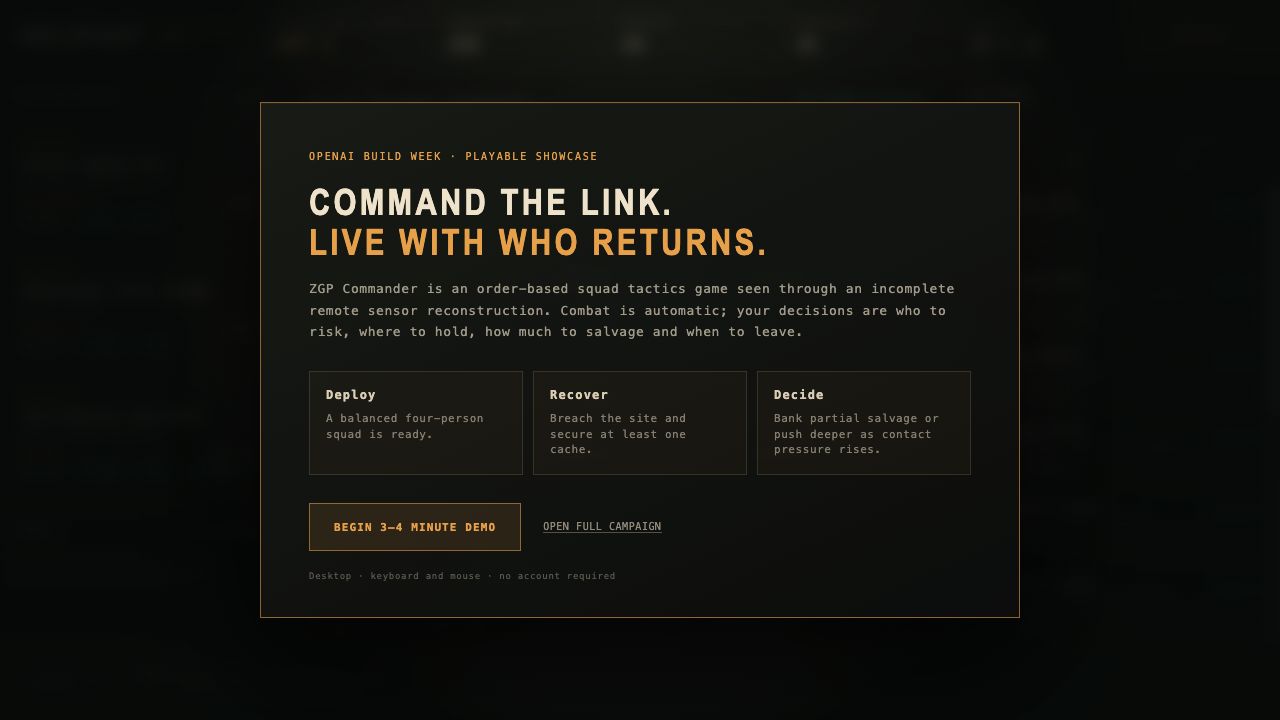
Build Week demo introduction: deploy, recover and decide.
-
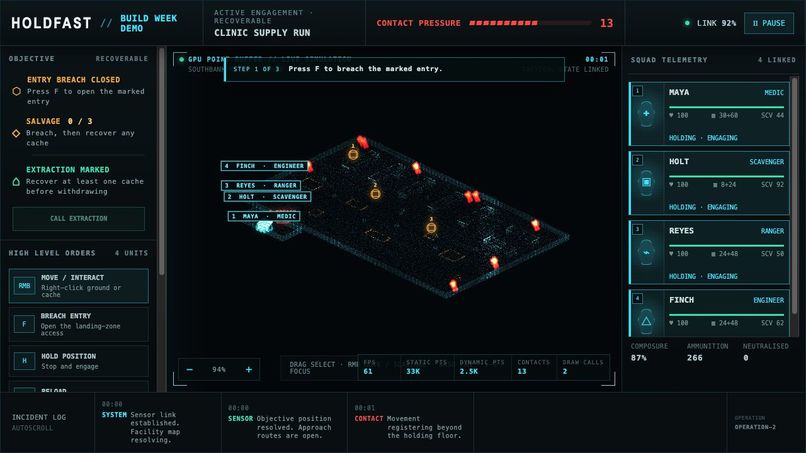
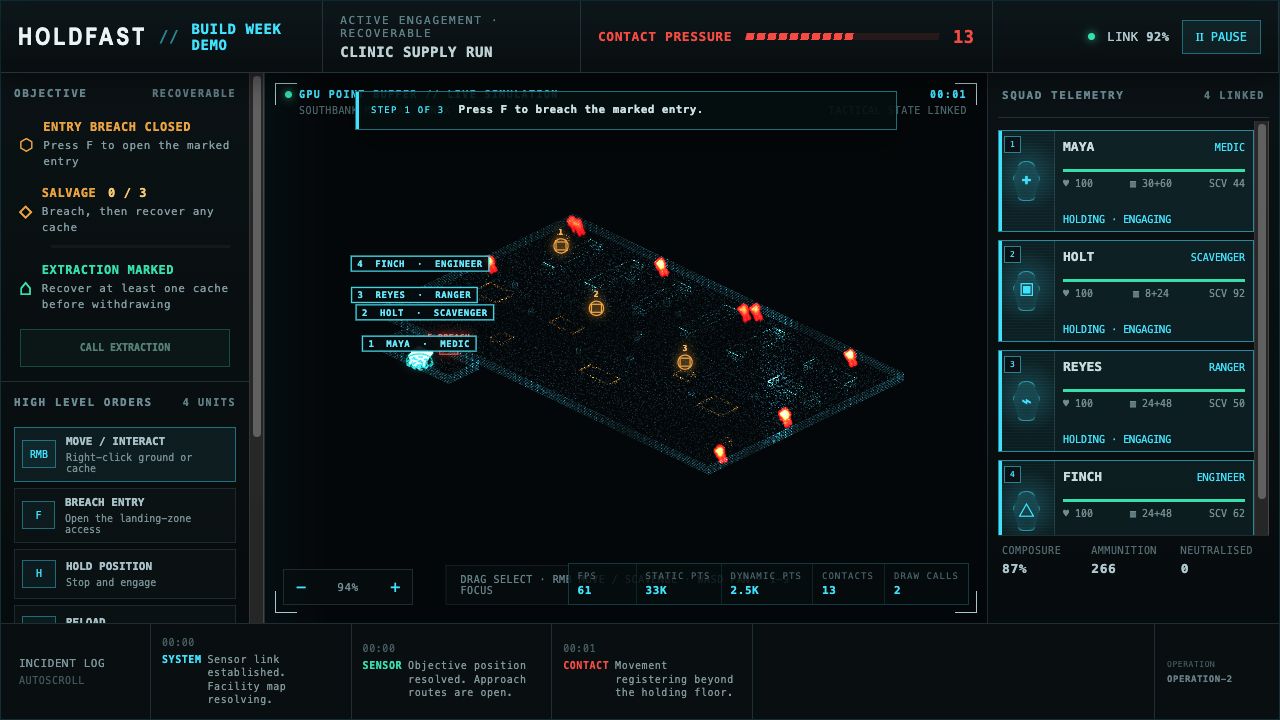
Four survivors operating through the incomplete Ghostlink point-cloud feed.
-
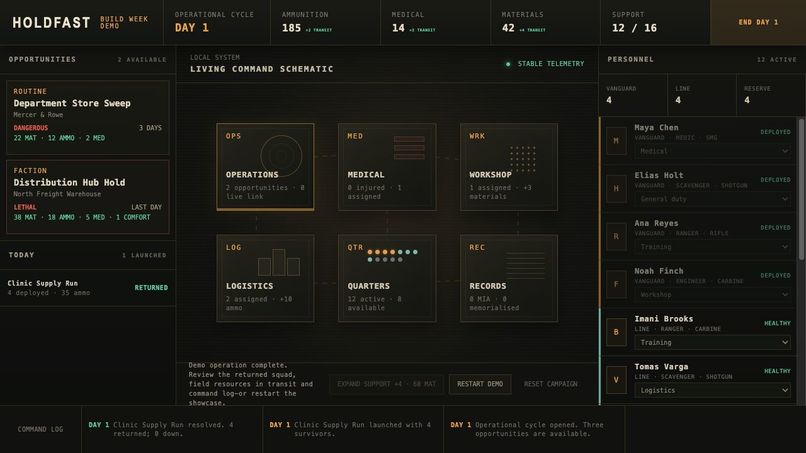
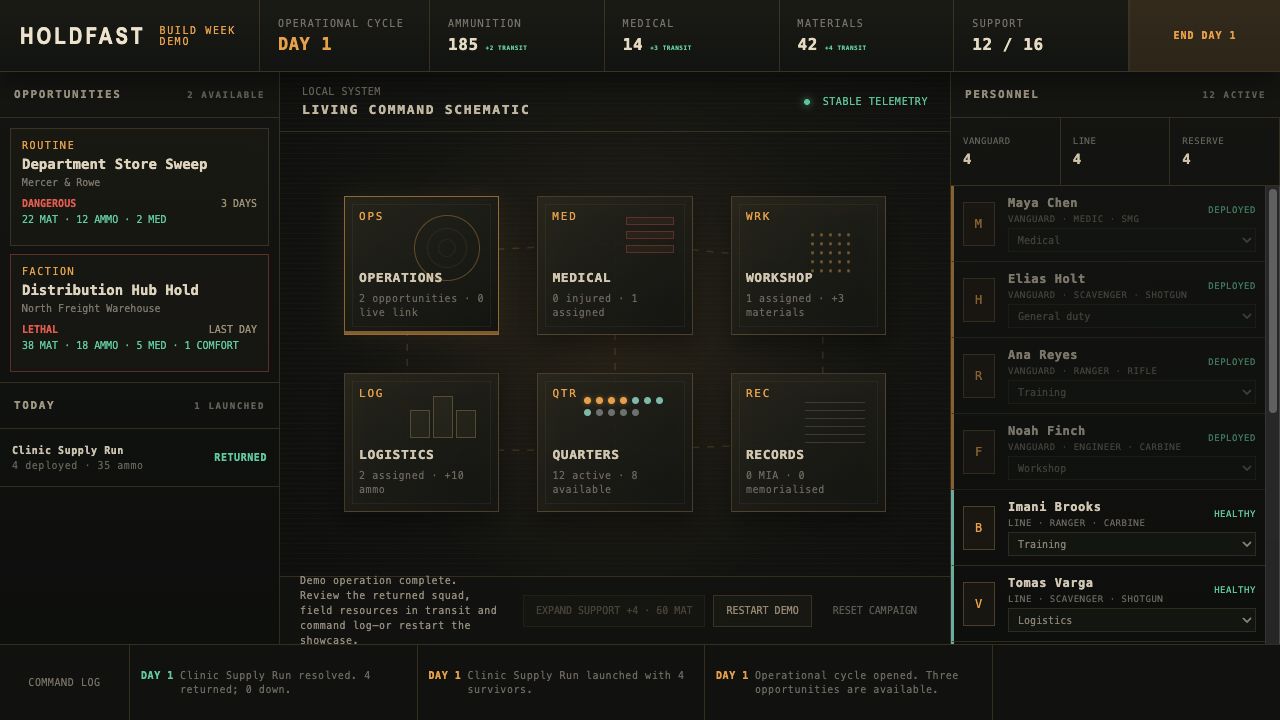
Returned squad, resources in transit and persistent consequences at the living base.
-
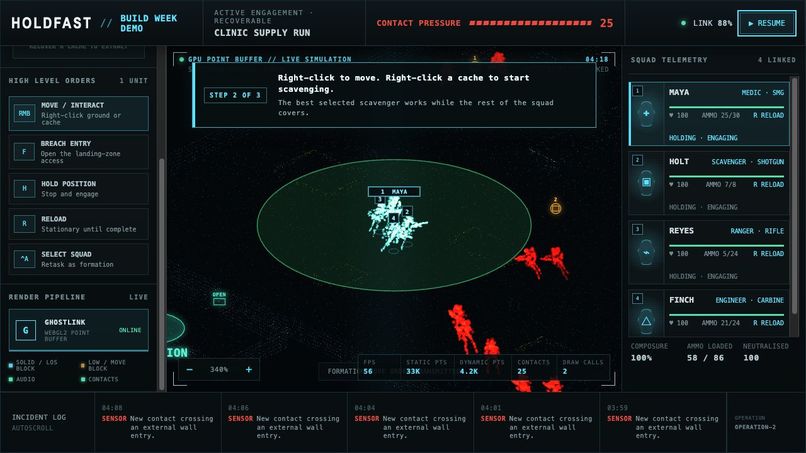
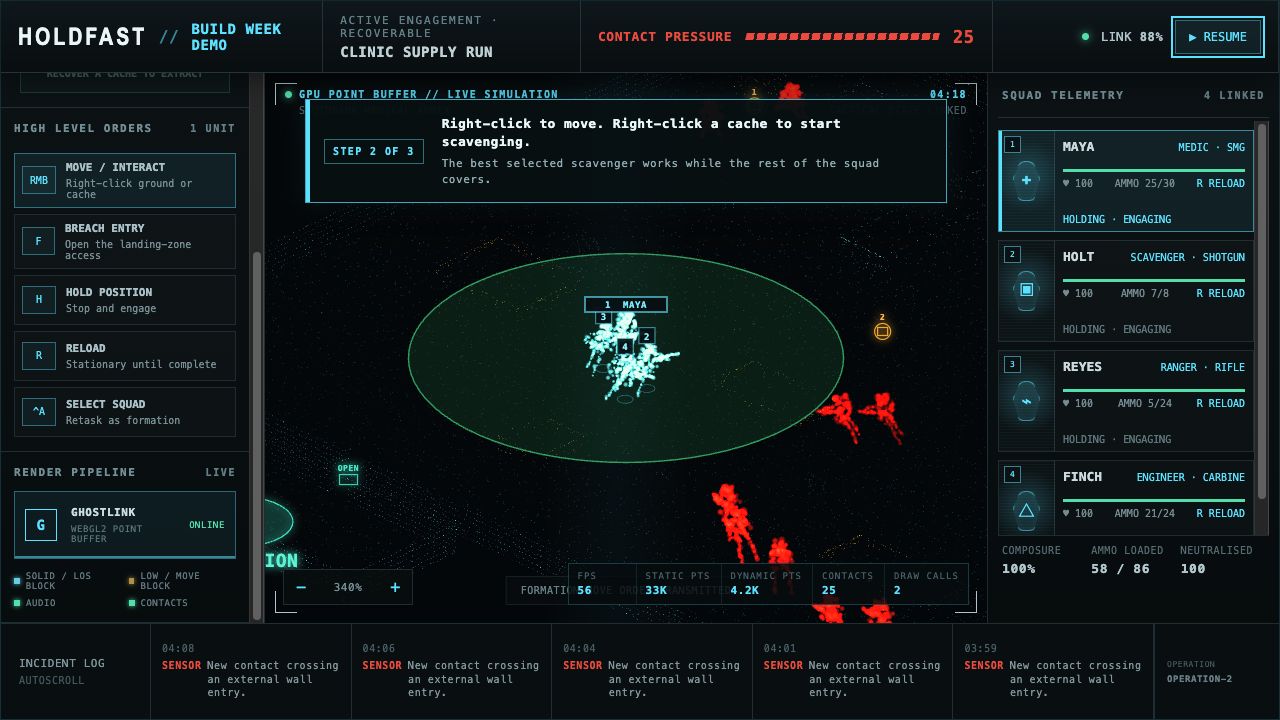
Ghostlink at 340% zoom: four survivors reconstructed from drifting sensor returns as hostile contacts close in.
Inspiration
There are auto-battlers and there are tactics games, but I really wanted was something that captured the essence of the old Last Stand: Dead Zone game. Something where you can build a team of survivors and pit them against the zombie horde. Sure you can hold the line, but can you do that while also getting the loot?
I had the project planned out a while back but I struggled to find a way to make it look good. I have no art skills and I found earlier agents to not be able to handle programatic SVG creation to the level I wanted and the asset packs I tried just didn't hit the spot.
What it does
Beginning with a small outpost, the player manages a 12-person survivor roster, base jobs and resources. They choose which teams to send out on missions or to take the low risk option of doing jobs at home. A dispatched squad enters Ghostlink: an incomplete remote sensor reconstruction of the operation.
Friendly telemetry is authoritative, but the environment and hostile contacts arrive as uncertain point-cloud data. The player selects positions, breaches, finds items to scavenge and recovers them while guarding the team member doing the hard work. The question then is to decide whether another cache is worth the rising pressure. Combat executes automatically, your task is to decide whether to push your luck and try for the next crate.
Getting the loot home will just be the start of things in the full game. Survivors may need patching up or memorialising if things didn't go to plan, use your loot to expand the base or build new gear. At the end of each in-game day, mission loot is received, jobs are completed and a new day dawns with a fresh set of actions and possibilities.
The Build Week showcase isolates a playable slice comprising a deterministic 3–4 minute route with a balanced squad, in-game guidance and a clean replay button. It uses the same campaign, simulation and renderer as the full slice.
How we built it
ZGP Commander is a static TypeScript and Vite application. Its tactical presentation uses a WebGL2 point-cloud renderer with a Canvas fallback. Campaign state creates mission definitions and deployments, the resulting tactical simulation publishes plain presentation snapshots. Our renderer consume those snapshots and creates the scene without being directly involved with the rest of the game.
I supplied the game structure and setup, Codex and Sol did all of the coding and made suggestions as to how those should be implemented.
Challenges we ran into
The point-cloud presentation was the main result of this hackathon. Previous versions of the game had SVG or sprite based graphical systems using engines such as Pygame and Godot but none felt viable or were good to look at. With the release of Sol, I was able to push for better and more interesting choices that previous agents weren't able to think of. The point-cloud system feels like a much better fit for programmatic generation and one in which my very poor artistic skills suddenly become less relevant.
Accomplishments that we're proud of
- A complete base-to-mission-to-consequences loop.
- Roughly 33,000 environment points rendered with two point-cloud draw calls.
- Persistent survivors, declared mission risk, rolling deployments and partial extraction.
- WebGL2 presentation with a Canvas fallback and no runtime image assets.
What we learned
Rapid implementation is only useful when paired with deliberate steering. Codex did more than accelerate implementation... after several visual attempts failed, it helped explore, compare and synthesise a graphical system that neither of us had started with. Human judgement decided which prototypes failed and which direction served the game best.
What's next for ZGP Commander
The next step is to broaden core loop: procedural operation layouts, more mission types (including survivor rescue missions for those MIA), faction based progression, richer survivor careers and craftable equipment, deeper base projects, and playtesting-driven balance. Asynchronous multiplayer, accounts and a large art pipeline are further down the line if people are interested in the project.
Built With
- canvas
- codex
- css
- gpt-5.6
- html5
- javascript
- typescript
- vite
- vitest
- webgl

Log in or sign up for Devpost to join the conversation.