ZeroWall
Inspiration
Complex AI optimization spans hardware, drivers, runtimes, inference engines, and models. Yet specialists and AI models usually optimize one layer while moving the bottleneck elsewhere. We built ZeroWall to search for the system winner, not the local winner.
What It Does
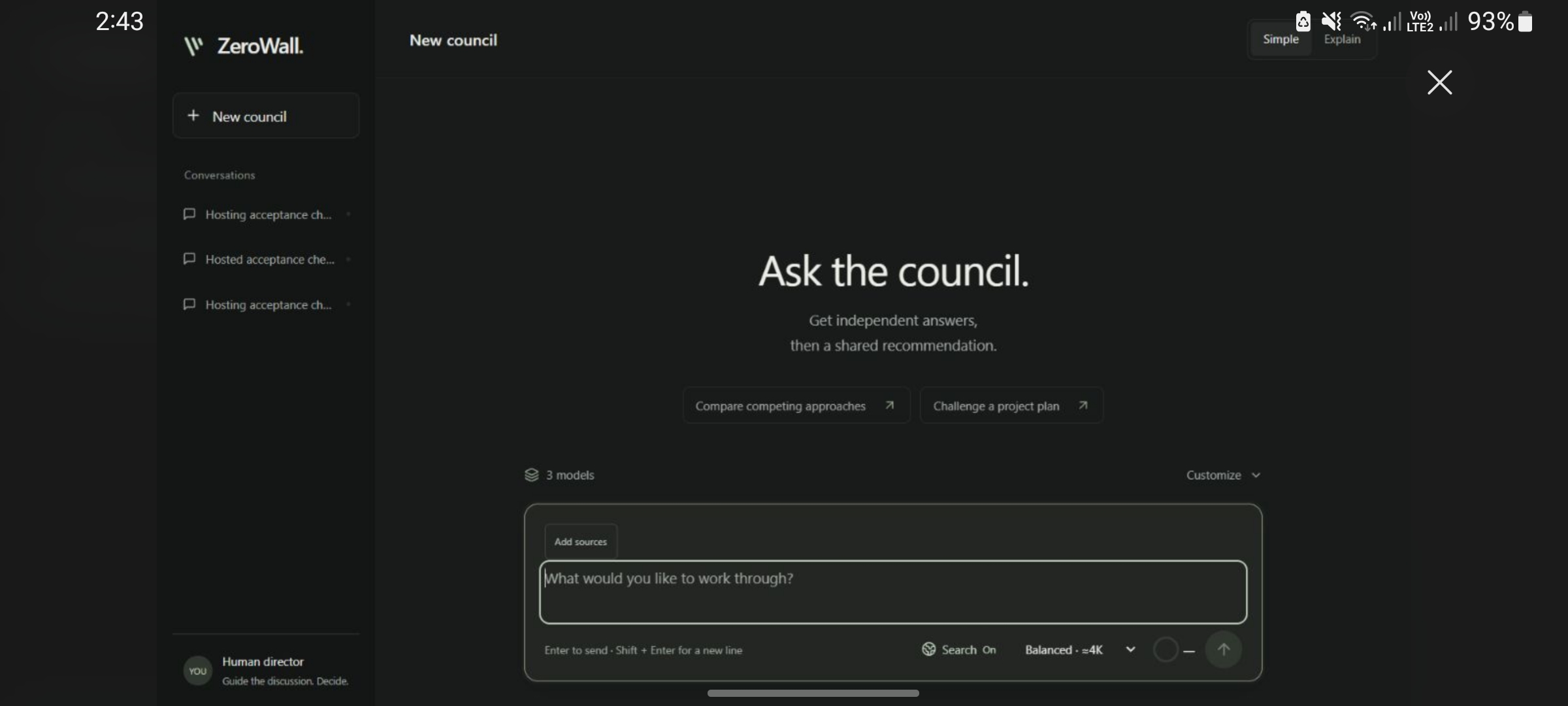
ZeroWall is a human-directed, multi-model research council. Independent AI researchers propose competing technical hypotheses before seeing one another’s work. They reveal their ideas, challenge assumptions, and convert disagreements into measurable experiments. Our first mission investigates the memory wall in local LLM inference. The goal is to increase performance while preserving quality, memory, latency, and energy constraints.
$$ \max T(\theta)\quad\text{subject to}\quad Q(\theta)\ge Q_0-\epsilon,\;M(\theta)\le M_{\max} $$
How We Built It
We run NVIDIA models through Nebius Token Factory. A council orchestrator manages Commit, Reveal, Cross-Examine, Experiment, and Reframe stages. ZeroWall stores hypotheses, concerns, evidence, failed experiments, and final decisions. A controlled runner executes benchmarks and links local changes to end-to-end tokens per second. LangSmith traces model calls, tool usage, latency, token consumption, and research rounds.
What We Learned
More models do not automatically create better research; structured disagreement and evidence do. Consensus is not proof, and the fastest kernel may not produce the fastest complete system. A measured ceiling may reflect the current design rather than a fundamental physical limit.
Challenges
Our main challenges were preventing anchoring, limiting endless debate, controlling costs, running fair benchmarks, and keeping the full-stack vision achievable within a hackathon.
Don’t optimize a layer. Challenge the limit.

Log in or sign up for Devpost to join the conversation.