-
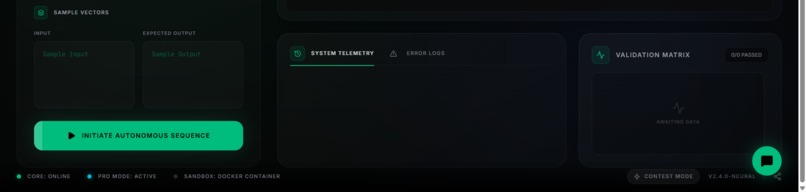
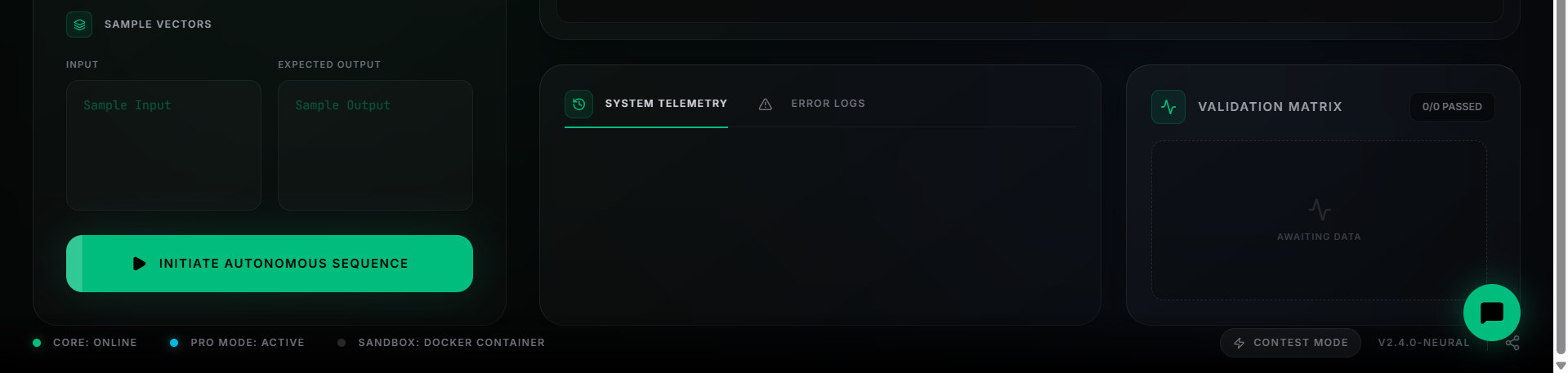
System Telemetry Error Logs and Validation Matrix box
-
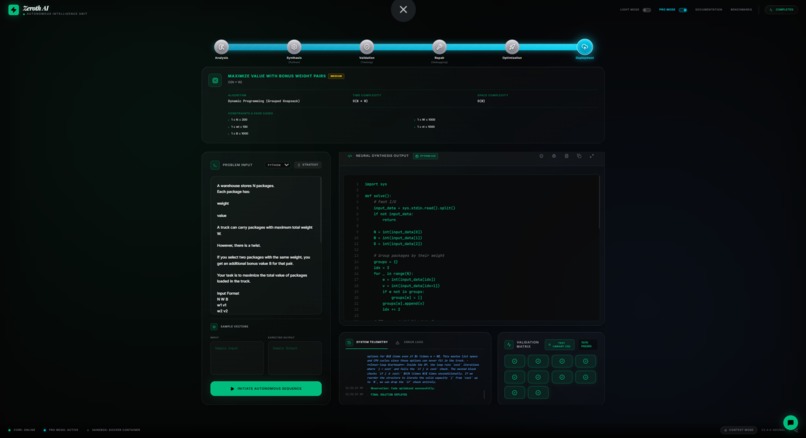
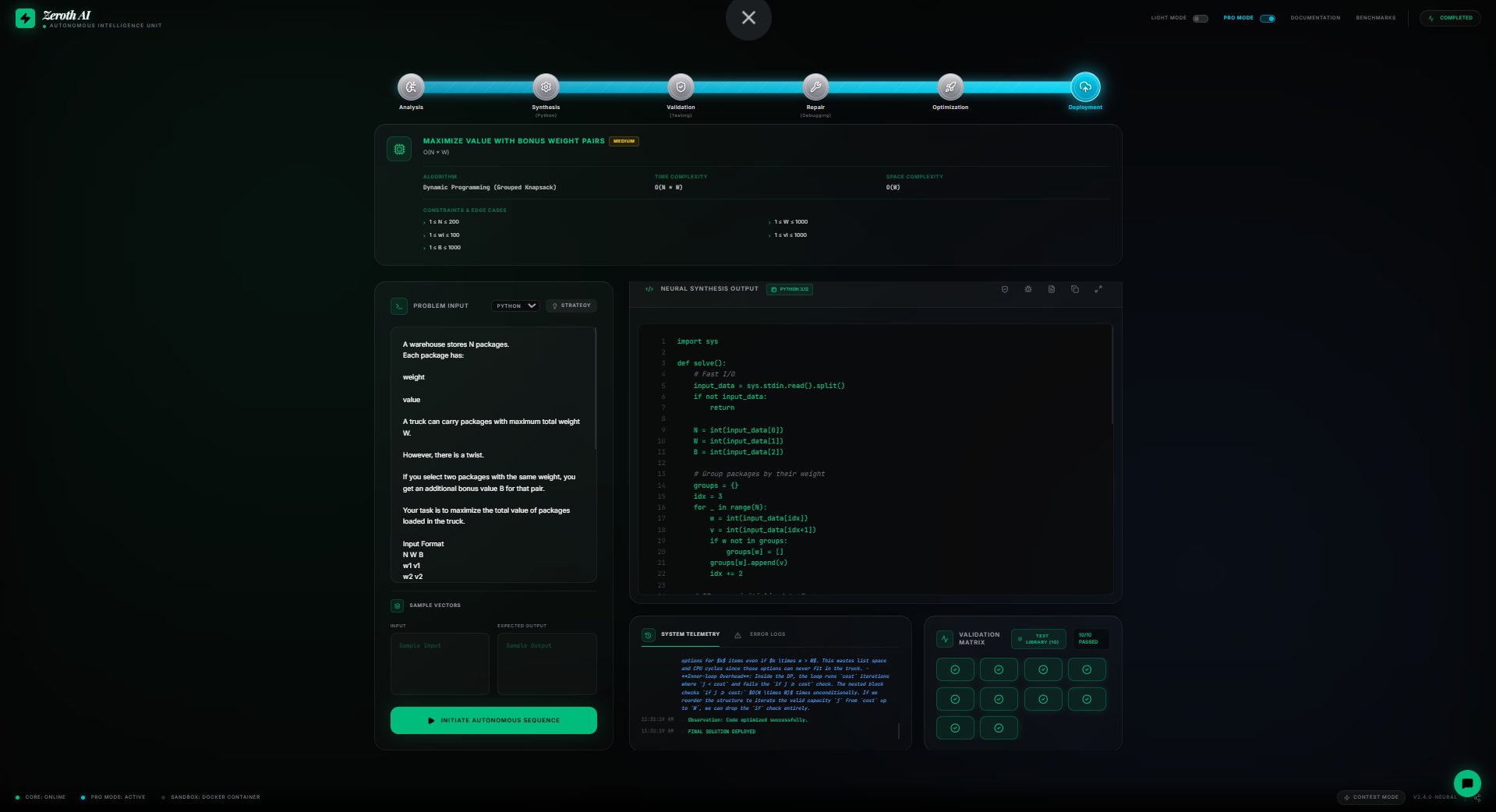
full processing page
-
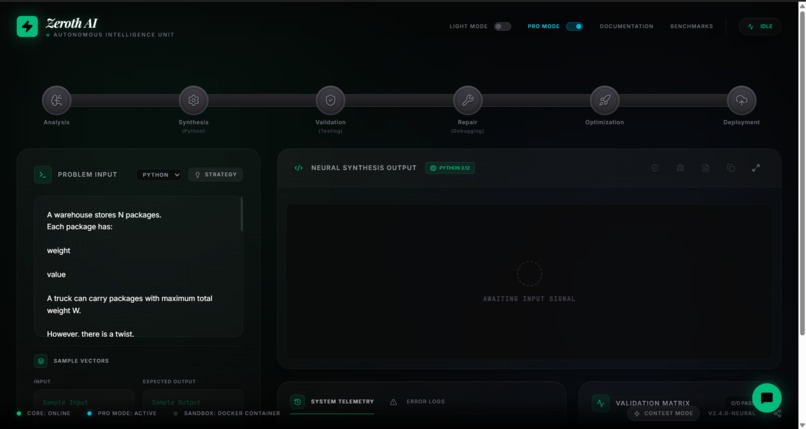
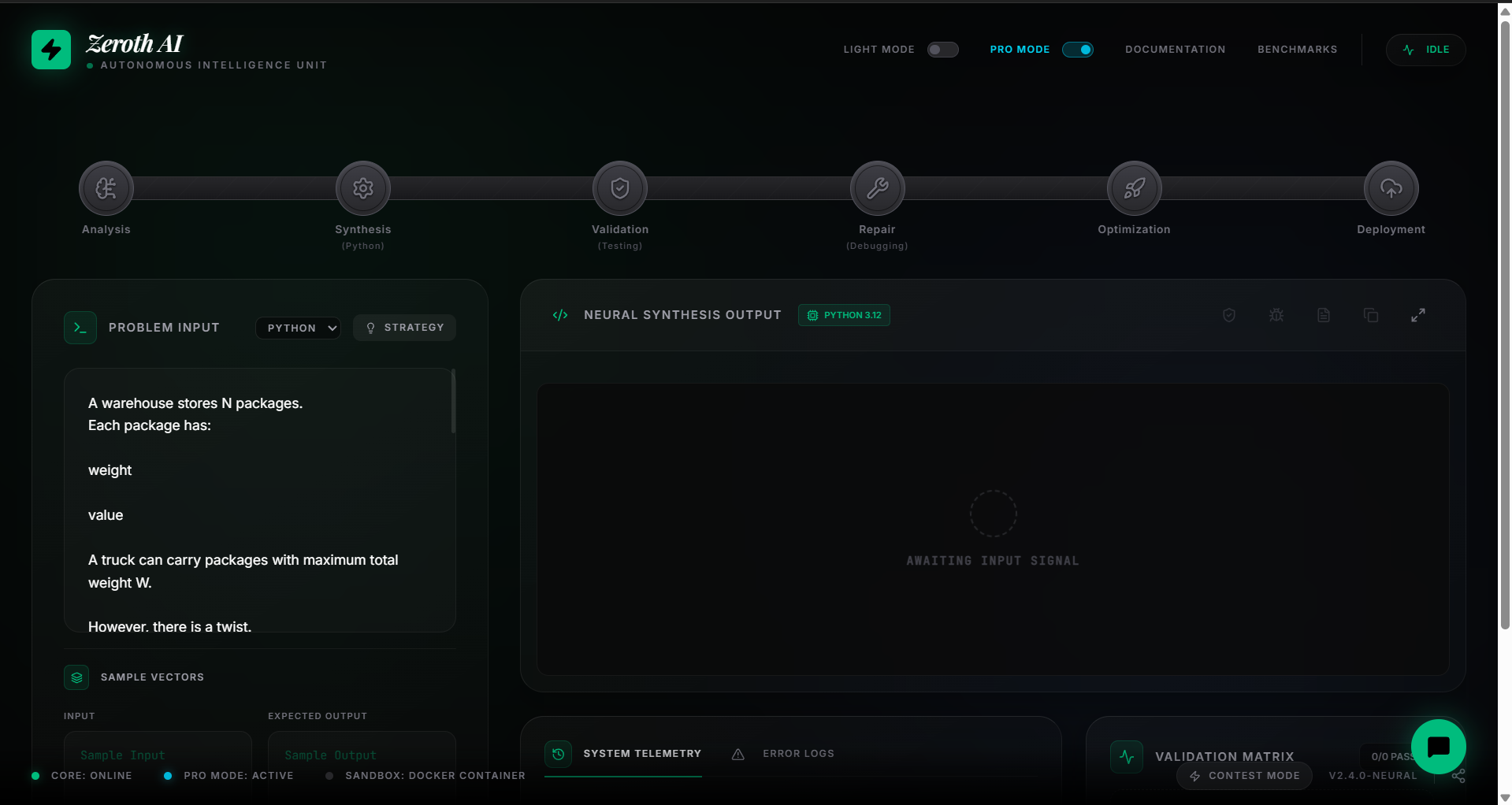
home page
-
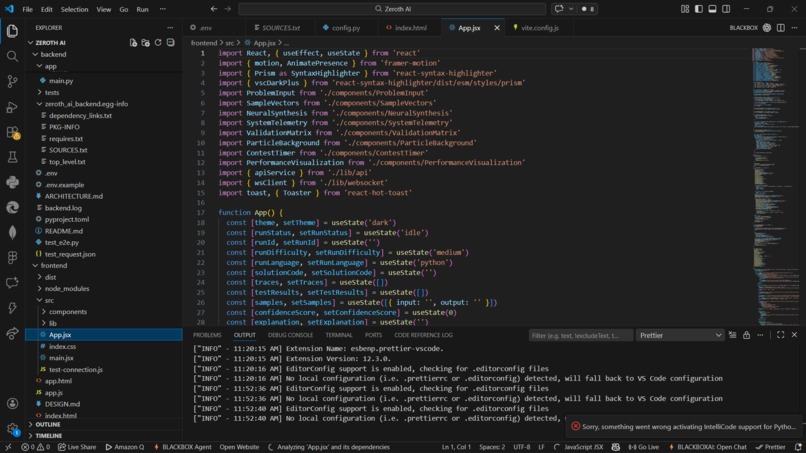
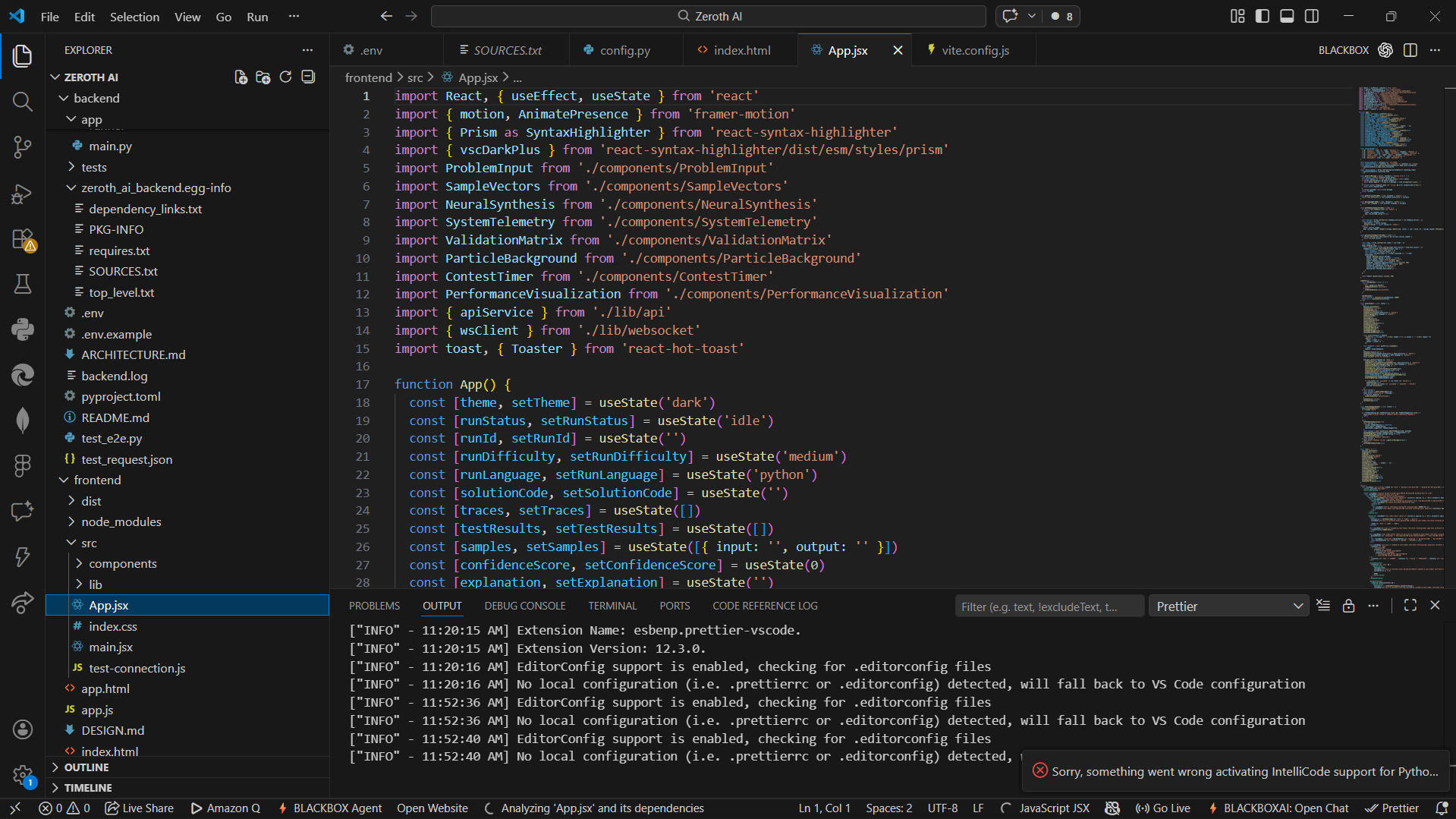
my coding area
Zeroth AI Inspiration
Competitive programming platforms such as Codeforces, LeetCode, and CodeChef evaluate solutions using hidden test cases that are not visible to participants. Many developers rely on generative AI tools to write code, but these tools typically provide a single solution without verifying whether it can handle edge cases, large constraints, or hidden judge scenarios.
We noticed a major gap: AI can generate code, but it rarely validates its correctness like a competitive programmer would.
This inspired us to build Zeroth AI — an autonomous coding agent designed to simulate the way expert programmers test their solutions. Instead of just generating code, Zeroth AI analyzes the problem, generates edge cases, stress-tests the solution, detects failures, and automatically fixes the code until it becomes robust and optimized.
Our goal was to create an AI system that helps developers reach a “zeroth-error state” — code that passes both visible and hidden test cases.
What it does
Zeroth AI is an autonomous AI coding agent designed to improve developer productivity by validating and strengthening algorithmic solutions.
When a user provides a programming problem, Zeroth AI:
Analyzes the problem statement and understands constraints and input formats.
Generates an initial solution using a large language model.
Runs the solution against public test cases.
Automatically generates additional edge cases and stress tests that simulate hidden judge scenarios.
Detects failures and identifies why the solution breaks.
Refines and fixes the code automatically through iterative debugging.
Optimizes the algorithm to meet time and space constraints.
The result is a robust, optimized solution that is far more likely to pass hidden test cases in competitive programming environments.
How we built it
We built Zeroth AI using a modular architecture designed around an autonomous agent workflow.
Core components include:
Problem Analyzer – Parses the problem and extracts constraints.
Code Generator – Uses an LLM to produce an initial implementation.
Execution Engine – Runs the generated code in a controlled environment.
Test Case Generator – Creates additional edge cases and stress tests.
Failure Analyzer – Identifies why the code fails on certain inputs.
Optimization Module – Improves the algorithm’s efficiency.
Tech Stack
Python (core backend logic)
LLM API for reasoning and code generation
Streamlit for the interactive web interface
Subprocess-based execution engine for running generated code
Algorithmic stress testing and dynamic test generation
The system runs in a loop where the agent continuously tests, analyzes, and improves the solution until it becomes stable.
Challenges we ran into
One of the biggest challenges was designing an agent that could reason about failures instead of just generating code repeatedly.
Some key difficulties included:
Generating meaningful edge cases that resemble hidden judge tests
Automatically identifying why a solution failed
Ensuring the agent doesn’t get stuck in infinite correction loops
Managing execution safety when running generated code
Handling large input constraints and performance optimization
We also had to carefully design the workflow so the AI could iteratively improve the solution instead of restarting from scratch each time.
Accomplishments that we're proud of
We are proud that Zeroth AI goes beyond simple code generation and introduces autonomous verification and improvement.
Key achievements include:
Successfully building an AI agent that stress-tests its own code
Implementing automatic edge case generation
Creating a system that can identify and fix logical errors
Demonstrating how AI can simulate the workflow of a competitive programmer
This transforms AI from a code generator into a self-improving coding assistant.
What we learned
Through this project we learned:
How to design agent-based AI systems
How LLMs can be combined with programmatic tools
The importance of test-driven development in AI-generated code
How iterative feedback loops dramatically improve AI outputs
We also discovered that the real power of AI agents comes not from generating answers once, but from testing, analyzing, and improving solutions continuously.
What's next for Zeroth AI
We believe Zeroth AI has the potential to become a powerful tool for developers and competitive programmers.
Future plans include:
Supporting multiple programming languages (C++, Java, Python)
Building a VS Code extension for real-time coding assistance
Integrating with competitive programming platforms
Adding advanced algorithm analysis and complexity prediction
Implementing distributed stress testing for large-scale evaluation
Ultimately, we envision Zeroth AI evolving into a full autonomous coding assistant that ensures code reliability before submission.

Log in or sign up for Devpost to join the conversation.