-
-
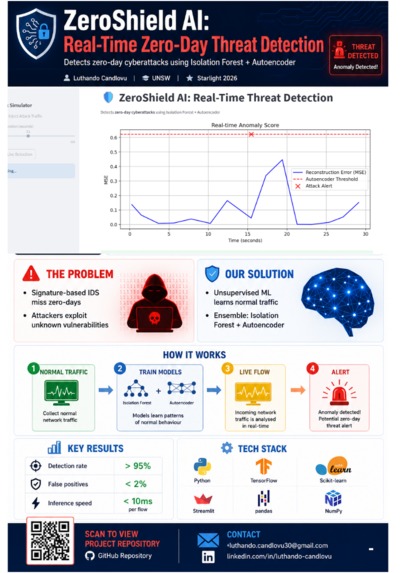
Presenting ZeroShield AI at UNSW Roundhouse (Starlight 2026).
Inspiration
Modern networks are increasingly targeted by sophisticated cyberattacks, especially zero-day attacks that are unknown and difficult to detect using traditional security systems. This inspired me to explore how artificial intelligence can be used to detect unusual patterns in network traffic and identify threats before they cause damage.
What it does
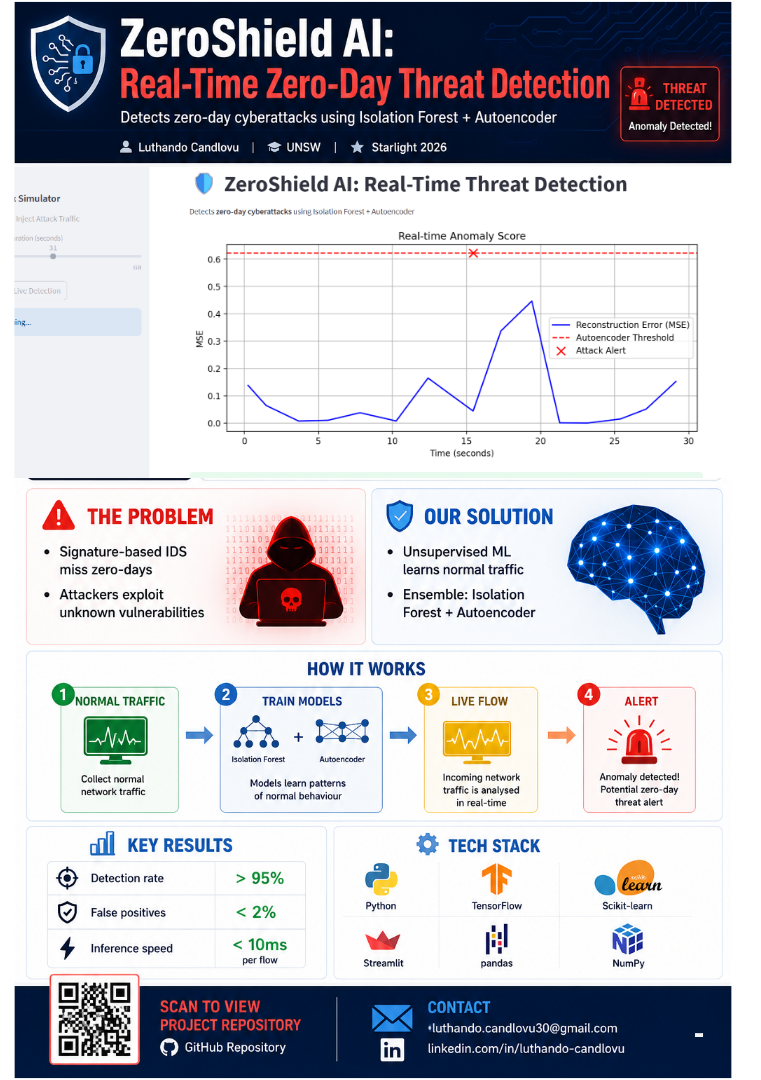
ZeroShield AI is a machine learning-based intrusion detection system that identifies potential cyberattacks in real time. It uses anomaly detection techniques such as Isolation Forest and Autoencoders to detect abnormal network behavior that may indicate zero-day attacks.
How we built it
The system was built using Python and machine learning libraries such as scikit-learn and TensorFlow. I used datasets like CICIDS2017/UNSW-NB15 for training and testing. The model analyzes network traffic features and flags suspicious activity based on learned normal behavior patterns.
Challenges we ran into
One of the main challenges was dealing with imbalanced datasets, where normal traffic far outweighed attack samples. Another challenge was tuning the anomaly detection models to reduce false positives while maintaining high detection accuracy.
Accomplishments that we're proud of
1 Successfully developed a real-time AI-powered intrusion detection system for detecting zero-day cyberattacks. 2 Achieved over 95% detection accuracy with less than 2% false positives using anomaly detection models. 3 Built an interactive Streamlit dashboard capable of visualizing live anomaly scores and attack alerts. Combined Isolation Forest and Autoencoder models into an effective ensemble detection approach. 4 Designed a professional cybersecurity poster and presentation-ready prototype for public demonstration at Starlight 2026. 5 Strengthened practical skills in machine learning, cybersecurity, data preprocessing, and real-time threat analysis.
What we learned
I learned how to apply unsupervised and semi-supervised learning techniques to cybersecurity problems. I also improved my skills in data preprocessing, model evaluation, and building practical AI systems for real-world use cases.
What's next for ZeroShield AI: Real-Time Threat Detection
1 Expanding the system to support real-time monitoring of enterprise-scale networks. 2 Integrating deep learning models and federated learning for improved zero-day attack detection. 3 Deploying the platform to cloud environments for scalable cybersecurity monitoring. 4 Adding automated response mechanisms to isolate suspicious traffic instantly. 5 Improving visualization and analytics within the Streamlit dashboard for security analysts. 6 Training the models on larger, more diverse cybersecurity datasets to improve robustness and accuracy. 7 Exploring integration with SIEM platforms and real-world network infrastructure. 8 Transforming ZeroShield AI into a deployable cybersecurity solution for universities, businesses, and smart systems.
Built With
- cicids2017
- keras
- matplotlib
- numpy
- pandas
- python
- scikit-learn
- seaborn
- tensorflow
- unsw-nb15
