Inspiration
Every time I analyzed a suspicious file, I was juggling five different tools — VirusTotal for hashes, URLScan for links, a separate APK analyzer, and still had no idea what the results actually meant in plain English. I wanted one unified platform that did all of it, explained it clearly, and worked even without internet. That frustration became ZeroRisk Sentinel.
What It Does
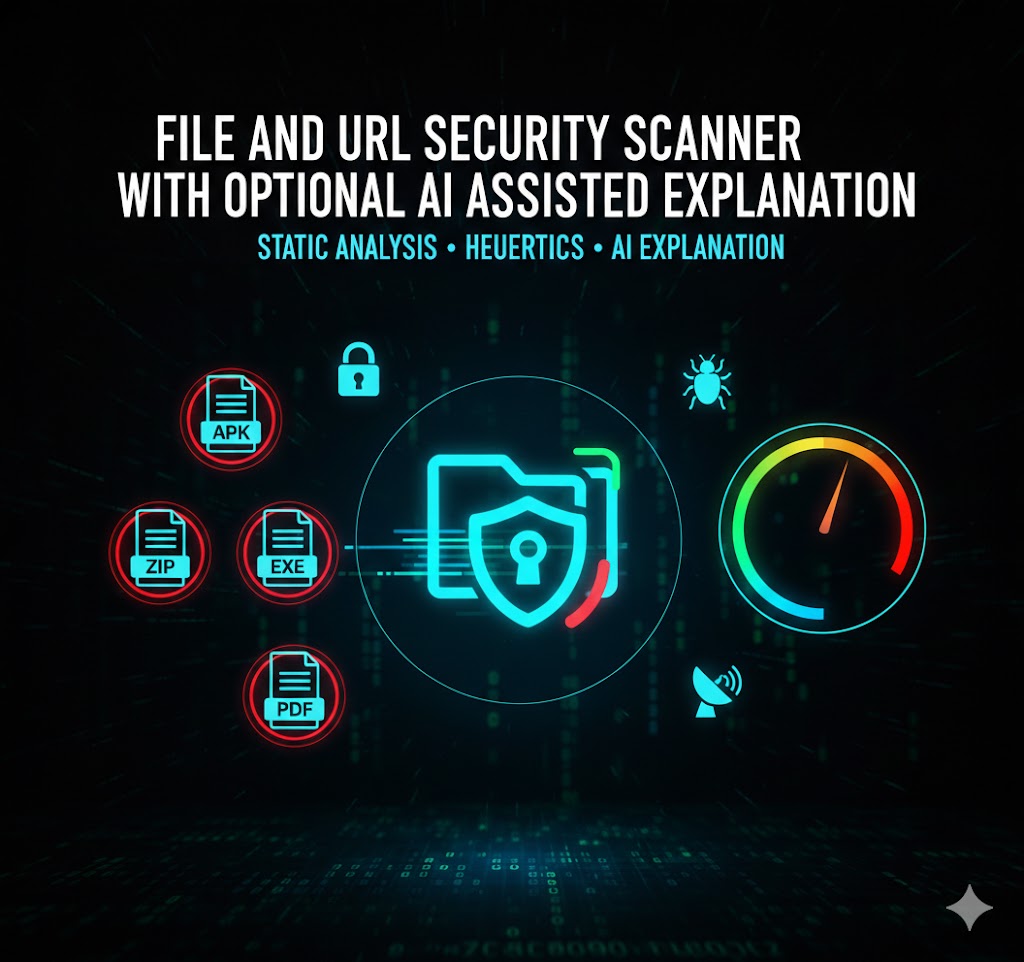
ZeroRisk Sentinel is a hybrid, multi-layered cybersecurity analysis platform detecting threats across three attack vectors:
- File Analysis Engine — YARA rule pattern matching, Shannon entropy detection (identifies packed/encrypted binaries), PE structure inspection, magic number vs extension validation (catches invoice.pdf.exe spoofing), and VirusTotal hash lookup across 70+ antivirus engines.
- URL Security Scanner — 9-source intelligence pipeline covering Google Safe Browsing, URLHaus, VirusTotal (70+ vendors), AbuseIPDB IP reputation, SecurityTrails domain intelligence, SSL/TLS certificate validation, DNS record analysis (A, MX, SPF), WHOIS domain age, and redirect chain unwinding up to 5 hops. Deep Scan mode adds live urlscan.io browser sandboxing with screenshot capture and network activity monitoring.
- APK Inspector — AndroGuard-powered Android package decompilation with permission risk scoring. Flags critical permissions (BIND_ACCESSIBILITY_SERVICE for keylogging, READ_SMS for OTP interception, BIND_VPN_SERVICE for traffic hijacking) with severity classification and combination heuristics.
- AI Threat Explanations — Groq Llama 3.3 70B converts raw technical IOCs into plain-English analysis: what the threat does, why it's dangerous, and concrete next steps.
- Sandbox Analysis — Submits suspicious files to Hybrid Analysis for live execution in an isolated Windows 7 VM, tracking process injection, network callbacks, file drops, and MITRE ATT&CK technique mapping.
The system uses a hybrid architecture — client-side JavaScript performs instant triage (entropy, magic bytes, extension spoofing) with zero latency, while the Python Flask backend provides deep multi-source intelligence. Core detection always works, even fully offline.
How I Built It
Six modular Python backend components, each independently testable:
file_scanner.py— YARA + VirusTotal + entropy + PE analysisurl_scanner.py— 9-source URL intelligence pipeline with unified response normalizationapk_analyzer.py— AndroGuard integration + custom permission risk heuristicsai_explainer.py— Groq Llama 3.3 70B with graceful fallback to heuristic modesandbox_scanner.py— Hybrid Analysis live VM execution integrationserver.py— Flask routing, CORS, and API key management
Challenges I Ran Into
- Normalizing 9 different threat intelligence APIs (each with different schemas, rate limits, error formats) into one unified, consistent response format was the hardest engineering challenge.
- Making core detection work offline required reimplementing entropy analysis, magic byte detection, and extension spoofing checks entirely in JavaScript — not just wrapping API calls.
- Getting Groq LLM to produce consistently structured, actionable explanations (not generic safety advice) required significant prompt engineering iteration.
What I Learned
How real malware detection works under the hood — PE headers, YARA signatures, Shannon entropy as a packed-file indicator. Also that the biggest gap in security tools isn't detection, it's explanation — most tools tell you a file is malicious but not why or what it does.
What's Next
- Docker containerization for one-command deployment
- Community YARA rule repository
- Browser extension for real-time URL scanning
- Team SaaS dashboard for SMBs
- CI/CD pipeline scanner plugin


Log in or sign up for Devpost to join the conversation.