-
-
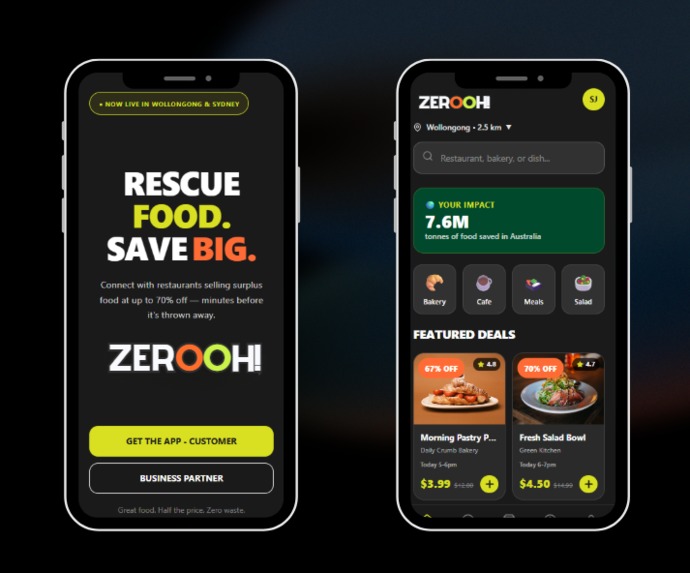
Zerooh! mobile app
Inspiration
Food waste keeps us up at night.
Not in an abstract, climate-report kind of way, in a very real, very local way. Walking past a café in Wollongong at 5 pm and watching the owner bag up a tray of perfectly good croissants headed straight for the bin. Talking to restaurant owners who told us they throw away $200 of food on a slow Tuesday and it kills them. Talking to students who are skipping meals, not because food doesn't exist nearby, but because they simply don't know it's available.
The problem isn't a lack of food. It's a broken connection between people who have too much and people who need it.
Australia wastes 7.6 million tonnes of food every year. That costs the economy $36.6 billion. And yet at 4:30 pm, right now, somewhere near you, a café is about to throw away a tray of food that someone would gladly pay half price for, if only they knew it existed.
We built Zerooh! to fix that connection. Fast, frictionless, and built around The reality of how hospitality actually works, not how we wish it worked.
What it does
Zerooh! is a two-sided real-time marketplace that turns closing-time food surplus into closing-time deals.
For restaurants, Zerooh! removes every barrier to listing surplus food. A business owner sets up their deal template once during onboarding, food category, typical items, pickup window, and discount level. At closing time, they open the app, adjust quantity if needed, and tap Publish. Their deal is live to nearby consumers in seconds. No typing. No pricing decisions. No friction.
For consumers, Zerooh! is a real-time feed of closing deals from local restaurants updated live as restaurants publish. Users can browse by category, filter by distance and price, and claim a deal in two taps. The restaurant gets notified the moment a claim is made.
The centrepiece of the consumer experience is our smart deal assistant a A guided chatbot that helps users find deals nearby, filter by mood or budget, and even suggests what to cook with whatever they claim. Ask it "what's good near me tonight under $8?" and it pulls live listings, filtered and ranked, right in the conversation.
Every transaction logs a real-time impact counter: kilograms of food rescued, dollars saved for consumers, meals redirected from landfill.
How we built it
We built Zerooh! in 60 hours as a full-stack mobile app.
Mobile app: React Native - giving us a true native mobile experience on both
iOS and Android from a single codebase. We designed the UI around the Zerooh!
brand identity - Deep Forest #00492C, Electric Lime #d9e021, Tangerine
#EF8E00, and Cream #EAEBC4 - with Bebas Neue for display typography and
DM Sans for body text. The result is a product that feels commercial, not like
a hackathon project.
Backend: Supabase handling real-time data sync (deals appear instantly on The consumer feed when a restaurant publishes, authentication with two user roles (restaurant and consumer), and a PostgreSQL database with row-level security.
Chatbot: A rule-based conversation engine with three core paths: find deals nearby, help me choose, and meal prep suggestions. It connects to live listing data from Supabase to return real, current results. Built with intentionality: three things done well beat ten things done poorly.
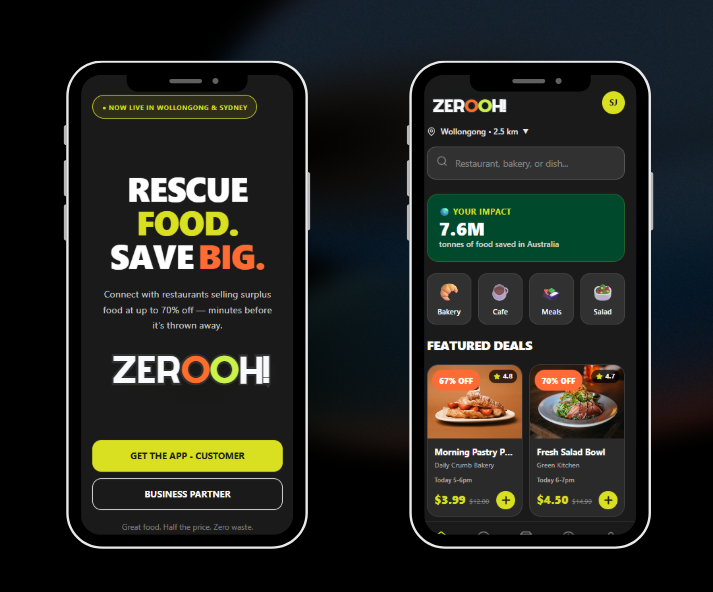
Design: Full UI/UX designed in Figma, including a 2-screen mobile app mockup and a production-grade landing page. Both were built to demonstrate the complete product vision beyond the MVP.
We validated the concept through 19+ customer interviews with restaurant owners and consumers in Wollongong before writing a single line of code. That research directly shaped the product, the 90-second listing flow, the template-first restaurant experience, and the chatbot's three conversation paths all came directly from what real people told us they needed.
Challenges we ran into
The restaurant side is harder than it looks. Our initial listing form had eight fields. Every interview with a restaurant owner made it shorter. Getting it to a true one-tap experience required us to rethink the entire onboarding flow, moving complexity into the setup phase so that the daily action is effortless. That architectural decision took most of Day 1 to get right.
Real-time without overengineering. We wanted the consumer feed to update the moment a restaurant publishes no refresh required. Supabase's real-time subscriptions made this possible, but getting the state management right in React without unnecessary re-renders required careful thought at 2 am on Day 2.
Making a chatbot feel alive without AI. Our smart assistant is rule-based intentionally. We didn't have time to build a reliable LLM integration into the app. So we designed three conversation paths that feel genuinely useful, pull live data, and give real results. The constraint made us design better, not worse.
Accomplishments that we're proud of
My teammate and I both have the same passion and devote our best to this product
A consumer chatbot that actually works: it queries live listings, filters by preference, and returns real deals in a conversational interface.
19+ customer interviews before building a product that directly reflects what those conversations taught us. Every feature traces back to a real conversation with a real person.
A complete brand identity logo, colour system, typography, landing page, and mobile app mockup that makes Zerooh! Looks like a real company, not a weekend project.
A one-tap deal publisher for restaurants that genuinely removes the friction That stops hospitality businesses from listing surplus today.
Building something we would actually use. That's nothing.
What we learned
We learned that the best startup ideas aren't clever, they're obvious in hindsight. Food is being thrown away every single night, metres from people who would happily buy it. The technology to fix that has existed for years. The only thing missing was someone who cared enough to build the right experience around it.
We learned that customer validation isn't a checkbox. The 19+ conversations we had before this hackathon didn't just confirm our hypothesis, they changed it. We came in thinking the consumer side was the hard problem. We left knowing the restaurant side was. That insight is what Zerooh!'s entire product architecture is built around.
We learned that scope is a design decision. Every feature we cut made the features we kept stronger. A product that does three things perfectly is more impressive than one that does ten things adequately. We will carry that lesson beyond this weekend.
And we learned again that the best time to build something is before you feel ready. We had 60 hours. We used all of them.
What's next for Zerooh!
Zerooh! doesn't end at the hackathon. This is a real problem that needs a real solution, and we intend to build it.
Immediate next steps (Month 1-3): Pilot with 5 restaurants in Wollongong CBD and Fairy Meadow. 0% commission At launch, get supply first, monetise once network density is real. Personal onboarding visit for every restaurant partner.
Month 3-6:
- Real impact dashboard for restaurants (kg saved, $ recouped, meals rescued)
- Commission rising to 12% at scale
- Expand to Sydney inner suburbs (Newtown, Surry Hills, Glebe)
Month 6-12:
- Subscription tier for restaurant partners ($29/month for analytics and priority features)
- B2B partnerships with hospitality groups facing ESG reporting requirements
- SecondBite integration for charity cascade on unclaimed deals
The mission: 1,000 restaurant partners across Australia. 500,000 meals rescued in Year 1. A platform that proves sustainable business and commercial success aren't a trade-off; they're the same thing.
Good food. Half the price. Zerooh! waste.
Built With
- codex
- figma
- react-native
- supabase


Log in or sign up for Devpost to join the conversation.