ZeroMark
Every minute has a price. Every rescue has a receipt.
Inspiration
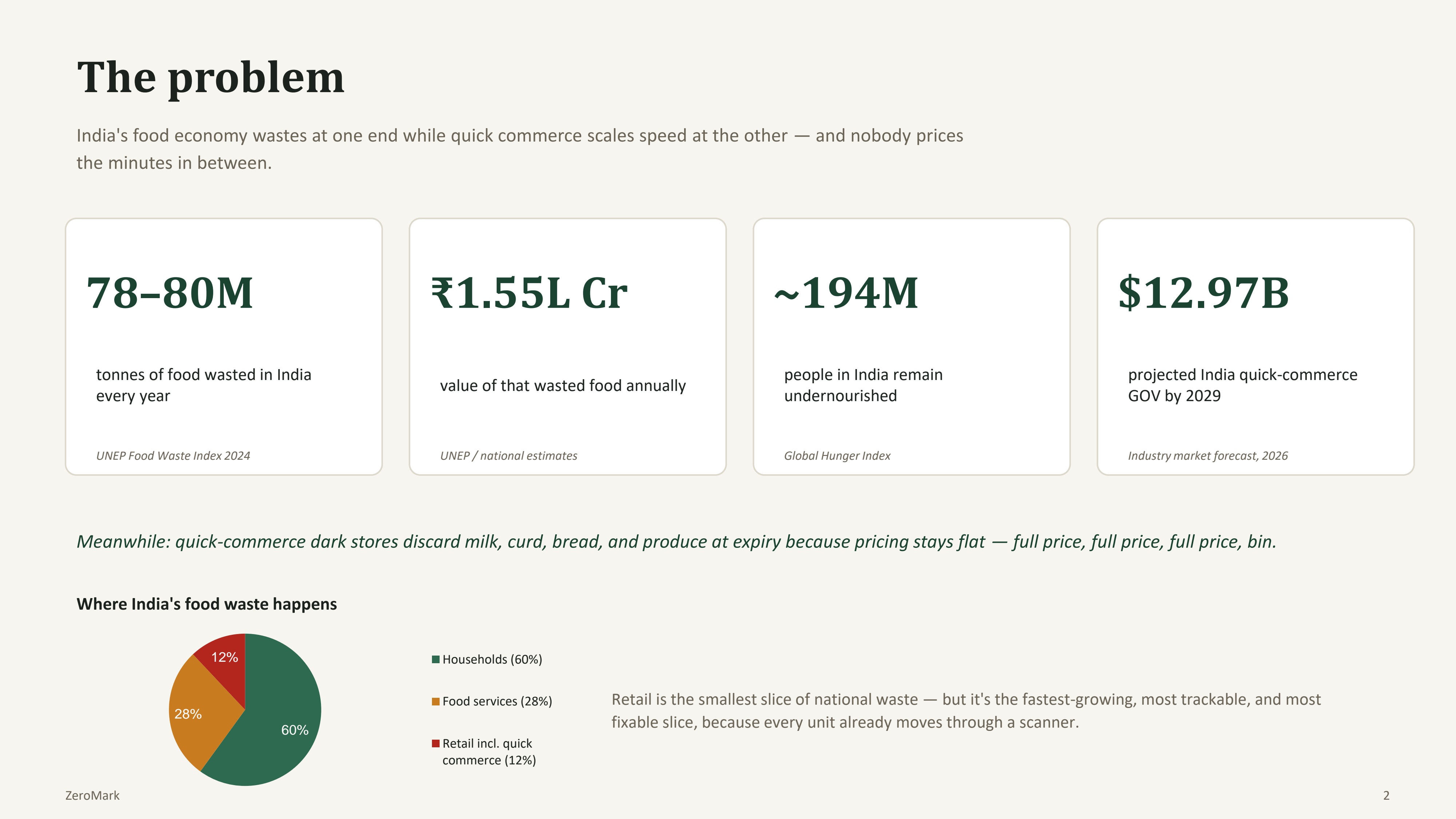
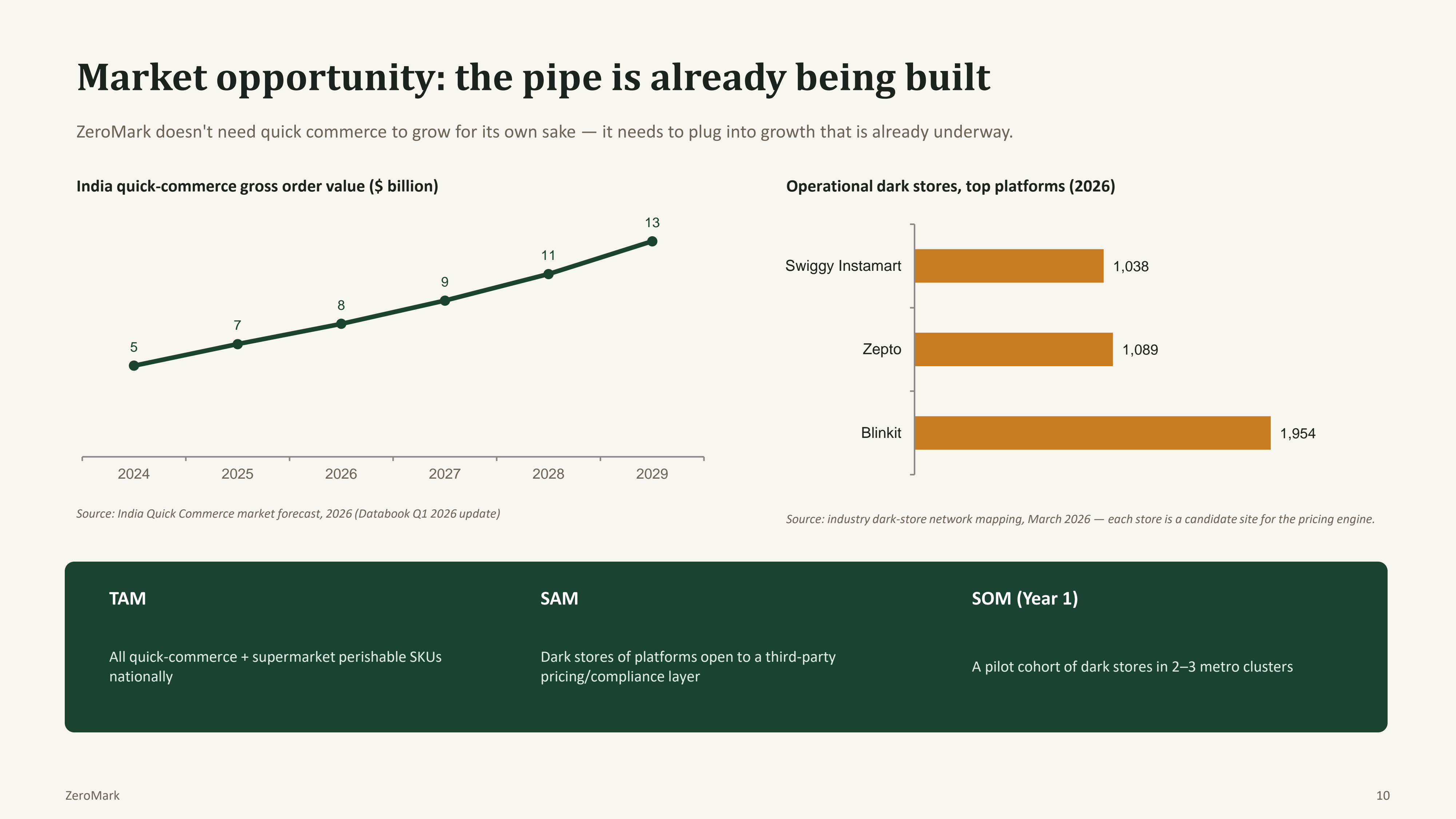
India wastes an estimated 78–80 million tonnes of food every year — worth roughly ₹1.55 lakh crore — while close to 194 million people remain undernourished. At the exact same time, quick commerce is one of the fastest-growing retail formats in the country, on track to reach nearly $13 billion in gross order value by 2029, running on a dense network of dark stores that restock hourly.
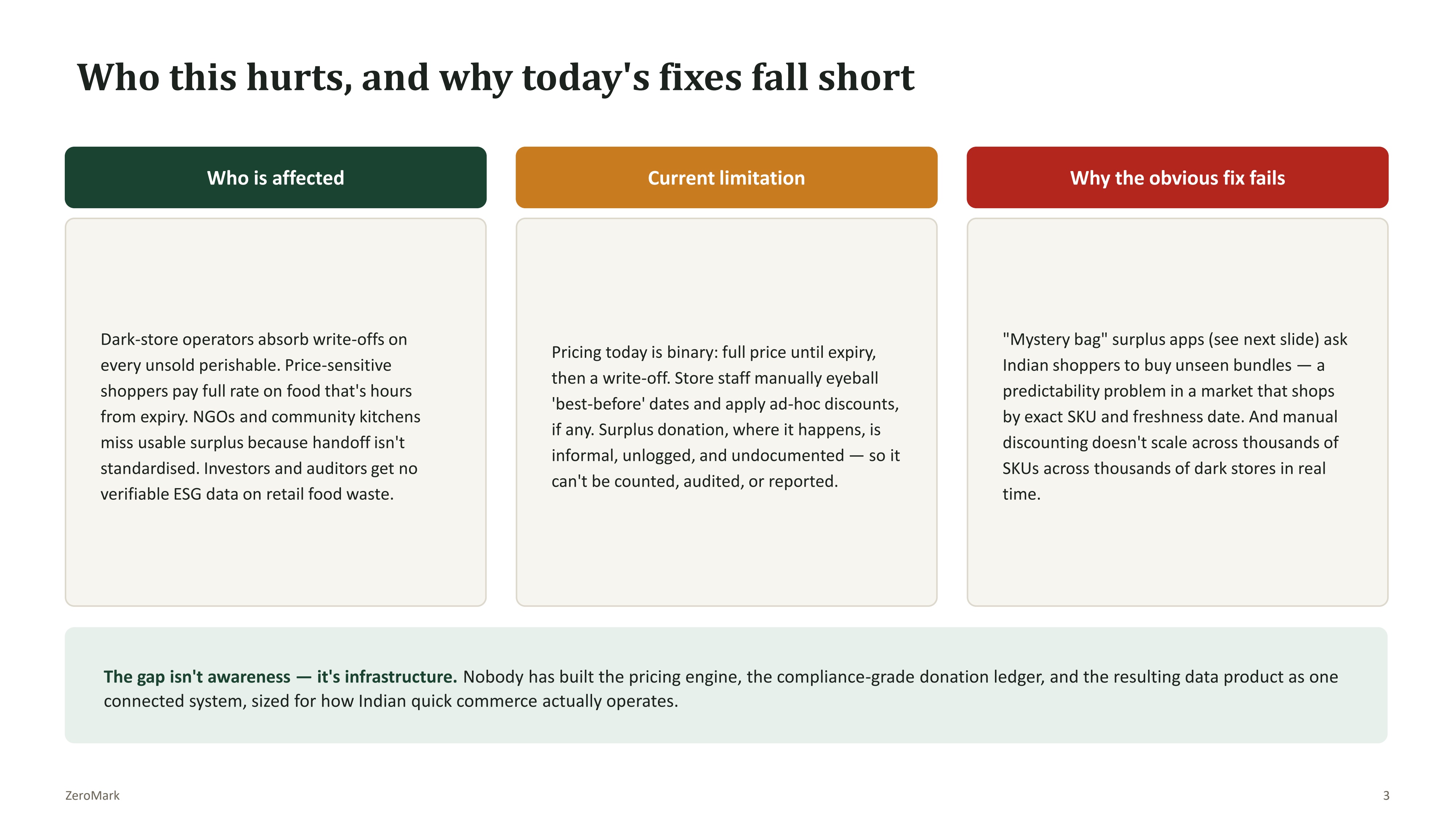
Those two facts sitting next to each other were the spark: every dark store is already discarding milk, curd, bread, and produce the moment it hits its best-before date, because pricing today is binary — full price until expiry, then a write-off. Nobody had priced the minutes in between.
The problem is not simply that food is being wasted. The deeper problem is that there is no live, systematic bridge between "full price" and "bin." Sellable, safe-to-eat food can be discarded purely because pricing never adjusted to reflect its shrinking shelf life.
We wanted to change that by making time itself part of the price.
The idea behind ZeroMark was to turn the final hours of a perishable item's shelf life from a write-off window into a recovery window — first through a sale, and ultimately through a structured rescue and donation process.
ZeroMark names exactly what the product does: it marks the moment a perishable item crosses into its final, priced countdown to expiry, and it makes that moment auditable — to the shopper, to the store, and to the food-donation record — rather than letting it disappear into a write-off.
What it does
ZeroMark is a dynamic, time-to-expiry pricing engine for quick-commerce dark stores, paired with an auditable donation ledger.
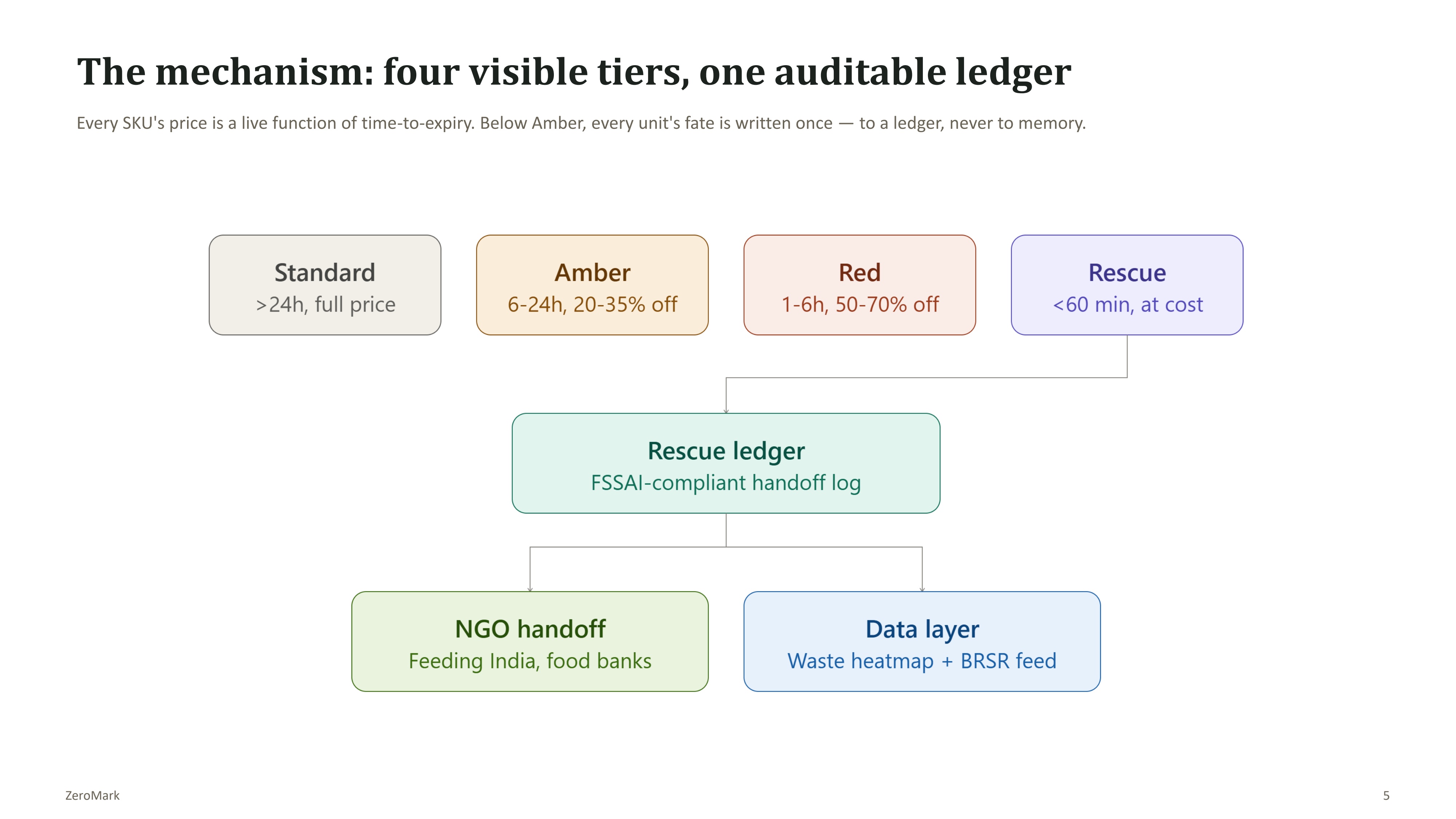
As a perishable item's shelf life counts down, it automatically moves through four visible tiers:
| Tier | Time to Expiry | What happens |
|---|---|---|
| Standard | More than 24 hours | Full price — no change to today's experience. |
| Amber | 6–24 hours | Automatic 20–35% discount, shown live in the app with the exact time remaining. |
| Red | 1–6 hours | Automatic 50–70% discount — the last realistic window for a normal sale. |
| Rescue | Under 60 minutes | Reserved at cost; if unclaimed, automatically routed to a registered redistribution partner and logged to the Rescue Ledger. |
Every Rescue-tier event — sold or donated — writes a single, timestamped record to the Rescue Ledger.
That ledger then splits into two outputs:
- an NGO handoff feed, routing surplus to registered redistribution partners;
- a data layer, creating a store-level and category-level waste heat-map for compliance, ESG, sustainability, finance, and audit reporting.
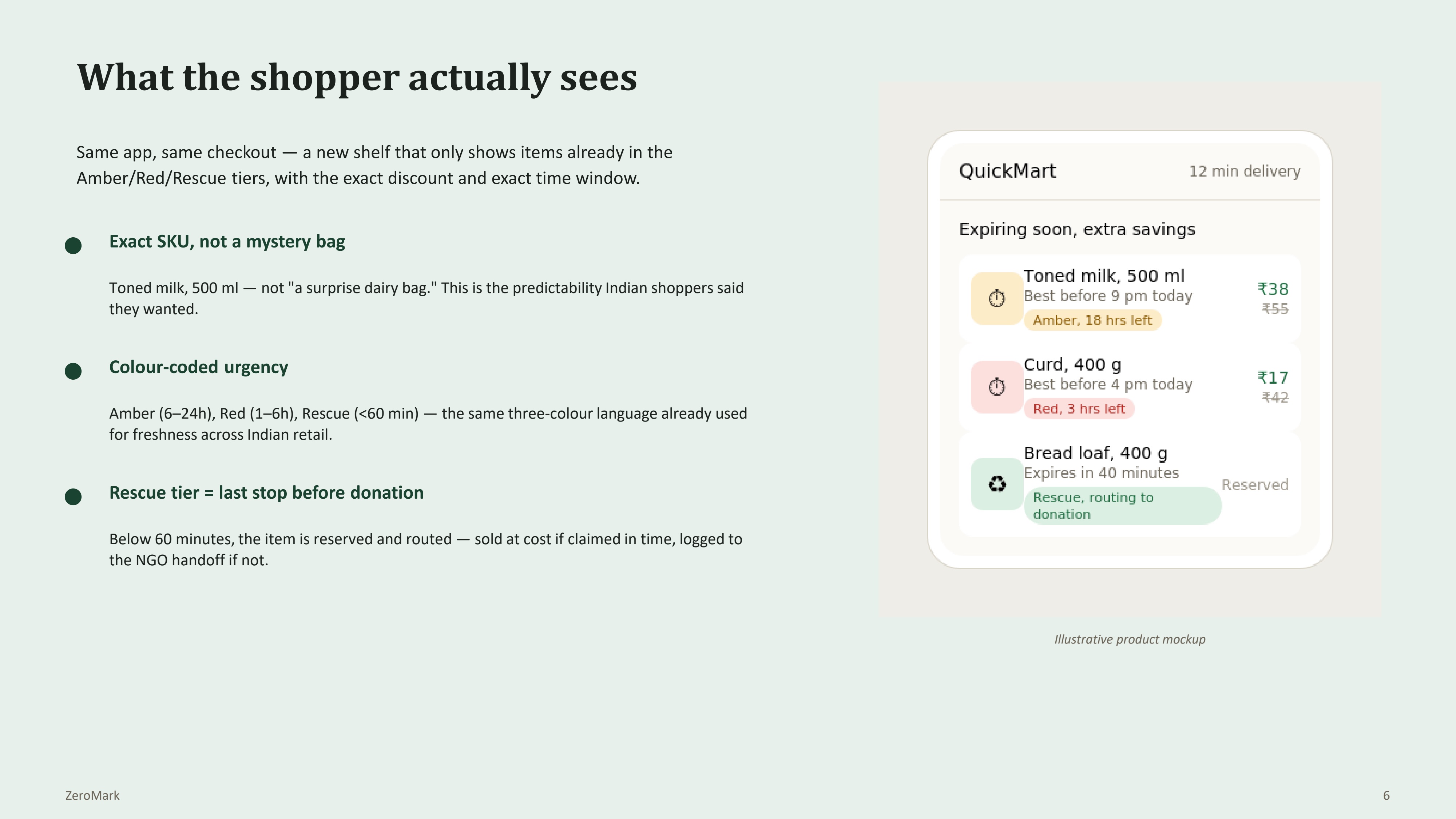
The shopper experiences ZeroMark through a dedicated "Expiring soon, extra savings" shelf inside the existing quick-commerce app. It shows only Amber, Red, and Rescue items, with the exact product name, precise time remaining, live discounted price, and struck-through original price.
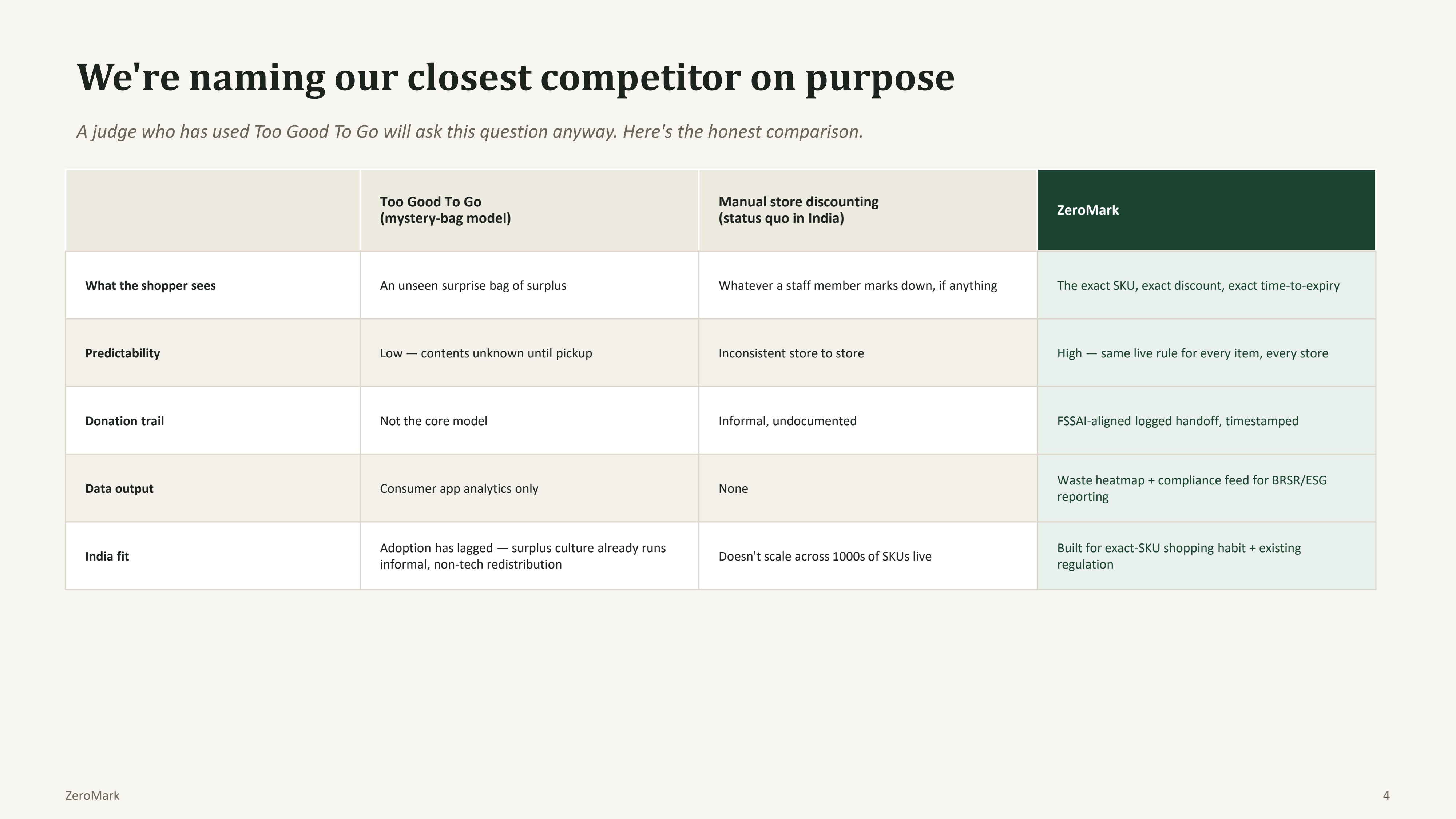
Unlike a mystery-bag model, the shopper always sees the exact item and exact discount rather than an unseen bundle.
Unlike manual discounting, the tiers update automatically and consistently across every SKU and every store.
And unlike either alternative, every Rescue-tier event produces a permanent, structured record — not just a transaction, but evidence.
Who uses it
- Dark-store and category-management teams at quick-commerce operators, who license the pricing engine and ledger.
- End shoppers, who see the expiry-priced shelf inside the existing app without needing to install a new application.
- Registered surplus-food redistribution organisations, who receive the automated Rescue-tier handoff.
- Sustainability, finance, and audit teams, who consume the resulting compliance reports and waste heat-map.
Why it matters
ZeroMark is fundamentally a food-waste-reduction system. Its core mechanism — time-based dynamic pricing that ends in either a sale or a logged donation — exists to reduce the volume of edible food that Indian quick-commerce dark stores discard.
It also connects sustainability with business and financial infrastructure:
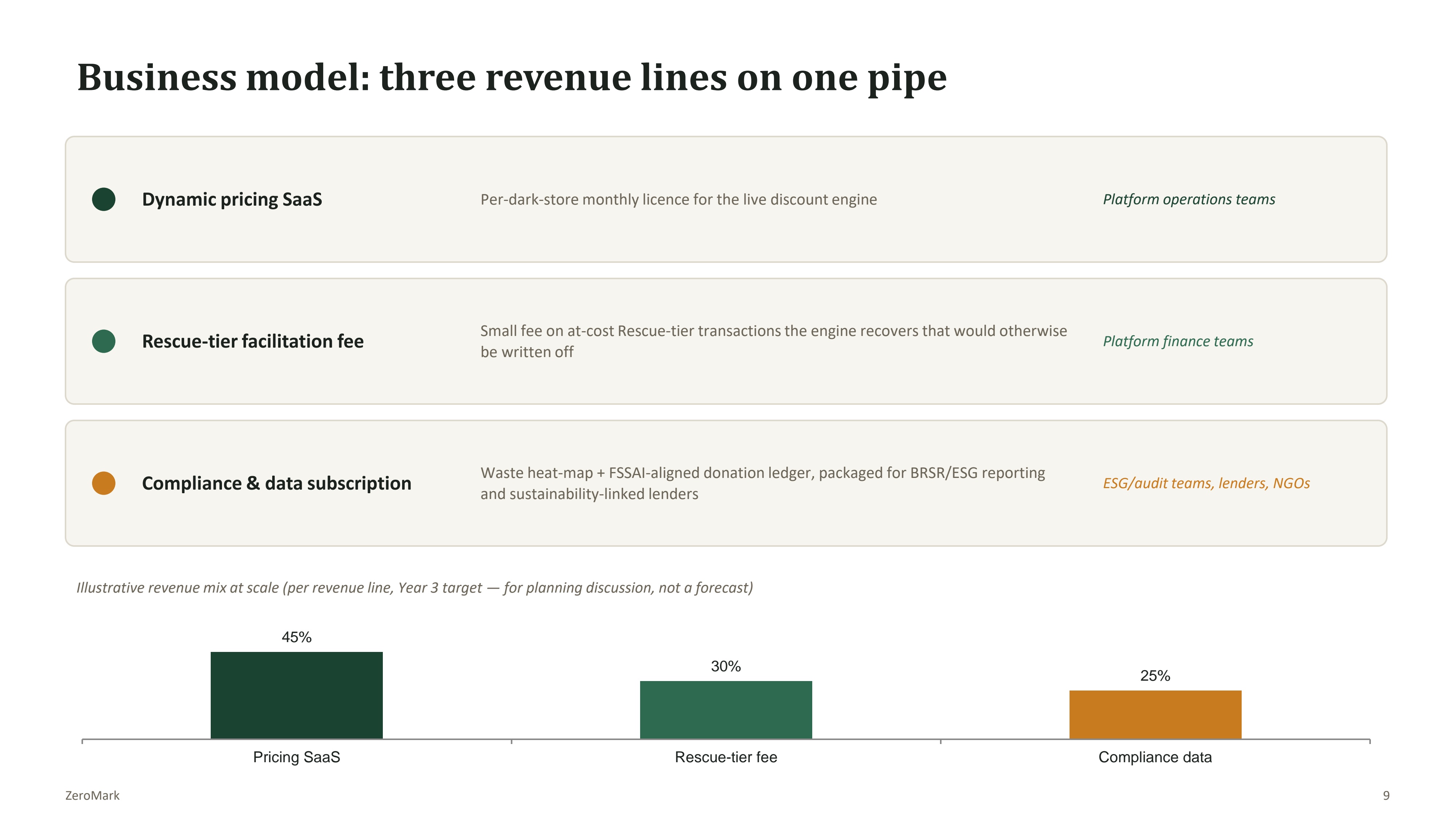
- Business Model — a three-part revenue design consisting of pricing SaaS, a Rescue-tier transaction/facilitation fee, and a compliance-data subscription means waste reduction can directly fund itself rather than relying on CSR budgets.
- FinTech — the Rescue Ledger produces a timestamped, auditable transaction record that can support ESG-linked lending and BRSR reporting, turning waste data into a financial reporting asset.
- Social Impact — the same ledger routes near-expiry surplus to registered redistribution organisations under an existing food-safety regulation, connecting retail waste directly to hunger relief.
The system can be expressed simply as:
$$ \text{Time Remaining} \rightarrow \text{Pricing Tier} \rightarrow \text{Sale / Rescue} \rightarrow \text{Rescue Ledger} $$
How we built it
This was built as a non-code concept submission, so the "build" was research and system design rather than software.
Problem validation
We grounded the idea in verified, current market data rather than assumptions, including the UNEP Food Waste Index 2024, India quick-commerce market forecasts, and dark-store network mapping.
The problem was framed around the gap between full-price inventory and a write-off: pricing remains essentially binary even while the remaining useful shelf life is continuously decreasing.
Competitive honesty
We explicitly benchmarked ZeroMark against existing approaches rather than claiming false originality.
The closest consumer-facing analogue is the "mystery bag" surplus-food model such as Too Good To Go. We identified why that format has not scaled the same way in India: shoppers expect exact-SKU predictability and freshness information rather than unseen bundles, while India already has meaningful informal, non-tech redistribution channels.
Dynamic expiry pricing itself is also not globally new. Israel's Wasteless is a direct precedent.
The differentiation we designed for ZeroMark is therefore narrower and more defensible: a system specifically designed around Indian quick commerce, including exact-SKU visibility, dark-store density, 10–20 minute delivery windows, and the regulatory rail India already has for surplus-food donation.
Regulatory grounding
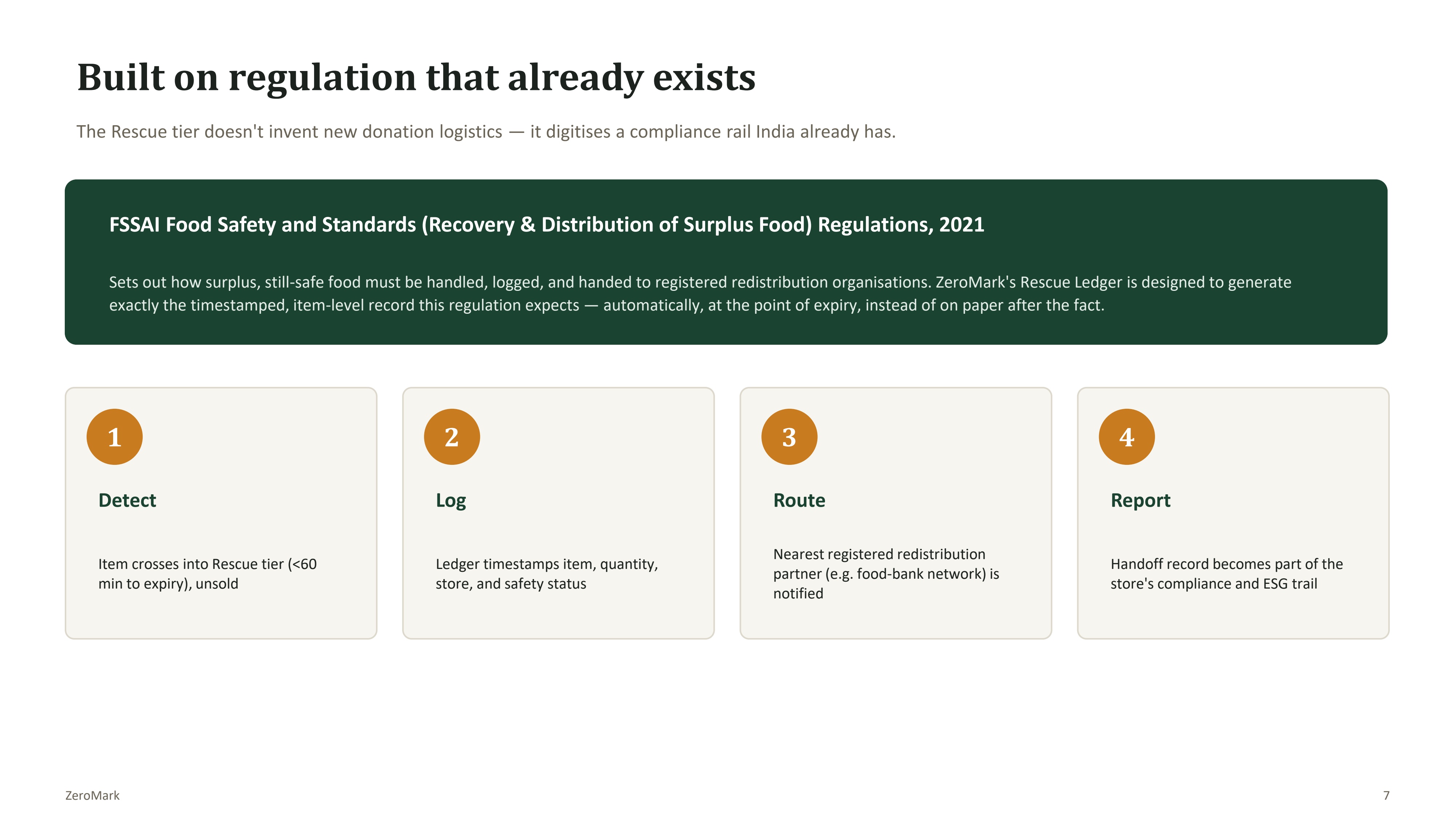
We designed the Rescue Ledger to align with the FSSAI Food Safety and Standards (Recovery & Distribution of Surplus Food) Regulations, 2021.
Rather than inventing a completely new donation logistics system, the ledger is designed to generate the timestamped, item-level record required for surplus-food handoffs.
This means the donation layer is intended to build on redistribution infrastructure that already exists rather than requiring ZeroMark to build a new delivery fleet, warehouse network, or physical infrastructure from scratch.
System and process design
The core system maps the four-tier pricing flow into a single ledger with two outputs:
$$ \text{Standard} \rightarrow \text{Amber} \rightarrow \text{Red} \rightarrow \text{Rescue} $$
At the Rescue stage:
$$ \text{Rescue Event} \rightarrow \begin{cases} \text{Sale} \ \text{Donation} \end{cases} \rightarrow \text{Timestamped Ledger Record} $$
The ledger then feeds:
$$ \text{Rescue Ledger} \rightarrow \begin{cases} \text{NGO Handoff Feed} \ \text{Waste Heat-Map / Data Layer} \end{cases} $$
This creates a connection between inventory, pricing, shoppers, rescue operations, donation, and compliance data.
Prototyping the experience
We designed an interactive-style mockup of the in-app "Expiring soon, extra savings" shelf.
The experience intentionally shows:
- exact SKUs;
- exact discounted prices;
- precise remaining time;
- the original price next to the discounted price.
This was important because the concept is designed around predictability rather than the uncertainty of a mystery bundle.
Business modeling
We designed three connected revenue lines:
- Pricing SaaS — a per-store pricing-engine licence.
- Rescue-tier facilitation fee — a small fee on recovered Rescue-tier sales.
- Compliance-data subscription — a subscription around the structured waste and compliance data.
The objective is to turn a cost centre — perishable write-offs — into a system with multiple connected revenue lines.
That means the sustainability outcome can potentially fund itself rather than depending entirely on a CSR budget.
Implementation design
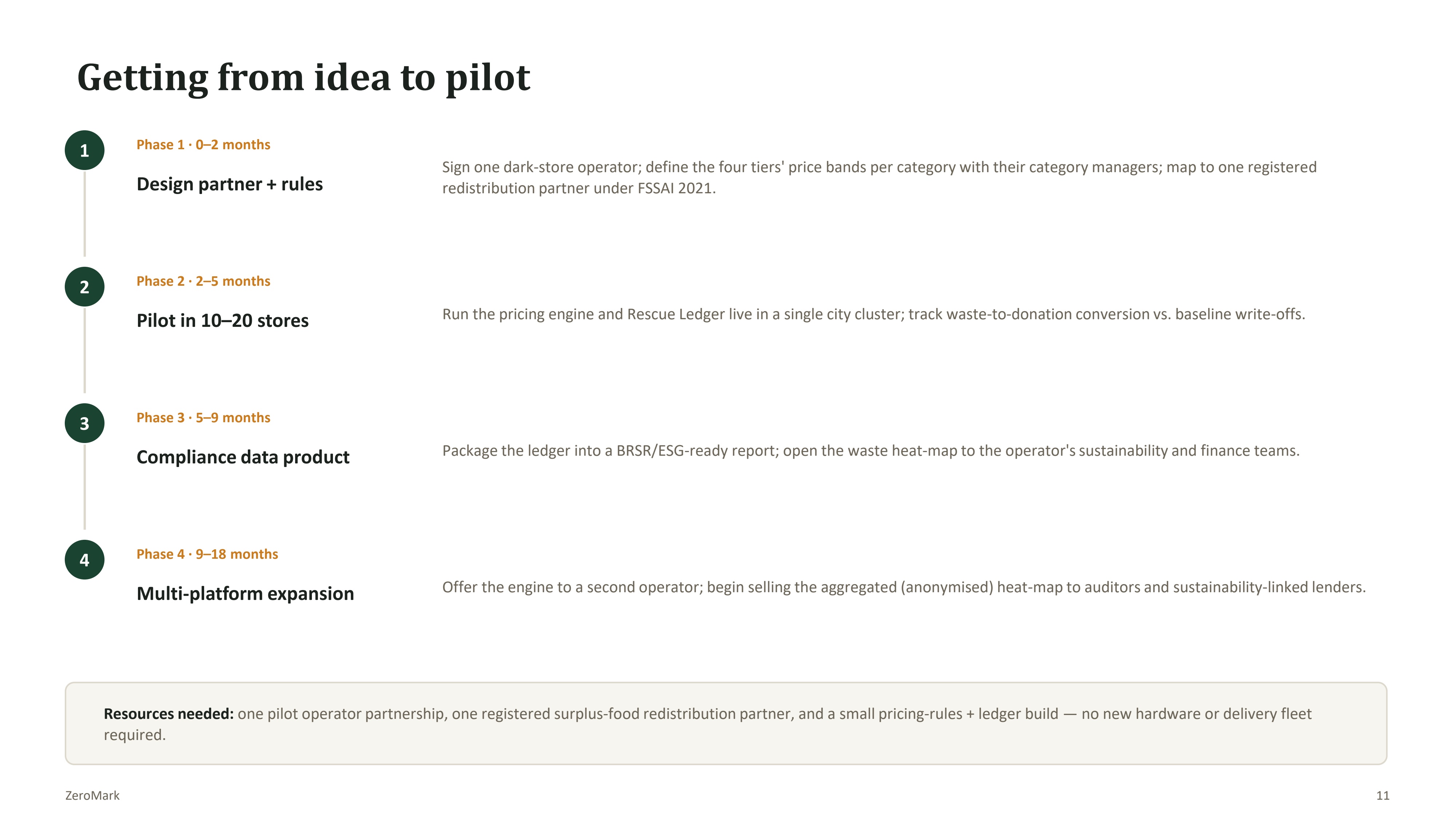
The proposed implementation is structured into four phases:
| Phase | Timeline | What happens |
|---|---|---|
| 1. Design partner + rules | Months 0–2 | Sign one dark-store operator; set tier price bands per category with category managers; map to one registered redistribution partner under FSSAI 2021. |
| 2. Pilot | Months 2–5 | Run the pricing engine and Rescue Ledger across 10–20 stores in a single city cluster; measure waste-to-donation conversion against a pre-pilot baseline. |
| 3. Compliance data product | Months 5–9 | Package the ledger into a BRSR/ESG-ready report and open the waste heat-map to sustainability and finance teams. |
| 4. Multi-platform expansion | Months 9–18 | Offer the engine to a second operator and begin licensing the aggregated, anonymised heat-map to auditors and sustainability-linked lenders. |
No new delivery fleet, warehousing, or hardware is required in the proposed model because the mechanism is designed to ride on infrastructure the operator already runs.
Challenges we ran into
Avoiding false originality
Dynamic expiry pricing isn't new globally. Israel's Wasteless is a direct precedent, and Too Good To Go is a close consumer-facing analogue.
The harder, more honest work was articulating what's actually different for the Indian market — exact-SKU predictability, dark-store density, short delivery windows, and an existing regulatory rail — rather than claiming to have invented the category.
Our originality claim is therefore intentionally narrower: ZeroMark is designed specifically for how Indian quick commerce operates and for the regulatory and redistribution infrastructure already available in India.
Making the donation layer credible
"Auto-donated in the last hour" is easy to say and hard to operationalize.
A donation system needs more than a button that says "Donate." It needs a reliable process, an eligible recipient, and a record of what happened.
Anchoring the Rescue Ledger to a regulation that already governs surplus food recovery in India — the FSSAI Food Safety and Standards (Recovery & Distribution of Surplus Food) Regulations, 2021 — was what turned it from a hand-wavy feature into something designed to be executable.
The proposed process is:
$$ \text{Near Expiry} \rightarrow \text{Rescue Tier} \rightarrow \text{Unclaimed} \rightarrow \text{Registered Redistribution Partner} \rightarrow \text{Timestamped Record} $$
Avoiding cannibalisation of full-price sales
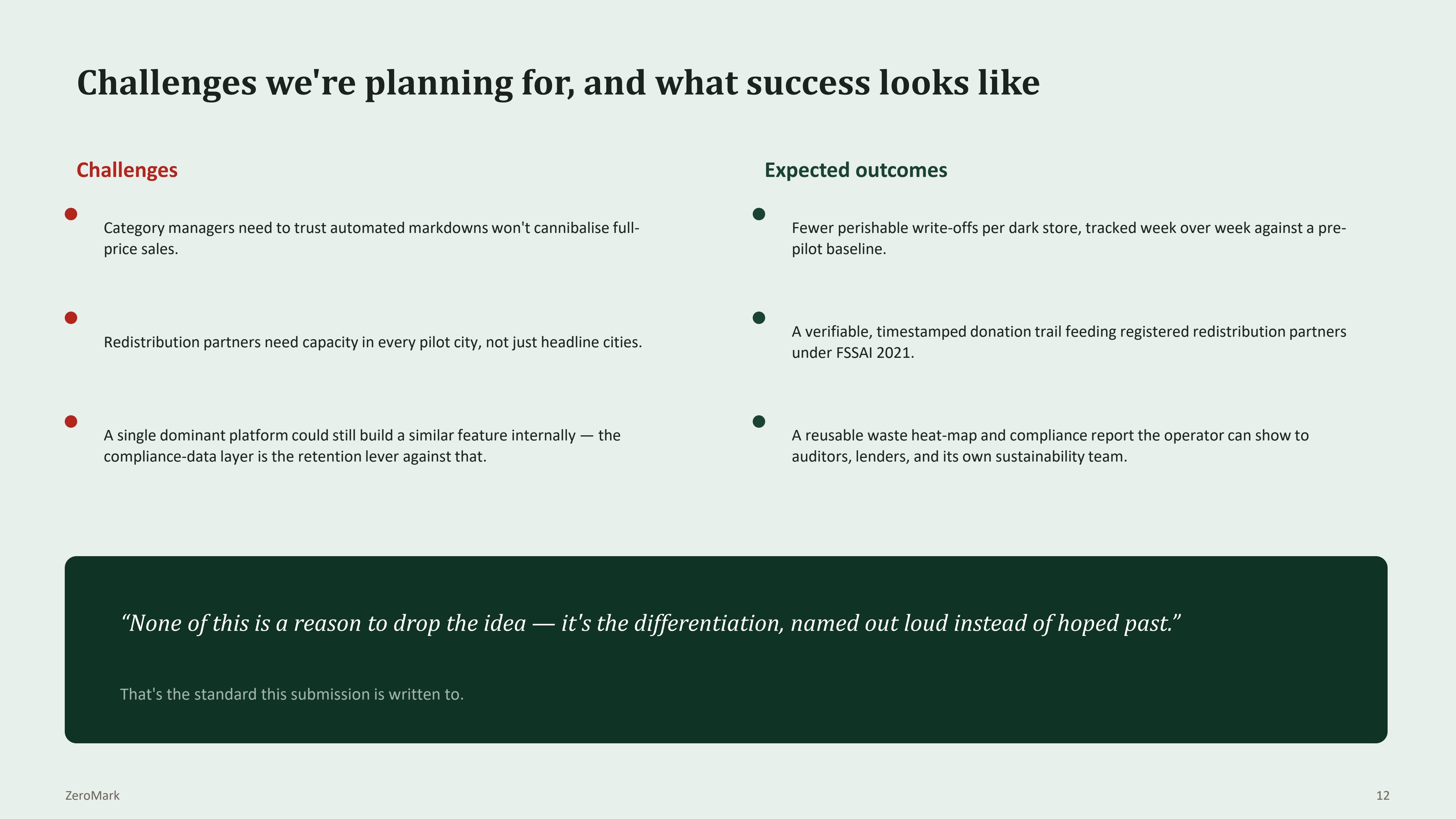
One of the major operational challenges is proving that automated markdowns recover margin from inventory that would otherwise be written off, rather than simply replacing full-price purchases with discounted ones.
The proposed answer is to start with a contained pilot and compare before-and-after write-off performance.
The key measurement is therefore not simply the number of discounted orders, but the change in otherwise avoidable waste.
Redistribution capacity
Redistribution partner capacity can vary by city.
The proposed approach is to begin in metro clusters where established food-bank and redistribution networks already exist, and expand to smaller cities as the partner network develops.
Turning a UI feature into a business
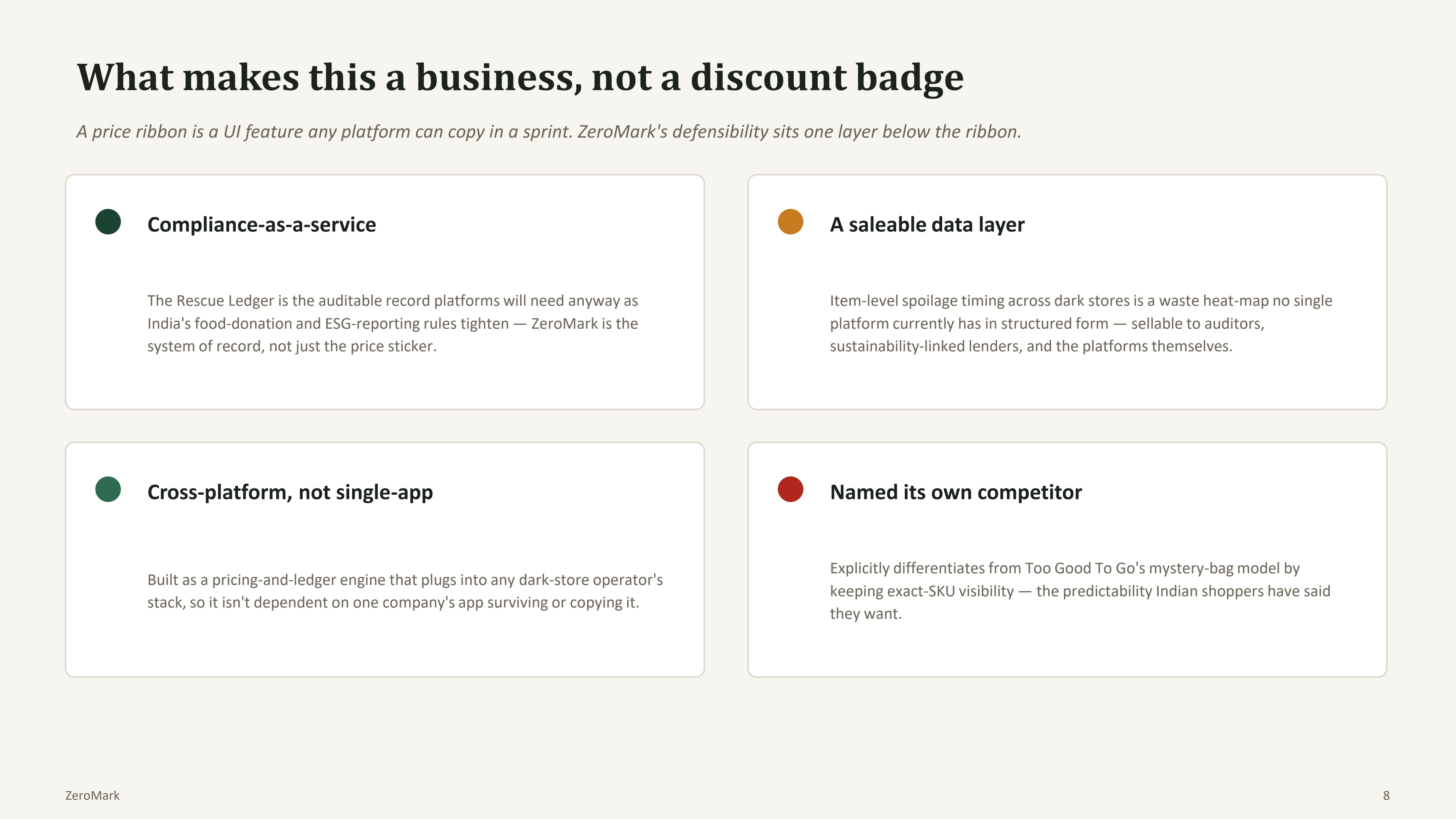
A discount badge on an expiry date is something any quick-commerce platform could copy in a short sprint.
The real challenge was finding the layer beneath the feature — a compliance-grade ledger and a saleable waste-data product — that makes the idea defensible rather than disposable.
The intended retention mechanism is therefore not the discount interface itself.
It is the combination of:
Pricing Engine + Rescue Ledger + Compliance Data + Waste Heat-Map
A dominant platform could potentially replicate the pricing feature internally, but the compliance-data layer and cross-platform positioning are intended to provide a deeper layer of differentiation.
What we learned
The biggest lesson was that the strongest version of an idea is usually the one that names its own competitors and limitations out loud instead of hoping a judge won't think of them.
We learned that dynamic expiry pricing is not itself a new invention. The more valuable question is how an existing idea can be rebuilt around a specific market's behaviour, regulation, and infrastructure.
A genuinely fresh idea in India often isn't a brand-new concept, but an existing one rebuilt around India-specific regulation, shopping behavior, and market infrastructure that a global template wasn't designed for.
We also learned that food waste is not only a sustainability problem. It is simultaneously a pricing problem, an operational problem, a data problem, a compliance problem, and a business-model problem.
That is why ZeroMark is designed as more than a discount feature.
The intended chain is:
$$ \text{Perishable Inventory} \rightarrow \text{Time-Based Pricing} \rightarrow \text{Recovery} \rightarrow \text{Rescue} \rightarrow \text{Auditable Data} $$
The sustainability outcome is the reduction in avoidable waste, but the mechanism can also create value for shoppers, operators, redistribution organisations, sustainability teams, finance teams, auditors, and lenders.
Most importantly, we learned that the final hours of an item's shelf life do not have to represent the final hours of its value.
Supporting Materials
The following materials accompany this submission:
- Concept presentation — a full pitch deck (
ZeroMark_Pitch_Deck.pptx) covering the problem, mechanism, competitive comparison, business model, market sizing, and implementation roadmap, each on its own slide with supporting charts. - Process diagram — the four-tier pricing flow into the Rescue Ledger, NGO handoff, and data layer.
- Product mockup — an illustrative in-app screen showing the expiry-priced shelf as a shopper would see it.
- Market research — cited figures on India's food-waste volume and value, quick-commerce market growth to 2029, and current dark-store network scale.
- Business model outline — the three-revenue-line structure and an illustrative revenue-mix chart.
Source appendix
- India food-waste volume and value: UNEP Food Waste Index Report, 2024; Global Hunger Index.
- India quick-commerce market size and 2029 forecast: India Quick Commerce Market Databook, Q1 2026 update.
- Dark-store network scale: industry dark-store network mapping, March 2026.
- Regulatory basis: FSSAI Food Safety and Standards (Recovery & Distribution of Surplus Food) Regulations, 2021.
Final Thought
Every perishable product has a countdown.
Today, that countdown often isn't reflected in its price, its workflow, or its data.
ZeroMark makes the countdown visible.
The objective isn't simply to sell food before it expires. It is to make sure that as little edible food as possible reaches the bin in the first place.
Every minute has a price. Every rescue has a receipt.
Built With
- business-model-design
- dynamic-pricing
- fintech
- market-research
- social-impact
- sustainability
