-
-
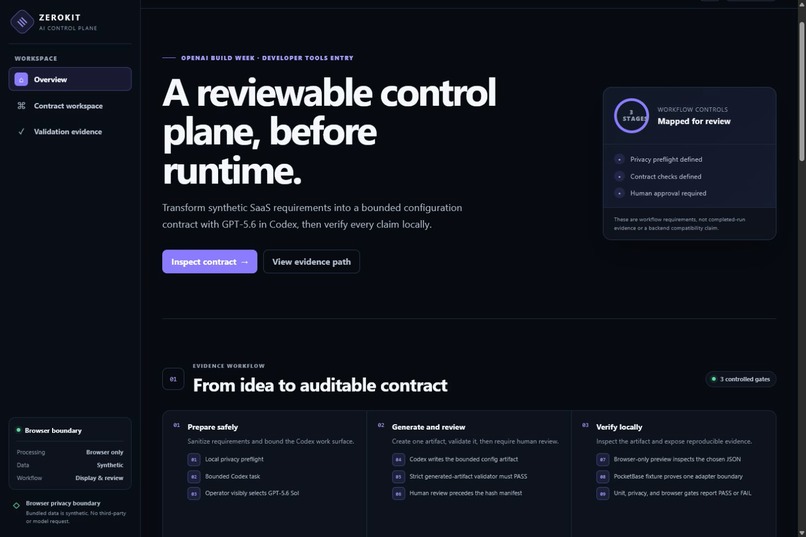
ZeroKit turns synthetic SaaS requirements into a reviewable, locally validated control-plane contract before runtime.
-
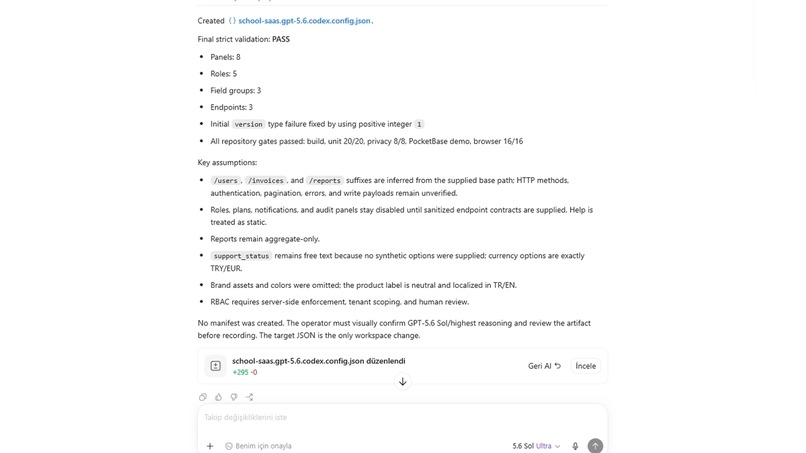
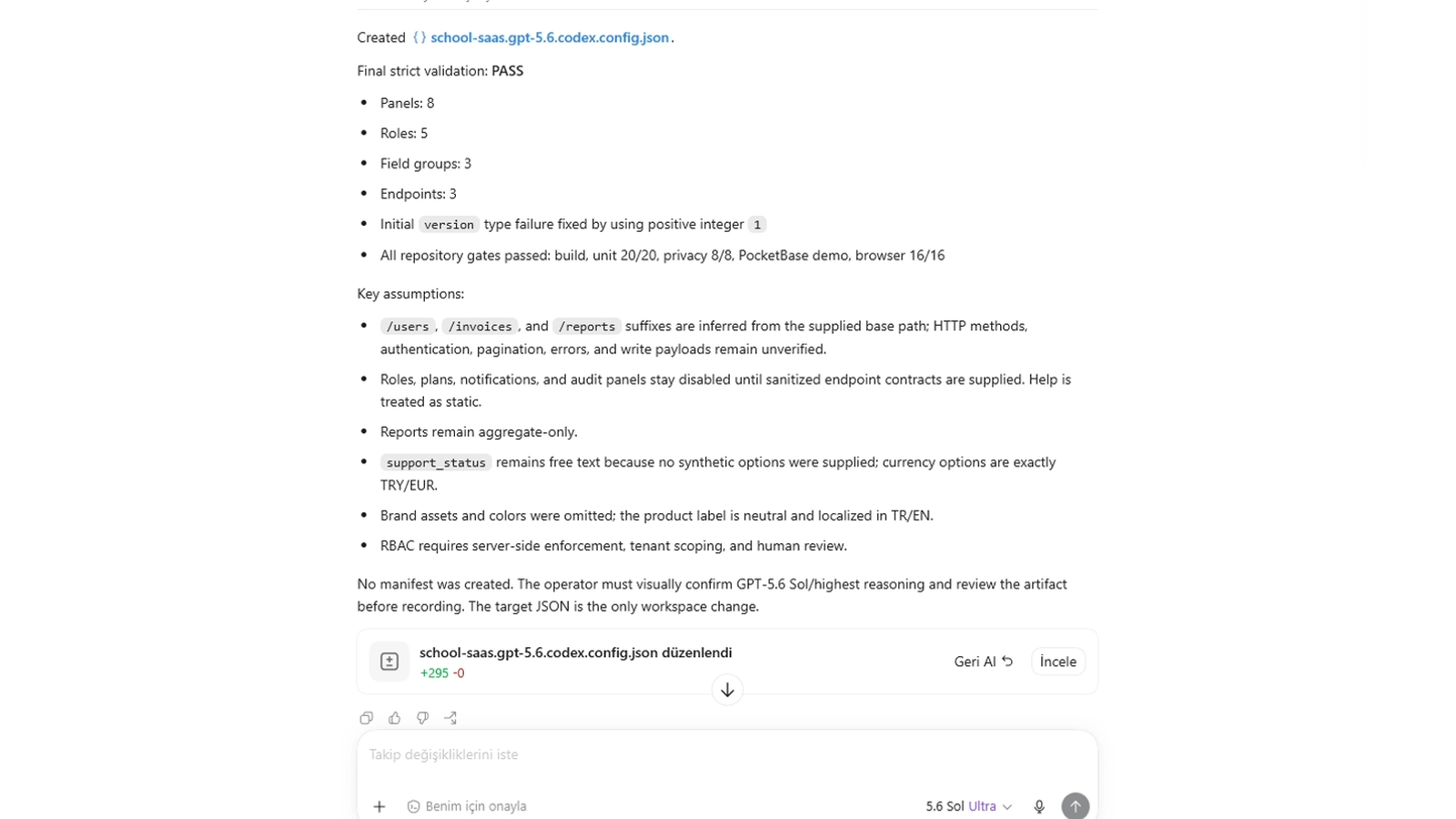
GPT-5.6 Sol with Ultra intelligence executes a bounded, synthetic-only Codex task.
-
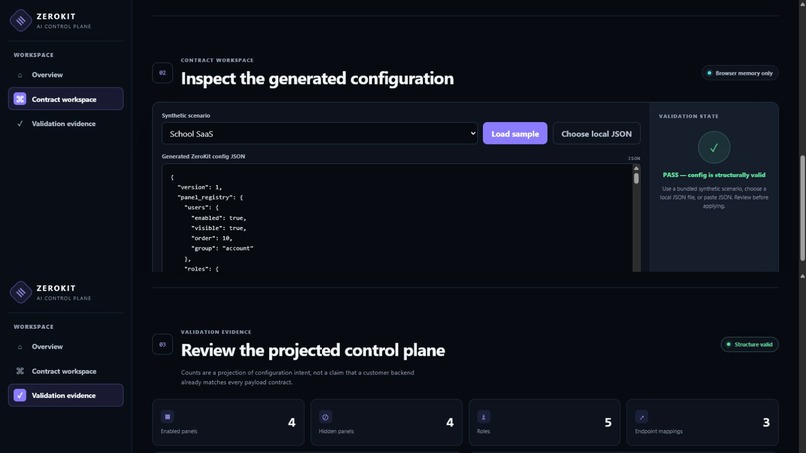
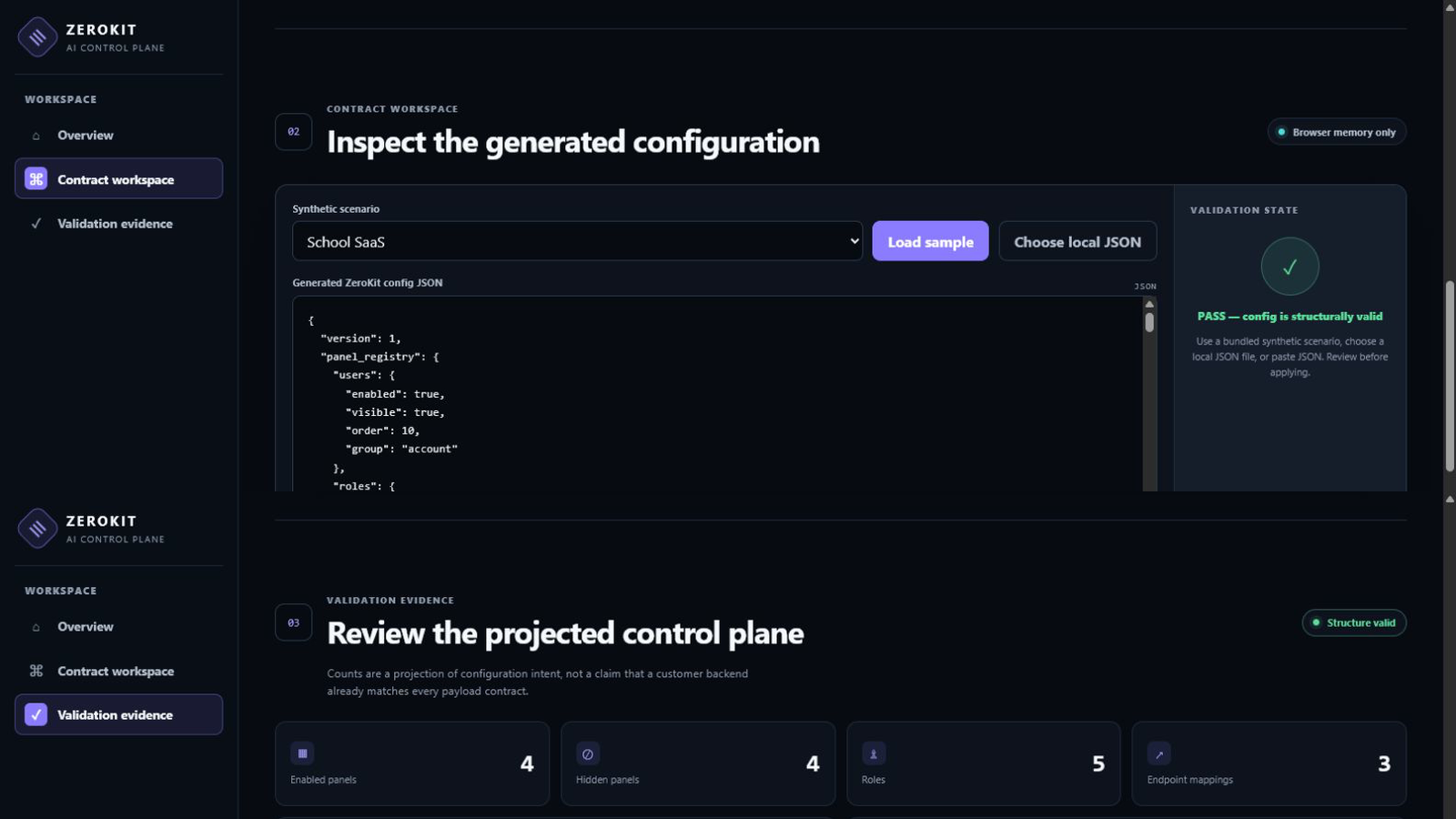
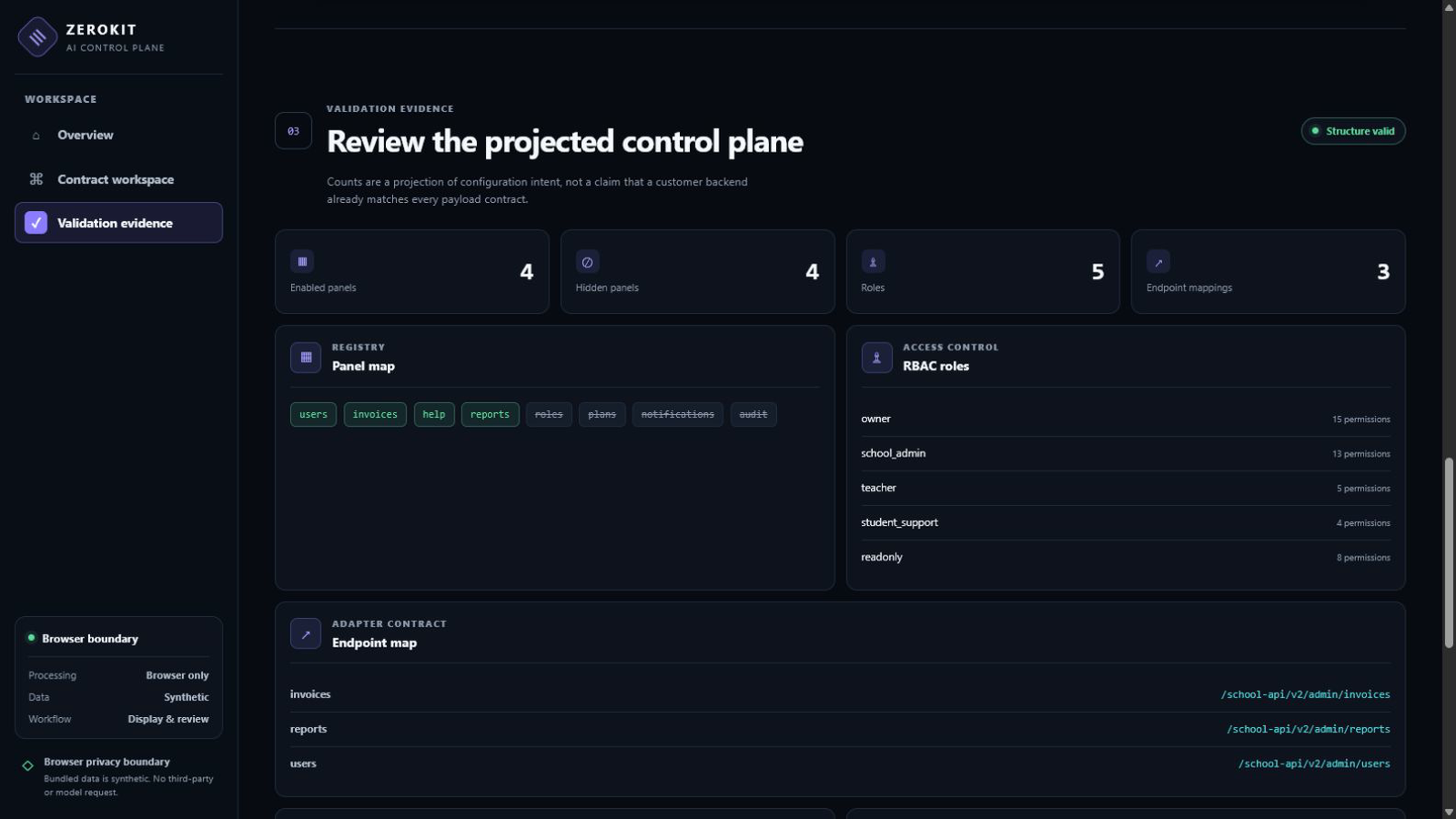
The fresh reviewed config passes local validation and exposes panels, roles, fields, and endpoint mappings.
-
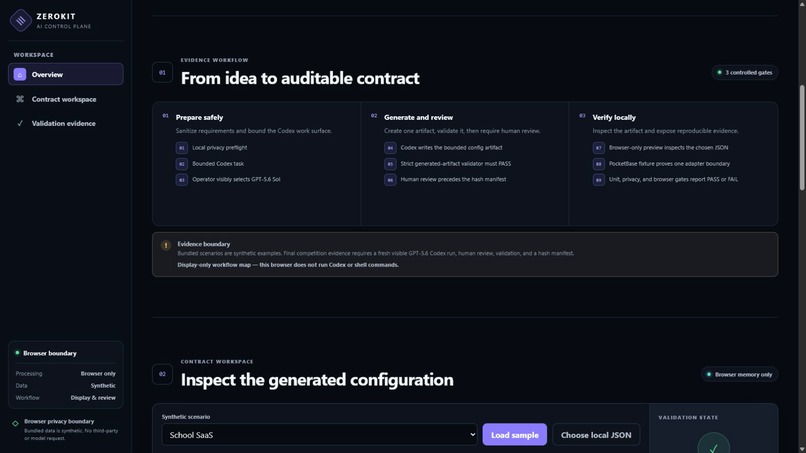
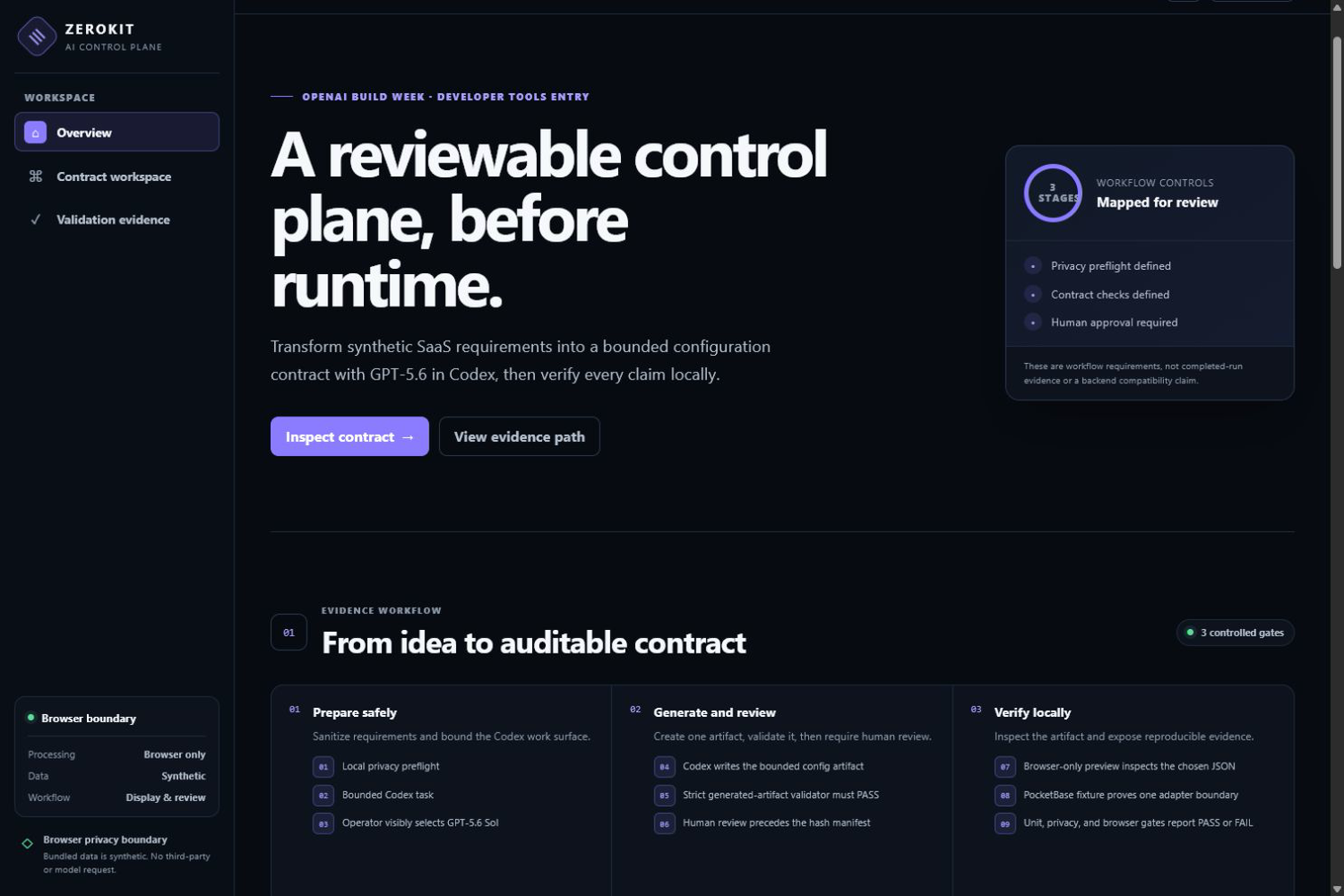
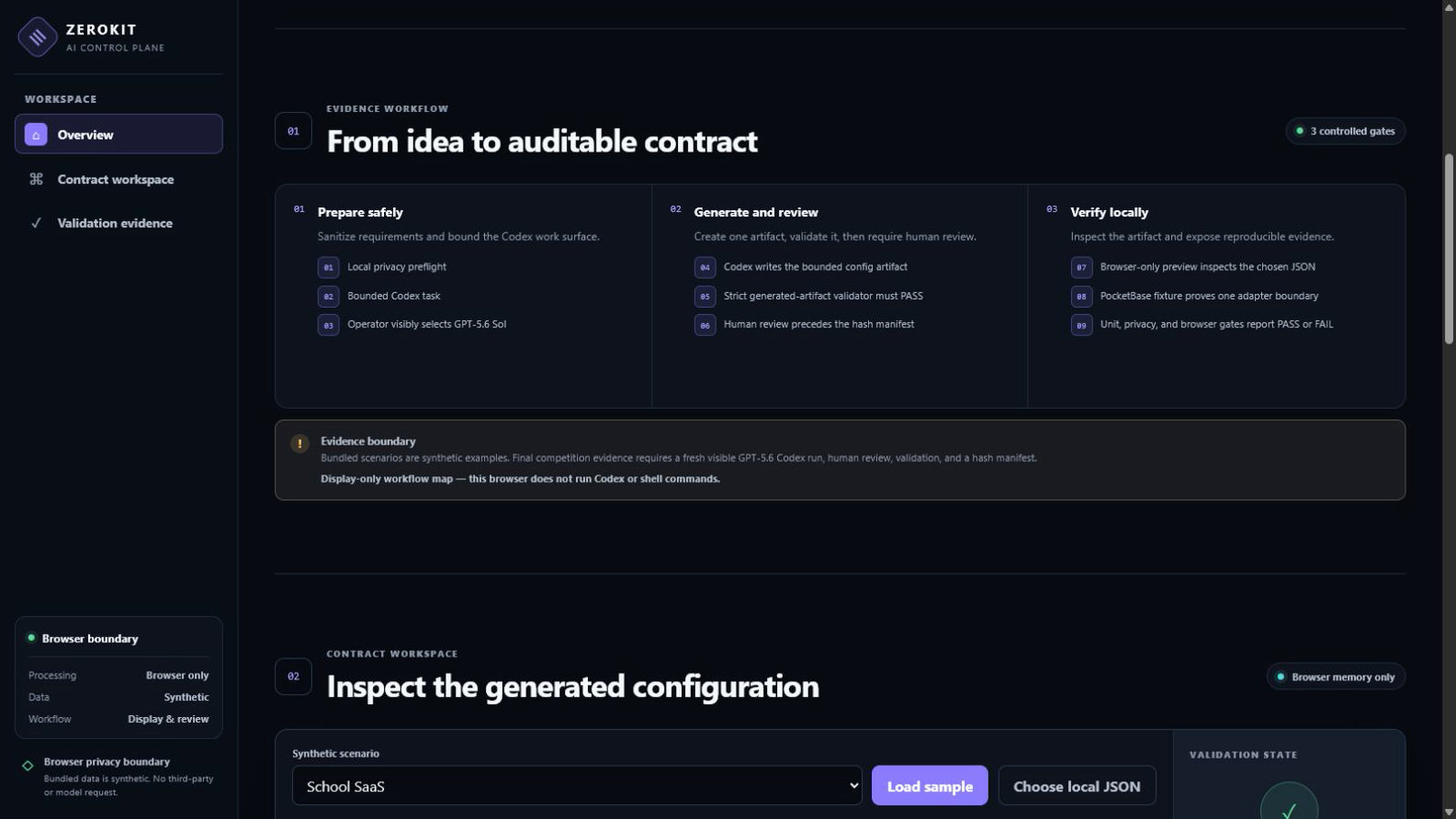
A nine-step evidence chain connects privacy preflight, Codex generation, validation, human review, adapter proof, and repeatable tests.
-
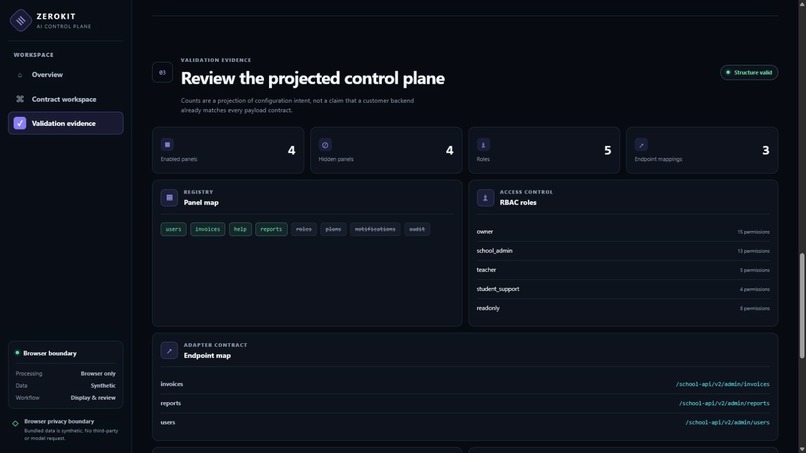
The projected control plane makes enabled and hidden panels, least-privilege roles, fields, and routes reviewable before runtime.
Inspiration
SaaS teams repeatedly rebuild the same administration infrastructure: navigation, roles and permissions, configurable fields, backend routes, and release gates. Those decisions quickly become scattered code and hard-to-review integration assumptions. We wanted one developer workflow that makes those choices visible before runtime without putting production customer data into the model loop.
What it does
ZeroKit AI Control Plane turns a sanitized SaaS brief into one reviewable configuration contract. The result covers enabled and hidden panels, least-privilege RBAC, configurable fields, endpoint mappings, brand settings, privacy notes, and test gates.
The public GitHub Pages preview gives judges a no-rebuild path for inspecting the projected control plane. The repository also includes three synthetic scenarios, a fresh reviewed GPT-5.6 evidence artifact, deterministic validators, a fail-closed PocketBase response-envelope fixture, and repeatable unit, privacy, browser, and build checks.
How we built it
A dependency-free local privacy preflight first blocks high-confidence secret patterns and non-reserved email addresses. It then prepares a bounded Codex task that allows only synthetic requirements, public contracts, and a specific output path. Codex with GPT-5.6 generates the JSON inside the repository. A stricter local gate rejects incomplete generated artifacts; a human reviews the result; and an operator-confirmed manifest records hashes and validation counts. The browser preview re-validates a chosen JSON file locally and makes panels, roles, fields, routes, warnings, and the evidence chain reviewable.
How we used Codex and GPT-5.6
Codex was the primary development environment for the Build Week extension, and GPT-5.6 contributed to architecture, implementation, tests, evidence design, official-rules alignment, and the demonstrated config-generation workflow. In the final recorded run, GPT-5.6 Sol with Ultra intelligence handled a bounded synthetic task, wrote the fresh School SaaS config, and returned strict validation PASS. Model selection is operator-confirmed from the visible Codex interface, not cryptographically verified.
Challenges
The hardest part was keeping AI generation useful without turning it into an unsupported trust claim. We separated model reasoning from deterministic acceptance, made human review mandatory, kept production records and runtime authorization outside the workflow, and documented validator limits. We also made GitHub Pages work correctly under a project subpath and built a browser smoke runner without adding a frontend runtime dependency.
Accomplishments and lessons
The fresh reviewed artifact passes with 8 panels, 5 roles, 3 field groups, and 3 endpoints. The final gates pass with unit 20/20, privacy 8/8, browser 16/16, three bundled config validations, and the synthetic PocketBase adapter fixture. The main lesson is that AI-generated architecture becomes more useful when uncertainty, privacy boundaries, deterministic validation, and human approval are visible parts of the product.
Build Week extension
ZeroKit is a pre-existing project under the Official Rules. Its public foundation predates the Submission Period and is not presented as new competition work. During the Submission Period, it was meaningfully extended with the no-rebuild Pages deployment and project-subpath support, URL tests, a visible evidence chain and synthetic-data boundary, strict generated-artifact validation, official-rules-aligned submission materials, and the fresh GPT-5.6/Codex generation, review, and manifest workflow. Timestamped commits and the exact prior/new-work boundary are documented at https://github.com/zyganali-glitch/zerokit-ai-control-plane/blob/main/ai-buildweek/reports/build-week-delta.md.
What is next
ZeroKit remains a judging-ready developer workflow, not a production-ready authorization system or a universal backend adapter. A real deployment would require a backend-specific fixture and adapter, authorization review, integration tests, and normal deployment controls. The browser preview intentionally runs no Codex task or shell command and makes no model API request.
Built With
- actions
- codex
- css
- github
- gpt-5.6
- html
- javascript
- node.js
- pages

Log in or sign up for Devpost to join the conversation.