-
-
zerofall_how_it_works.jpg
-
zerofall_gait_analysis.jpg
-
zerofall_app_dashboard.jpg
-
zerofall_impact_stats.jpg
-
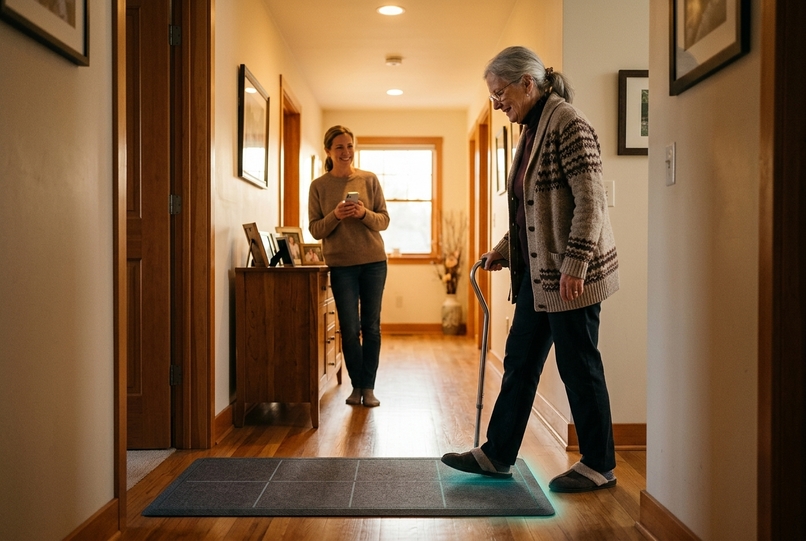
zerofall_mat_hero.jpg
Inspiration
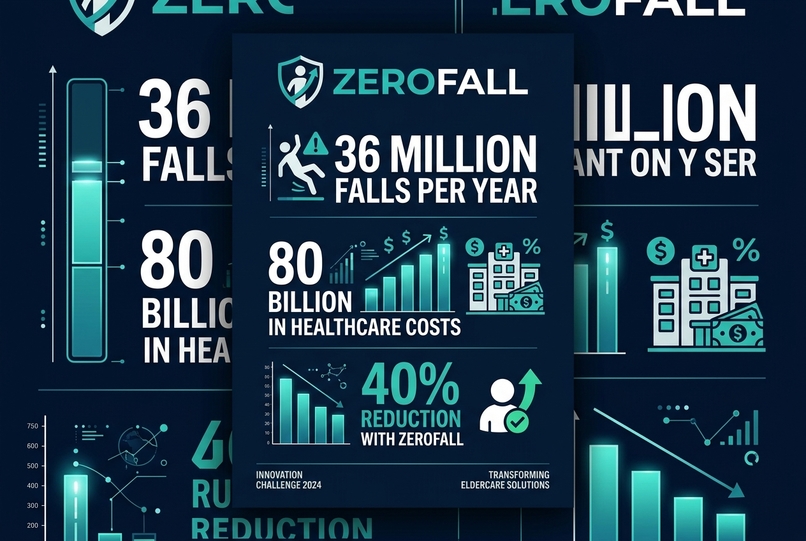
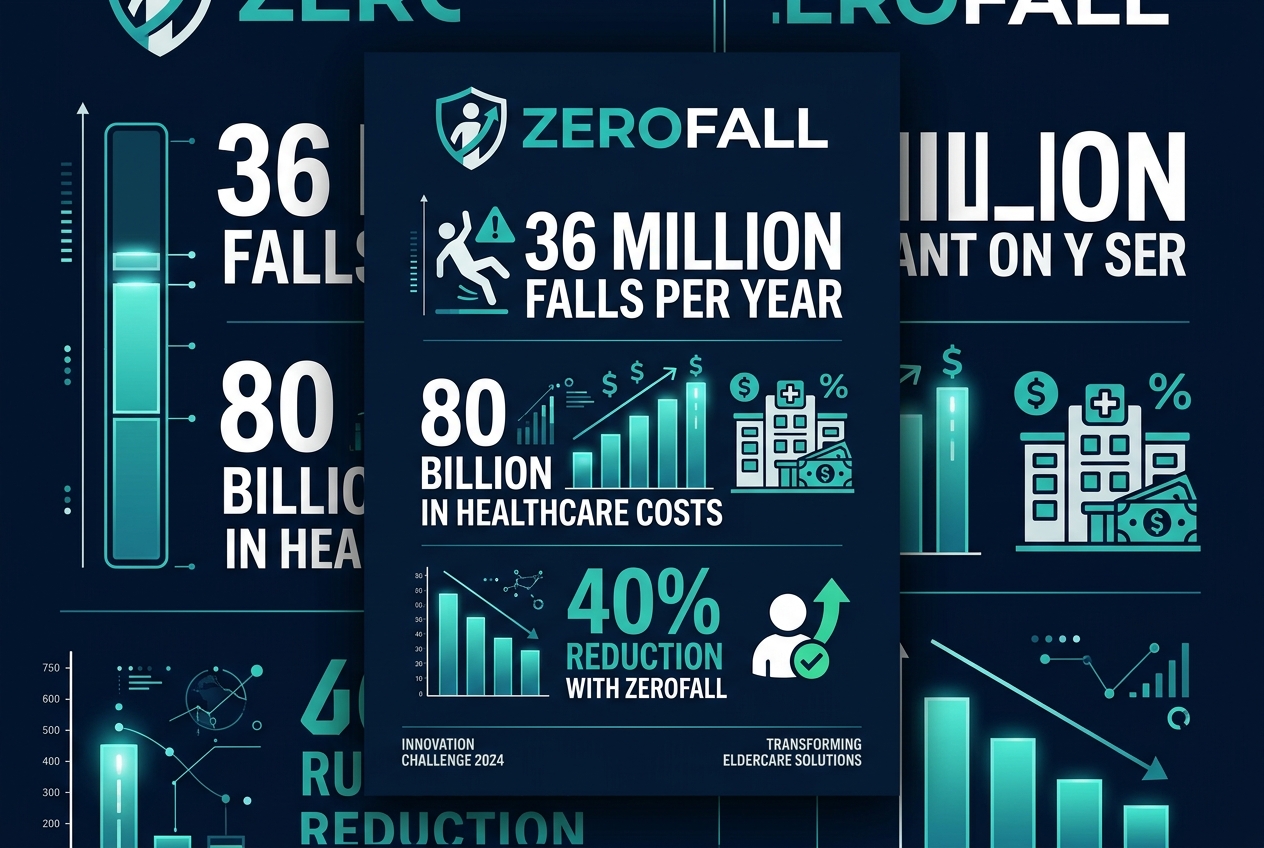
Every 19 minutes, an elderly person dies from a fall-related injury in the United States alone. Over 36 million falls occur each year among adults over 65 — resulting in $80 billion in direct medical expenditure and robbing millions of our seniors of their independence, mobility, and dignity.
Most personal tragedies happen quietly: an elderly parent falls in their bathroom at 4:00 AM. Cameras are
unacceptable due to privacy violations. Wearables fail because of an observed 68% non-compliance rate (seniors take them off to sleep, shower, or simply forget to recharge them). Emergency call pendants require the person to remain conscious and within reach after the trauma has already occurred.
Falls are not sudden, unpredictable anomalies. Clinical biomechanics has established that gait patterns
deteriorate days or weeks before a catastrophic fall. We asked ourselves a simple design question: What if the floor itself was intelligent enough to listen before the fall happens?
What it does
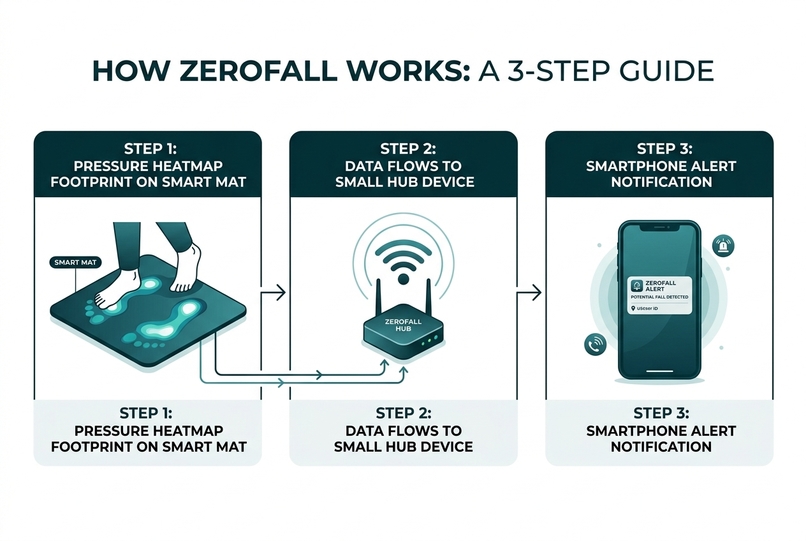
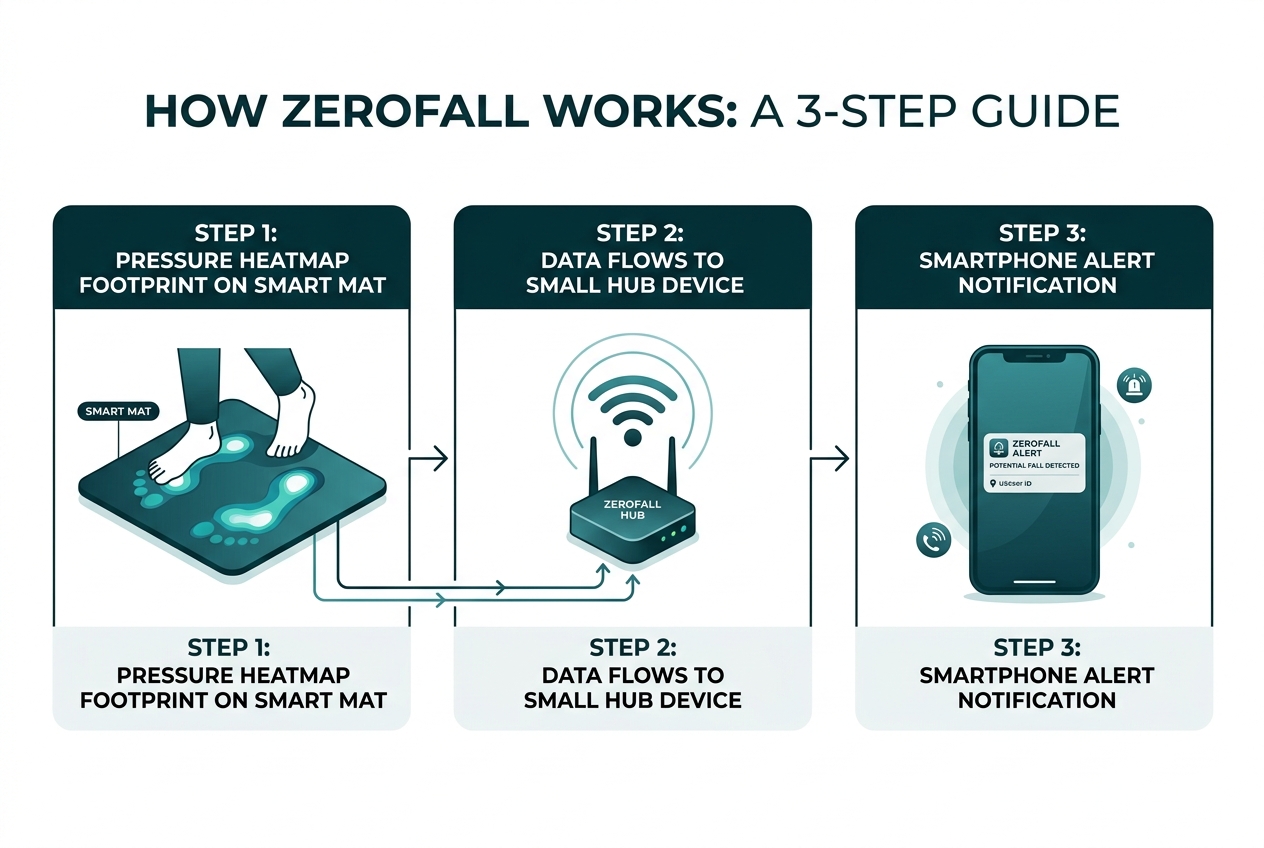
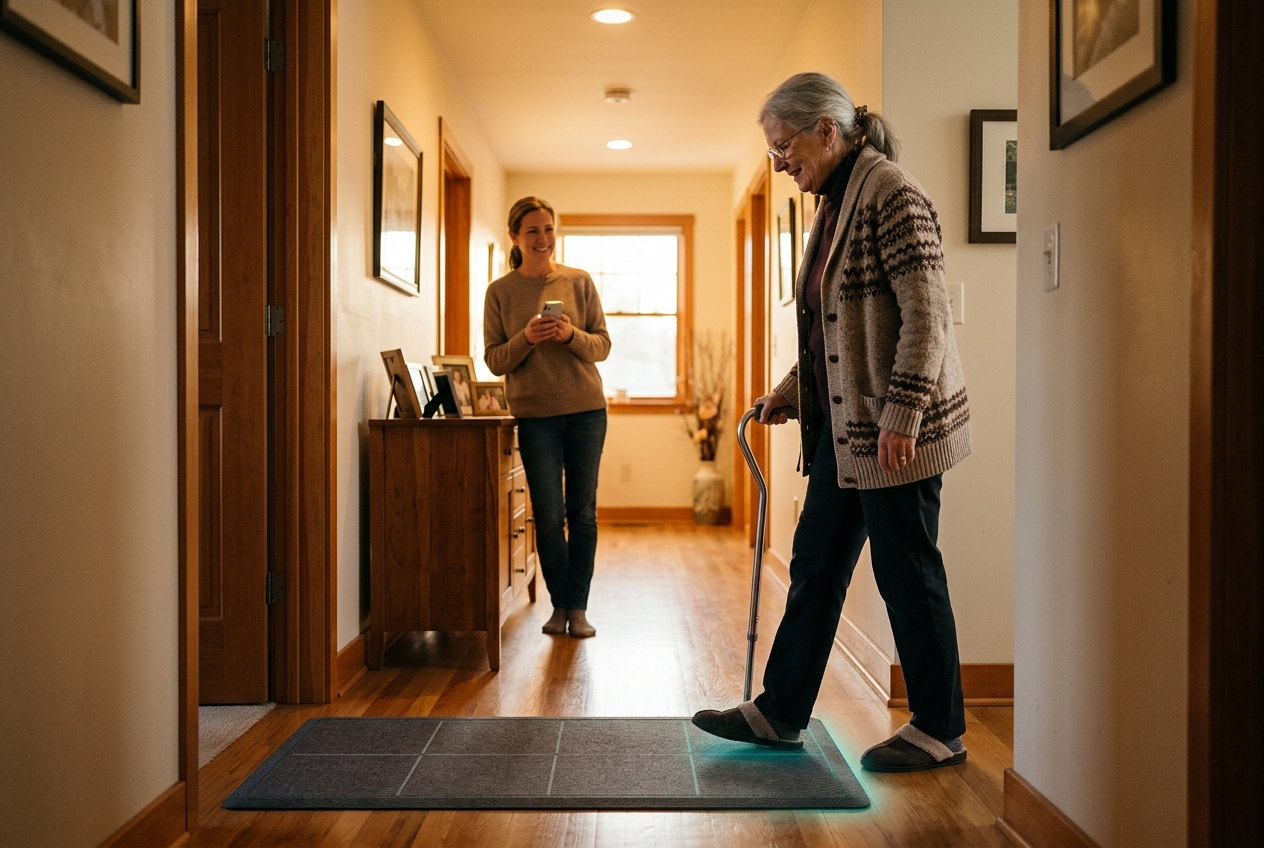
ZEROFALL is a passive, wearable-free, camera-free predictive fall-prevention ecosystem composed of three synchronized layers:
1. **ZeroMat™ (Tactile Hardware):** A non-slip, washable 90cm × 60cm mat embedding an array of 640 piezoelectric
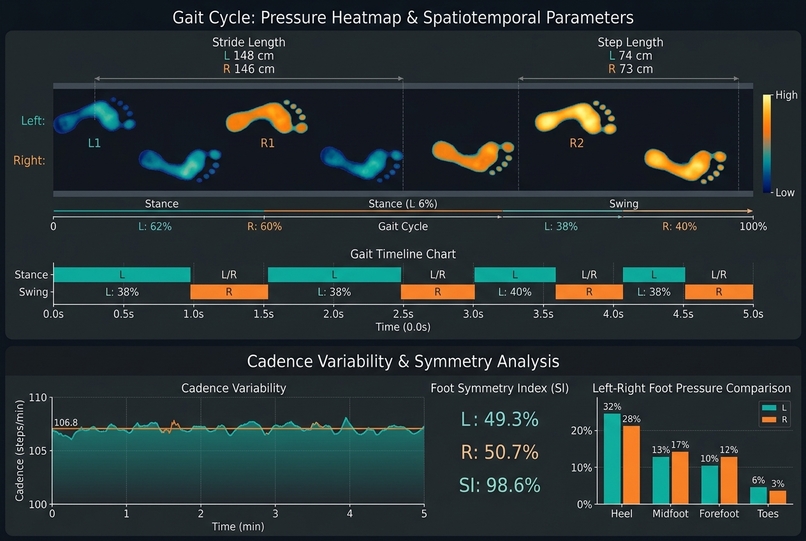
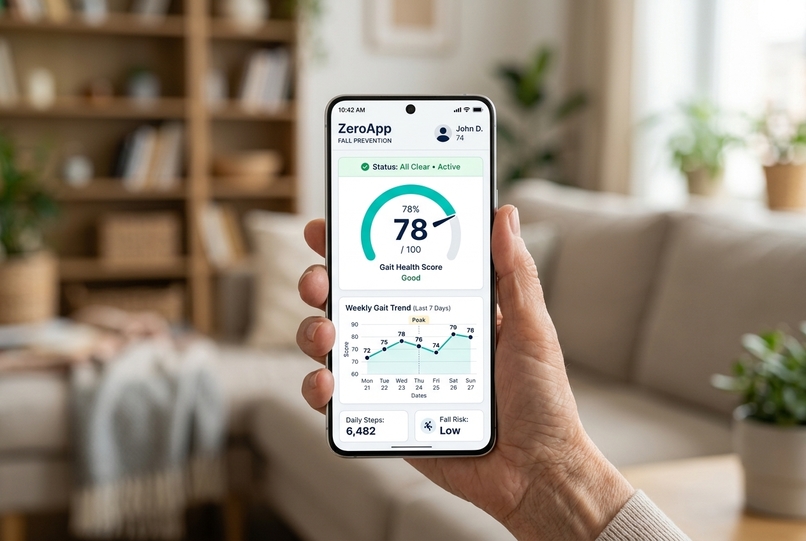
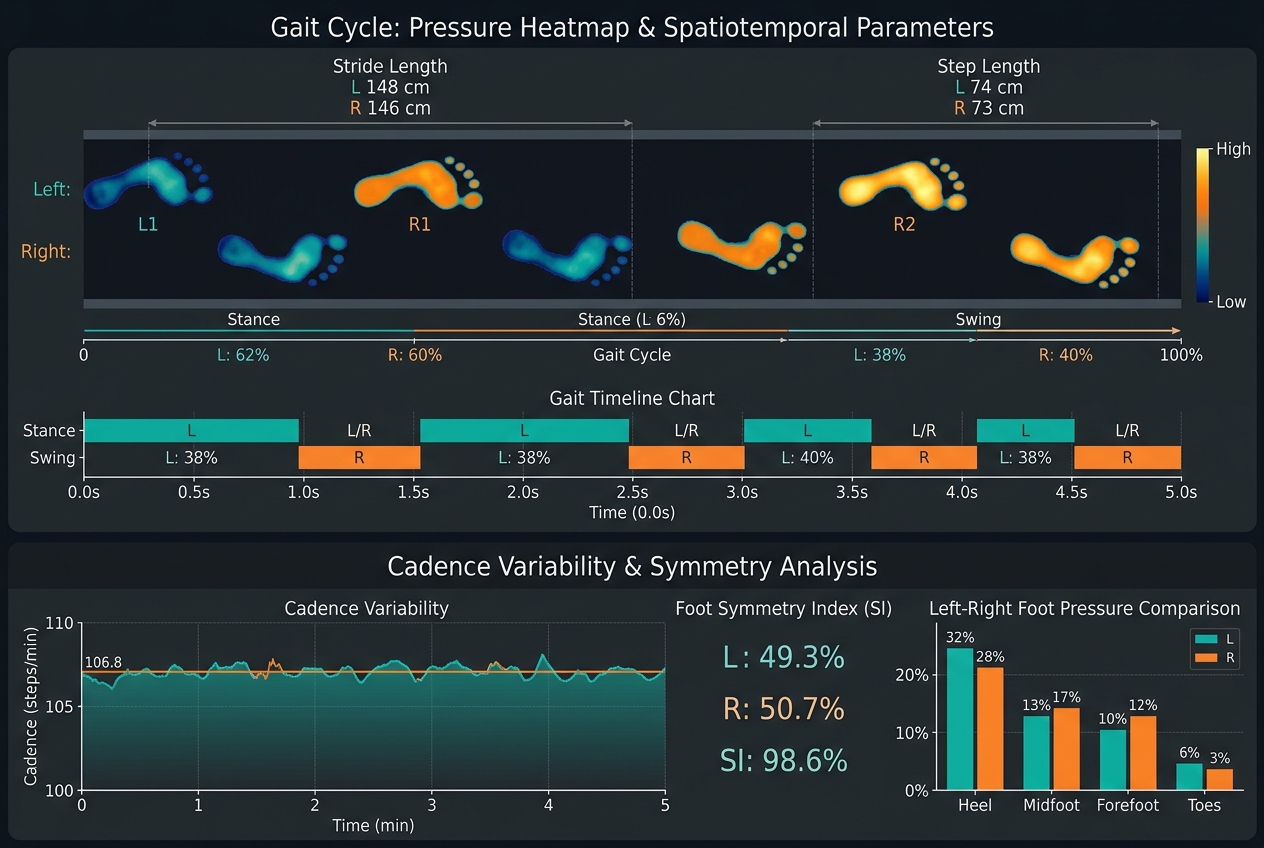
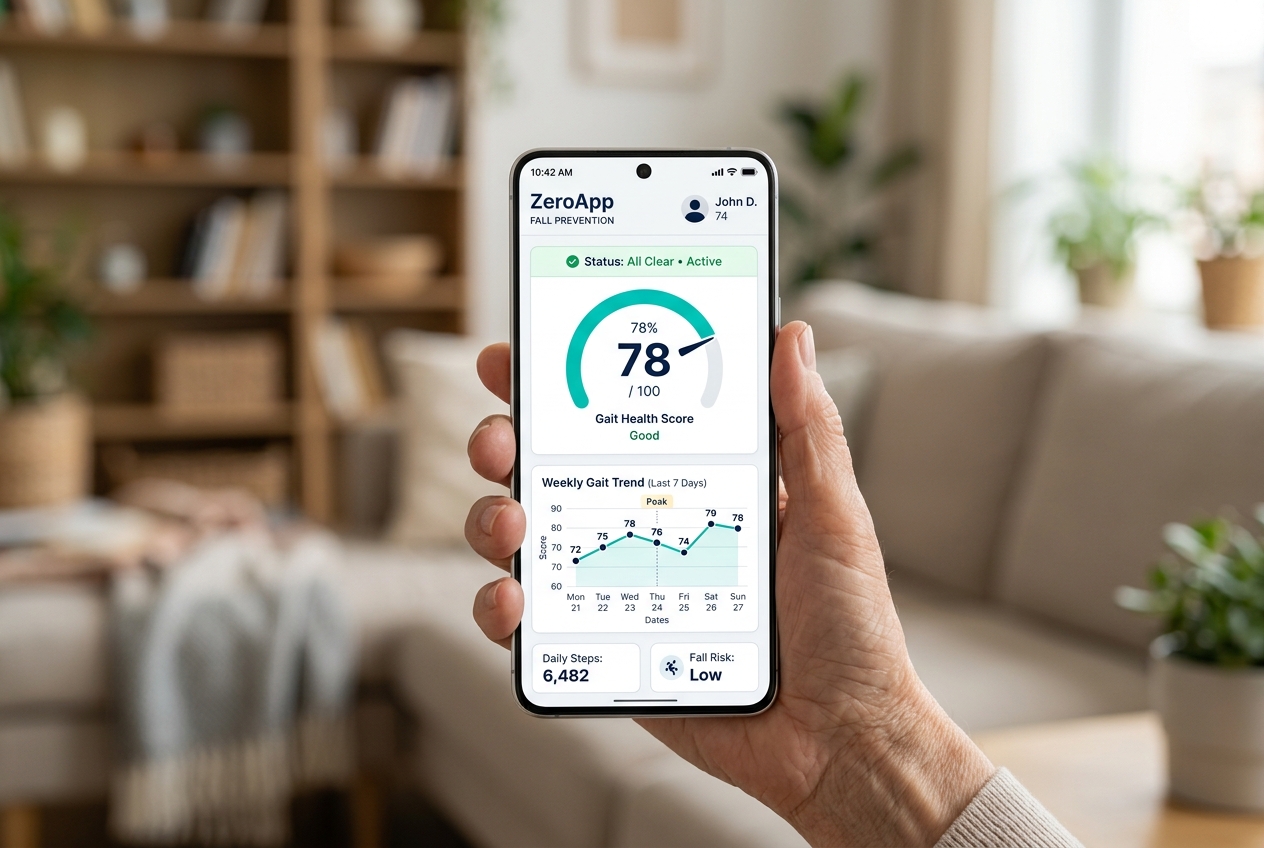
pressure sensors ($32 \times 20$ grid) sampling at 100 Hz. Installed at standard transition points (bedside, bathroom doorways, hallways), it gathers biomechanical footprints during ordinary walking. 2. ZeroHub™ (Edge Processing): A wall-plug unit communicating locally with up to 6 mats via BLE 5.2. It extracts 12 spatiotemporal gait parameters on-device. Raw pressure distributions and personal imagery never leave the home. 3. ZeroApp™ (Caregiver Intelligence): Translates complex gait metrics into a daily Gait Health Score ($1\text{--}100$) and issues tiered preventive notifications up to 72 hours prior to high-risk events: - 🟢 Green: Stable personalized baseline. - 🟡 Yellow: Subtle stride irregularity or balance degradation detected (prompts scheduling a GP or physical therapy evaluation). - 🔴 Red: Urgent imbalance, shuffling, or marked asymmetry (triggers automated family/caregiver check-ins).
How we built it
ZEROFALL was engineered as an interdisciplinary healthcare and industrial innovation: - Biomechanical Modeling: Designed around empirical clinical benchmarks (Hausdorff et al., Lord et al.) monitoring Cadence Variability ($CV$), Stride Asymmetry ($SA$), and Heel Strike Attenuation: $$\text{CV}{\text{stride}} = \left( \frac{\sigma{\text{stride}}}{\mu_{\text{stride}}} \right) \times 100\%$$ $$\text{Symmetry Index (SI)} = \frac{|P_{\text{left}} - P_{\text{right}}|}{0.5 \cdot (P_{\text{left}} + P_{\text{right}})} \times 100\%$$ - Privacy-by-Architecture: Data pipelines are decoupled so that individual footsteps are compressed into anonymized statistical vectors on the local hub before transmission. - Economic & Market Frameworks: Formulated a dual-tier business model combining D2C hardware ($149 mat + $49 hub + $12/month) with an insurer-funded B2B pathway. At an average hospitalization cost of $34,000 per hip fracture, preventing a single fall yields: $$\text{ROI} = \frac{\text{Direct Costs Avoided}}{\text{Annual Device Cost}} = \frac{\$34{,}000}{\$250} \approx 136\times$$ - Interactive Cloud Prototype: Packaged and deployed via an automated Dockerized Alpine Linux stack on Fly.io to provide an immediate live reference site.
Challenges we ran into
- The Compliance Barrier: Most eldercare gadgets demand behavioral adjustments. Eliminating user interfaces
entirely forced us to solve all hardware triggering passively within the mat’s piezo threshold layers.
- The Privacy Dilemma in High-Risk Zones: The highest risk zones (bathrooms and bedrooms) are the exact spaces where cameras and microphones are rejected. Solving this required proving that pressure gradients alone provide clinical-grade fidelity without visual sensors.
- Combating False Positive Fatigue: A rigid population-wide rule generates endless false alarms. We countered this by introducing an adaptive 14-day calibration window, contrasting the user only against their own personalized moving average. ## Accomplishments that we're proud of
- Designed a high-impact, non-code healthcare innovation addressing a $80B/year problem with a solution centered on dignity and passive interaction.
- Formulated an architecture where privacy is guaranteed mathematically by discarding raw sensor matrices on edge devices.
- Established an institutional insurance distribution strategy that lowers the barrier of entry to $0 for end users via preventive Medicare/private payer subsidies.
- Packaged complete engineering specifications, risk matrices, financial models, high-res renders, and a live deployment. ## What we learned
- Gait is a real-time vital sign: Step hesitation and cadence variations are as diagnostic as heart rate, yet
remain almost totally unmonitored in residential environments.
- Invisible tech is the most compassionate tech: The greatest medical innovation for seniors is the one they never have to learn how to operate.
- Structural cost arbitrage: Prevention delivers over 100x economic return compared to acute post-injury care, providing a powerful lever for public healthcare integration. ## What's next for ZEROFALL
- Stage 1 (Clinical Validation): 50-unit pilot in partnership with university geriatrics departments
validating correlations with the Timed Up and Go (TUG) and Berg Balance Scale tests.
- Stage 2 (Regulatory Filing): Submit FDA 510(k) pathway as a Class II exempt general wellness predictive monitoring device.
- Stage 3 (Predictive Expansion): Extend the biomarker analytical suite to identify early micro-tremors associated with Parkinson's disease onset, post-stroke rehabilitation tracking, and acute medication side effects.

Log in or sign up for Devpost to join the conversation.