Inspiration
My inspiration came from my younger days of playing city builder and RTS games. With humanity being a new age of AI and our civilization is undergoing changes that we may or may not see, it sparked a question in my mind.
What would it look like if your city-builder concept was flipped on its head and the player had to keep the city alive from the collapse instead of building a grand city?
I wanted to build something that sat between management and resources and survival inside your favorite city-builder genre. A place where resources, population, transportation, infrastructure, environment, and human behaviors are not just stats you grow -- but interconnected systems that visibly or invisibily affect the world.
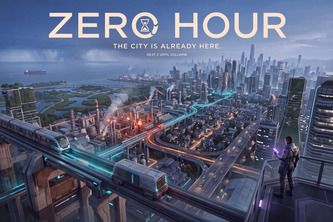
City builders give the player sandbox and challenges to grow a grand simulated world -- Zero Hour gives you a city that's already living, your job is to keep it alive.
What it does
Zero Hour is a real-time civilization survival game built around interconnected systems.
The player inherits a living city where they are able to manage the developing world where things like:
- HRC -- human resources
- H20 -- water
- TRN -- transportation
- ECO -- economy
- POP -- population
- ENV -- environment are constantly interacting.
The city is divided into 5 districts, including CORE, BELT, GARDEN, ARC, and DOCKS, each serving a different purpose within the civilization.
The important part is that these systems do not exist as isolated mechanics.
The goal is for the player to see the consequences of their decisinos physically emerge in the world.
More population creates new demads. Infrastructure changes movement. Resource shortages create pressure. Econimic decisions change development. Environmental conditions affect civilization.
ZERO HOUR is a living city sandbox where the player becomes the operator.
How we built it
I approached ZERO HOUR as a game-systems-first project.
Instead of starting with massive amounts of content, I focused on creating the underlying framework that would be the game and player interactions that could eventually support a much larger world.
The project combines: Simulation systems -> world state -> districts -> resources -> visualization -> player interaction.
The experience was designed around a real-time 3D/isometric perspective so the player can pull back and understand the civilization as a whole while still being able to zoom into individual areas.
The UI is designed as micro information layer over the world rather being the world itself.
That distinction is extremely important to the project.
I wanted it to move from:
"Here's a dashboard and then a city."
to:
"Here's the city. The dashboard is how you understand it."
The architecture is also intentionally modular so that additional districts, systems, events, buildings, characters, and simulation mechanics can be added without rebuilding the entire foundation.
Challenges we ran into
The biggest challenge was scope.
It's easy to say you're going to build a living civilization. The idea was enourmous. It is very easy to build a beautiful interface that looks like a game without actually creating the underlying simulation.
I had to constantly ask:
What is most important for simulation and most important for visual?
Another challenge was the camera and presentation.
The original interface was becoming too zoomed-in and UI-heavy. It was communicating information instead of civilzation or place.
I needed to make the transition into a 3D world without losing the clarity of the original interface or the feeling of the game.
That meant solving the relationship between: camera + world + UI + information density.
I also had to think carefully about performance and modularity. A civilzation simulation can quickly become expensive or memory heavy if every object, citizen, resource, and interaction is simulated independently.
So I flipped the table and started thinking about the world in layers: Macro simulation -> district simulation -> local simulation -> visual representation.
With that, I got the illusion of the complex city without have everything simulating at maximum details all the time.
Accomplishments that I'm proud of
The biggest accomplishment is that ZERO HOUR became more than a visual concept or "1-shot demo".
I established a foundation for an actual playable world.
I created a clear simulation language, defined the major resource systems, established districts, and began translating the interfact into a physical 3D environment.
I am especially proud of the direction of the camera and world presentation.
The project started feeling like a dashboard.
Now I'm pushing it toward something that feels like a place.
That sift is important.
I also proved that as a solo dev --- or a single developer using modern AI-assisted workflows -- can approach problems that traditionally required much larger production teams.
ZERO HOUR is an experiment in that idea, and that idea has built a foundation to drive into the game industry!
What we learned
I learned that systems are more important than spectacle.
You can make an incredible screenshot, or demo video, but if nothing underneath it reacts, the world feels dead.
I also learned that good UI doesn't mean putting more information on screen.
It means giving the player the right information at the right moment.
The camera became part of the UI.
The world became part of the UI.
Districts became information.
Even environmental changes can become information.
That fundamentally changed how I think about the project.
We also learned that AI-assisted developmenet changes the economics of prototyping.
Instead of spending weeks just getting an idea into a rough prototype, I can iterate on architecture, visuals, interaction, and systems much faster.
The real skill becomes knowing what to build, why it matters, and how all the pieces connect.
What's next for ZERO HOUR
ZERO HOUR is just the beginning.
The next major milestones is turning the current prototype into a fully living 3D civilization simulation.
That means expanding the district system, adding actual buildings and infrastructure, introducing citizens and transportation, connecting the resource systems, and making the conseqquences of player decision visible in real time.
From there, we want to introduce:
- Dynamic events
- Resource chains
- Population behavior
- Economic simulation
- Environmental systems
- Infrastructure networks
- Disctrict specialization
- Procedural world expansion
- Deeper player decision-making
- More sophisticated AI-driven citizens
Eventually, I want ZERO HOUR to become something much larger:
a world where every district, person, resource, structure, and decision contribute to an emergent story.
You aren't just playing a civilization.
You're saving one.
