Inspiration
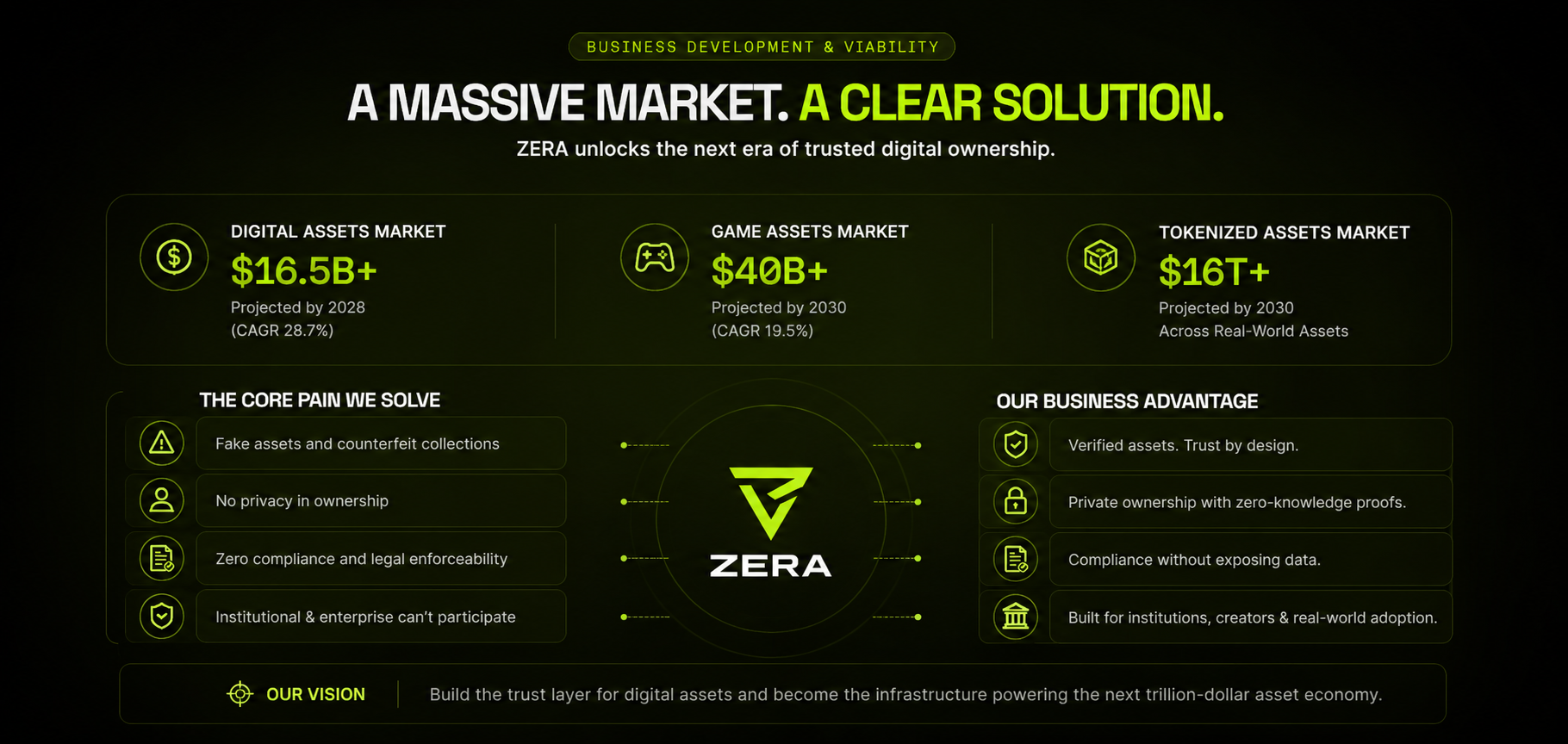
NFTs were supposed to redefine digital ownership, but the space became heavily associated with speculation rather than real ownership.
We wanted to ask a different question: What would digital assets look like if ownership, authenticity, privacy, and compliance were built into the system from day one?
That led us to ZERA.
Instead of building another marketplace optimized around visibility and hype, we wanted to build a verification-first, privacy-preserving asset marketplace where ownership is something you can prove without exposing everything about yourself.
The core idea was simple: replace trust assumptions with cryptographic proofs.
What it does
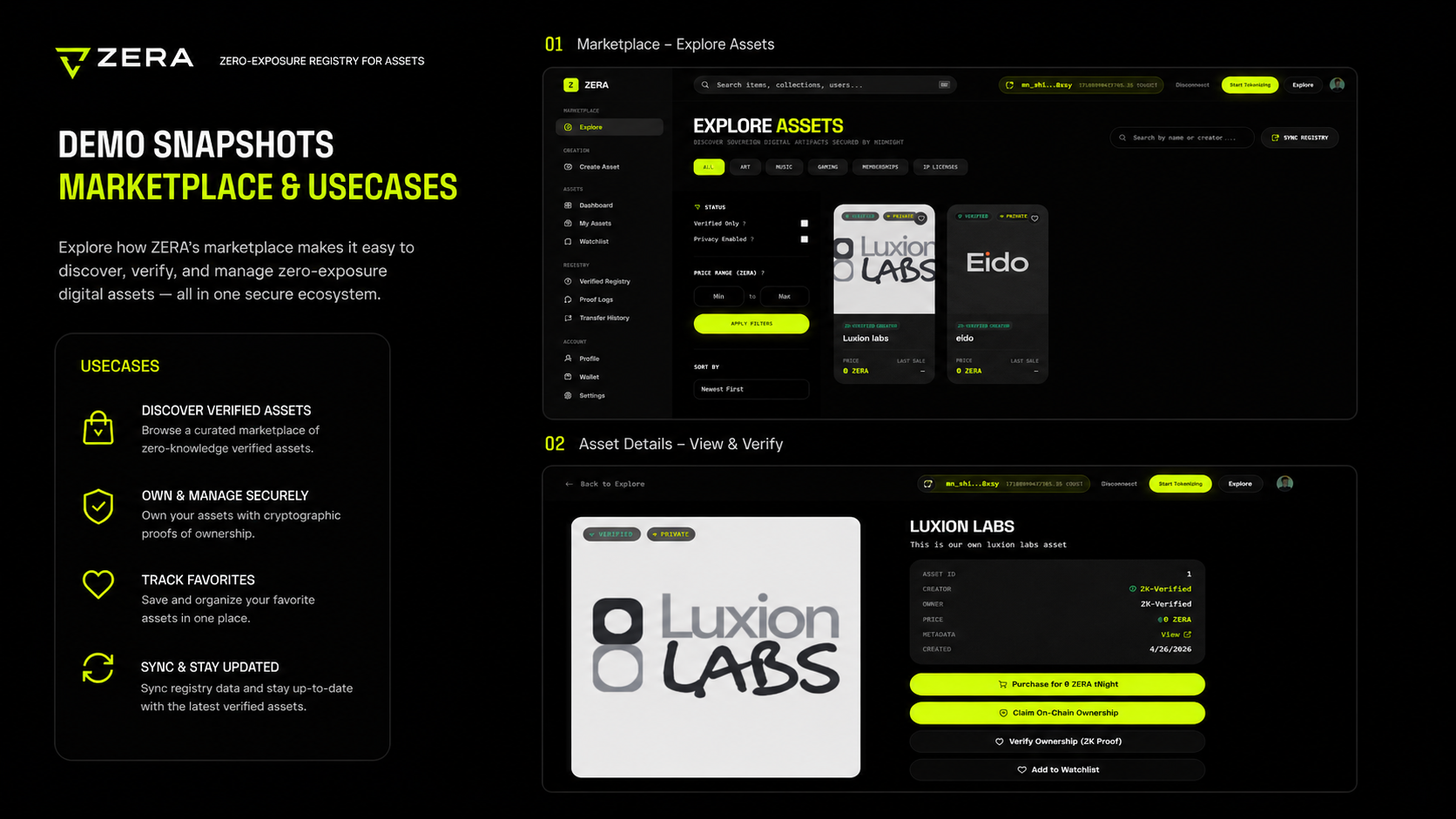
ZERA is an institutional-grade digital asset marketplace built around verified ownership, privacy, and compliance.
Before an asset can enter the marketplace, it goes through a verification process. Its provenance is established through cryptographic signatures and its identity is recorded on the Midnight Network.
Users can:
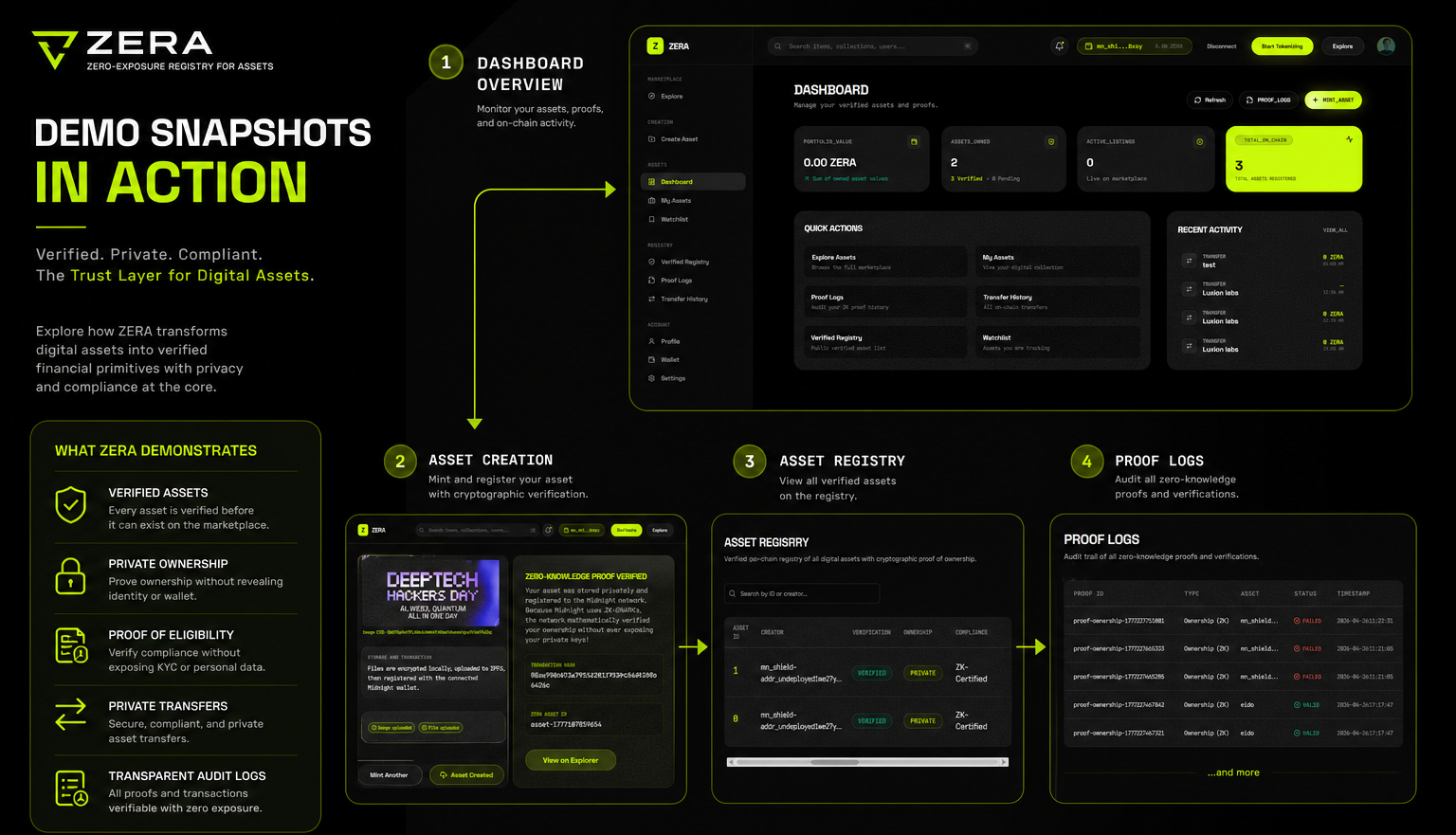
- Verify asset authenticity before trading.
- Prove ownership privately without exposing their wallet or identity.
- Prove eligibility using Zero-Knowledge KYC without exposing underlying personal information.
- Trade privately through shielded transaction states.
- Prevent duplicate or counterfeit assets through on-chain asset hashes.
The result is a marketplace where ownership becomes provable rather than publicly visible.
How we built it
ZERA is built around the idea that privacy and verification shouldn't be features added on top — they should be part of the protocol itself.
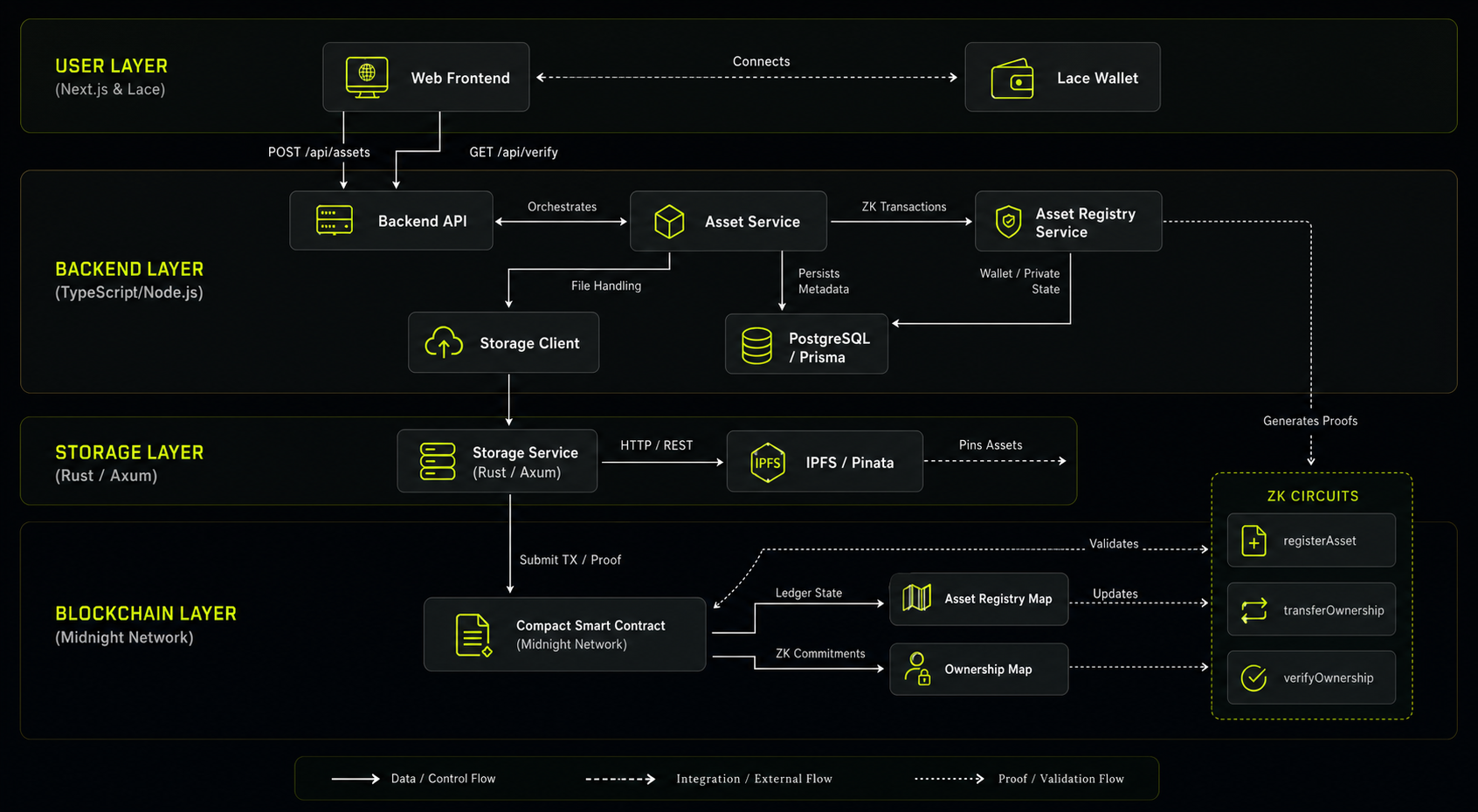
The core architecture uses:
- Midnight Network for privacy-preserving smart contracts and the underlying ledger.
- Zero-Knowledge Proofs for private ownership and eligibility verification.
- Compact for Midnight smart contracts.
- Next.js + TypeScript for the frontend.
- Node.js for backend services.
- Prisma + PostgreSQL for application data.
- Rust/Cargo for the storage service.
- Docker for running the local network and supporting infrastructure.
The asset lifecycle follows a strict cryptographic flow:
Upload → Sign → Verify → Register → Trade
When purchasing an asset, the buyer generates an eligibility proof locally, the network verifies compliance without requiring the underlying private information, and the transfer is executed privately.
After the transaction, ownership can also be proven using a Zero-Knowledge proof without exposing the owner's wallet.
Challenges we ran into
The biggest challenge was trying to make privacy, verification, and usability work together.
A normal marketplace can simply display a wallet address, transaction history, and ownership records. ZERA couldn't rely on that model because exposing all of that information defeats the purpose of private ownership.
We had to think about the system as a sequence of proofs rather than a sequence of publicly visible transactions.
We also had to work across several layers of the stack — from the Next.js application and database to Rust storage services and Midnight smart contracts — while making sure the entire local development environment could run together.
The hardest conceptual shift was designing around the question:
"What does a user actually need to prove, and what information should they never have to reveal?"
That became one of the principles behind the architecture.
Accomplishments that we're proud of
We're proud that we didn't stop at the idea of a private NFT marketplace.
We built a foundation for a verification-first digital asset protocol where:
- Assets have cryptographically verifiable provenance.
- Ownership can be proven without exposing identity.
- Eligibility can be verified through Zero-Knowledge proofs.
- Transactions can happen through privacy-preserving states.
- Assets are registered on the Midnight ledger.
- The architecture is designed with institutional and regulated use cases in mind.
More importantly, we changed the framing of the problem.
ZERA isn't trying to make NFTs more exciting. We're trying to make digital ownership more legitimate.
What we learned
We learned that building privacy-first systems requires thinking differently about product design.
In traditional applications, more data often makes verification easier. In a privacy-preserving system, the goal is almost the opposite:
Prove the fact without revealing the information behind the fact.
That forced us to separate verification from visibility.
We also learned how powerful Zero-Knowledge Proofs can be when they're treated as a product primitive rather than simply a cryptographic technology.
Instead of asking users to trust a platform, ZERA moves toward a model where important properties — ownership, eligibility, and authenticity — can be mathematically verified.
What's next for ZERA
The current implementation is the foundation. Our next goal is to expand ZERA beyond digital collectibles into a broader privacy-preserving financial layer for digital assets.
We're exploring:
- Tokenized real-world assets, including real estate and luxury goods.
- Tokenized securities and debt instruments.
- Automated regulatory compliance through compliance oracles.
- Institutional custody with multisig, threshold signatures, and cold storage.
- Cross-chain verification across networks such as Ethereum, Polkadot, and Cardano.
- Privacy-preserving reputation systems based on verification history.
Our long-term vision is bigger than an NFT marketplace.
We want ZERA to become infrastructure for digital ownership where authenticity is verifiable, compliance is programmable, and privacy is the default.


Log in or sign up for Devpost to join the conversation.