Zer0 Downtime
GridDB Powered UNS Predictive Maintenance with RAG
Inspiration
As an IoT Engineer who has worked on real industrial IoT projects involving global giants like ABB and Siemens, I have seen firsthand that most factories already generate massive volumes of machine data but struggle to turn it into actionable intelligence. Data is often siloed, tightly coupled to applications, and underutilized beyond basic monitoring.
We wanted to build a modern, UNS-based predictive maintenance system that reflects how next generation smart factories should operate: decoupled, scalable, real-time, and explainable while using GridDB Cloud as the core industrial time-series backbone.
What It Does
This project is an AI-based Predictive Maintenance system for industrial machines using IIoT style time-series data.
It continuously monitors key machine parameters such as:
- Vibration
- Temperature
- Current / power draw
- RPM / load
- Torque
Using these signals, the platform:
- Detects early signs of abnormal machine behavior
- Tracks machine health degradation over time
- Predicts potential failures before breakdowns occur
- Provides explainable insights using an AI-driven RAG layer
The result is condition based maintenance, reduced unplanned downtime, and lower maintenance costs exactly what modern industrial operations demand.
How We Built It
Architecture Overview
The system follows a Unified Namespace (UNS) architecture, where all machine data exists as realtime, structured, and historical time series independent of applications.
Data Flow:
- Machine data is simulated via an ESP32 publisher and sent as real-time streams using MQTT
- Node-RED handles data orchestration, transformation, and UNS topic management
- Data is ingested into GridDB Cloud, which acts as the system of record for all time-series data
- Predictive maintenance models analyze both live and historical data stored in GridDB
- Grafana visualizes operational KPIs, health indicators, and maintenance insights
- A RAG-based intelligence layer queries GridDB to generate contextual, explainable insights

Why UNS?
Unified Namespace (UNS) forms the backbone of our project, redefining how industrial data is organized, accessed, and utilized in an Industry 4.0 environment. Traditional frameworks like ISA-95 rely on rigid, hierarchical data flows that often lead to isolated systems and delayed insights.
 ISA-95: traditional IIoT practice, point to point communication
Our approach replaces this with a real-time, centralized data layer where information from sensors, machines, SCADA, MES, and ERP systems seamlessly converges into a single, contextualized source of truth. By enabling both horizontal and vertical data sharing, the UNS eliminates silos and ensures that every system from the shop floor to enterprise level applications can consume the same live data with full context. This architecture is critical for enabling truly smart and agile industrial operations. With real-time visibility across the entire production ecosystem, the system empowers faster, data-driven decision-making and supports automated, event-driven responses. The UNS also provides the interoperability and scalability needed to effortlessly integrate emerging technologies such as IoT devices, AI-driven analytics, and edge computing. As a result, organizations can adapt quickly to changing conditions, optimize production efficiency, and unlock the full potential of Industry 4.0, transforming raw industrial data into actionable intelligence.
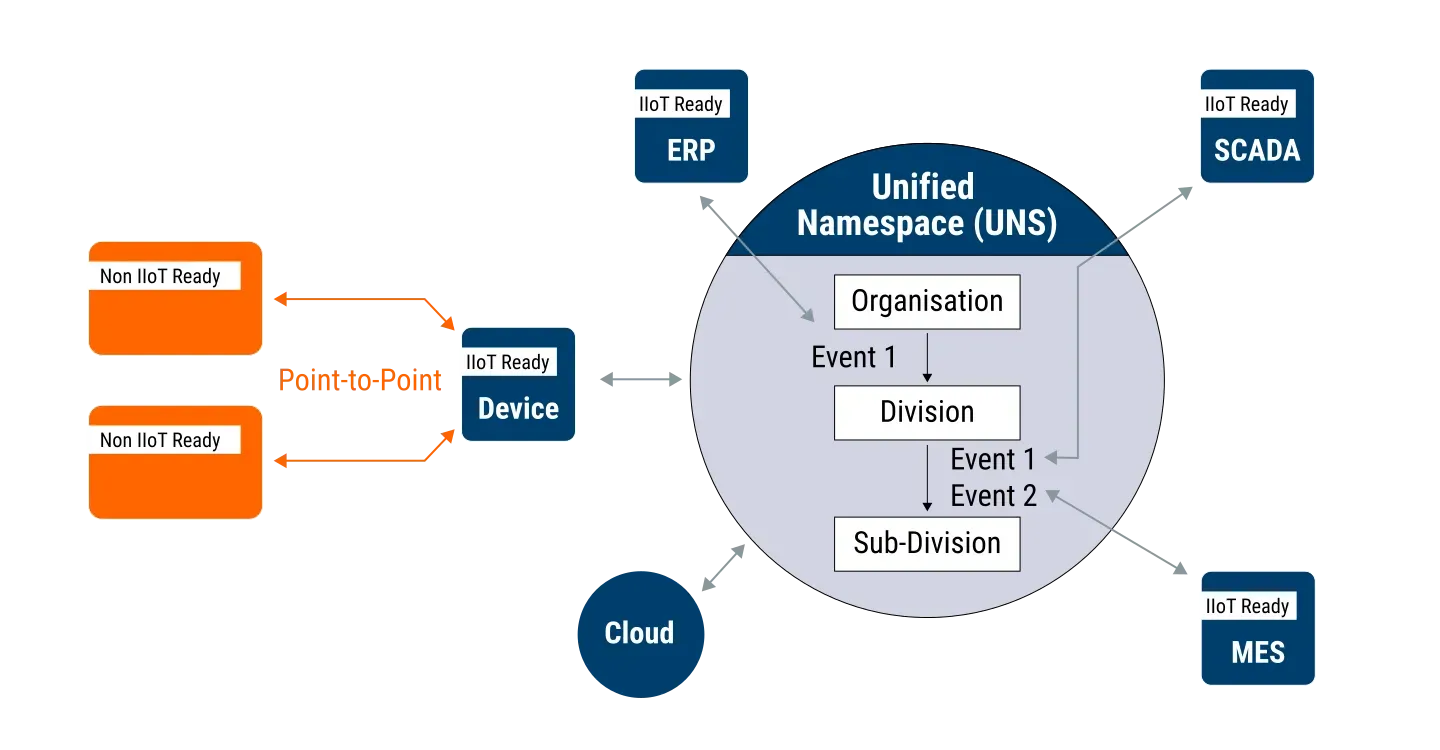 UNS: Single Source of Truth
Why GridDB Cloud
GridDB Cloud is used extensively because it:
- Is optimized for high-ingestion time-series workloads
- Supports long-term historical analysis, essential for predictive maintenance
- Enables real-time + historical querying from the same data store
- Scales seamlessly as machine count and data volume grow
- Fits naturally into UNS and industrial analytics architectures
All raw sensor data, engineered features, anomaly scores, health indices, and predictions are stored as first-class time-series entities in GridDB.
Predictive Maintenance Approach
Parameters Used
- Vibration (RMS, Peak) : primary indicator of bearing and mechanical faults
- Temperature (Motor/Bearing) : thermal stress and lubrication issues
- Current / Power Draw : electrical load, inefficiencies, and degradation
- RPM / Load : operational context to reduce false alarms
Algorithms & Techniques
- Feature engineering on raw time-series signals
- Statistical trend analysis and rolling degradation metrics
- Anomaly detection using Isolation Forest
- Health index and failure probability estimation
- Time-series degradation monitoring for early fault detection
All predictions and health metrics are written back into GridDB for traceability, visualization, and explainability.
RAG-Based Intelligence Layer
Instead of producing black-box alerts, the system uses a Retrieval-Augmented Generation (RAG) approach to explain why an anomaly or prediction occurred.
The RAG layer:
- Retrieves historical machine behavior from GridDB
- Compares current trends with past degradation patterns
- Uses contextual metadata such as operating mode and load
- Generates human-readable, engineering-aligned explanations
Example insight:
“The increase in vibration RMS under constant load conditions matches early stage bearing wear observed previously in similar machines.”
Challenges We Ran Into
- Designing a realistic UNS structure that mirrors industrial deployments
- Avoiding false positives caused by load and speed variations
- Generating believable industrial data for a prototype without live sensors
- Ensuring AI predictions remain explainable and auditable
Accomplishments That We’re Proud Of
- Implemented a true UNS-based architecture, not a tightly coupled pipeline
- Used GridDB Cloud as a core industrial time-series platform, not just storage
- Built a predictive maintenance flow aligned with real industry practices
- Designed dashboards and KPIs that reflect real factory operations
What We Learned
- Predictive maintenance is as much about data architecture as algorithms
- GridDB’s time-series performance is ideal for industrial analytics at scale
- UNS significantly simplifies integration, scalability, and future expansion
- Explainability is critical for real-world industrial AI adoption
What’s Next for the Project
- Integrate live industrial protocols (OPC UA / Modbus)
- Add Remaining Useful Life (RUL) estimation models
- Expand UNS across multiple production lines and assets
- Enable automated maintenance ticket generation
- Integrate explainable AI using RAG instead of opaque alerts
This project demonstrates how GridDB Cloud, UNS, and AI can work together to power the next generation of smart, resilient, and intelligent factories.
Built With
- griddb
- javascript
- mqtt
- node-red
- python
- rag


Log in or sign up for Devpost to join the conversation.