-
-
zephyr-global-hawk
-
architecture
Inspiration
Air resistance affects how efficiently vehicles move, but it is invisible to most people. Understanding it usually means navigating specialist simulation tools, complex settings, and results that can be difficult to interpret.
We wanted to make that process more approachable for automotive designers, engineering students, and small teams exploring new ideas. What if you could describe a design change, see how it affects the vehicle, and understand the aerodynamic prediction in the same workspace?
That idea became Zephyr.
What it does
Zephyr is an aerodynamic design copilot that connects a design idea to a visible, measurable comparison.
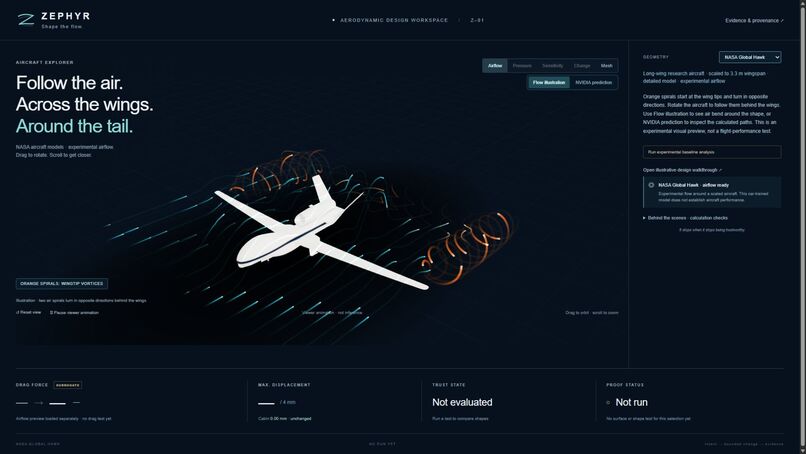
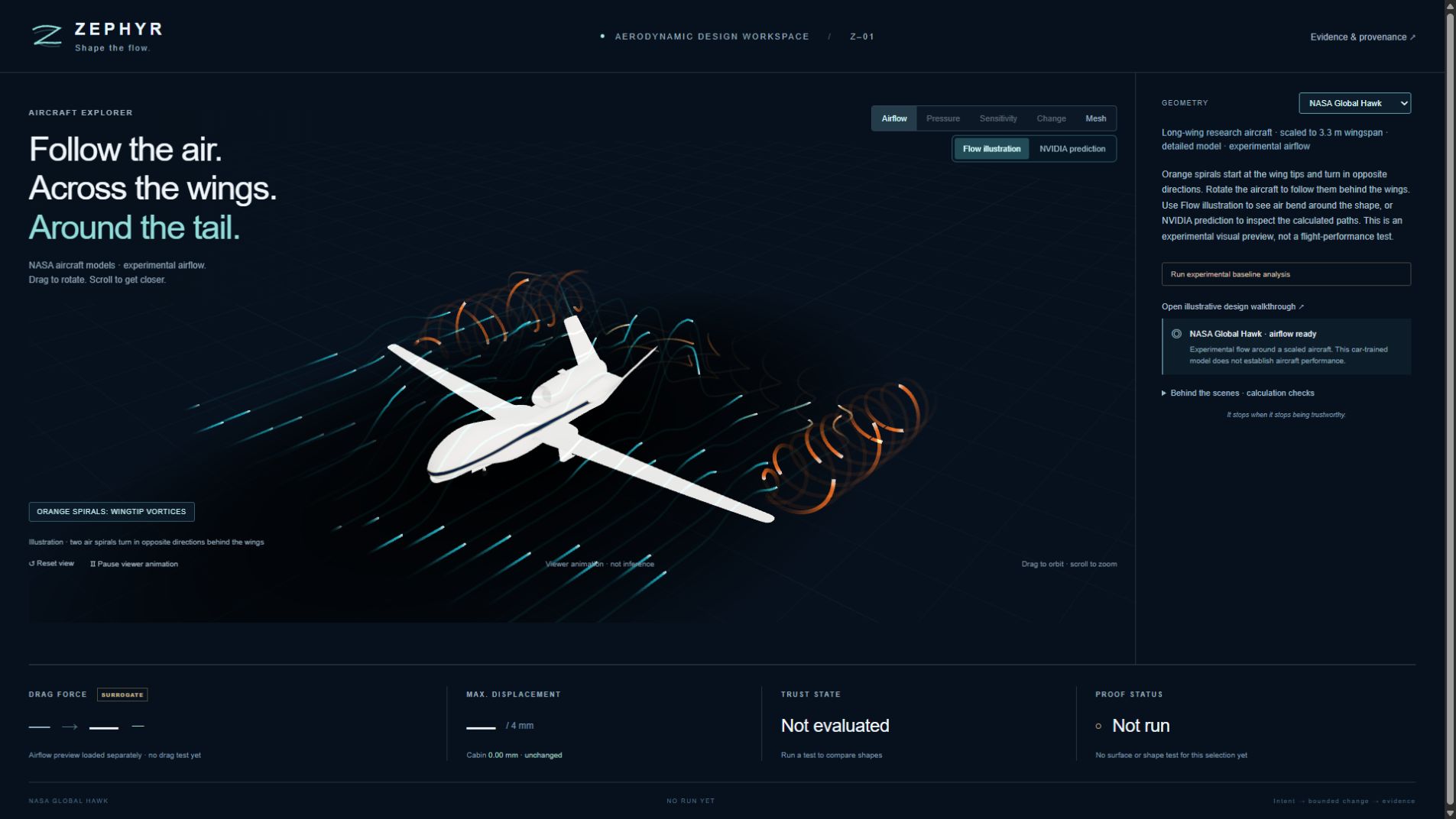
Users can explore cars and aircraft in an interactive 3D viewer, follow airflow around their surfaces, and inspect NVIDIA-predicted fields. For supported car geometries, they can describe a goal, make a controlled shape change, and compare the original and modified designs.
The workflow brings together:
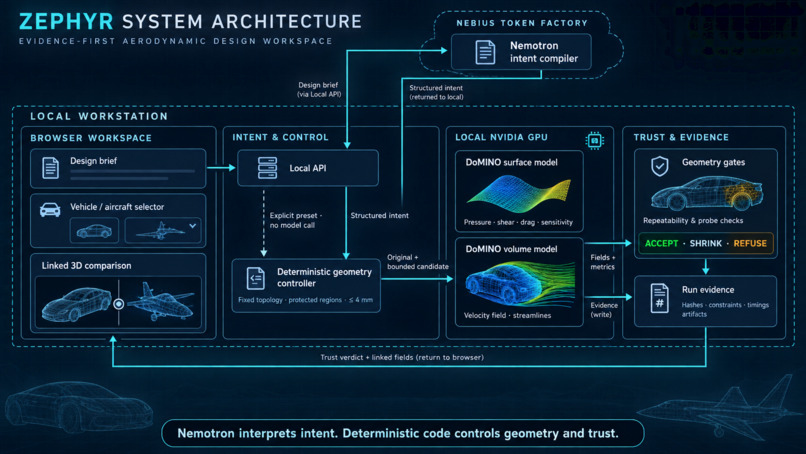
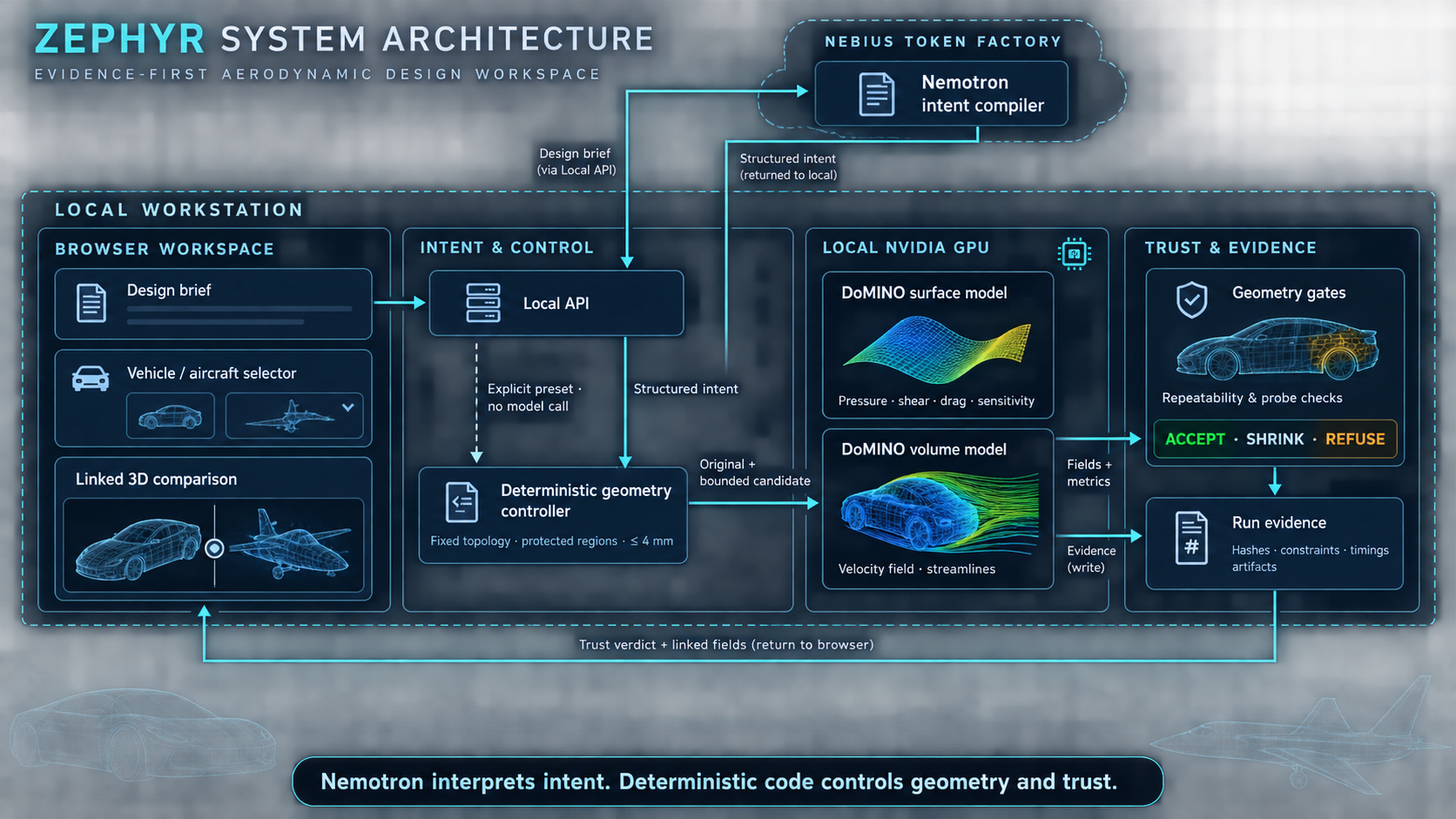
- Natural-language design requests, interpreted by NVIDIA Nemotron served through Nebius.
- Aerodynamic predictions, powered by NVIDIA DoMINO.
- Controlled geometry changes, with protected regions such as the passenger cabin.
- Interactive comparisons of predicted resistance, pressure, sensitivity, and actual surface movement.
- Evidence-based explanations, helping users understand the numbers and what changed.
The full application also includes a bring-your-own-car workflow. Our public demo lets visitors explore completed sessions and a catalog of nine cars and aircraft without installing software.
How we built it
We built a Python backend and a TypeScript frontend using Three.js for interactive 3D visualization.
NVIDIA DoMINO supplies the aerodynamic predictions. Its surface model predicts pressure and wall shear, which we use to calculate aerodynamic forces. A separate volume model predicts velocity around the geometry, allowing us to visualize the surrounding airflow.
NVIDIA Nemotron, served through Nebius, connects natural-language requests to the application’s supported design operations and explains results using recorded evidence. NVIDIA provides both the physics models and language reasoning, while Nebius provides the Nemotron serving layer that makes the conversational workflow possible.
Geometry changes are handled by deterministic code. We constrain movement, preserve protected regions, check the resulting mesh, and evaluate the modified shape separately.
We also built a static replay mode for GitHub Pages. It packages completed results, saved explanations, and visualization assets so anyone can explore the project without backend access or API credentials.
Challenges we ran into
One challenge was keeping the visual experience connected to the actual calculation. A smooth animation is useful, but users also need to know which shape was evaluated, what the colors represent, and how much the geometry really moved.
We separated illustrative airflow from model-predicted velocity, kept original and modified results distinct, and made display enlargement explicit.
Another challenge was connecting language models to geometry safely. A request such as “reduce drag while keeping the cabin unchanged” must become a controlled operation. We used Nemotron to interpret intent, then relied on deterministic geometry code and checks to execute it.
Large meshes and result files also made browser performance and deployment challenging. We reduced display geometry while retaining full-mesh force calculations, compressed saved results, and adapted the application to work under a static hosting path.
Accomplishments that we're proud of
We built an end-to-end workflow connecting natural-language intent, controlled geometry changes, NVIDIA aerodynamic predictions, and understandable explanations.
One recorded design comparison produced a 3.33% reduction in predicted drag force, from 621.70 N to 600.97 N, while keeping the protected cabin unchanged.
We are also proud of the interactive original-versus-modified comparison, the synthetic hood-dent demonstration, the car and aircraft catalog, and the downloadable evidence that makes results inspectable.
Most importantly, Zephyr is something people can use and explore, with a working application, a complete video demonstration, and a public interactive demo.
What we learned
We learned that making engineering AI useful requires more than connecting a model to a viewer. Geometry, units, constraints, model inputs, and explanations must agree throughout the workflow.
We also learned the value of giving each component a clear responsibility. Nemotron interprets and explains. Deterministic code controls geometry. DoMINO predicts aerodynamic behavior. Recorded evidence connects the result back to its source.
Good visualization makes complex engineering easier to understand, especially when users can inspect the original shape, the changed shape, and the corresponding fields themselves.
What's next for Zephyr
We want to make Zephyr more useful for real design iteration by:
- Comparing promising candidates against independent CFD results.
- Expanding supported geometries and improving the custom-car import workflow.
- Making repeated design comparisons faster and easier to navigate.
- Extending Nemotron’s ability to explain tradeoffs across multiple candidates.
- Improving load times and offering a hosted workflow for running new evaluations.
Our goal is to help more people move from “I wonder if this shape would work better” to an aerodynamic comparison they can see, understand, and investigate.

Log in or sign up for Devpost to join the conversation.