Inspiration
Scams on social apps don't succeed because of clever hacking. They succeed because someone is rushed, trusting and alone with a message: a "friend" who needs the 6-digit code, a "support" account that wants your password, a prize that only needs a small fee. We noticed that nearly all safety advice for teens is a poster, a video or a multiple-choice quiz, and none of those build the instinct to pause when it's actually happening on your own phone. We wanted people to fall for a scam once in a safe place, so they don't fall for it for real.
What it does
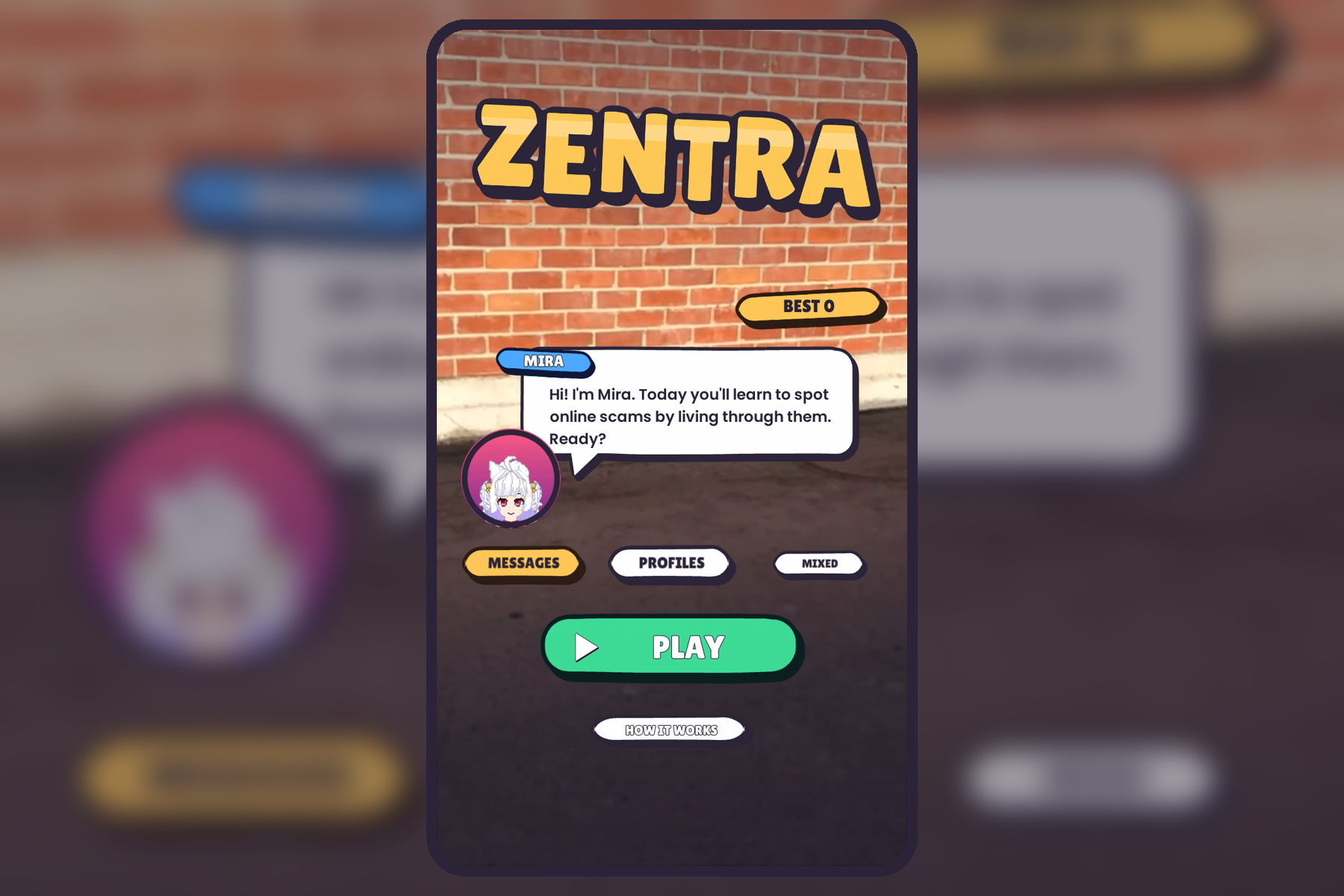
ZENTRA is a Snapchat Lens that turns scam awareness into a short story you play in your own room.
- Mira, a 3D anime guide, stands in your real room. You tap the floor or a table and she appears there through AR. She talks with lip-sync, blinks and changes expression, and her speech bubble follows her.
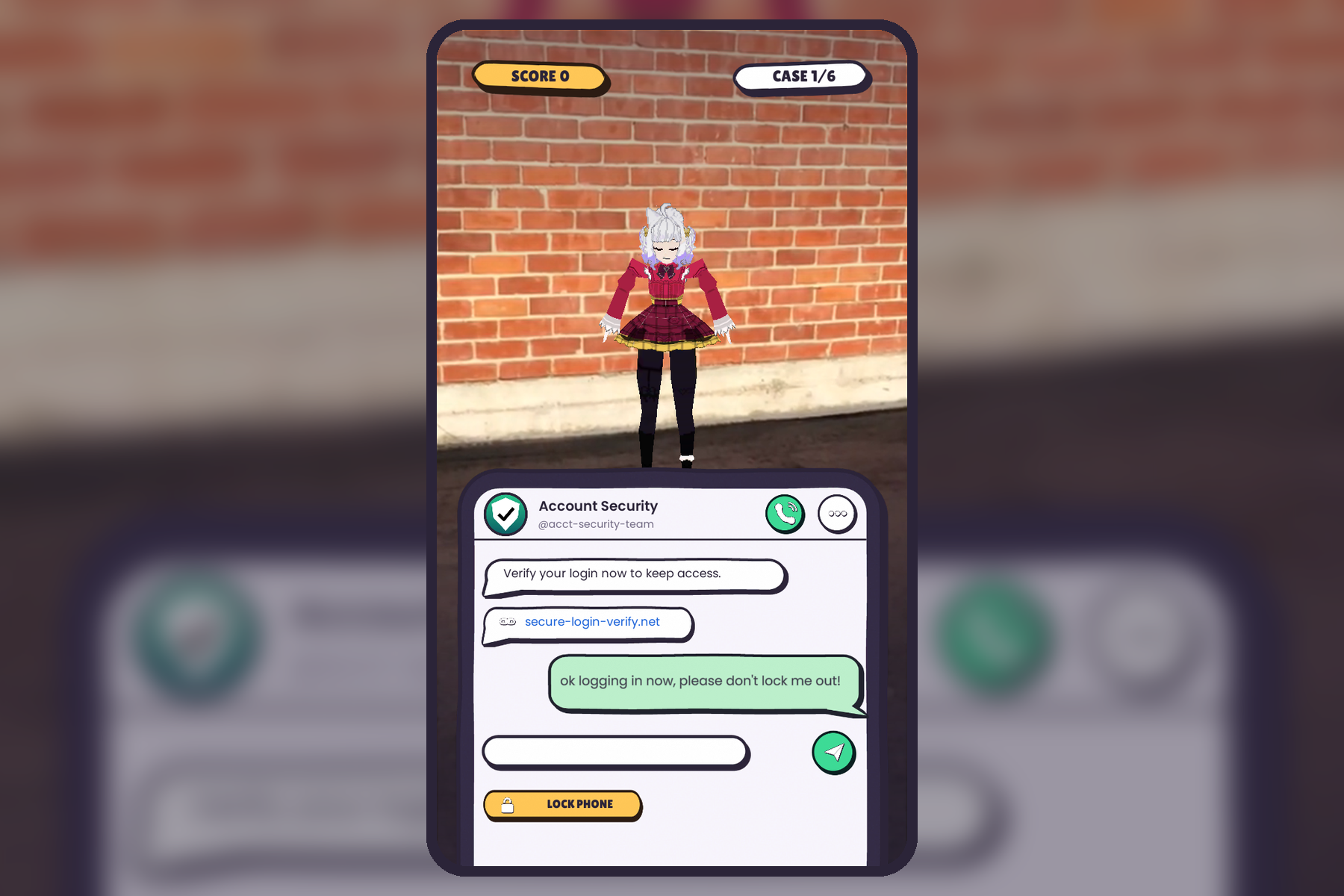
- A scam arrives on a simulated phone. It might be a fake giveaway, a cloned friend asking for a login code, a "support" account, a suspicious payment request or a fake prize.
- You react the way you really would. There are no A/B/C/D options. You press Send, tap the link, tap the avatar to inspect the profile, press the call button to verify, open the "..." menu to report or block, or lock the phone to ignore it. If you hesitate, the scammer gets pushier, just like real life.
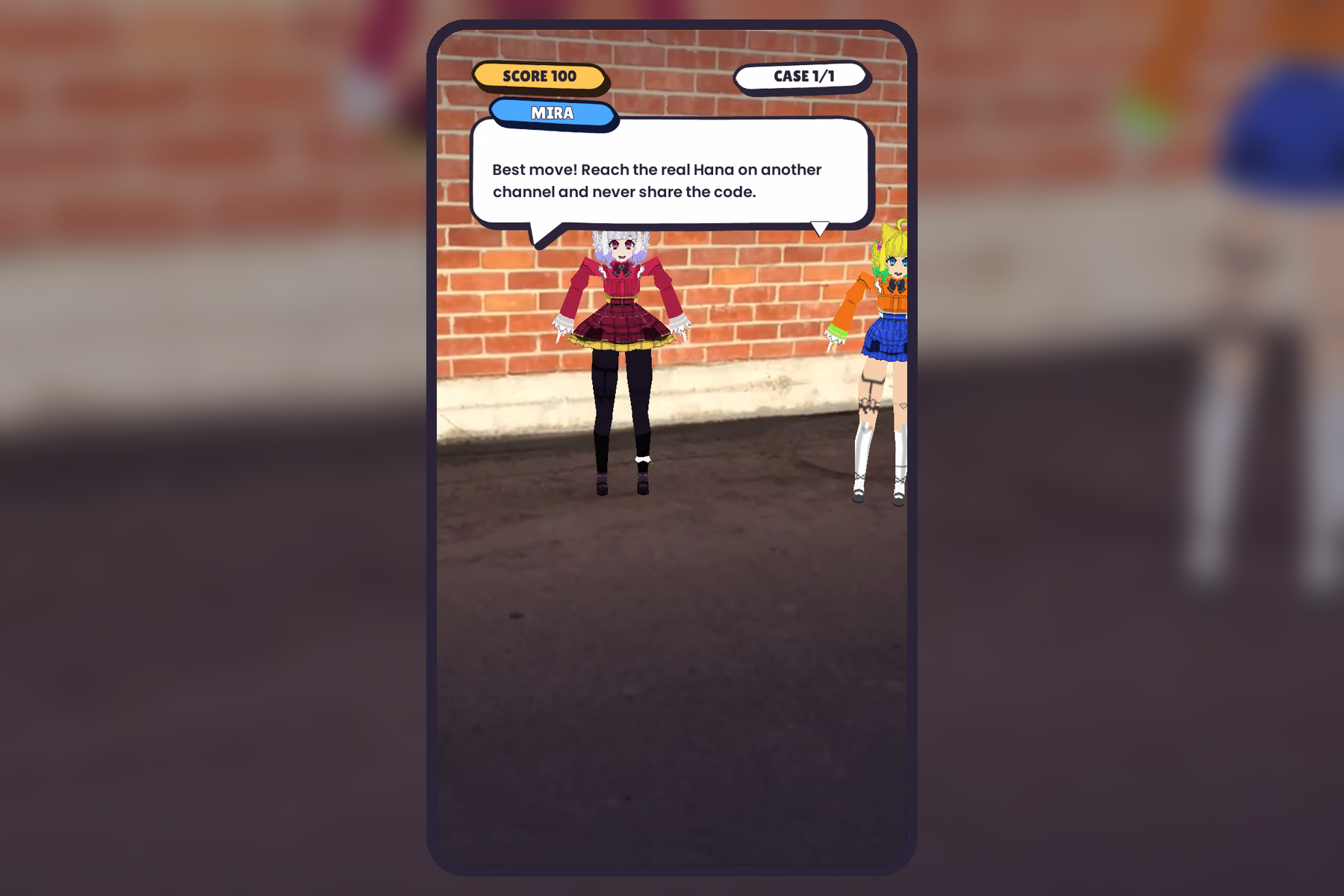
- You see the consequence. Trusting a scam gives a "SCAMMED!" stamp, a screen shake and a shocked Mira. Calling the real person makes that friend appear in AR next to Mira and say "I never sent that!" A correct call gets confetti.
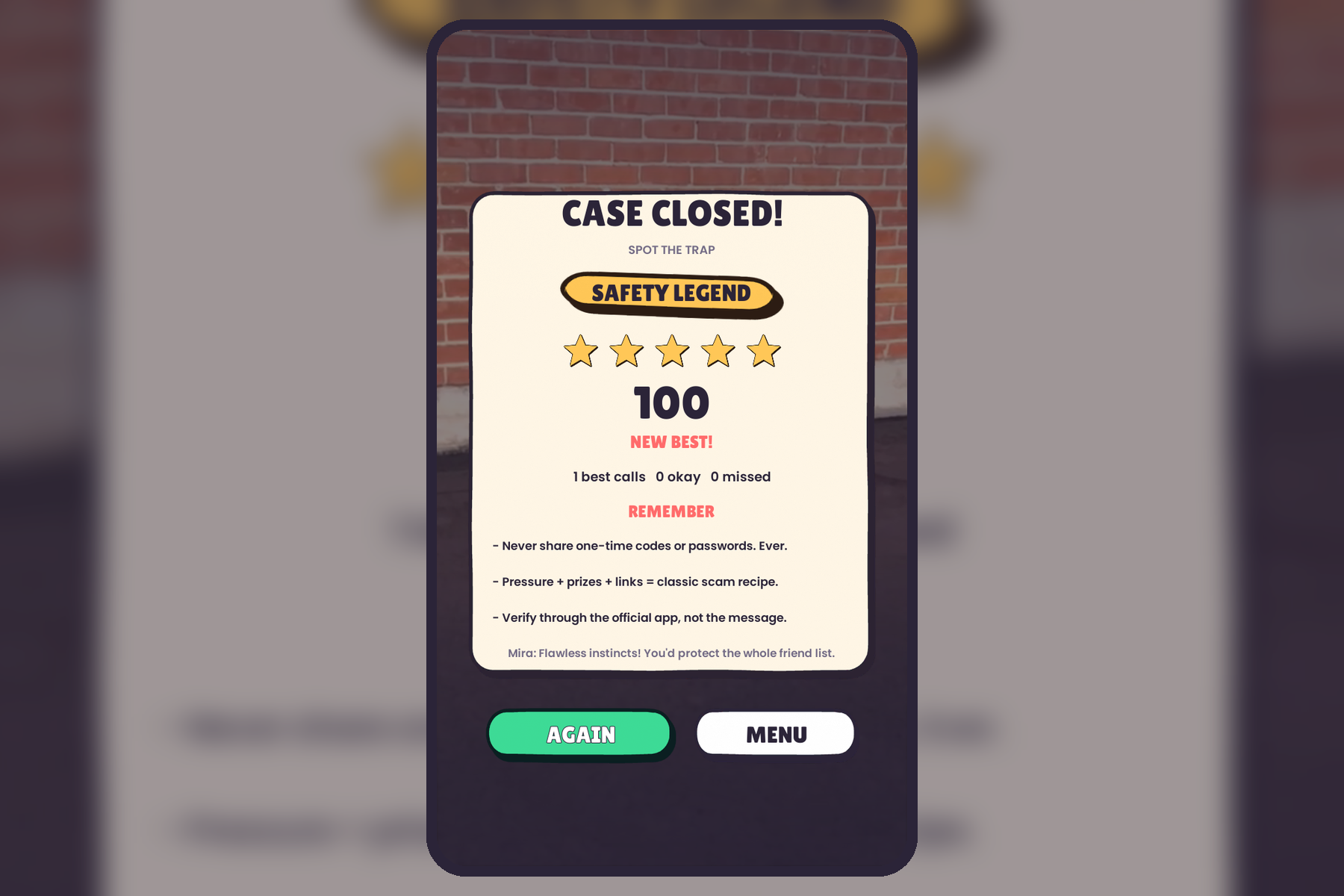
- Then Mira explains. She covers why it was a scam, the red flags to look for, the safer move and one lesson to remember.
- Not everything is a scam. Some cases are genuinely safe (a real friend, a verified brand), and reporting those counts as a false alarm, so players learn to stay alert without being paranoid.
It has 17 fictional cases across three chapters (Messages, Profiles and Mixed), with difficulty rising as you go. You also get a score, a streak, a rank, a "remember" list and a saved best score. It has a looping soundtrack, a distinct sound for every button, and a ringing phone for the call.
Safer outcome example: a "friend" asks for your login code from a 2-day-old account with a slightly different handle. You inspect the profile, call the real friend, and learn it wasn't her. The lesson is never to share one-time codes.
Limitation: it teaches patterns from 17 scripted, synthetic cases. It cannot detect real scams, and it never reads real Snapchat messages or accounts.
How I built it
- Snapchat Lens Studio 5.23 with TypeScript for the game, with a world-tracked AR camera on the rear camera and a separate Screen UI camera.
- A small UI toolkit written from scratch for runtime-built menus, tweens, touch hit-testing and a 9:16 safe frame that adapts to any phone shape, plus best scores stored with the Lens persistent storage.
- Blender 5.3, run headless from scripts, to pose the anime characters and render them.
- 3D characters with a custom face system: the models are static meshes, so we swap the eye and mouth textures at runtime (14 mouth shapes for lip-sync and 10 eye expressions for blinking and moods) on an unlit, alpha-tested toon material, and add bounce and sway for life.
- Python (Pillow and NumPy) generators for the hand-made "sticker" UI textures (wobbly ink outlines, hard shadows, paper grain) and for every sound effect and the background music, with no stock assets.
- Clean separation of content and logic: scenario data and story extras are separate from the state-machine controller, the view layer and the character rig, so adding a new scam case is a data change.
Challenges I ran into
- Nothing showed in the preview. The template's scene output was a render target, so cameras drawing to the screen never appeared. Assigning that target to both cameras fixed it.
- A stale-reference crash. Destroyed chat bubbles stayed registered in the text system and froze the whole game loop on the next layout. We added proper cleanup and made tweens survive destroyed targets.
- Black silhouettes. Imported 3D characters rendered black because they needed lighting, so we rebuilt them on an unlit toon material with runtime-swapped faces.
- A compile error from leftover starter packages blocked script inputs until we removed them.
- It looked "AI generated". Our first neon dashboard look felt generic, so we threw it away and rebuilt everything in a flat, outlined, hand-lettered style.
- Teaching without quiz buttons. We had to turn four safety actions into natural phone actions (send, call, report/block, lock) that each produce a believable consequence.
Accomplishments that I am proud of
- A full playable loop in AR: place Mira, get a scam, act, see the consequence, get taught, see your rank.
- Characters that talk, blink and react, and a second 3D character that appears in your room when you call the real friend.
- Learning by experience: there is no quiz screen anywhere in the game.
- A distinctive hand-made look, and a fully custom audio layer (music, a different sound for every button, and a ringing phone) built from code.
- Everything is synthetic and safe: no real accounts, links or data.
What I learned
- People remember a scam they "fell for" in a safe sandbox far better than a rule they read, so the consequence matters more than the explanation.
- In Lens Studio, project-level settings such as the render output matter as much as code, and a tight loop of changing a script, previewing, and checking logs catches problems fast.
- Small details carry a lot of personality: a blink, a typed-out message and a ringing phone made a safety lesson feel like a story.
- Good safety teaching also needs "this one is fine" cases, otherwise players just learn to distrust everything.
