-
-
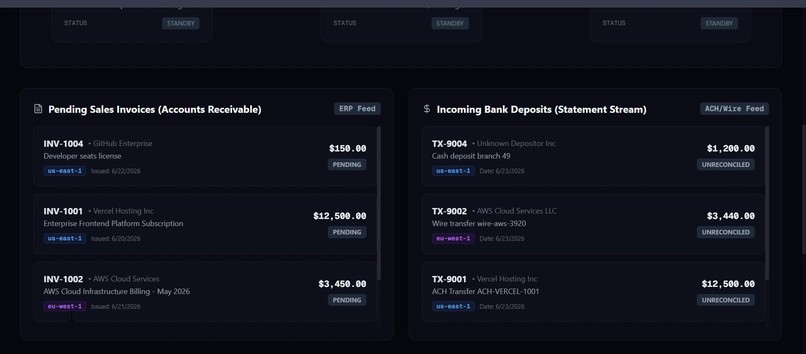
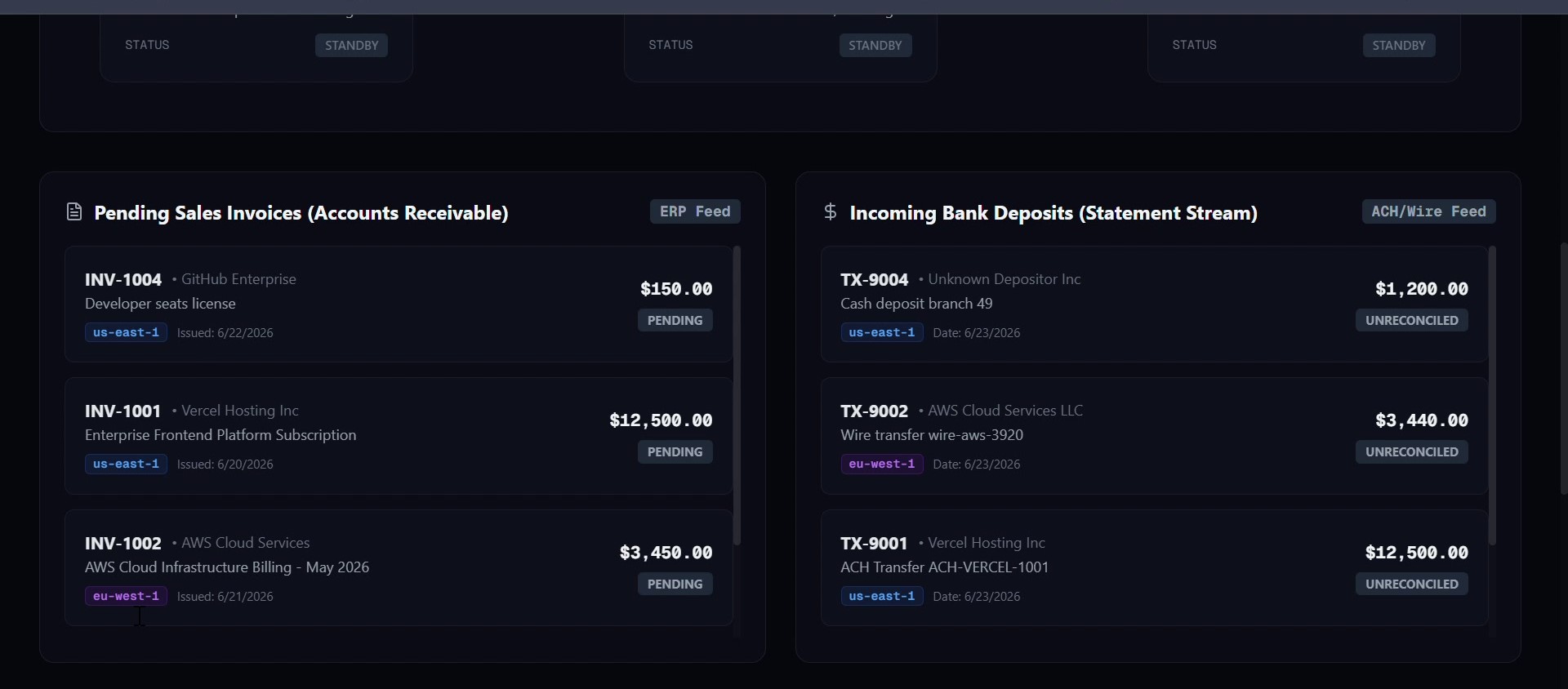
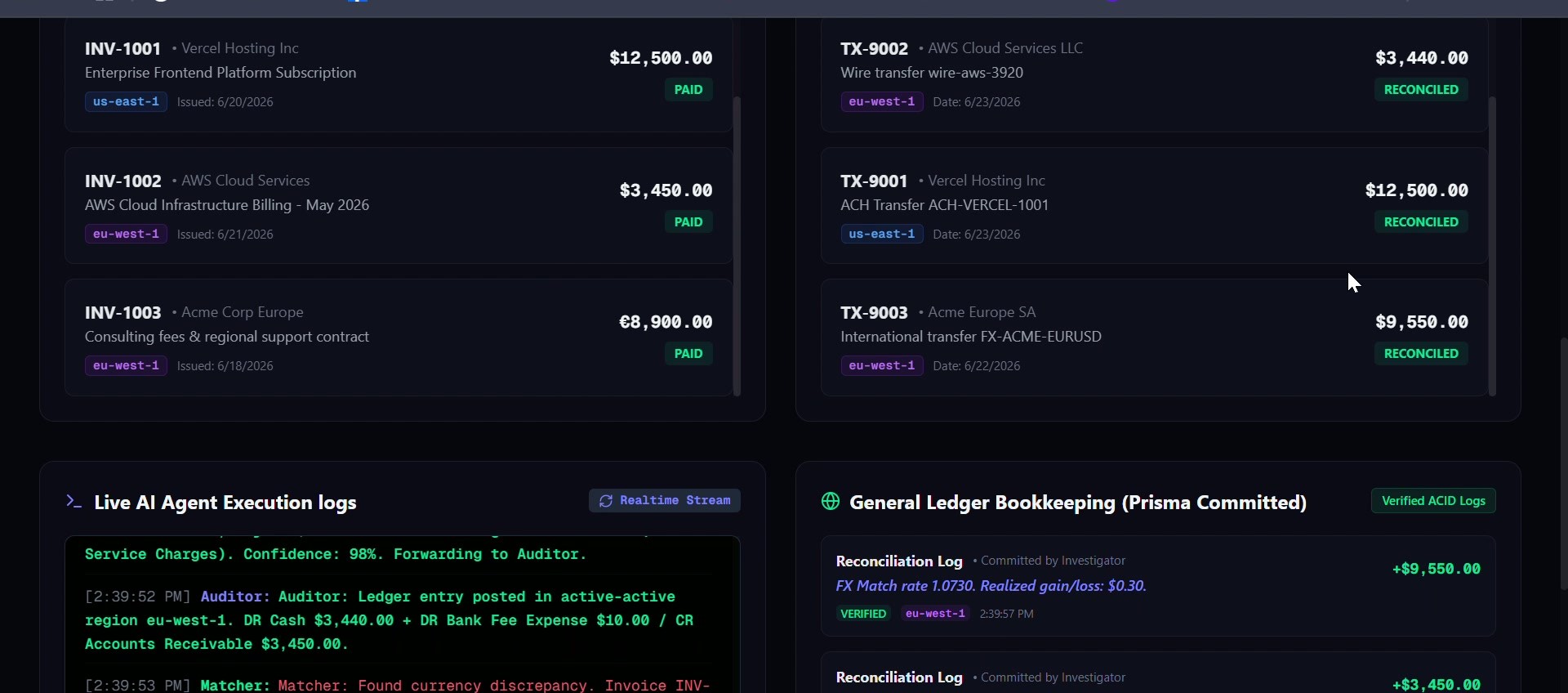
Initial Feed: Displays the ledger state showing incoming sales invoices and unreconciled bank deposits before reconciliation starts.
-
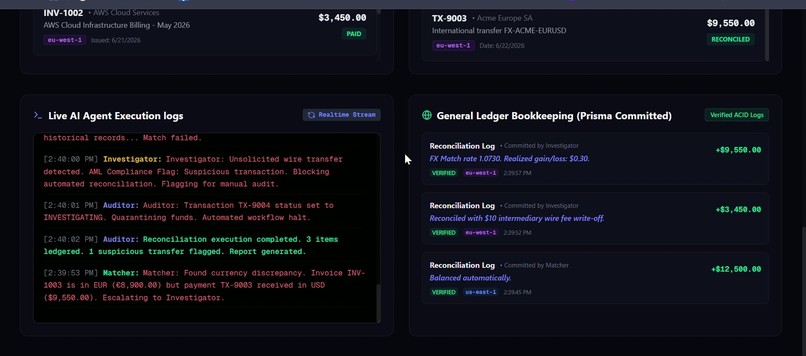
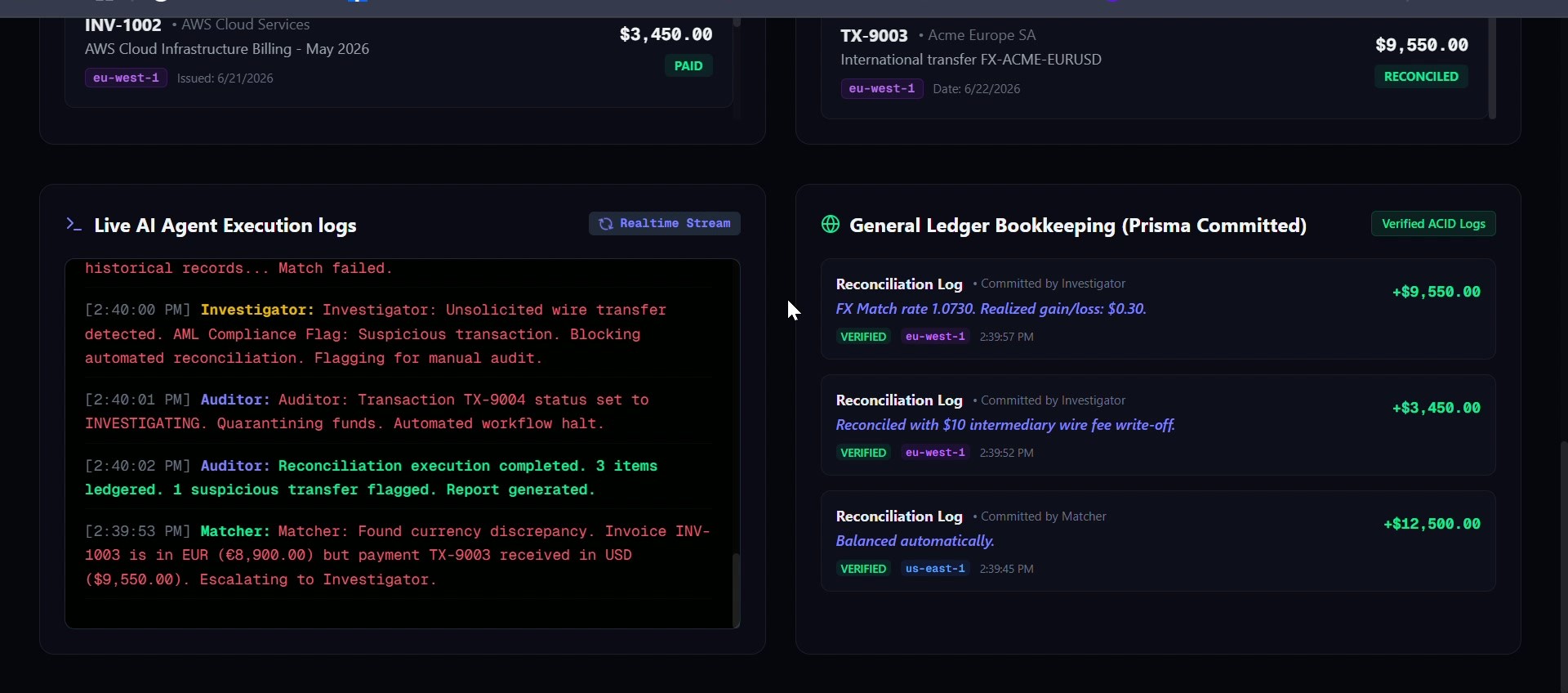
Live AI Agent Logs: Matcher and Investigator agents resolving discrepancies, currency conversions, and AML quarantine flags.
-
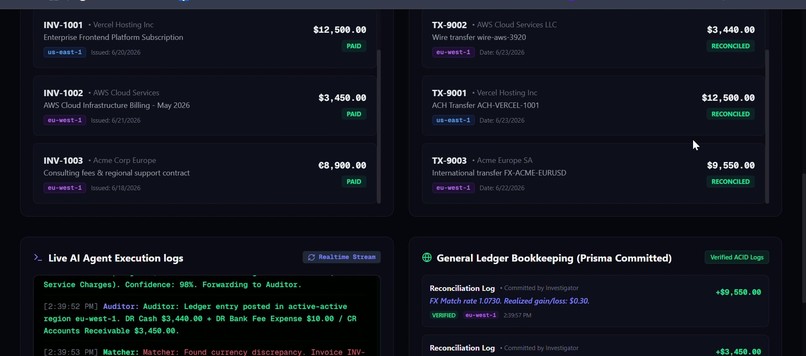
Reconciled Bookkeeping: General ledger showing ACID-compliant double-entry commits across multi-region AWS DSQL shards.
Inspiration
Corporate treasury and ledger reconciliation are traditionally manual, slow, and error-prone. Multinational enterprises face huge operational overhead reconciling accounts across different regional entities, dealing with fluctuating currency rates (FX variances), wire transfer fees, and strict AML (Anti-Money Laundering) regulations. We wanted to build an autonomous, zero-friction, and globally consistent solution.
Zenith Treasury demonstrates how a modern B2B application can automate complex double-entry bookkeeping using an active-active, globally replicated relational database (AWS Aurora DSQL) combined with a collaborative, multi-agent AI system.
What it does
Zenith Treasury streams incoming bank statements and ERP sales invoices, processing them through a multi-agent AI mesh:
- Matcher Agent identifies matches. If the amount, currency, and metadata match perfectly, it signs off. If it detects a discrepancy, it flags the transaction and hands it off to the Investigator.
- Investigator Agent resolves edge cases: it parses wire transfer descriptors to identify and write off intermediary bank fees, converts cross-border currencies (using real-time ECB rates) to account for FX variances, and checks unsolicited deposits for compliance, quarantining suspicious funds.
- Auditor Agent validates the double-entry accounting records, signs the transactional commits, and writes the ledger entries to AWS Aurora DSQL shards in
us-east-1(Virginia) oreu-west-1(Dublin).
How we built it
- Frontend: Next.js (App Router, Tailwind CSS, Lucide Icons) deployed on Vercel with Edge runtime optimizations.
- Database Engine: AWS Aurora DSQL (Distributed SQL) serving as a single, globally replicated active-active relational database.
- ORM & Connection: Prisma v7 ORM configured with
relationMode = "prisma"and@prisma/adapter-pg. - Security & IAM Auth: Short-lived tokens signed dynamically using
@aws-sdk/dsql-signerto authenticate thepg.Poolconnection adapter without static passwords. - Real-time Logs: Next.js Server-Sent Events (SSE) API to stream agent-to-agent logs directly to a high-fidelity glassmorphic dashboard terminal.
Challenges we ran into
- DSQL Indexing Constraints: Aurora DSQL does not support synchronous secondary unique indexes. We resolved this constraint by moving unique checks to the application and repository layer logic.
- Relation Handling: Aurora DSQL distributes data across global shards and does not enforce traditional foreign keys at the storage level. We configured Prisma's
relationMode = "prisma"to manage relations at the client ORM level. - IAM Token Connection Pool: Since DSQL doesn't use passwords, we had to implement a custom asynchronous token generator in our pool connection configuration to refresh the IAM signature dynamically.
Accomplishments that we're proud of
- Designing a system that works locally out-of-the-box (using a smart seeded in-memory state engine) and escalates to a live AWS cloud database as soon as the
DATABASE_URLenvironment variable is defined. - Creating a visually stunning, premium-grade dashboard utilizing dark mode, glassmorphism, and live glowing neon state-lights representing active agent statuses.
- Implementing a Server-Sent Events (SSE) pipeline that streams real-time, multi-agent discussions as they resolve variances and record ACID-compliant double-entry ledger items.
What we learned
- How to connect Node.js application runtimes to passwordless AWS Aurora DSQL databases using
@aws-sdk/dsql-signer. - How to model database schemas under distributed SQL environments where foreign keys are managed at the client layer.
- How to structure multi-agent systems where LLMs collaborate to perform structured bookkeeping tasks and ensure audit-ready ledger consistency.
What's next for Zenith Treasury
- Integration with standard ERP system webhooks (such as NetSuite, SAP, and QuickBooks).
- Expanding the agent mesh with a Forecasting & Liquidity Agent to predict cash runway and treasury health.
- Integration with open banking APIs (Plaid/Yodlee) for automated, live bank statement feeds.
Built With
- amazon-web-services
- aws-aurora-dsql
- next.js
- node.js
- postgresql
- prisma
- react
- tailwindcss
- typescript
- vercel
- vercel-ai-sdk

Log in or sign up for Devpost to join the conversation.