
Inspiration
Zenith started with a simple thought: how could my parents reduce their electricity bills, and would installing solar panels actually be worth it for them?
What sounded like a straightforward question quickly became much more complicated. I wanted to know how many solar panels would be needed, how much the installation would cost, how long it would take to recover the investment, what government subsidies were available, and what the savings might look like over the next 20 years.
The information existed, but it was scattered across different tools, calculations, policies, and assumptions. I began wondering whether these questions could be brought together into one connected experience.
That idea gradually grew into Zenith. What started as a personal attempt to understand whether solar could make sense for my own family expanded into exploring rooftop feasibility, subsidy estimates, long-term financial projections, and eventually how decentralized homes could participate in optimized community energy systems.
Zenith was inspired by the idea of turning one ordinary question about my parents' electricity bill into a clearer journey from solar planning to smarter energy decisions.
What it does
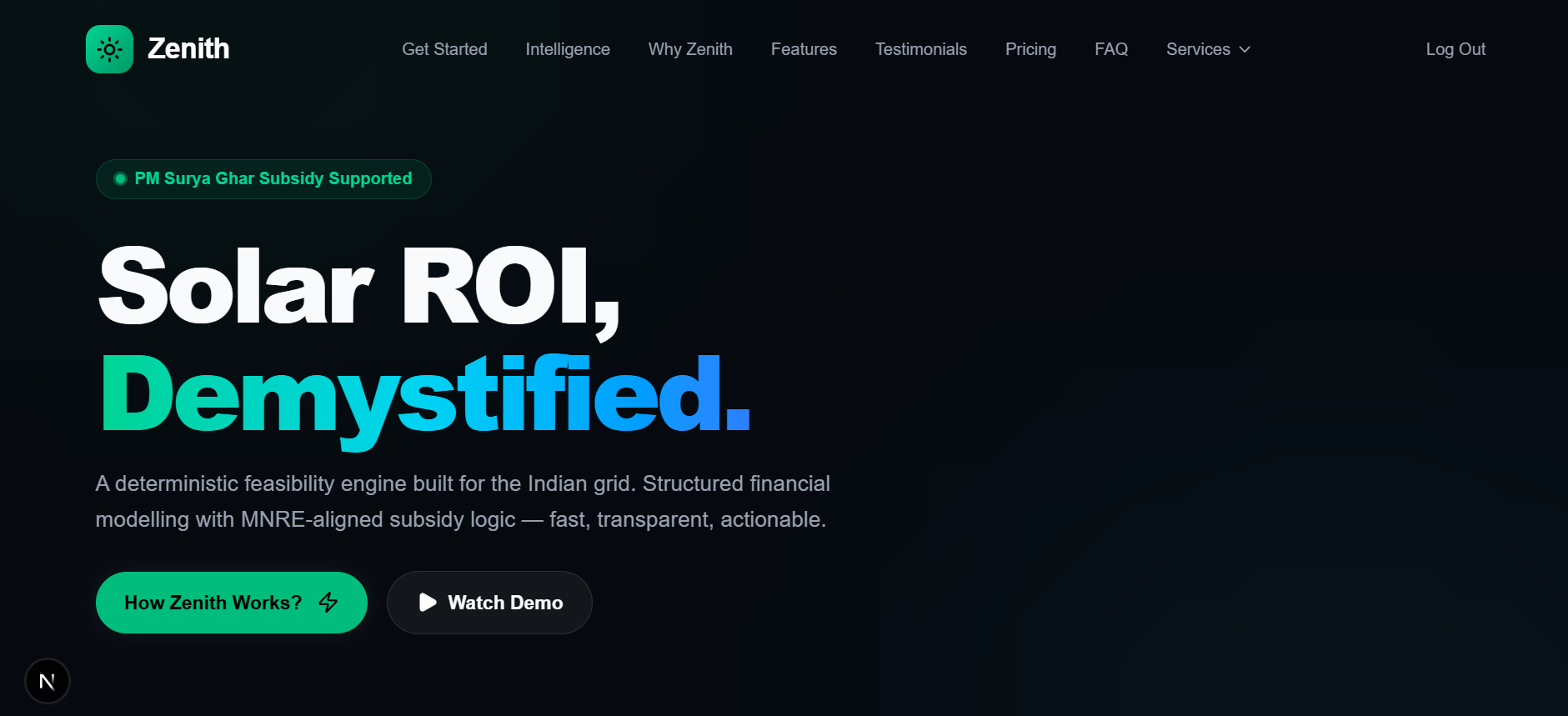
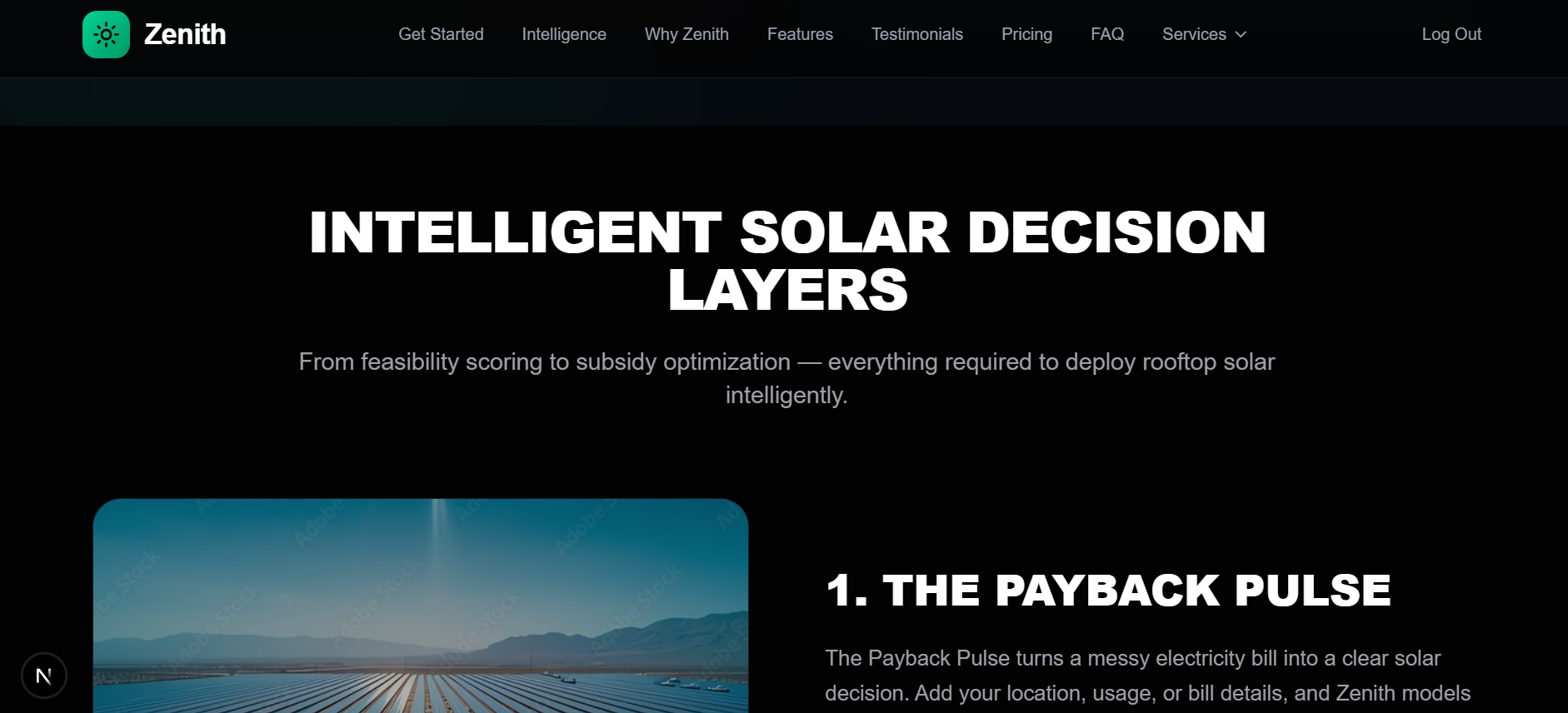
Zenith is a full-stack solar intelligence platform that transforms rooftop solar planning from a scattered guessing game into a connected decision journey. It helps users move from first curiosity to practical feasibility, subsidy estimation, long-term financial forecasting, rooftop capacity analysis, and neighborhood-scale energy coordination.
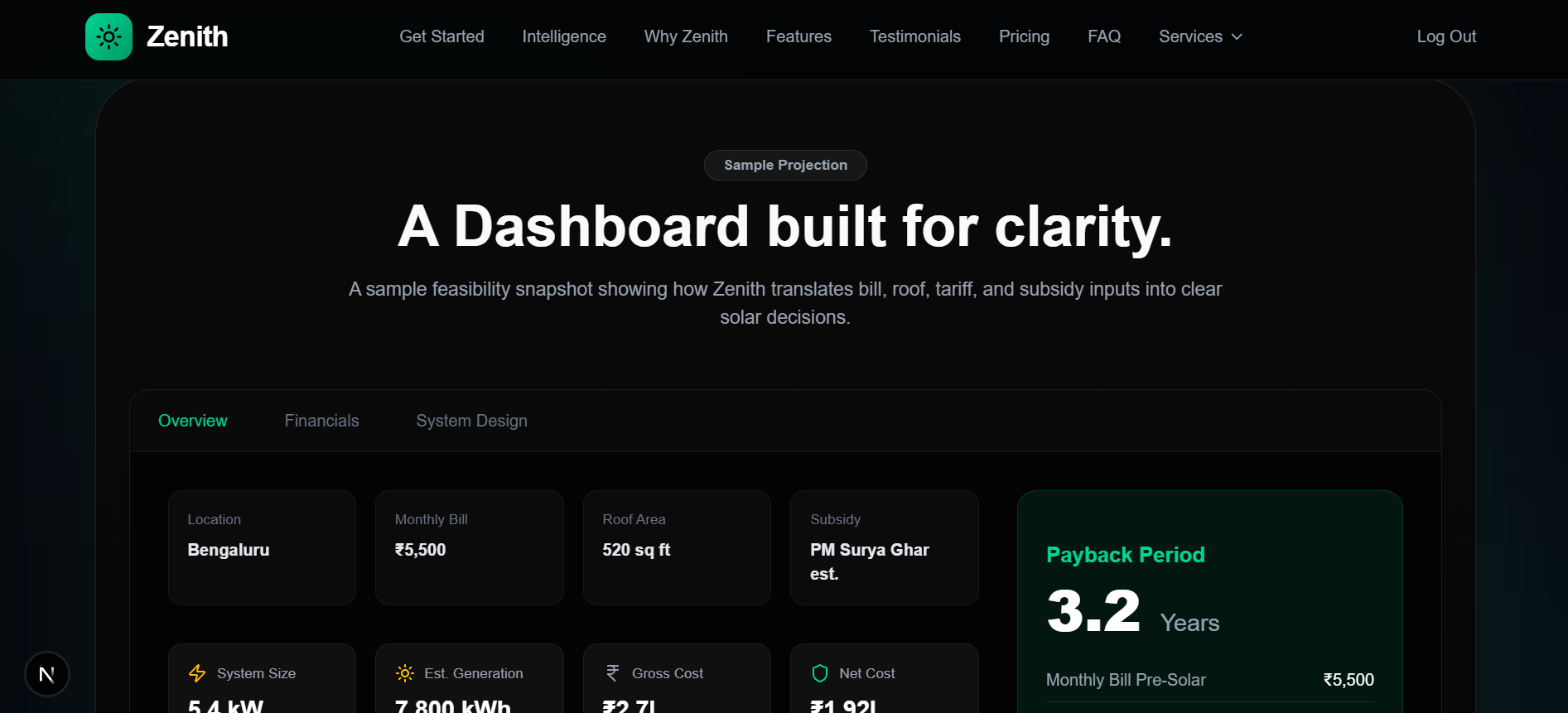
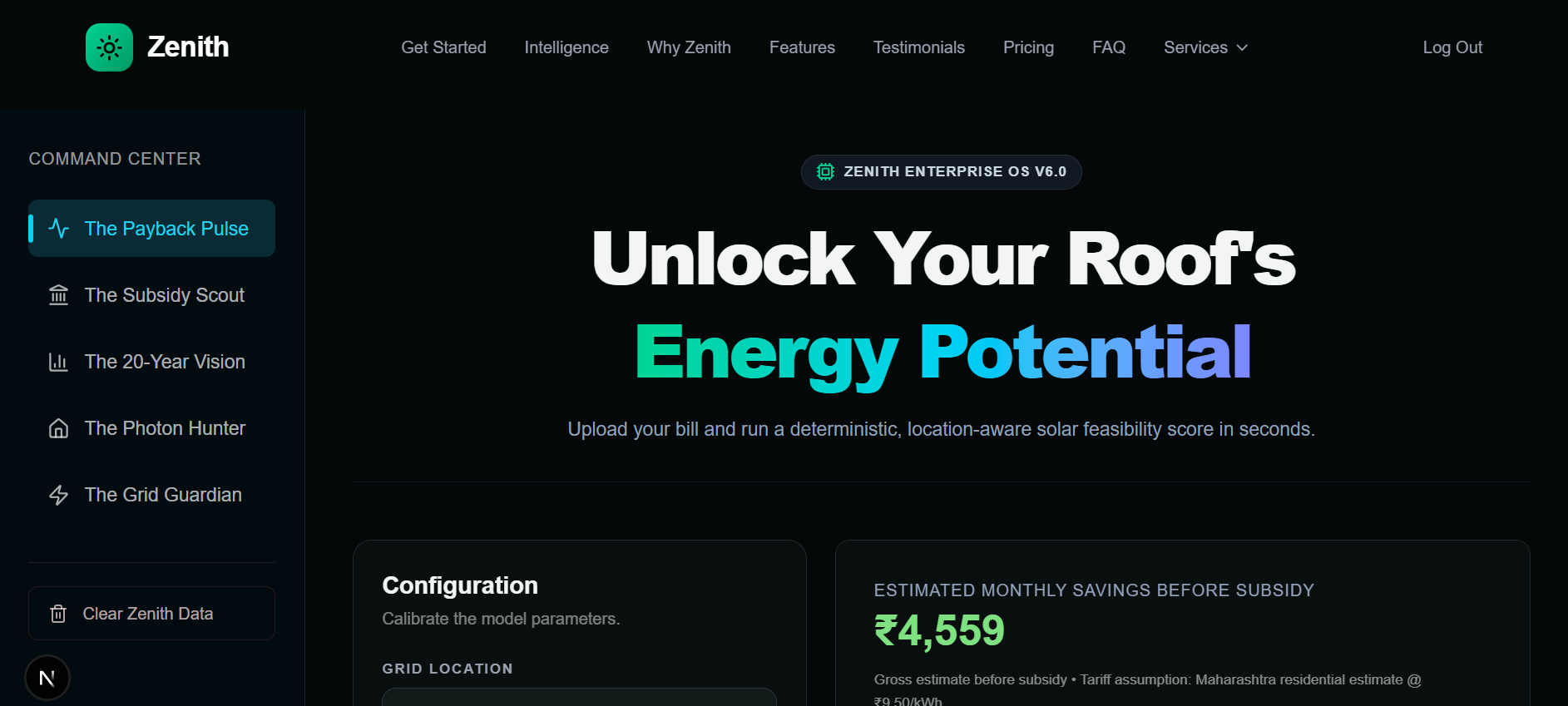
The Payback Pulse evaluates whether rooftop solar makes financial and technical sense for a user's home. Using location, electricity bill inputs, and solar-climate data, it estimates system size, installation cost, expected generation, monthly savings, payback period, and overall feasibility.
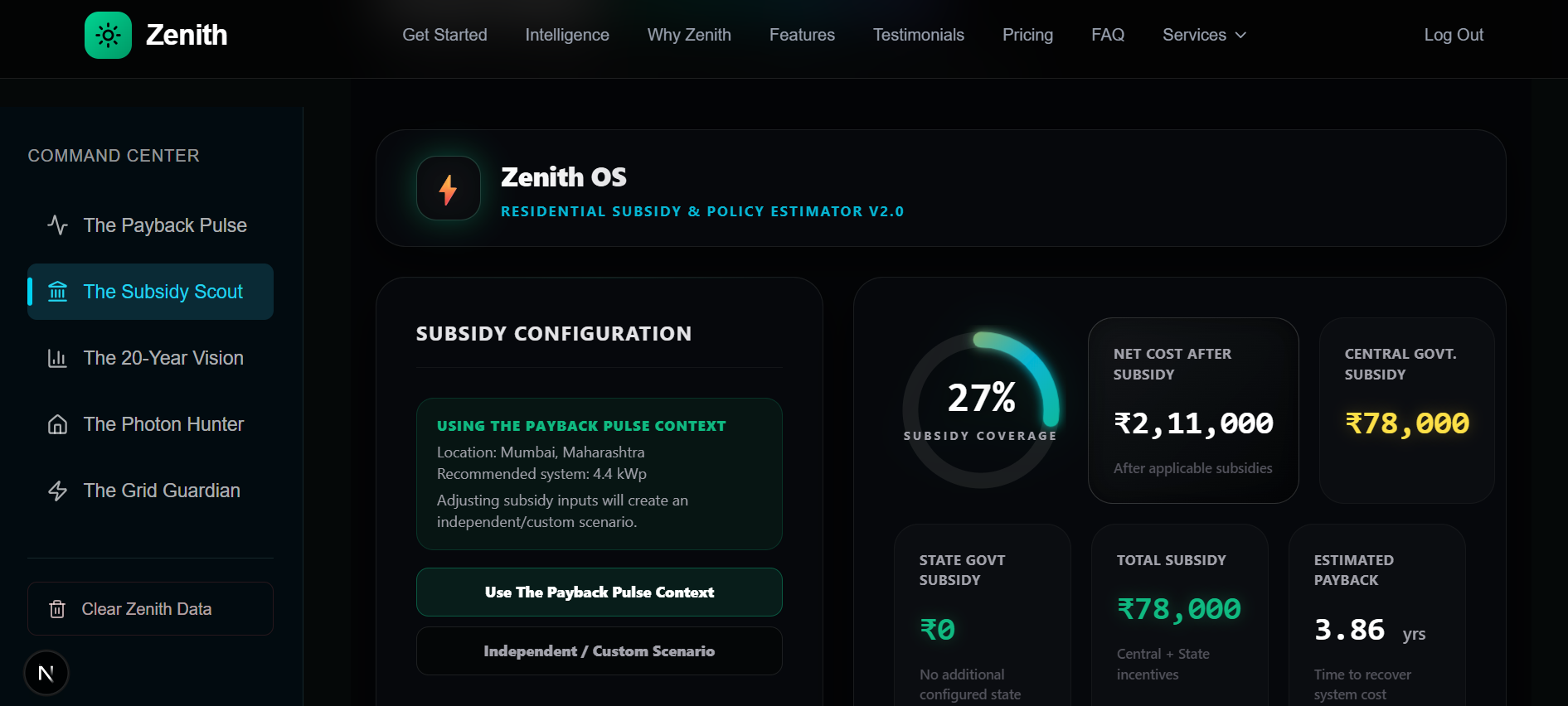
The Subsidy Scout brings policy incentives into the decision. It estimates how central and selected state-level solar subsidies can reduce upfront installation costs, allowing users to compare project scenarios using imported Zenith project context or independent custom inputs.
The 20-Year Vision expands the decision beyond the first installation quote. It models solar as a long-term infrastructure investment, projecting savings, tariff escalation, maintenance, degradation, payback, and cumulative returns across two decades.
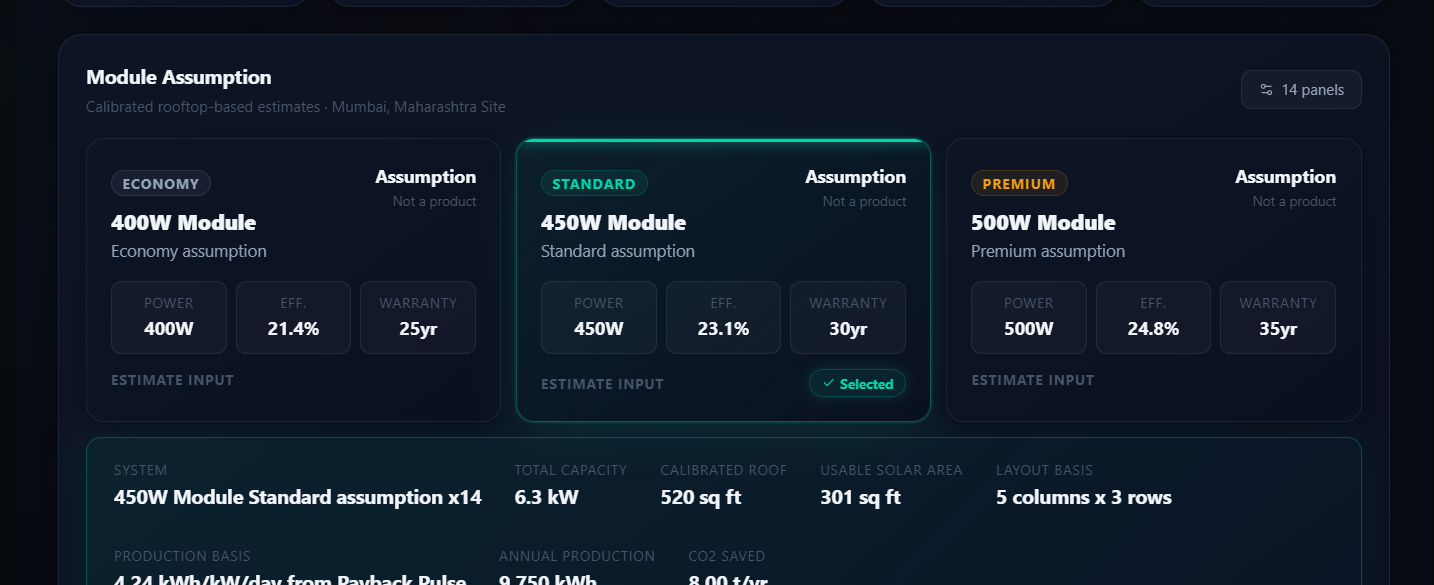
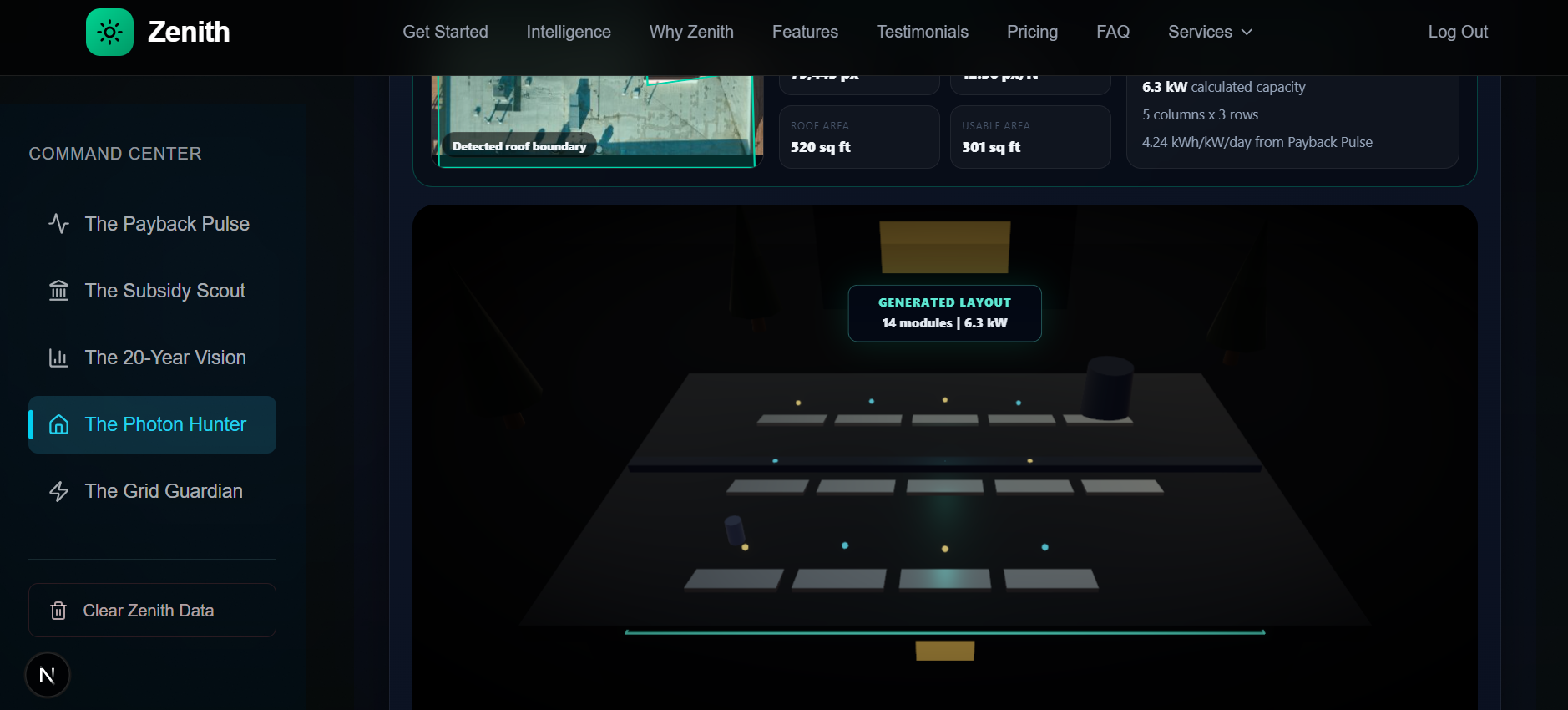
The Photon Hunter is an experimental computer-vision prototype that turns rooftop imagery into actionable solar potential. By analyzing an uploaded rooftop photo and using user calibration, it estimates rooftop area, possible panel layout, system capacity, energy generation potential, and environmental impact. Because rooftop detection depends heavily on image quality and visual conditions, its image-analysis and layout results should be interpreted as feasibility estimates rather than precise engineering measurements.
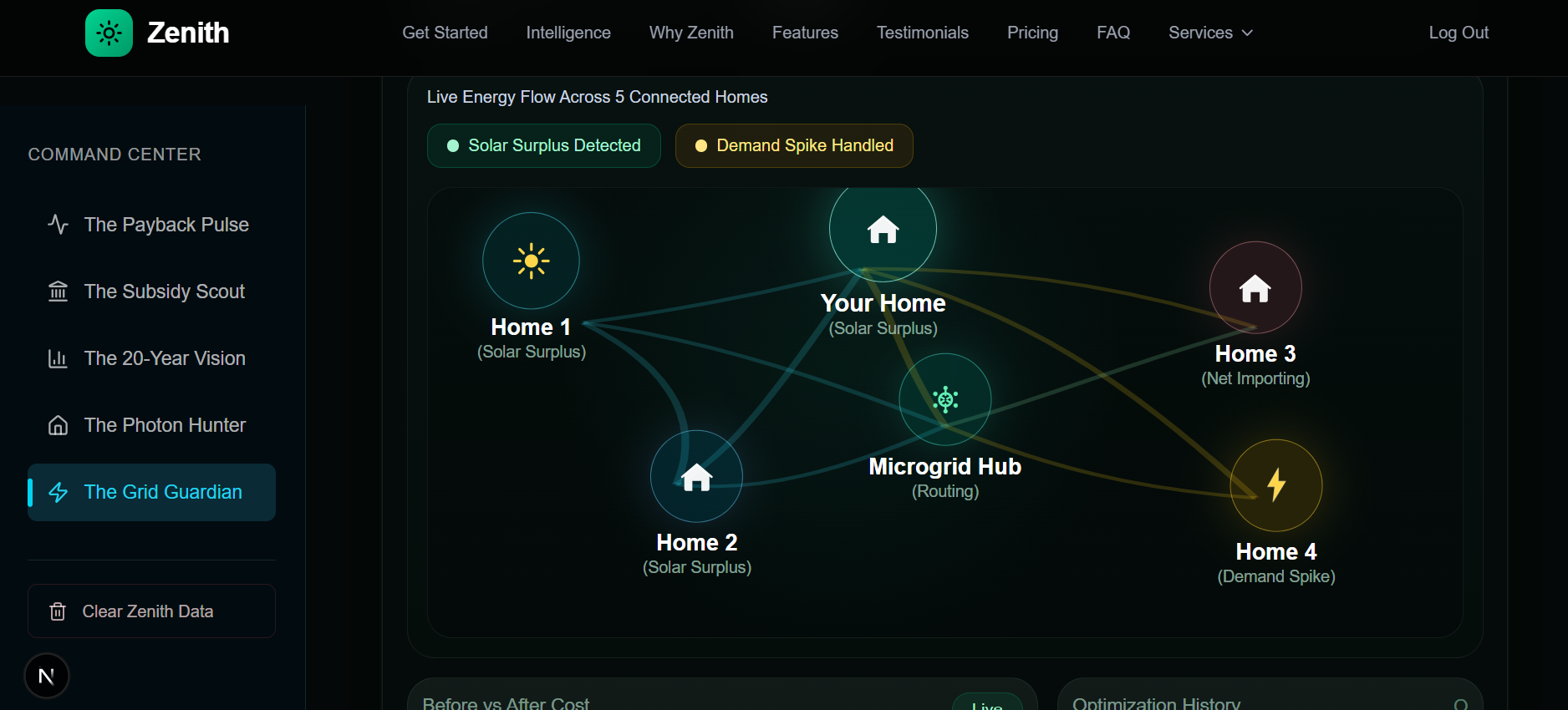
The Grid Guardian, powered by Zenith's Lumen Logic engine, explores what happens after individual solar adoption becomes a connected energy network. Using deterministic linear-programming optimization with PuLP, it simulates a five-home microgrid and compares how coordinated energy sharing can reduce costs, balance demand, and make better use of local solar generation.
Together, Zenith connects the full rooftop solar journey: from "Does solar make sense for me?" to "What will it save?", "What will fit on my roof?", "What support can I get?", and ultimately, "How could my home participate in a smarter decentralized grid?"
How we built it
Zenith was built as a full-stack web application using Next.js, React, TypeScript, and Tailwind CSS. The project is structured as a connected five-service system, where validated project context can flow between services while each service can still operate independently.
Solar Intelligence and Financial Modeling
The Payback Pulse combines user inputs with external solar and climate data from NASA POWER. Location is resolved through curated Indian locations with geocoding fallback, while the user's monthly electricity bill is used to estimate consumption and system requirements. Zenith then applies transparent models for solar production, tariff estimation, system sizing, installation cost, savings, payback, maintenance, and degradation.
For bill uploads, Gemini is used to extract the monthly payable amount and populate the bill input. The calculation engine then uses that value in the same modeling pipeline as manually entered bills.
Subsidy and Long-Term Projection
The Subsidy Scout uses deterministic, configurable models to estimate Indian central and selected state-level residential rooftop solar subsidies. Users can build on their existing Zenith project context or explore an independent custom scenario by changing jurisdiction, system size, and battery capacity.
The 20-Year Vision extends these calculations into a long-term projection using assumptions for tariff escalation, solar degradation, maintenance inflation, inverter replacement, and discounted cash flow. Context validation ensures subsidy-adjusted values are only applied when they are compatible with the underlying project.
Rooftop Image Analysis
The Photon Hunter uses a Next.js API route and Python/OpenCV pipeline to analyze uploaded rooftop images. The image is processed using techniques including grayscale conversion, Gaussian blur, Canny edge detection, morphology, and contour analysis to identify a potential rooftop boundary.
The user then calibrates the image by selecting two points with a known real-world distance. This produces a pixels-per-foot scale that converts the detected pixel area into an estimated real-world rooftop area. That area feeds into usable-area calculations, panel count, system capacity, expected generation, and an estimated 3D feasibility layout.
Photon Hunter is currently an experimental prototype and remains one of the areas requiring further refinement. Rooftop detection and 3D layout generation can vary depending on image quality, viewing angle, shadows, lighting, and rooftop complexity.
Microgrid Optimization
The Grid Guardian is powered by Lumen Logic, a Python optimization engine built using PuLP and the CBC solver. It models a five-home microgrid and optimizes energy sharing based on solar generation, demand, battery capacity, grid energy prices, and peer-to-peer energy prices.
The frontend visualizes solver outputs as network energy flows, cost comparisons, grid imports, and optimization results. Users can run the simulation independently or explicitly import validated Zenith project context for the Reference Home.
Data Integrity and Connected Services
A major part of the build was making the services work as one system without forcing the user through a rigid sequence. Valid completed project data is persisted locally and shared only when it passes validation checks. Users can move between services through the sidebar, use imported context where relevant, or create independent scenarios.
We also built safeguards for changing or clearing project data, preventing incomplete or stale calculations from being treated as valid downstream results. Clear Zenith Data provides a single way to reset user-generated project data while preserving built-in demo scenarios and application settings.
Challenges we ran into
One of the biggest challenges was turning five complex services into one connected product without making the user experience feel rigid. Zenith needed services to share useful project context while still allowing users to explore each one independently. We had to design validation and persistence rules so incomplete, stale, or incompatible calculations would not silently affect downstream services.
For example, changing a location or electricity bill in The Payback Pulse should not allow outdated results to remain active as the current project. Similarly, The Subsidy Scout needed to distinguish between a scenario genuinely based on Payback Pulse context and an independently customized scenario. We also had to ensure that a subsidy result from one jurisdiction could not be applied to a project from another location in The 20-Year Vision.
Photon Hunter presented a different kind of challenge. Detecting a rooftop from user-provided media with traditional OpenCV techniques depends heavily on image quality, angle, lighting, shadows, and visual complexity. We initially experimented with video analysis, but sampled video frames produced inconsistent results. We adapted the experience toward rooftop photo analysis, where users can choose clearer imagery and manually calibrate the detected roof area. Rather than presenting the resulting 3D view as an exact reconstruction, we reframed it as an estimated feasibility layout and made the workflow clearer: image analysis, user calibration, usable-area estimation, panel layout, and solar potential.
Grid Guardian required balancing realism with the constraints of a hackathon project. We wanted genuine optimization rather than a hardcoded simulation, so we integrated PuLP and CBC to solve the microgrid energy-allocation problem. At the same time, we had to keep the system understandable, responsive, and clearly framed as a simulation rather than a live energy-control platform.
Another challenge was deciding where real data ended and modeled estimates began. Zenith combines external solar and climate data, user-provided information, AI-assisted bill extraction, deterministic financial models, and optimization-based simulation. Making those distinctions transparent was important to us, especially for a decision-support product dealing with financial and energy estimates.
Overall, the biggest challenge was not building five separate features, but making them work together as a coherent system while preserving data integrity, transparency, and independent usability.
Accomplishments that we're proud of
We're proud that Zenith grew from a simple question: could solar reduce a household electricity bill? It evolved into a connected platform for solar feasibility, subsidies, long-term planning, rooftop analysis, and microgrid simulation.
One major accomplishment was making five services work independently while still sharing validated project context. The Payback Pulse, The Subsidy Scout, and The 20-Year Vision use provenance and compatibility checks so stale or mismatched data does not flow downstream.
We're also proud that Zenith uses real computation instead of static demo outputs: NASA POWER solar data, AI-assisted bill extraction, deterministic financial models, Python/OpenCV rooftop analysis, and PuLP/CBC microgrid optimization.
Photon Hunter was especially meaningful because it turns an uploaded rooftop image and user calibration into estimated roof area, panel capacity, solar potential, and a 3D feasibility layout.
Most importantly, Zenith became more than five separate features. It became one coherent decision-support journey for understanding rooftop solar and its role in a smarter decentralized energy future.
What we learned
The biggest lesson I learned was simple: don't leave important things until the last minute.
While building Zenith, I realized that taking things too leisurely during the day often meant working late into the night when I should have been sleeping. A project like this takes more time than expected, especially when features break, integrations behave differently than planned, or testing reveals issues near the end.
I also learned the importance of leaving enough time for testing, polish, and improvements instead of treating them as final-minute tasks.
Next time, I would start earlier, work more consistently, and avoid turning nights meant for rest into coding sessions.
What's next for Zenith: Solar-to-Grid Intelligence Platform
Zenith is currently a working prototype. Its models are useful for decision support, but real-world deployment would require deeper validation, richer datasets, installer feedback, policy updates, and expert review.
Beyond the hackathon, I would like to continue developing Zenith into a more accurate and practical solar intelligence platform, potentially as a startup with support from people experienced in solar energy, engineering, data, finance, and business.
The next step would be improving the accuracy of feasibility estimates, expanding subsidy and tariff coverage, strengthening rooftop analysis, and making the microgrid simulation more realistic.
The long-term goal is to evolve Zenith from a student-built prototype into a platform that helps households make better solar decisions and eventually supports smarter, decentralized energy networks.
Login Credentials Email: [email protected] Password: zenith123
Built With
- cbc-solver
- computer-vision
- google-gemini
- linear-programming
- nasa-power
- next.js
- opencv
- pulp
- python
- react
- tailwind-css
- typescript

Log in or sign up for Devpost to join the conversation.