Inspiration
Solar adoption is often presented as a simple question: How many panels do I need?
In reality, it is a chain of difficult decisions.
A user may discover that their location has strong solar potential but still not know whether the investment is financially worthwhile. A business may understand the long-term economics but struggle to navigate incentives and subsidies. Even after installation, the real challenge becomes operational: how should solar, battery storage, and grid energy work together to reduce cost and improve resilience?
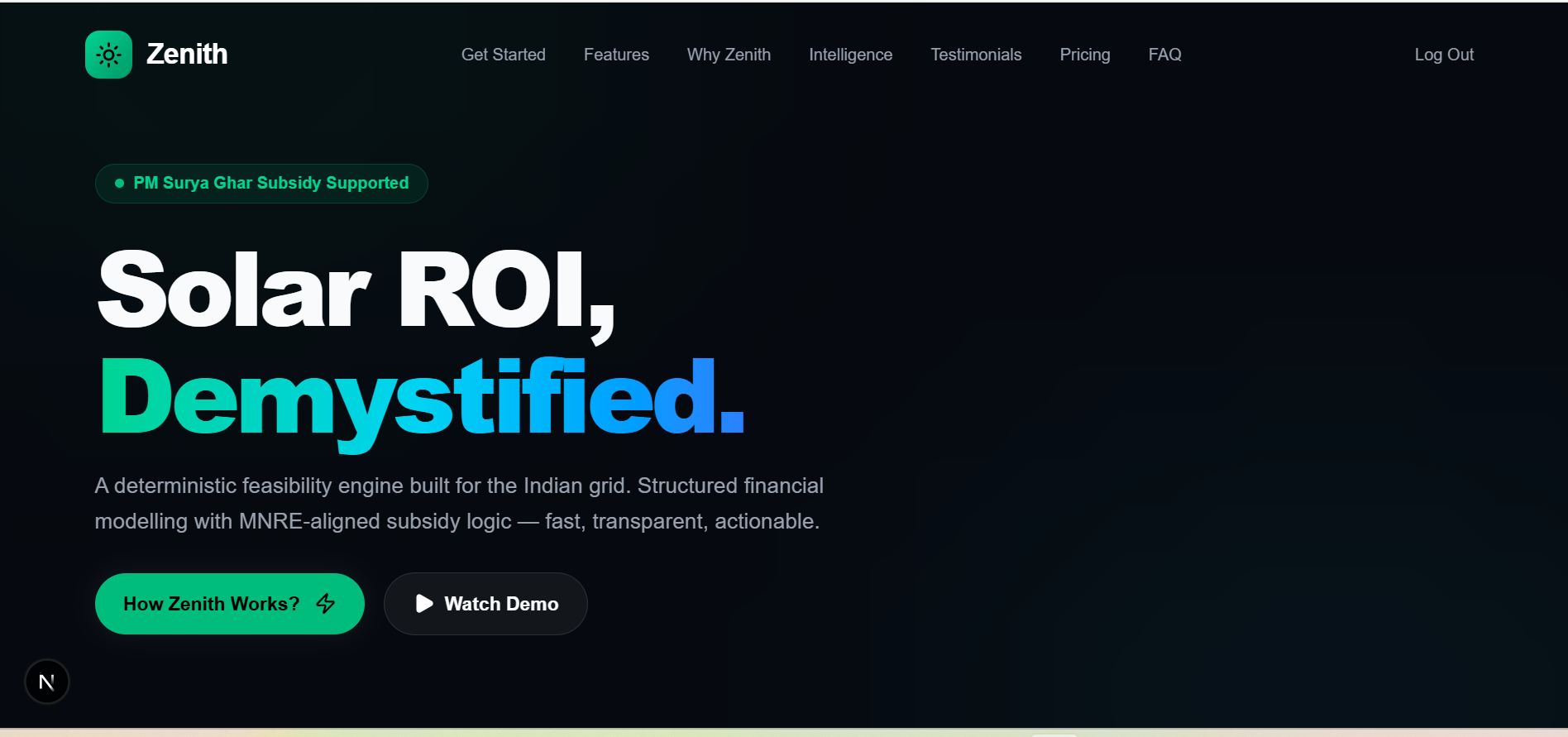
We built Zenith: Solar-to-Grid Intelligence Core to connect these fragmented decisions into one intelligence system.
Our goal was not to build another solar calculator. We wanted to build a system that follows the actual journey from:
"Can solar work here?" → "Is it financially worth it?" → "What incentives apply?" → "How should the energy system operate?"
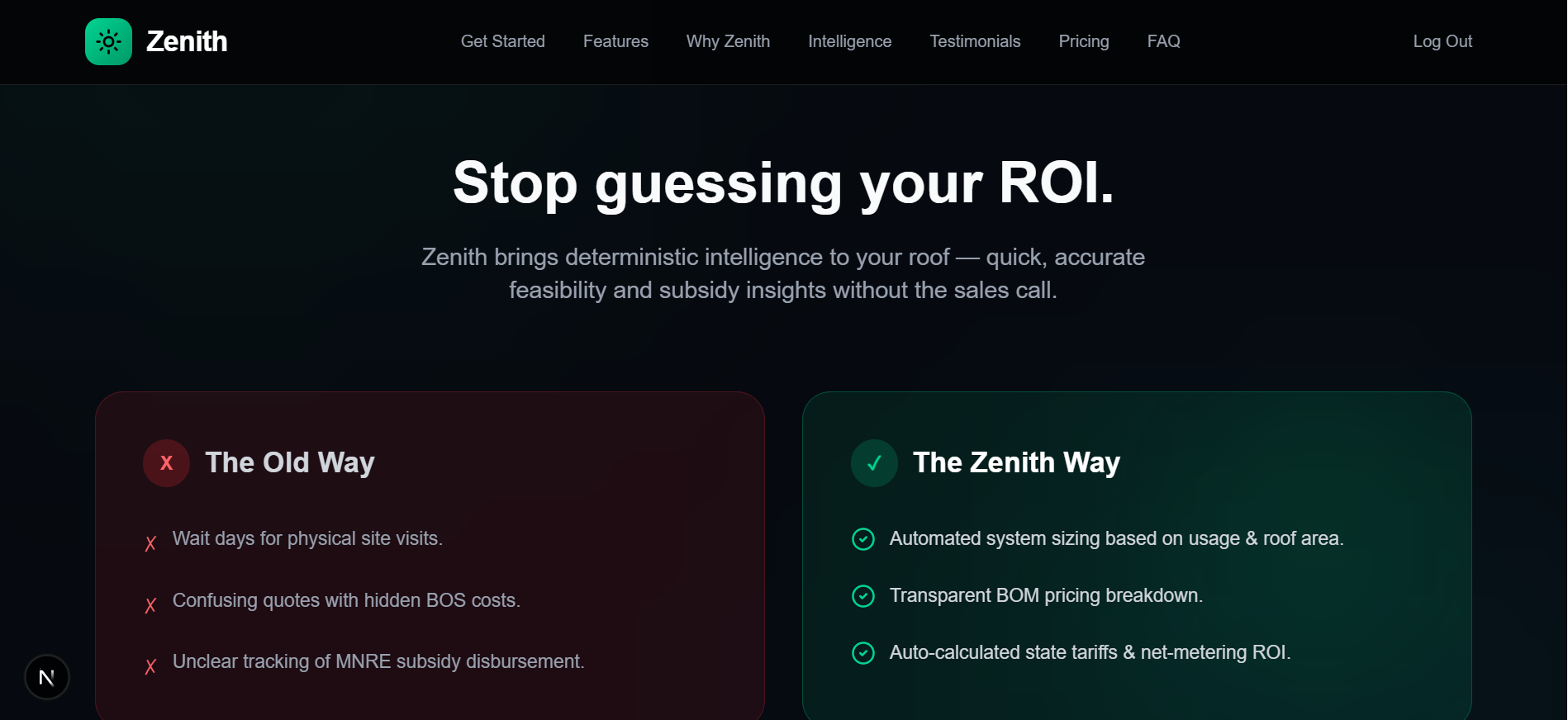
Zenith brings feasibility analysis, 20-year financial modeling, subsidy intelligence, AI explanations, and energy optimization into one unified platform.
What it does
Zenith is a multi-layered solar intelligence platform designed to support both individual and larger energy decisions.
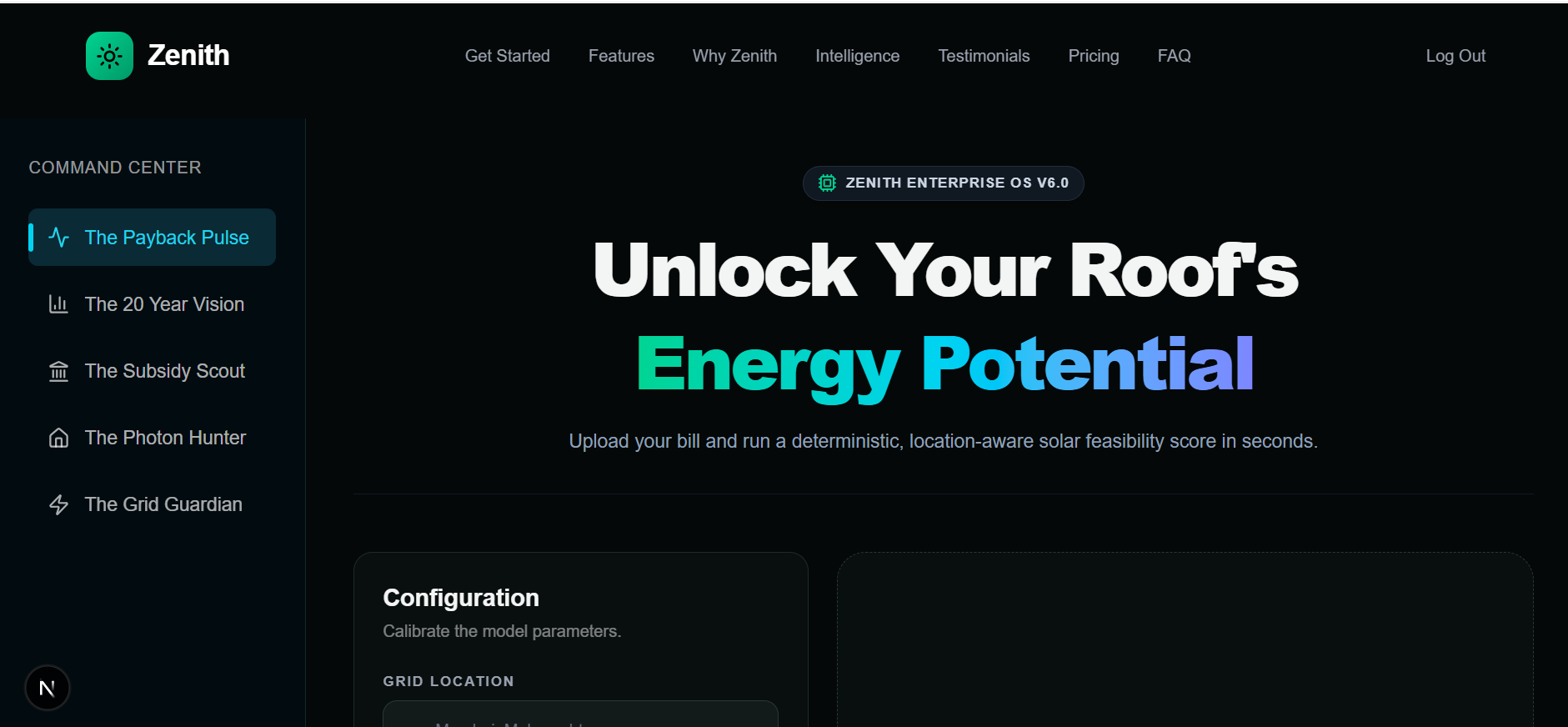
1. The Payback Pulse — Solar Feasibility
Zenith begins with location-based solar feasibility.
Users can explore whether solar is viable for their situation through a transparent, multi-factor analysis rather than relying on a simple hardcoded city result. The system considers factors relevant to solar potential and provides an understandable recommendation.
It also forms the starting point of the Zenith journey by transferring relevant project context into downstream financial analysis.
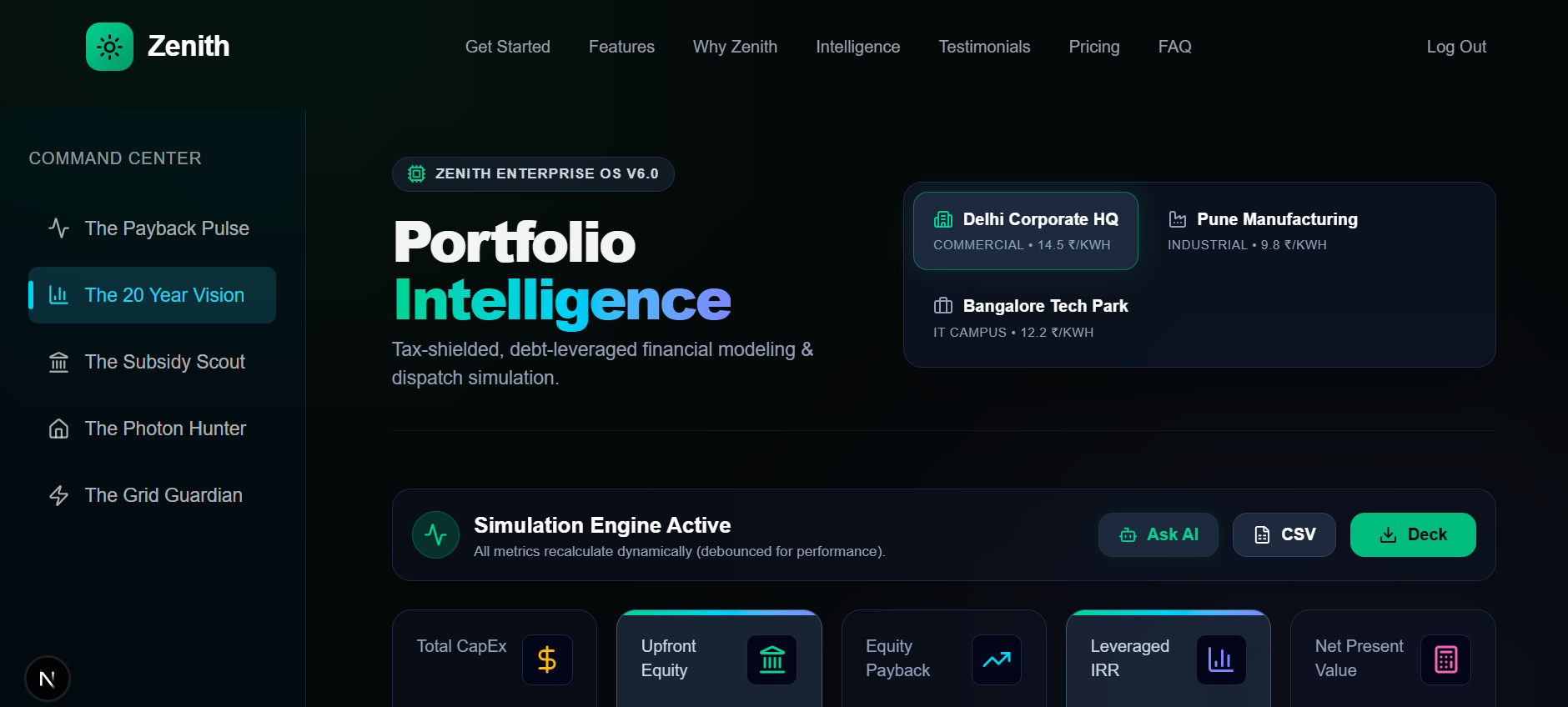
2. The 20 Year Vision — Long-Term Financial Modeling
This is Zenith's long-horizon financial simulation layer.
Users can explore solar and battery economics across a 20-year model, including:
- Total capital expenditure
- Equity requirement
- Debt financing
- Annual debt service
- Solar generation and degradation
- Battery storage economics
- REC revenue assumptions
- O&M escalation
- Depreciation
- Taxes
- Annual and cumulative cash flow
- NPV
- Leveraged IRR
- Equity payback
The platform supports both:
- Enterprise scenarios for larger commercial and industrial systems
- Personalized projects transferred from solar feasibility analysis
A personalized project can carry information such as system size, electricity tariff, solar production, monthly bill, and location into the financial model.
For residential-style projects, Zenith also applies safer assumptions such as removing enterprise-only corporate tax and REC benefits and preventing modeled savings from exceeding estimated annual electricity consumption.
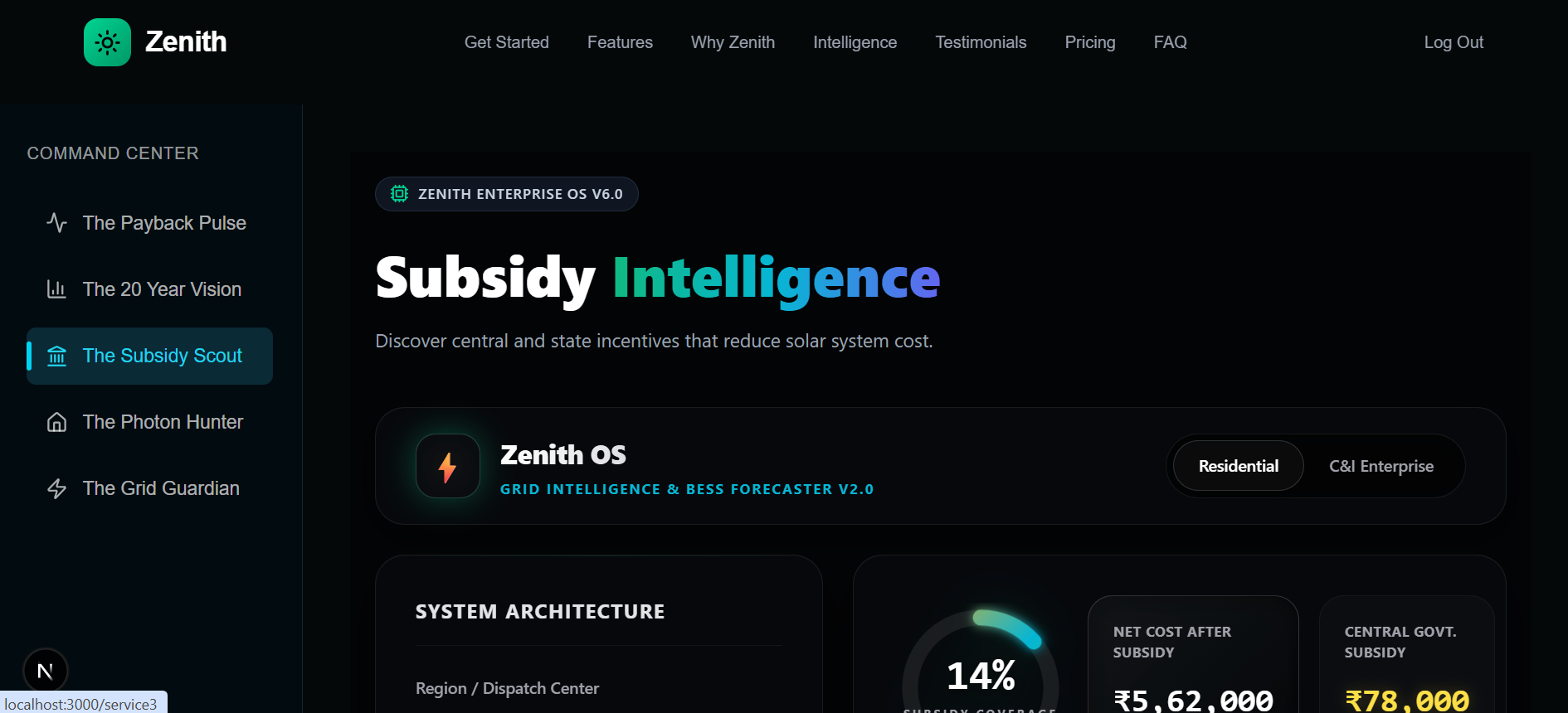
3. The Subsidy Scout — Incentive Intelligence
Solar economics depend heavily on incentives, but subsidy information is fragmented and difficult to interpret.
The Subsidy Scout allows users to explore:
- Central government subsidy estimates
- State-level incentive estimates
- Subsidy coverage
- Net cost after incentives
- Internally calculated generation, savings, and payback estimates
- Residential vs C&I context
For residential projects, Zenith models the PM Surya Ghar-style central subsidy structure and combines it with supported location-based state incentive logic.
The system is designed as a transparent estimator rather than a black box, making it easier for users to understand how incentives influence project economics.
4. The Photon Hunter — Solar Intelligence Layer
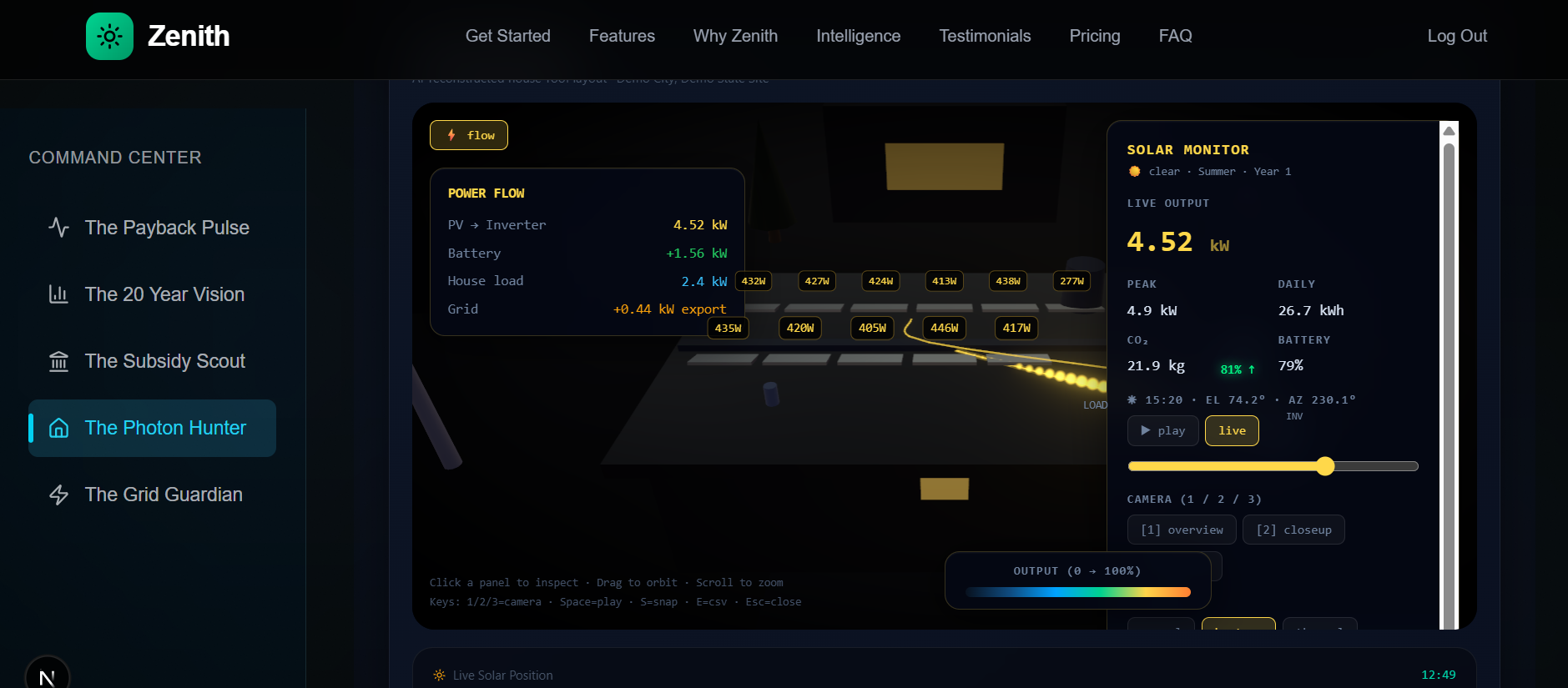
🚧 Under Active Development: Photon Hunter currently demonstrates our computer-vision prototype for rooftop detection and calibrated area estimation. Further work is focused on improving detection robustness across real-world rooftop videos.
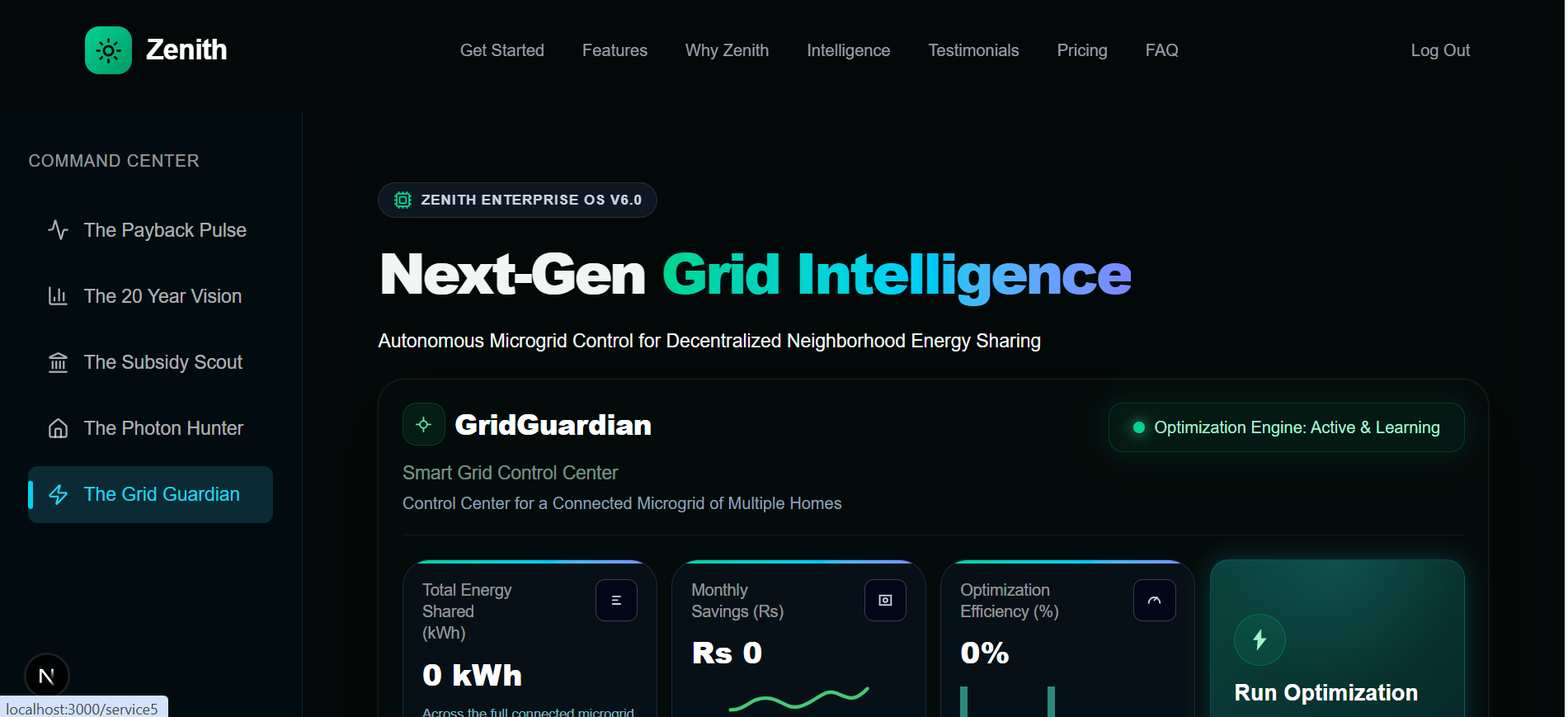
5. The Grid Guardian — Energy Optimization
Zenith's intelligence extends beyond installation decisions.
Through its Lumen Logic optimization layer, Zenith explores how energy resources can be coordinated at the microgrid level.
The system connects the existing Grid Guardian interface with a Python-based optimization engine to model energy decisions involving:
- Solar generation
- Battery storage
- Grid electricity
- Load demand
- Cost optimization
The objective is to determine a better operational strategy rather than treating solar generation, batteries, and the grid as isolated components.
This is the final step in Zenith's core vision: moving from solar planning to solar intelligence and energy operation.
How we built it
Zenith was built as a full-stack application combining frontend intelligence, backend APIs, AI explanations, and optimization.
Frontend
We built the platform using:
- Next.js
- React
- TypeScript
- Tailwind CSS
- Interactive dashboards and data visualizations
The interface was designed around the idea of a central energy command center, allowing users to move through different stages of the solar-to-grid journey.
Backend and AI
Zenith connects key parts of the solar decision journey, including feasibility-to-finance and feasibility-to-subsidy context transfer, while the optimization layer demonstrates the next stage of energy operation.
We integrated:
-Gemini for contextual AI explanations -Next.js API routes for backend workflows -Python-based optimization and rooftop analysis scripts -PuLP for energy optimization logic -OpenCV for rooftop video and frame analysis
Financial modeling
The 20-year financial model includes:
- Solar and storage CapEx
- Debt financing
- Equity contribution
- Annual energy generation
- Solar degradation
- Battery degradation
- Tariff escalation
- O&M escalation
- Depreciation
- Taxes
- Cash flow
- IRR
- NPV
- Payback calculations
We also audited and corrected the financial model during development, including fixing a tax-benefit double-counting issue before extending the projection horizon from 10 to 20 years.
System integration
A major focus was making Zenith feel like a connected intelligence system rather than a collection of isolated pages.
For example, solar feasibility results can now initialize a personalized long-term financial project, while the broader platform architecture connects planning, financial analysis, incentives, and operational optimization.
Challenges we ran into
Turning multiple tools into one coherent journey
The biggest challenge was architectural.
A feasibility calculator, a financial simulator, a subsidy estimator, and a microgrid optimizer can easily become separate projects. We had to rethink Zenith as a connected decision journey instead of a dashboard with unrelated features.
This required us to audit how data moved between services and identify places where one module appeared connected to another but was not actually consuming the transferred information.
One important fix was connecting feasibility results to the 20-year financial model through personalized project initialization.
Making financial results mathematically consistent
Financial models can look impressive while still being wrong.
During development, we found that the tax logic was effectively capturing depreciation and interest benefits twice: once by reducing taxable income and again by adding a separate tax shield to cash flow.
We corrected the model so the tax benefit is accounted for only once.
We also audited:
- Debt treatment
- Interest deductions
- Depreciation
- IRR cash-flow sequences
- NPV
- Payback
- Cumulative cash flow
- Residential assumptions
This was one of the most important parts of the project because we wanted Zenith to be more than a visually convincing simulation.
Handling residential and enterprise projects fairly
A large enterprise financial model should not automatically be applied to a 3 kW residential solar system.
We had to separate assumptions between project types. Personalized residential projects now avoid enterprise-only assumptions such as corporate tax benefits and REC revenue, while savings are capped by estimated electricity consumption unless export revenue is explicitly modeled.
Building under hackathon constraints
Zenith combines frontend development, financial modeling, AI integration, policy estimation, and optimization.
The challenge was deciding where to build deep intelligence and where to be transparent about simplified assumptions.
For hackathon scope, some datasets and policy rules remain curated rather than live. Instead of pretending every value is real-time, we focused on building a strong architecture that can later connect to authoritative data sources.
Accomplishments that we're proud of
We are especially proud that Zenith evolved beyond a single-purpose solar calculator.
A complete decision journey
Zenith connects the major questions around solar adoption:
Feasibility → Financial Value → Incentives → Energy Operation
A 20-year financial engine
The financial simulator now models a full 20-year horizon with dynamic degradation, escalation, debt schedules, taxes, cash flows, IRR, NPV, and payback.
Personalized financial analysis
Feasibility results can initialize a personalized financial project rather than forcing every user into a generic enterprise scenario.
Financial correctness work
We did not stop after getting numbers on screen. We audited the financial model and corrected the tax double-counting issue before finalizing the long-term projection.
Residential-aware logic
Small personalized solar systems are no longer forced through corporate financing and tax assumptions.
Energy optimization
By integrating a Python optimization layer into the Grid Guardian concept, Zenith moves beyond "Should I install solar?" toward "How should my energy system operate?"
What we learned
We learned that AI and intelligence features are only valuable when the underlying system is trustworthy.
A polished interface can hide disconnected data flows. A financial model can produce precise-looking numbers while containing flawed assumptions. An AI explanation is only as useful as the data and logic behind it.
The biggest lesson was to repeatedly audit our own architecture.
We learned to ask:
- Is this feature actually connected?
- Is this data really being used?
- Is this assumption appropriate for this type of user?
- Are we calculating a result, or only displaying something believable?
- Does the journey make sense from the user's perspective?
We also learned that building a complex AI system is often less about adding more AI and more about designing clear interactions between data, models, rules, optimization, and users.
What's next for Zenith: Solar-to-Grid Intelligence Core
Zenith is designed as the foundation of a larger energy intelligence platform.
Next, we want to:
- Connect subsidy intelligence to live or regularly updated authoritative policy sources
- Expand location coverage beyond the current supported regions
- Deepen the connection between feasibility, incentives, finance, and optimization
- Improve battery dispatch using actual load and solar profiles
- Add richer project-specific energy consumption modeling
- Expand the 20-year simulator with more realistic export and tariff structures
- Strengthen the Grid Guardian optimization layer with more dynamic energy scenarios
- Add transparent confidence and assumption indicators across the platform
Our long-term vision is for Zenith to become an intelligence layer that helps people move from understanding solar potential to making confident financial decisions and eventually to optimizing how clean energy systems operate.
Zenith began with a simple question:
Can solar work for me?
We want it to grow into a system that can answer the much bigger question:
How can solar, storage, incentives, finance, and the grid work together intelligently?
Demo Access Email: [email protected] Password: zenith123

Log in or sign up for Devpost to join the conversation.