Inspiration
The transition to solar energy should feel empowering, yet for most homeowners, it feels uncertain. People are left asking the same questions: Is my location suitable? Will I actually save money? Is it worth the investment? What subsidies truly apply?
We realized the real barrier to solar adoption is not interest — it is clarity.
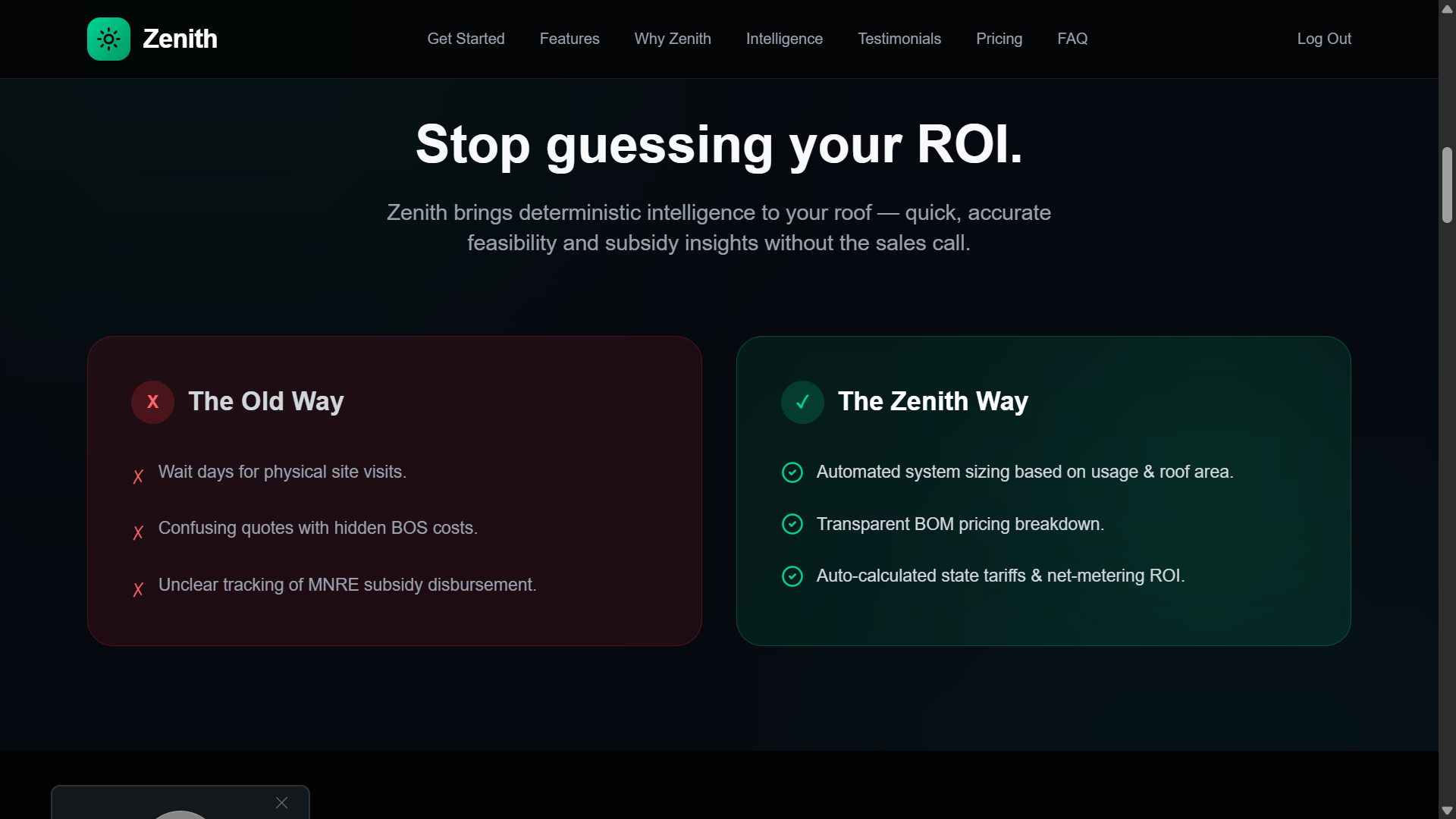
Existing solutions are fragmented and often overwhelming. Users are forced to rely on guesswork instead of confidence. Zenith was built to solve this — to provide a simple, trustworthy system that transforms uncertainty into clear, data-driven decisions.
What it does
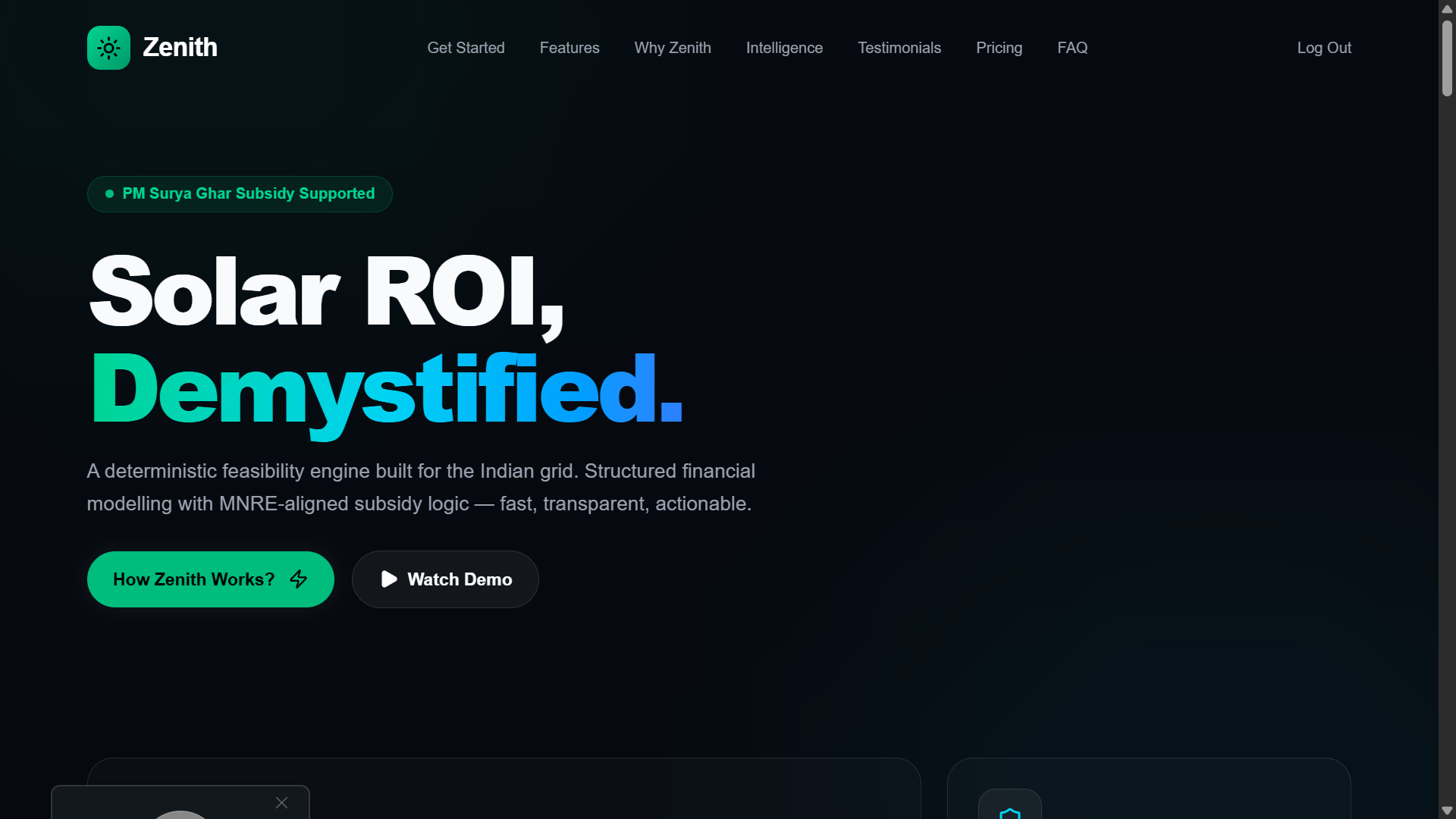
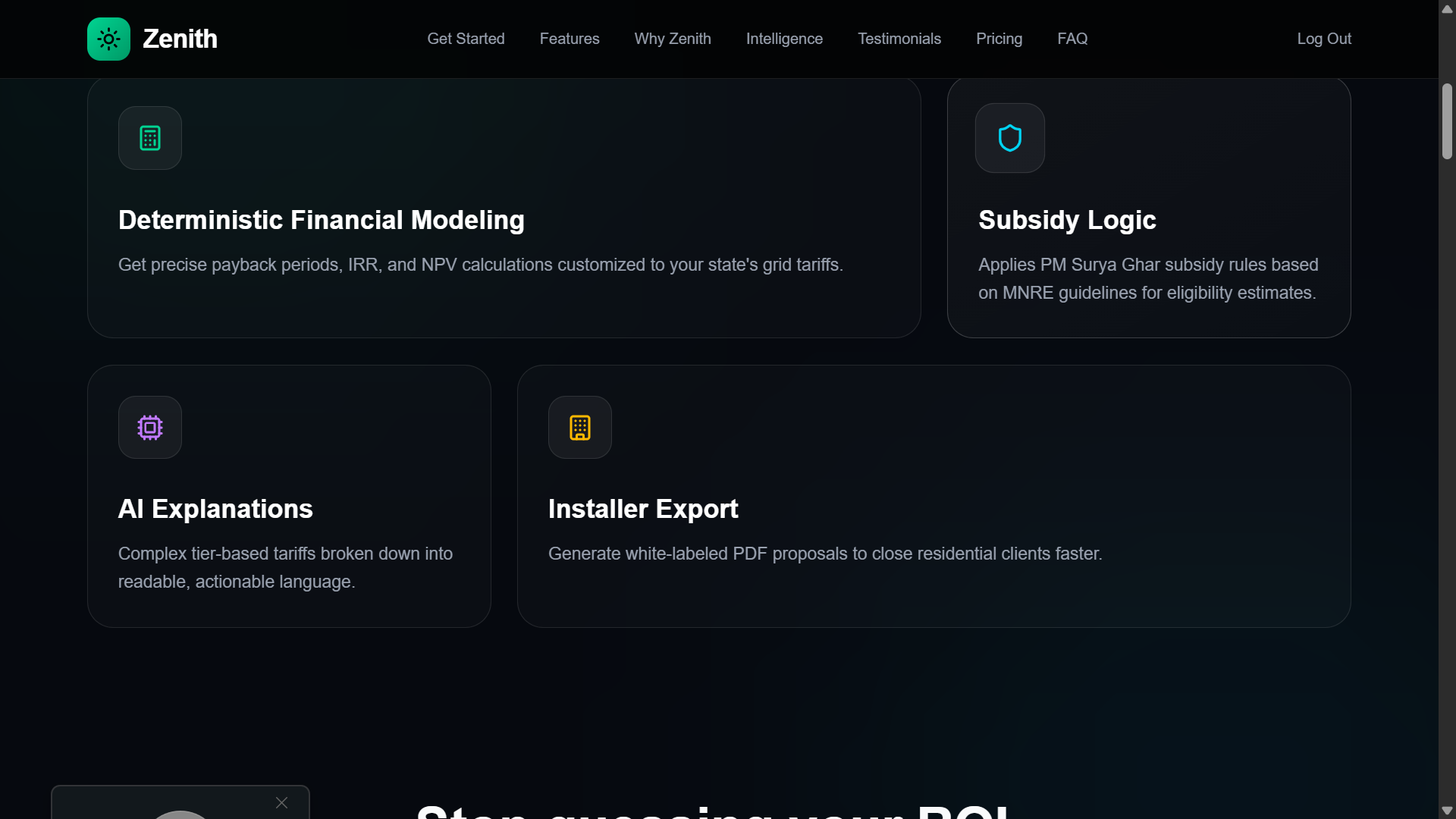
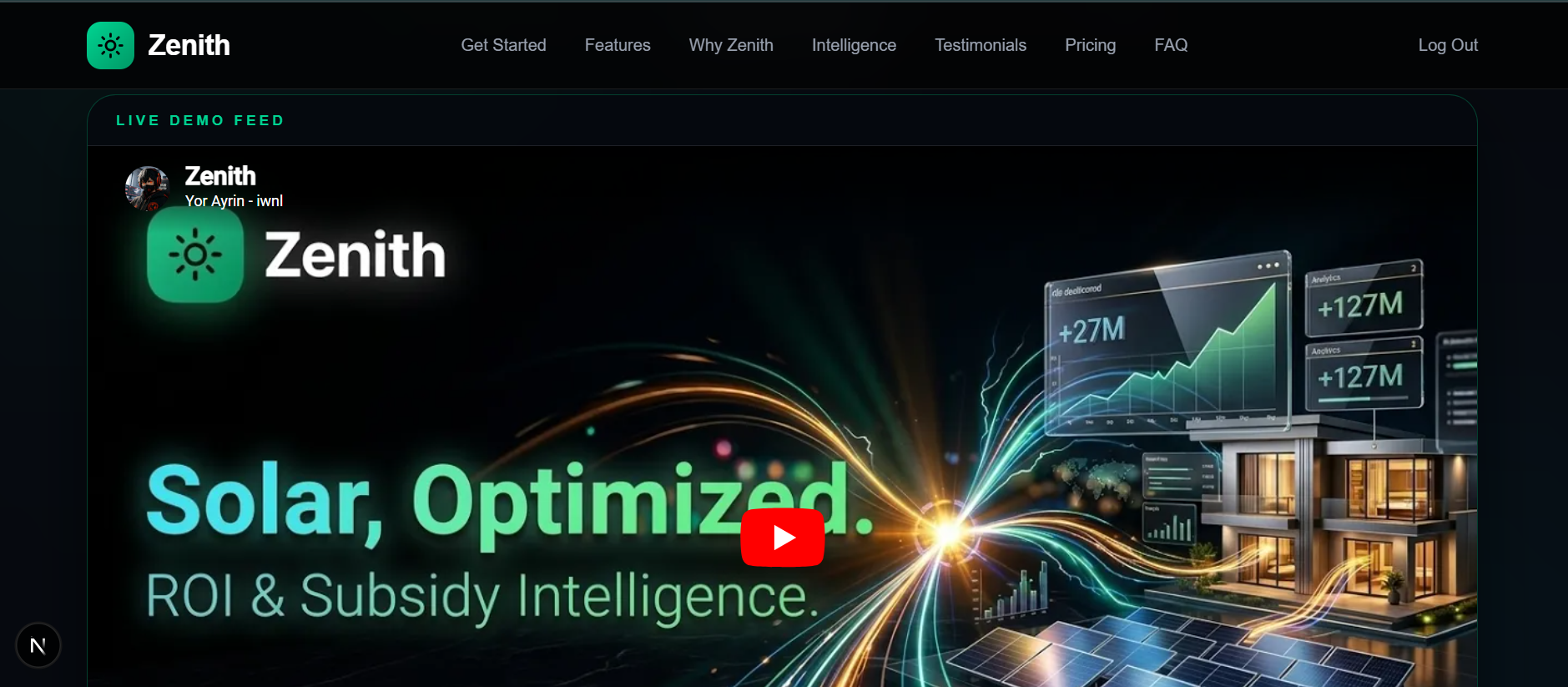
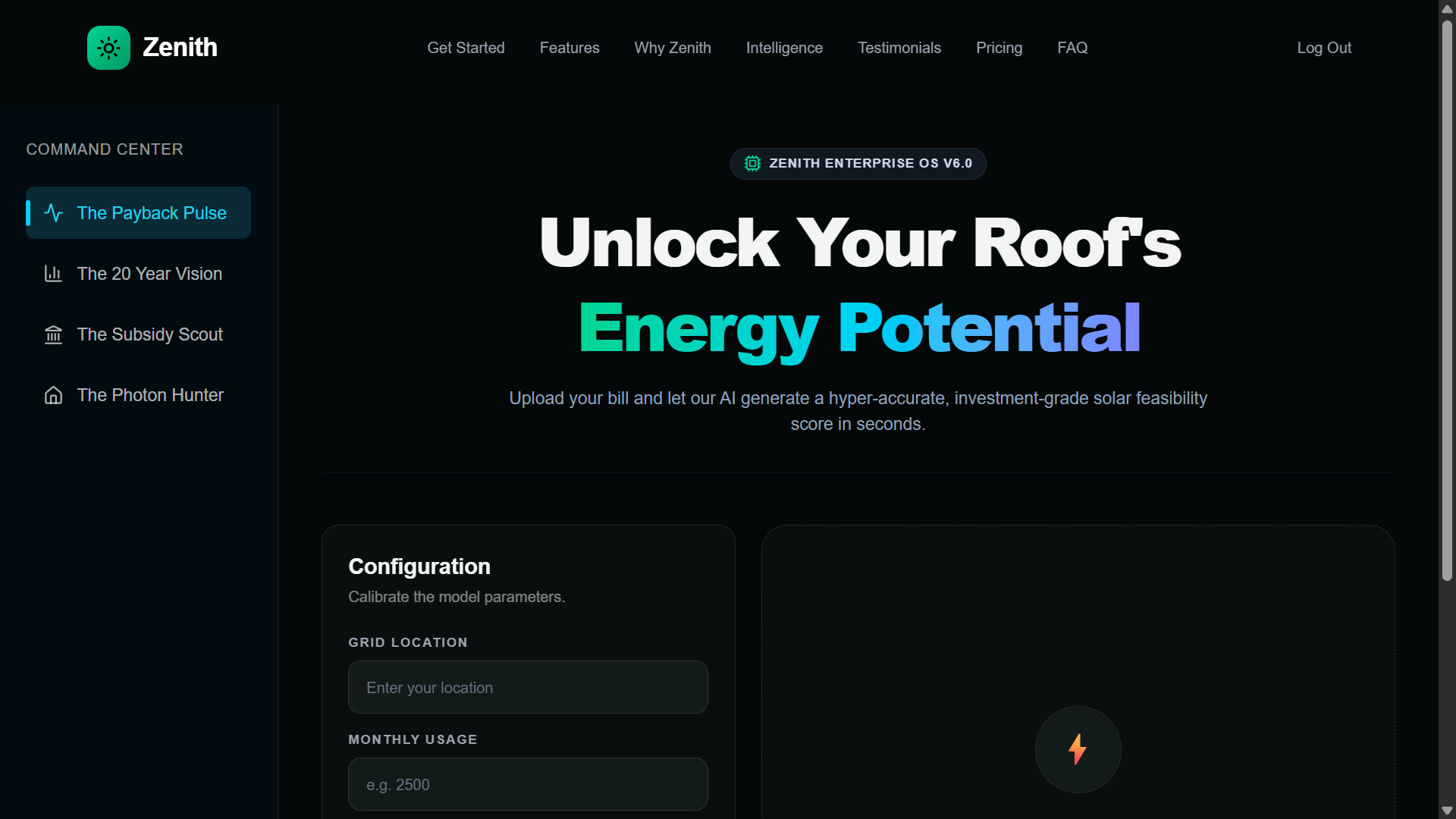
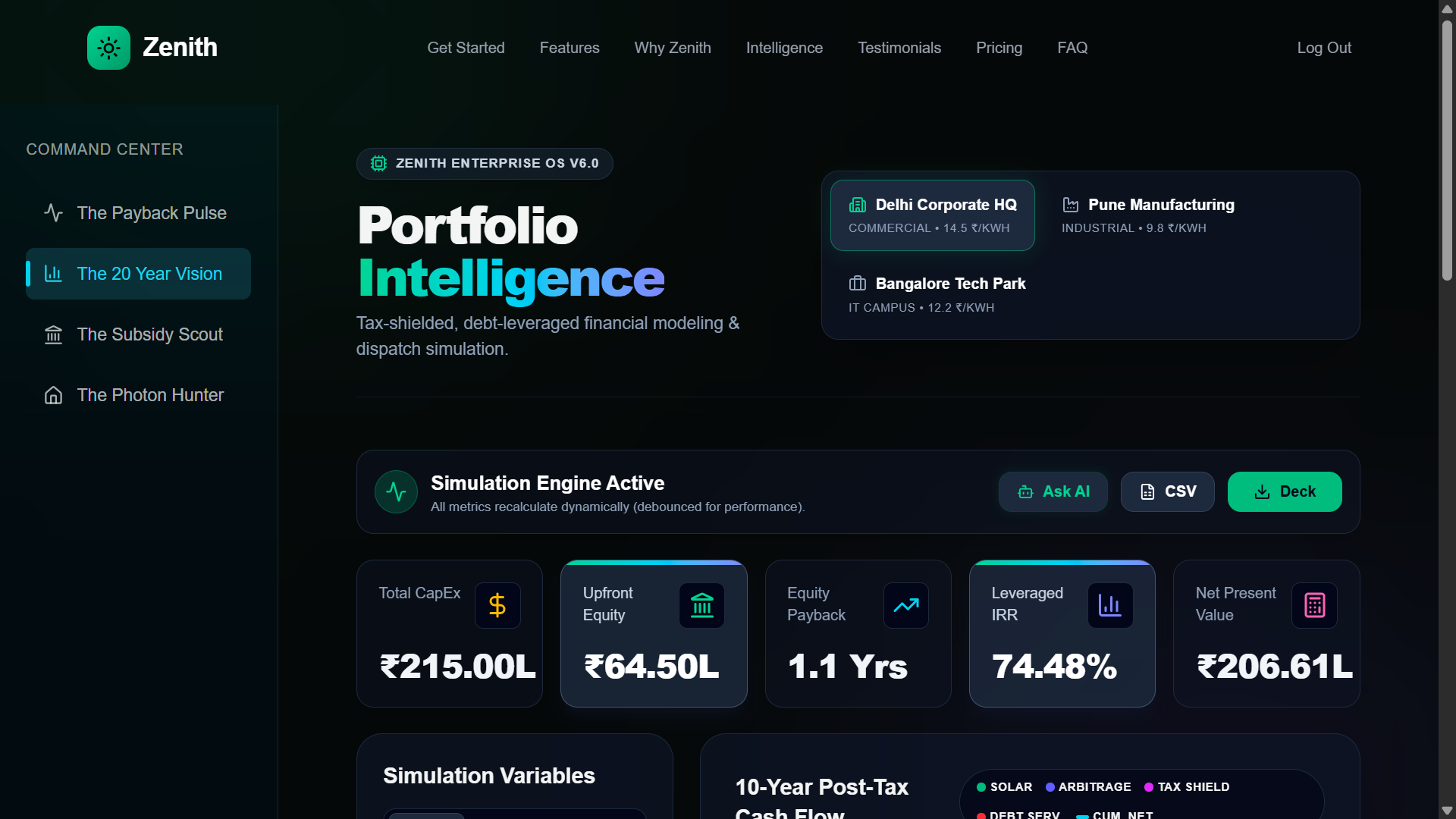
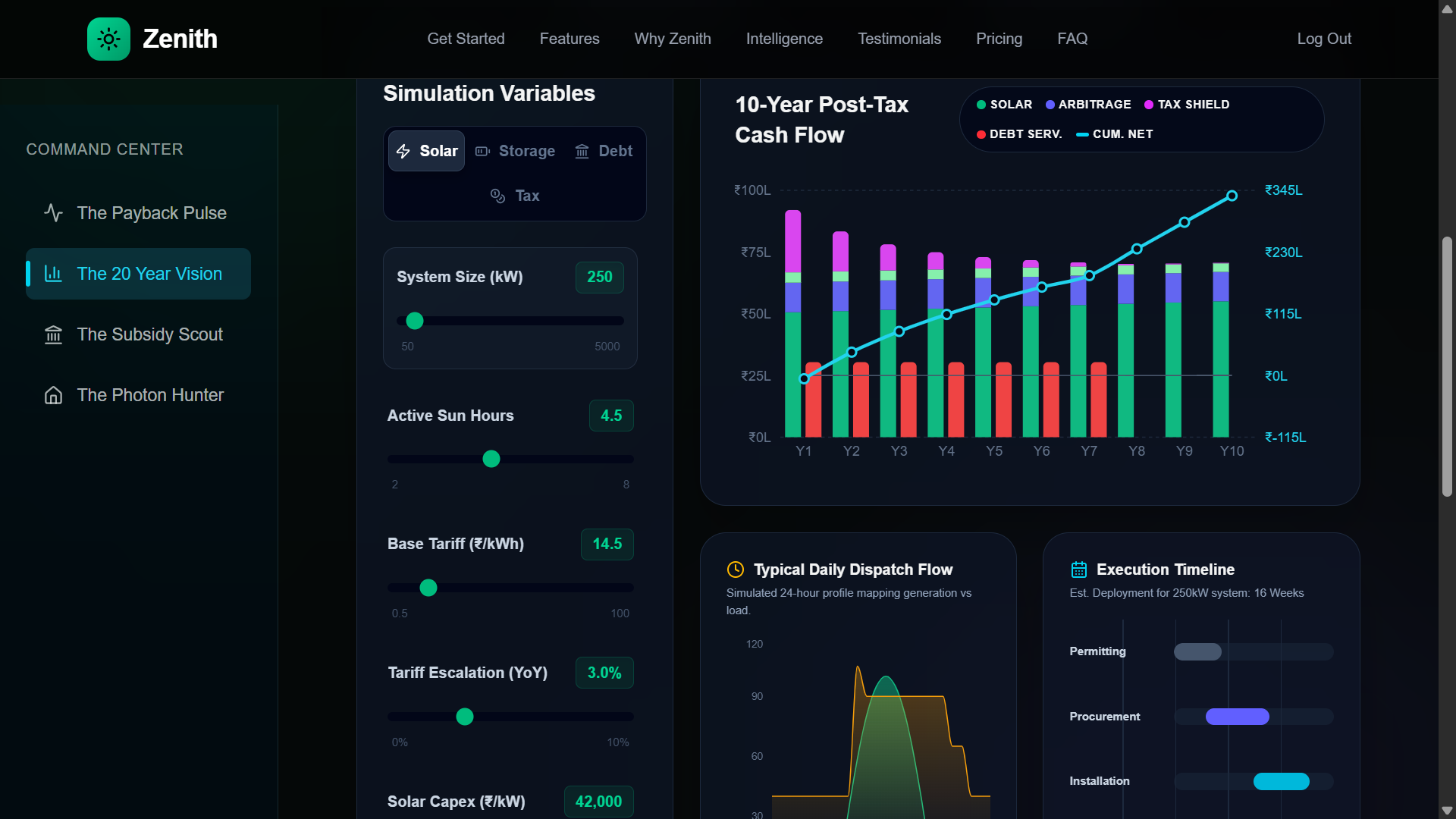
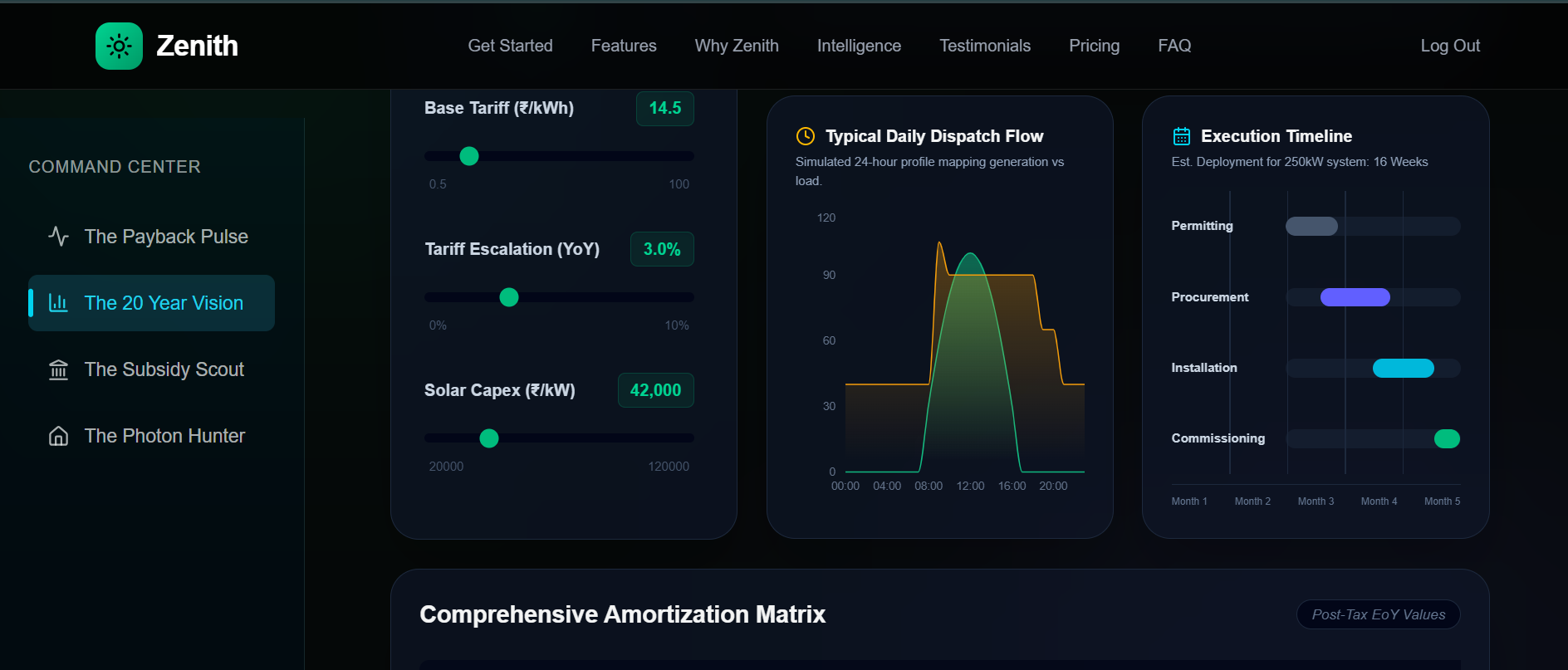
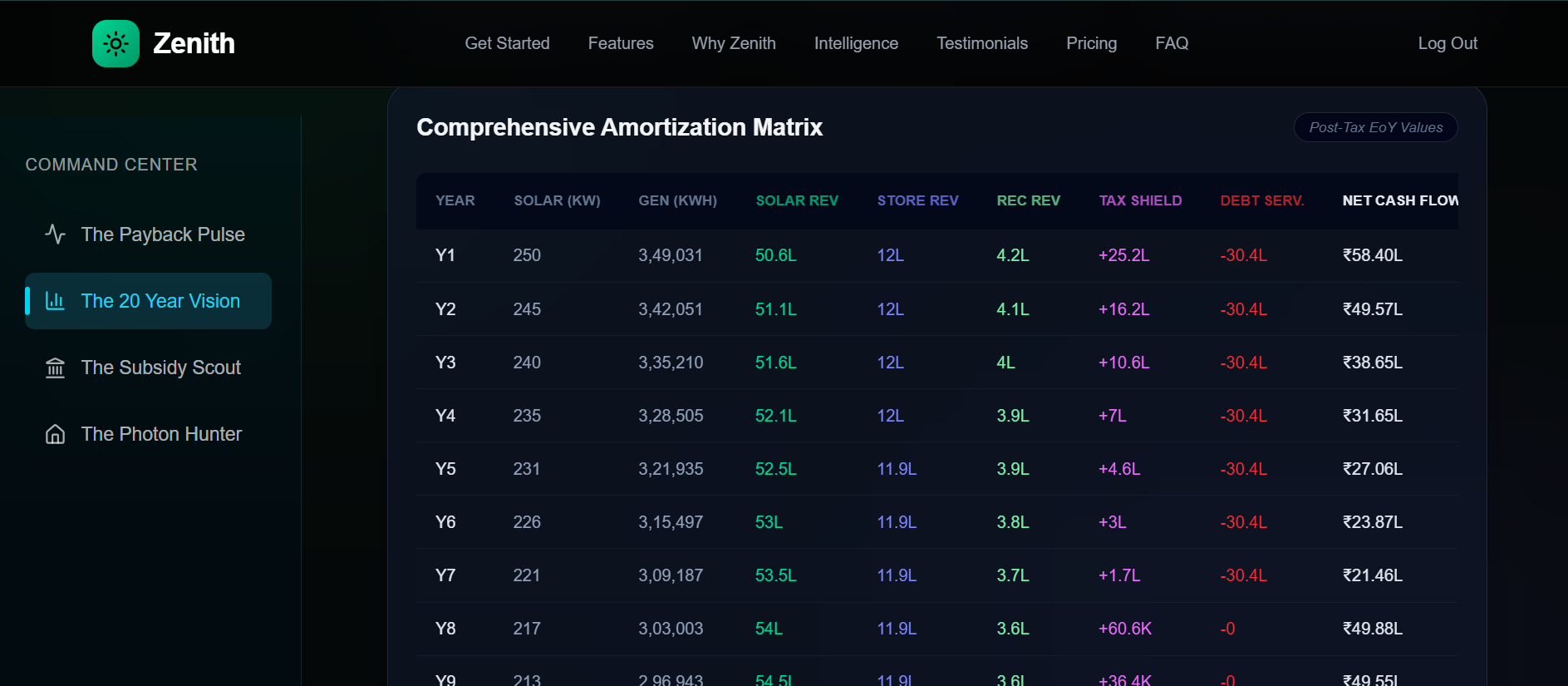
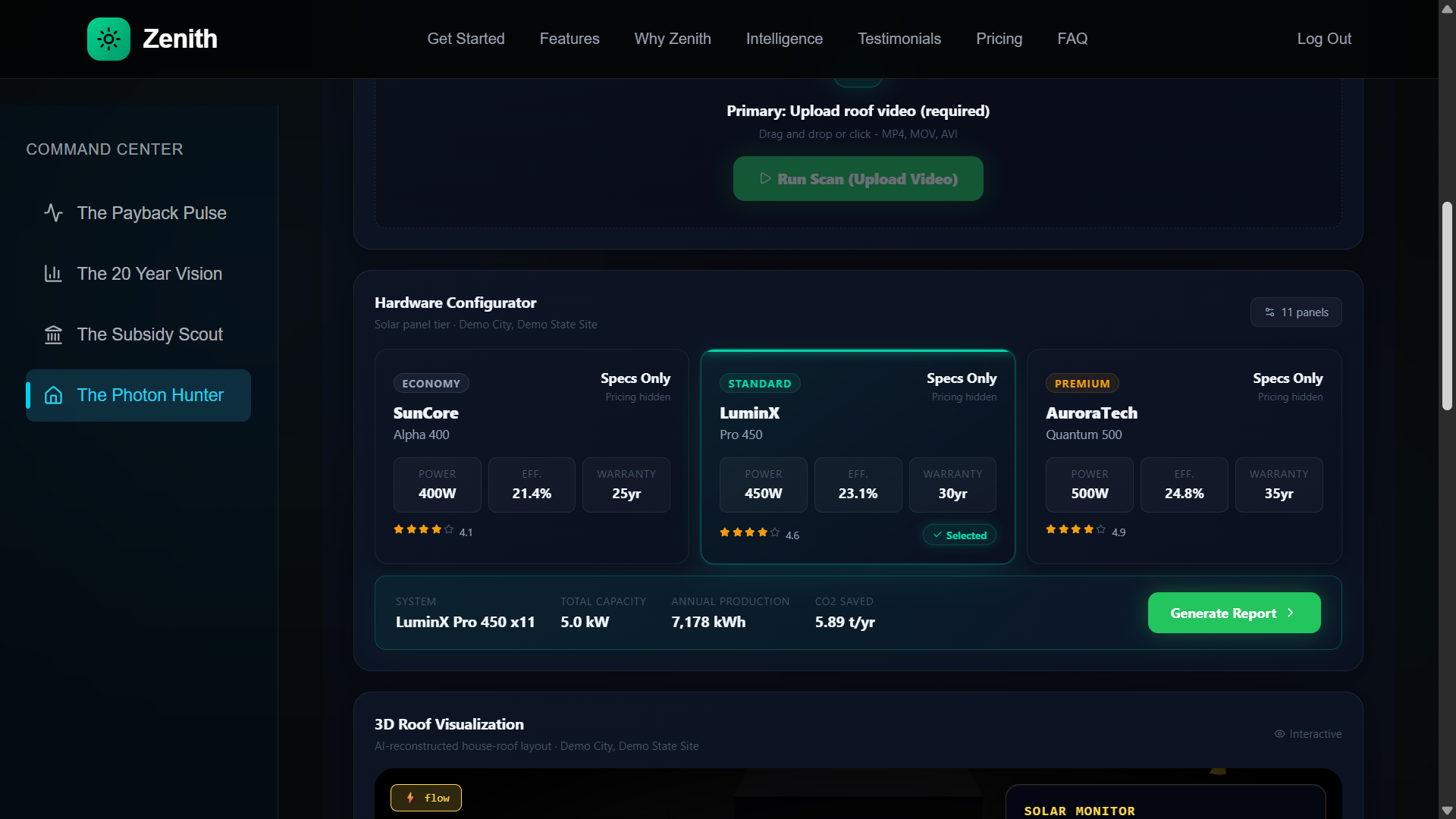
Zenith is an end-to-end Solar Energy Planning & Decision Support System that transforms complex solar data into a clear, intuitive journey.
It allows users to:
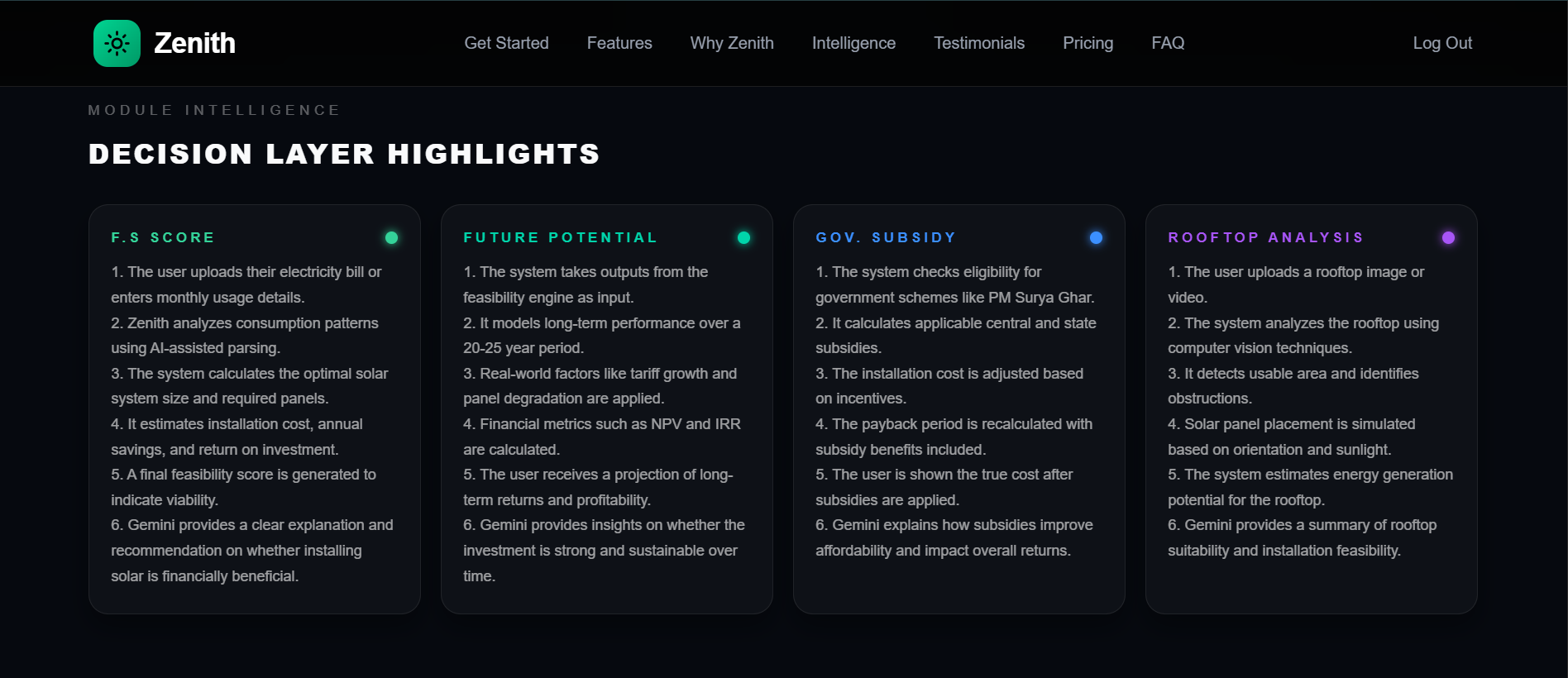
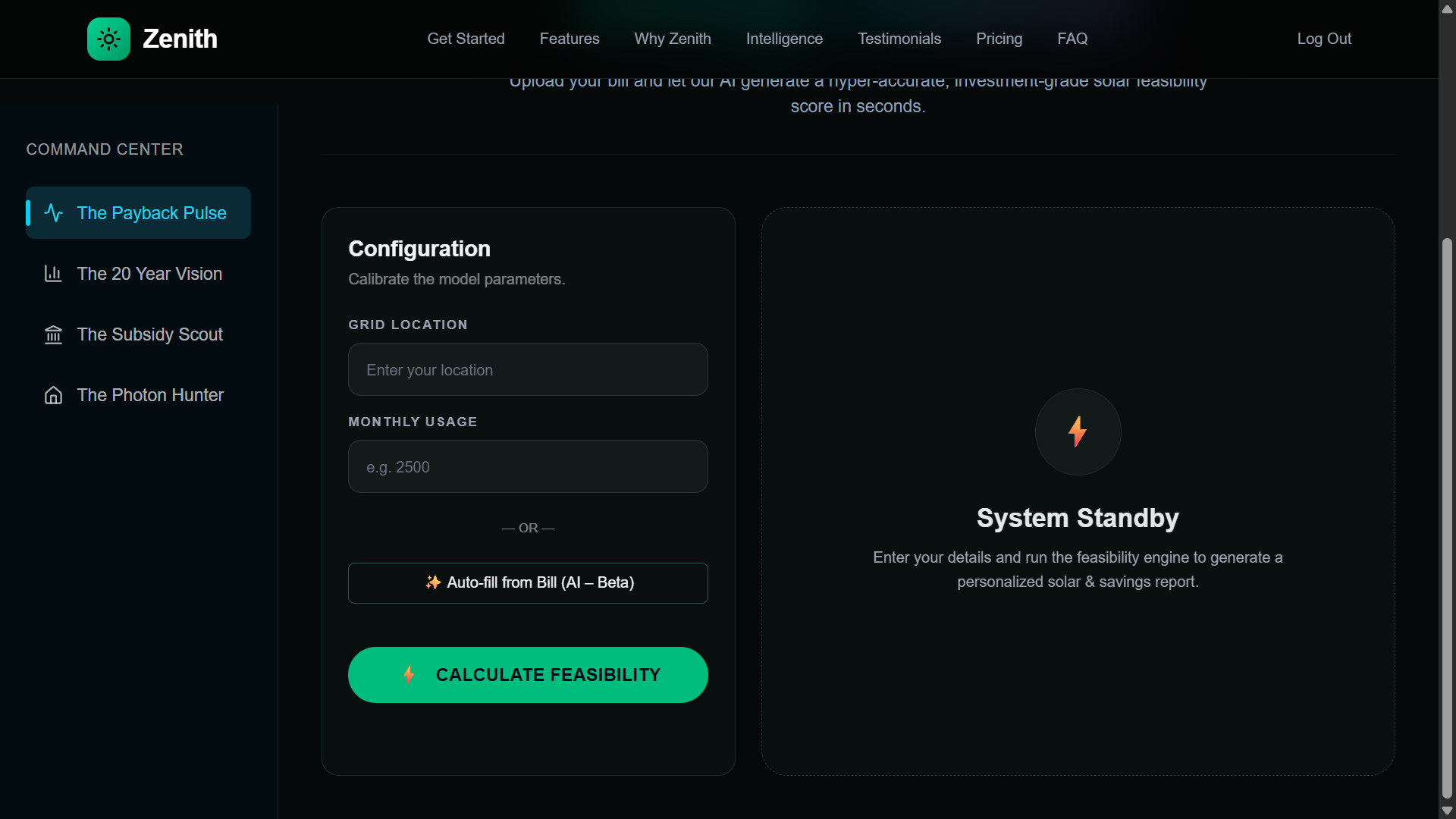
- Automatically interpret electricity usage through bill parsing
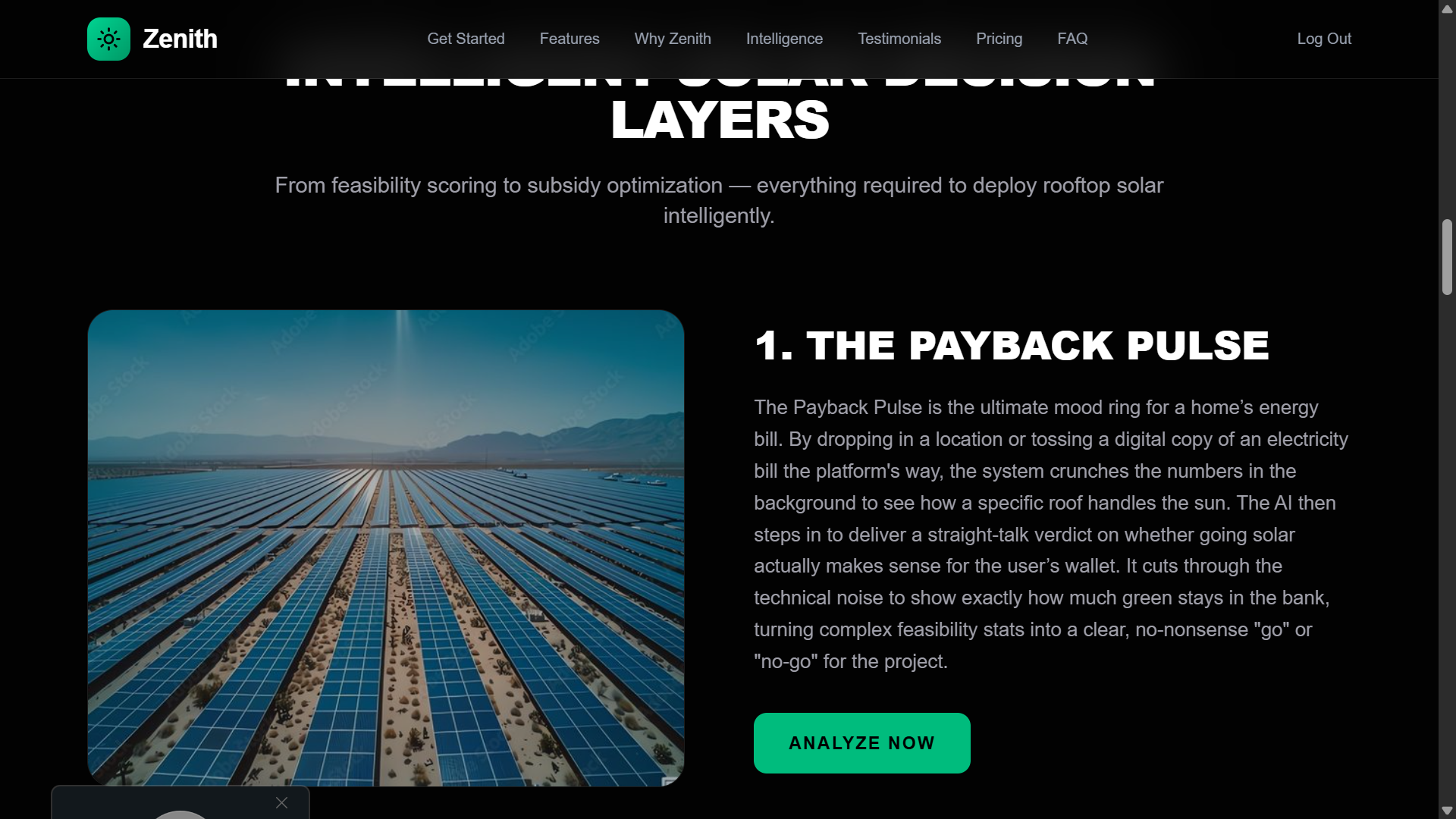
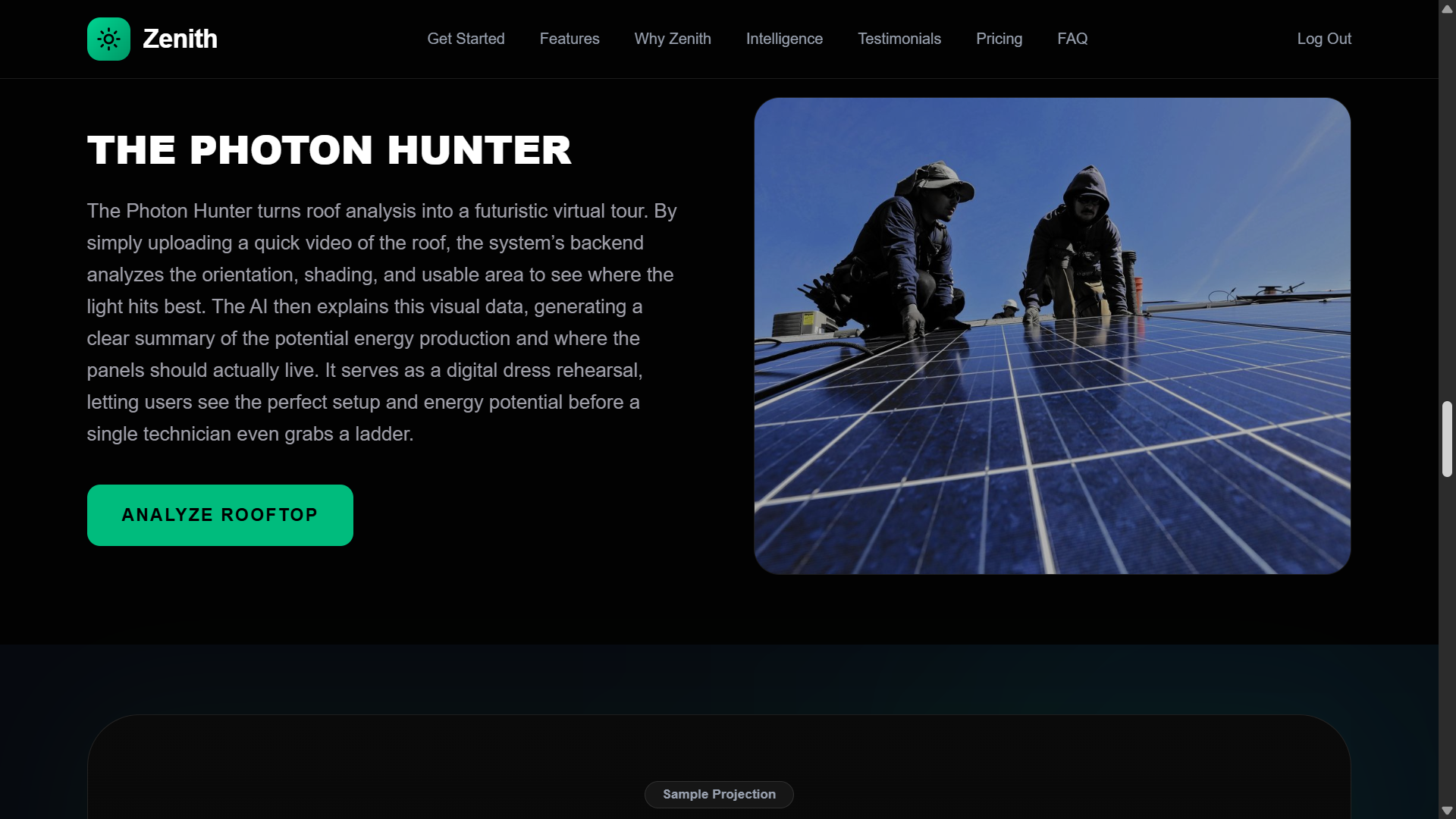
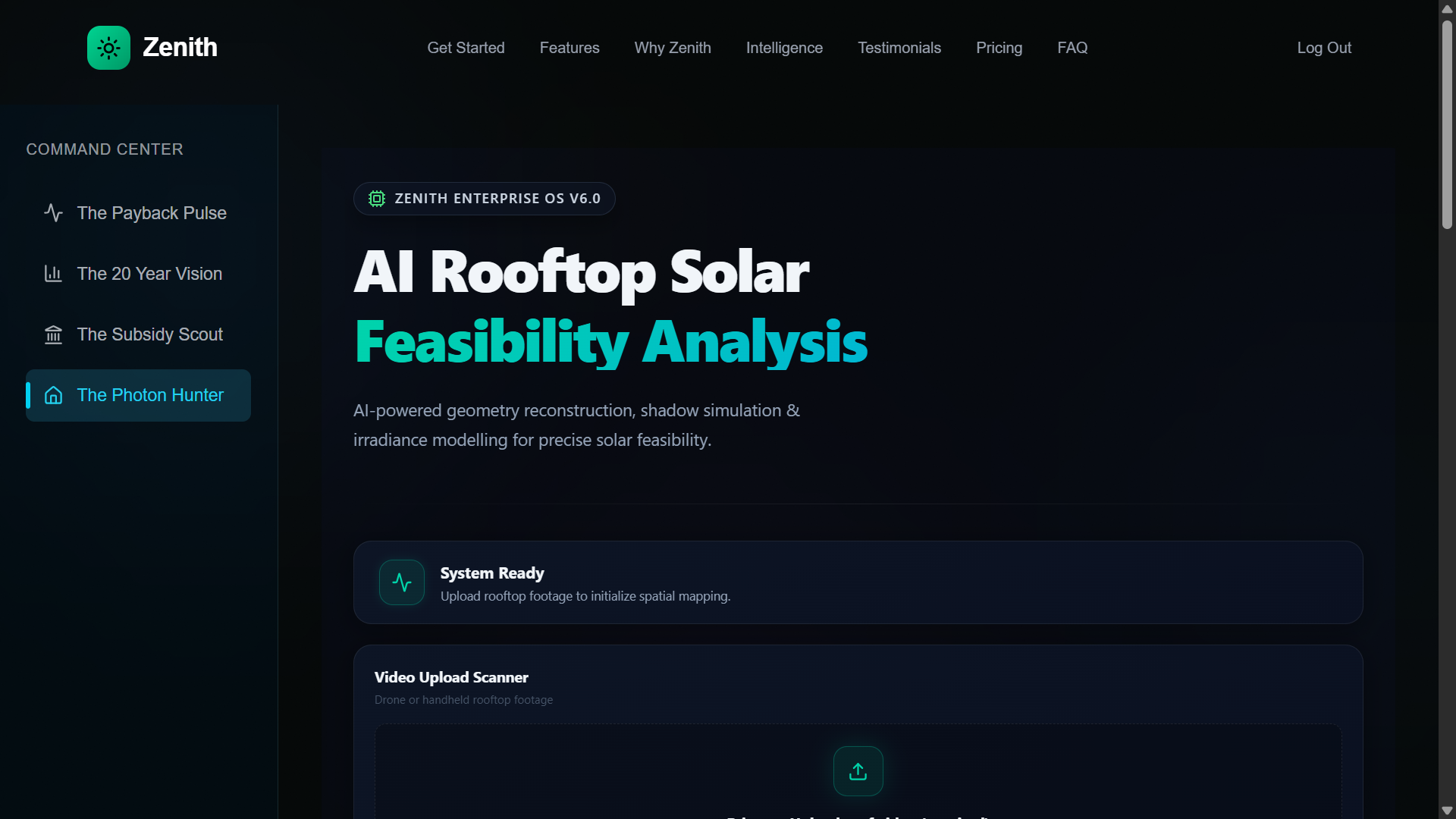
- Evaluate rooftop potential using visual scanning tools
- Calculate the optimal number of panels and system configuration
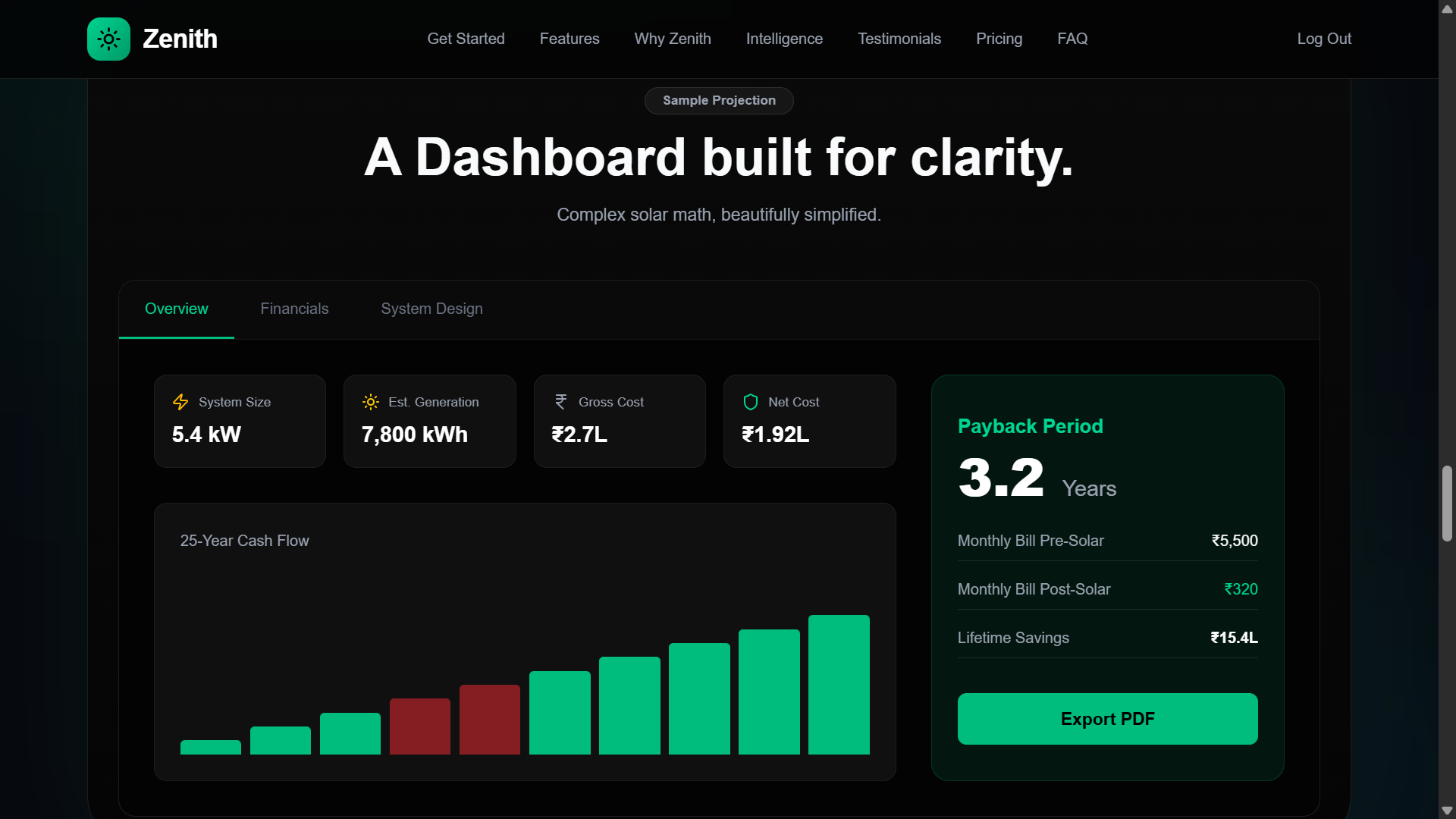
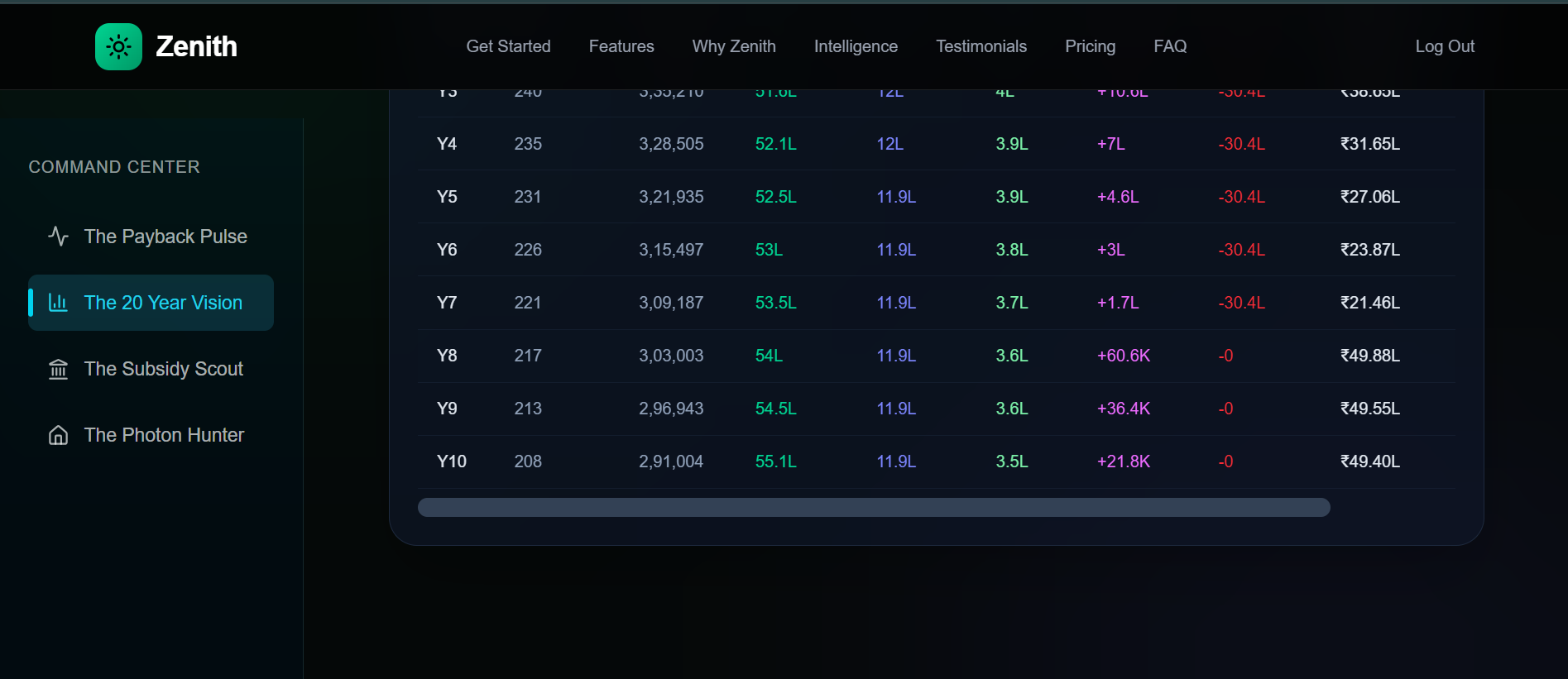
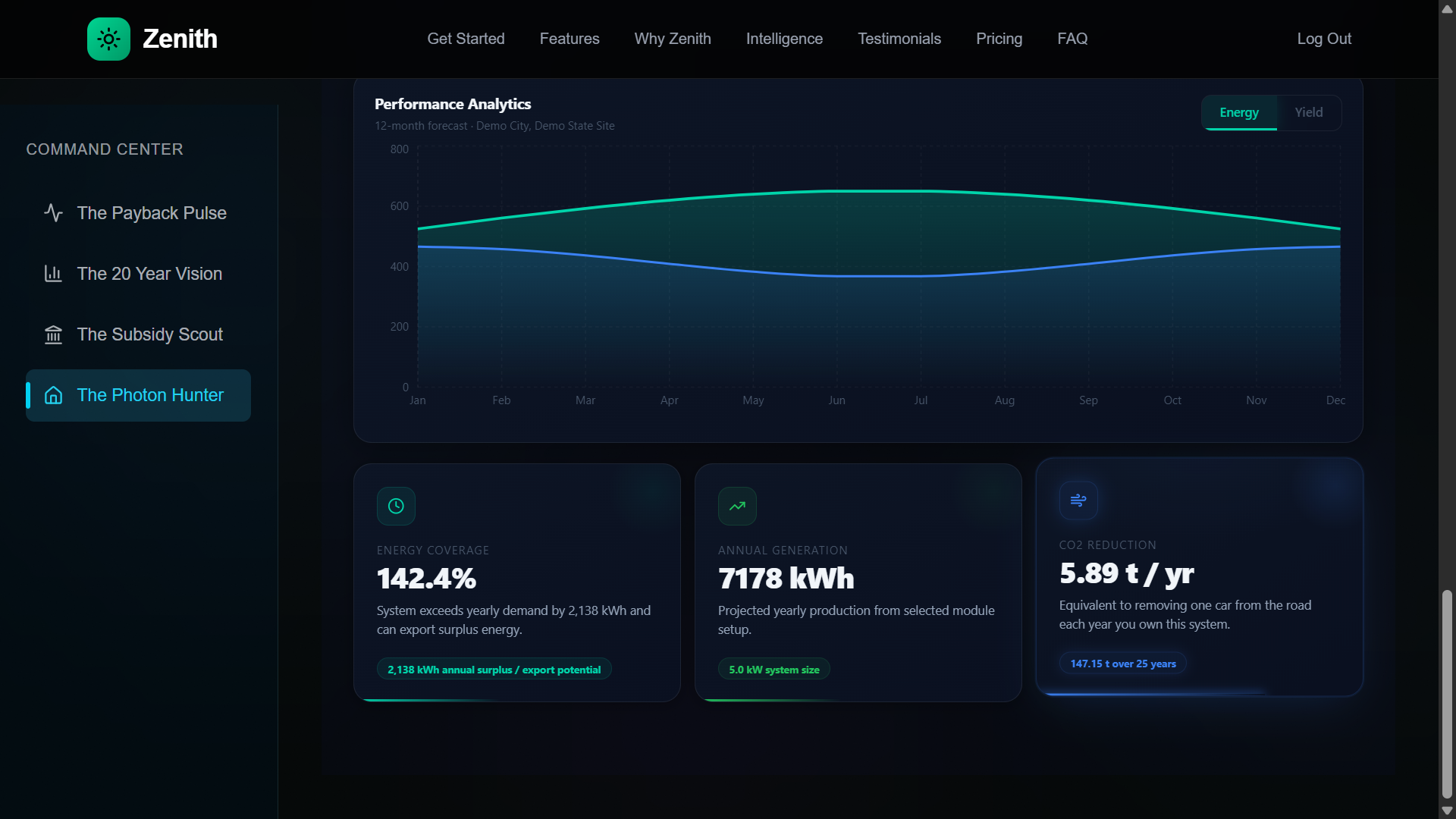
- Forecast energy generation and long-term financial savings
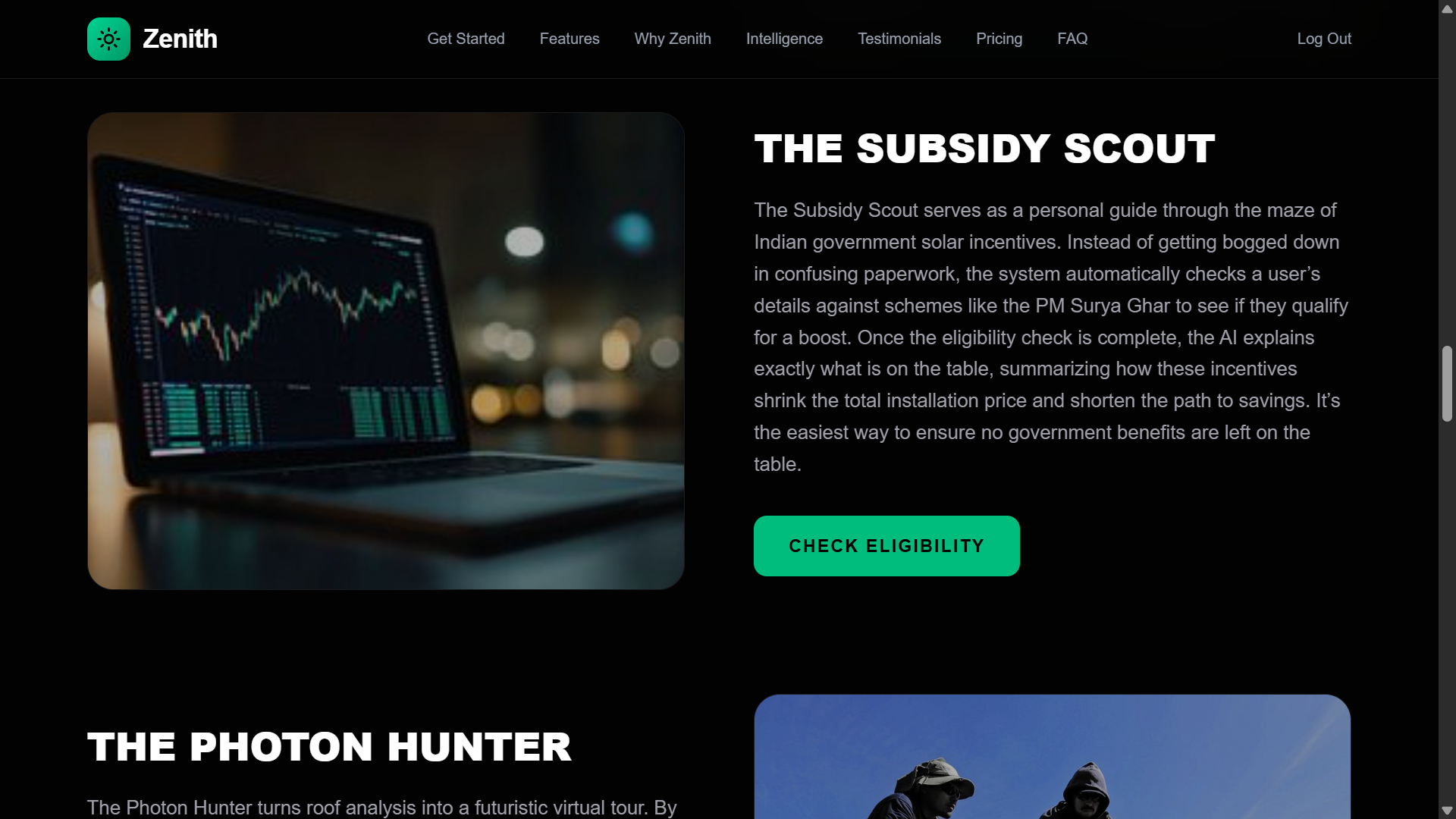
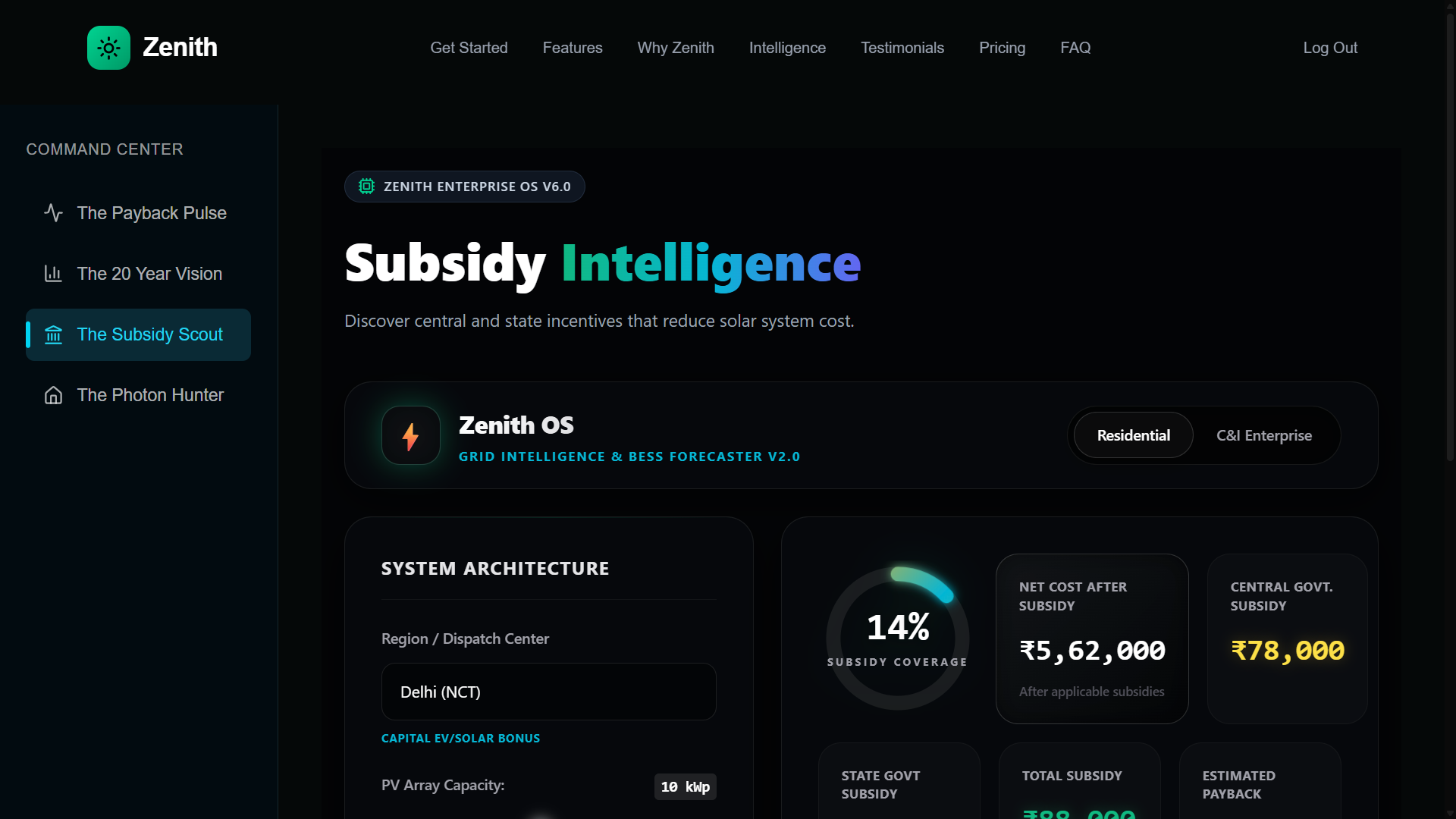
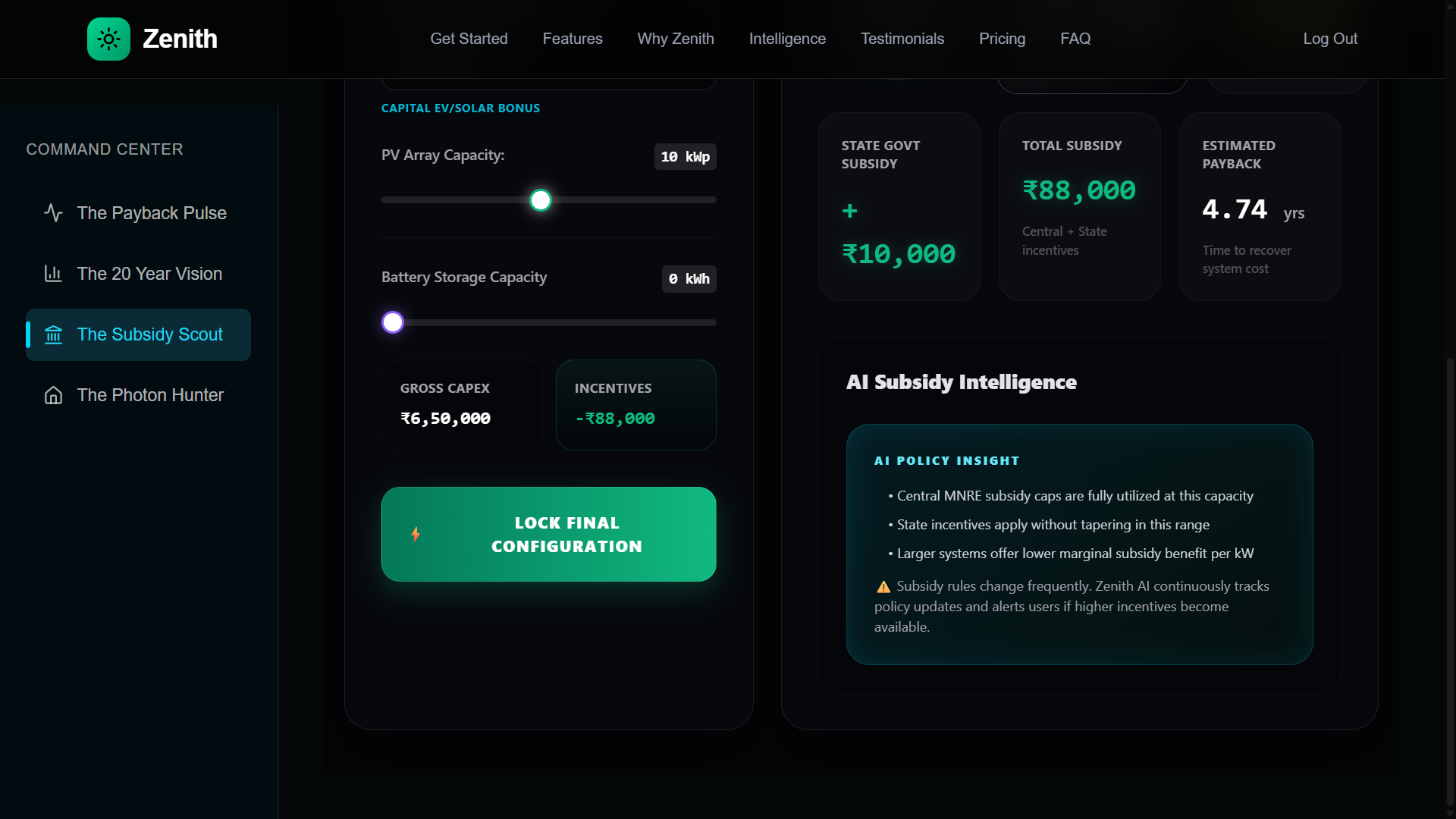
- Apply government subsidies accurately based on location
But Zenith goes beyond numbers.
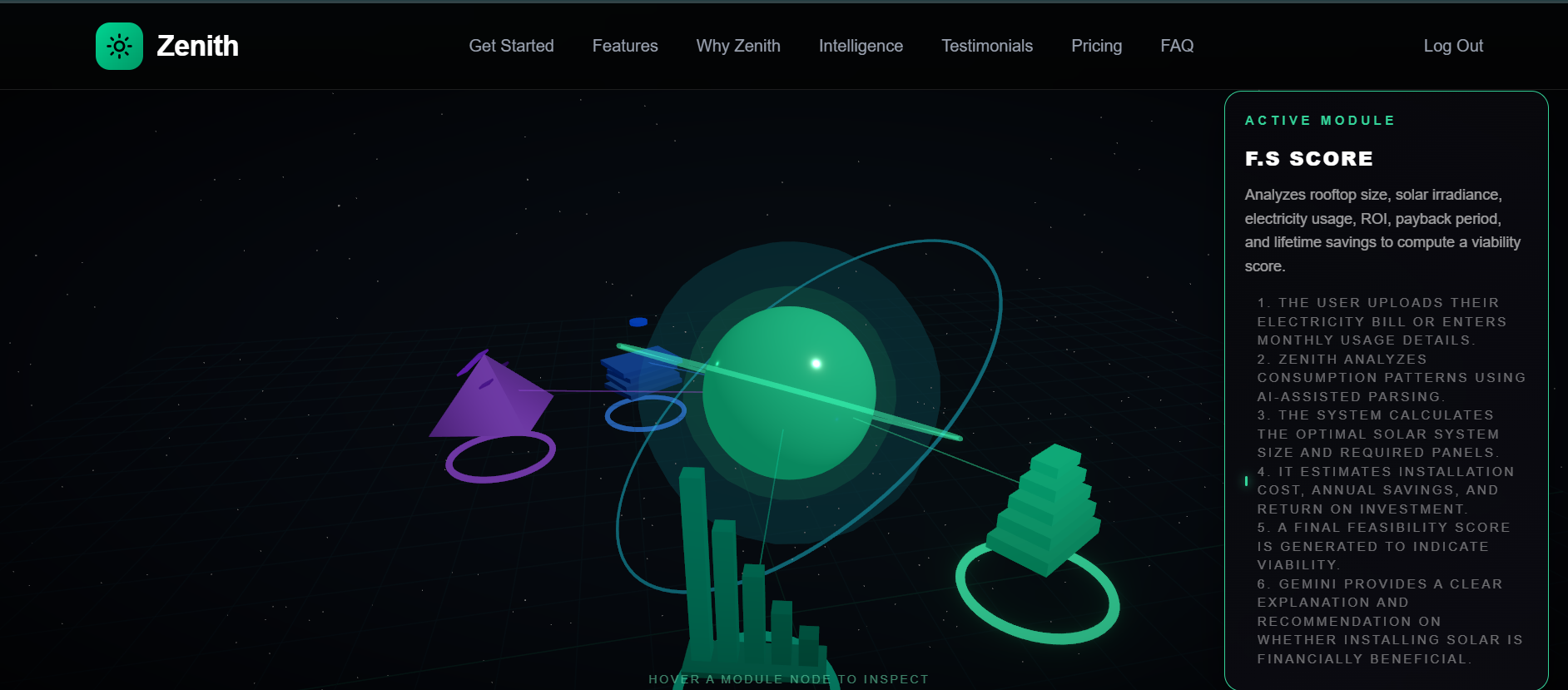
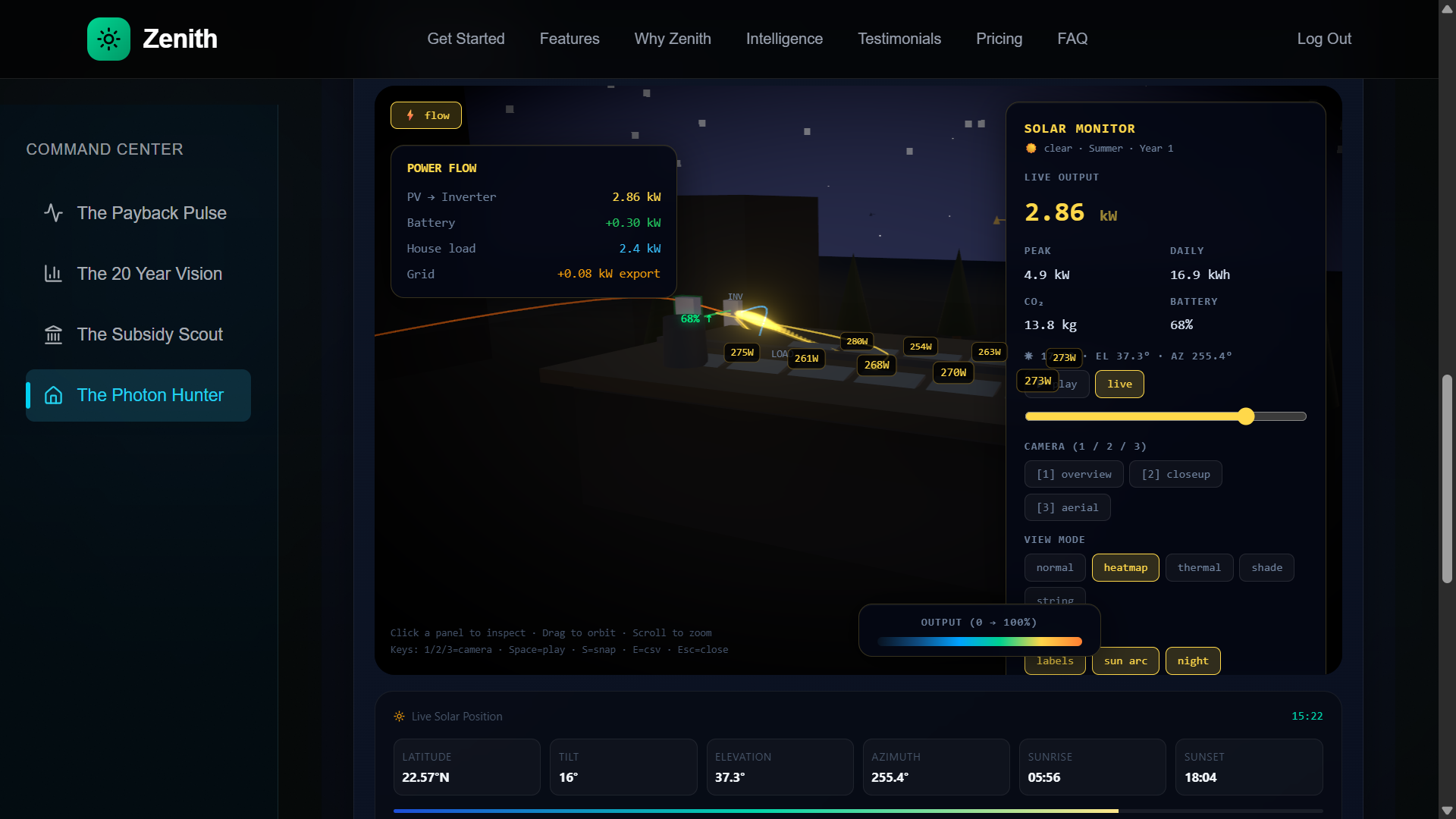
It visualizes the entire flow of energy — from sunlight to solar panels, through the inverter and battery, and into the grid. What is usually hidden behind technical complexity becomes something visible, understandable, and real. Users don’t just see results; they see how their system works.
How we built it
Zenith is built as a lightweight yet intelligent decision-support system.
Frontend:
- React + Tailwind CSS
- Clean, modern UI focused on clarity and usability
- Structured flow for fast understanding
Logic & AI Layer:
- Feasibility scoring system based on location
- Gemini API integration for human-readable explanations
- Financial and system-sizing calculations based on realistic assumptions
- Future Cast and subsidy logic integrated into decision flow
Core Model:
Inputs:
- Monthly electricity consumption (kWh)
- Monthly electricity bill (₹)
- Feasibility Score (FS ∈ [1,10])
Assumptions:
- 1 kW generates ~4 kWh/day (ideal)
- 20% system losses
- Panel size: 0.55 kW
- Cost: ₹60,000 per kW
- Offset: 80%
- Lifetime: 25 years
Outputs:
- System size
- Number of panels
- Installation cost
- Annual savings
- Payback period
- Lifetime profit
- AI-based feasibility explanation
This ensures the system is both realistic and easy to understand.
Challenges we ran into
The biggest challenge was balancing realism with simplicity.
Solar feasibility depends on multiple variables — location, sunlight, system losses, consumption patterns, and financial assumptions. Presenting all of this directly would overwhelm users.
We had to carefully design the experience so that:
- The system remains accurate
- The interface stays simple
- The insights are delivered instantly
- AI explanations enhance understanding without confusion
Another limitation was that the rooftop scanner is currently a demo, so we focused on making the rest of the system strong and reliable.
Accomplishments that we're proud of
We are proud that Zenith is not just an idea, but a working system with real-world logic.
We built:
- A functional feasibility scoring system
- A financial forecasting model
- A Future Cast feature
- Subsidy-aware logic
- A rooftop scan demo
- Gemini-powered explanation layer
- City-level feasibility analysis
Most importantly, we transformed a complex decision into something users can understand within seconds.
What we learned
We learned that solar adoption is not just a technical problem — it is a trust problem.
Users need clarity, not complexity. They need to understand:
- Does this work for me?
- Will I save money?
- Is this worth it?
We also learned the power of combining structured logic with AI explanations. The math provides accuracy, while AI makes it accessible.
What's next for Untitled
The next step for Zenith is to improve realism and expand coverage.
We plan to add:
- Accurate rooftop assessment
- Better location-based feasibility calibration
- Expanded subsidy coverage
- Live weather-based forecasting
- More precise ROI modeling
- Stronger metro-city benchmarking
We are launching Zenith as a startup and believe it has the potential to grow into a billion-dollar idea.
Our vision is to move towards vertical integration — not just helping users plan solar systems, but also providing complete services including solar panels, installation, and maintenance packages. This will allow us to deliver a seamless end-to-end solar experience.
Our long-term goal is to evolve Zenith into a complete solar decision and service platform that helps users move from curiosity to confidence — and from planning to real adoption.
Built With
- css
- extjs
- framer-motion
- gemini-api
- google-generative-ai
- html2canvas
- javascript
- json
- jspdf
- lucide-react
- markdown
- node.js
- npm
- postcss
- react
- react-dom
- react-three-drei
- react-three-fiber
- react-three-postprocessing
- recharts
- tailwindcss
- three-stdlib
- three.js
- typescript
- vercel


Log in or sign up for Devpost to join the conversation.