Problem Statement
Despite the growing adoption of solar energy, most systems operate in isolation, leading to inefficient energy utilization. Homes with excess solar power often sell it back to the grid at low rates, while nearby homes simultaneously purchase expensive electricity.
Additionally, homeowners face uncertainty when adopting solar due to unclear savings, costs, and incentives.
This results in:
- Underutilization of renewable energy
- Higher energy costs
- Lack of intelligent coordination between energy producers and consumers
There is a need for a system that not only helps users adopt solar confidently but also optimizes energy usage at a community level.
Inspiration
The transition to solar energy should feel empowering, yet for most homeowners, it feels uncertain. People struggle with basic questions: Is solar worth it? Will I actually save money? What incentives apply?
But beyond adoption, we identified a deeper problem.
Even when solar is installed, systems operate in isolation. Homes with excess energy sell it back to the grid at low prices, while nearby homes simultaneously buy expensive electricity. This leads to inefficiency, wasted renewable energy, and unnecessary costs.
We realized the real gap is not just decision-making — it is intelligent energy utilization.
Zenith was built to solve both.
Solution Overview
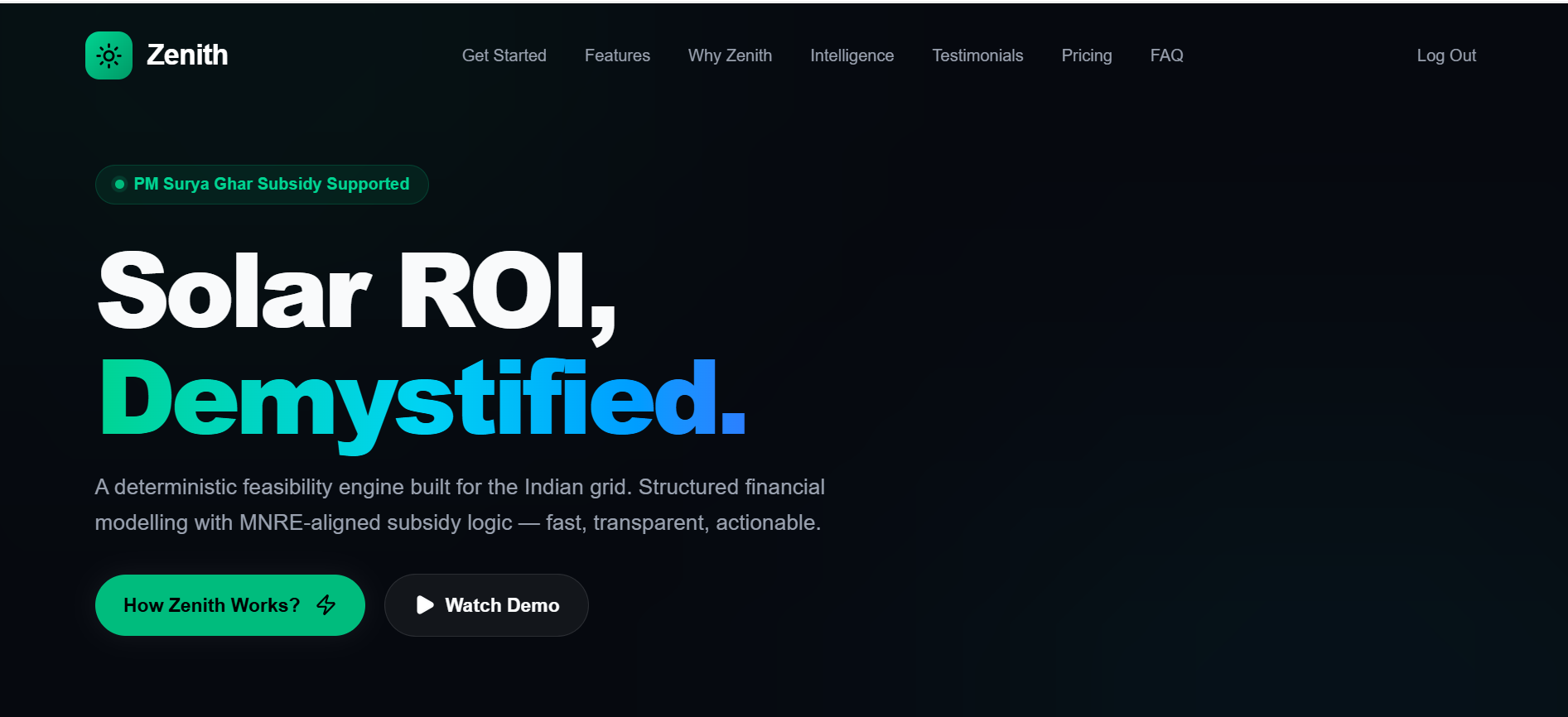
Zenith is an end-to-end energy intelligence platform that helps users adopt solar and then optimizes how that energy is used across communities.
At the individual level, Zenith:
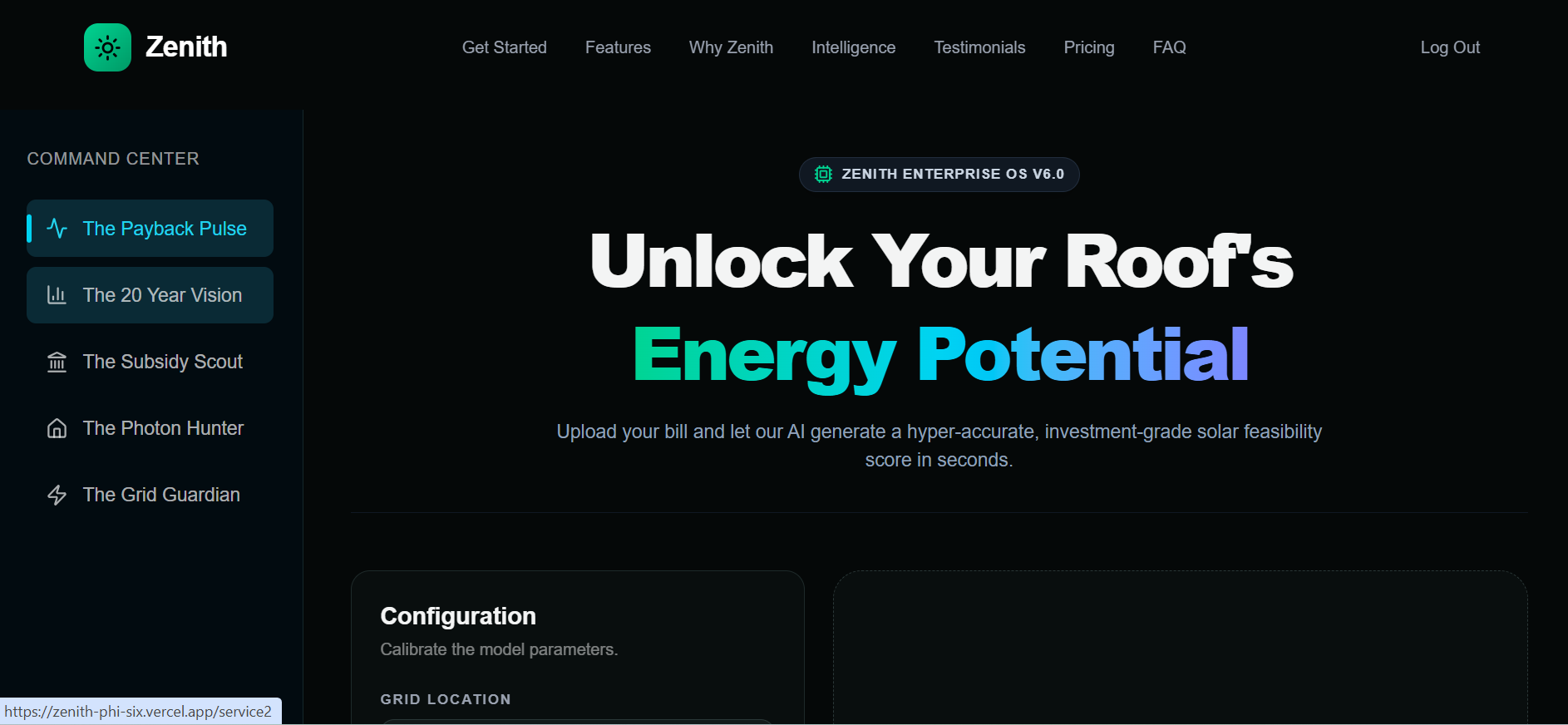
- Parses electricity bills using AI
- Estimates optimal solar system size
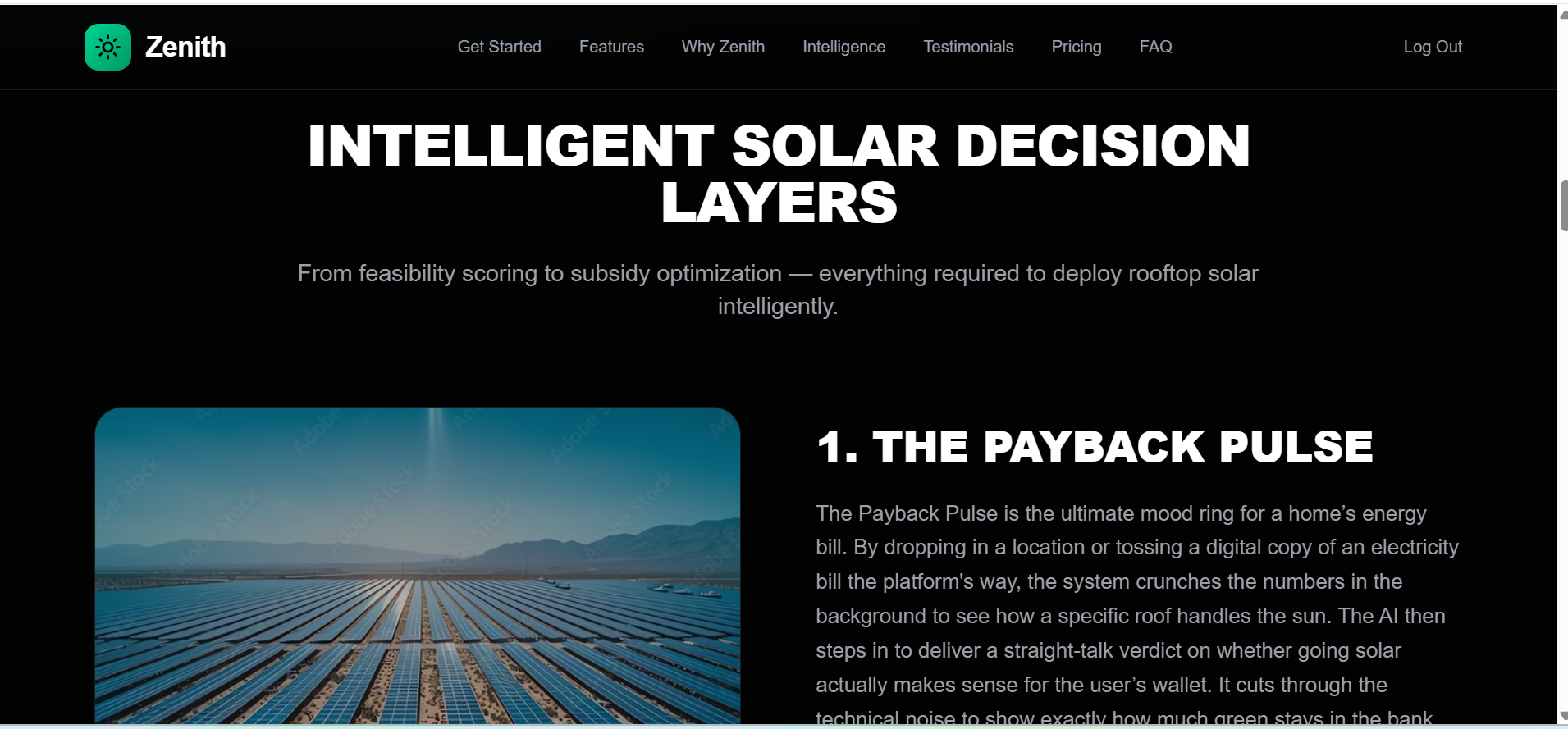
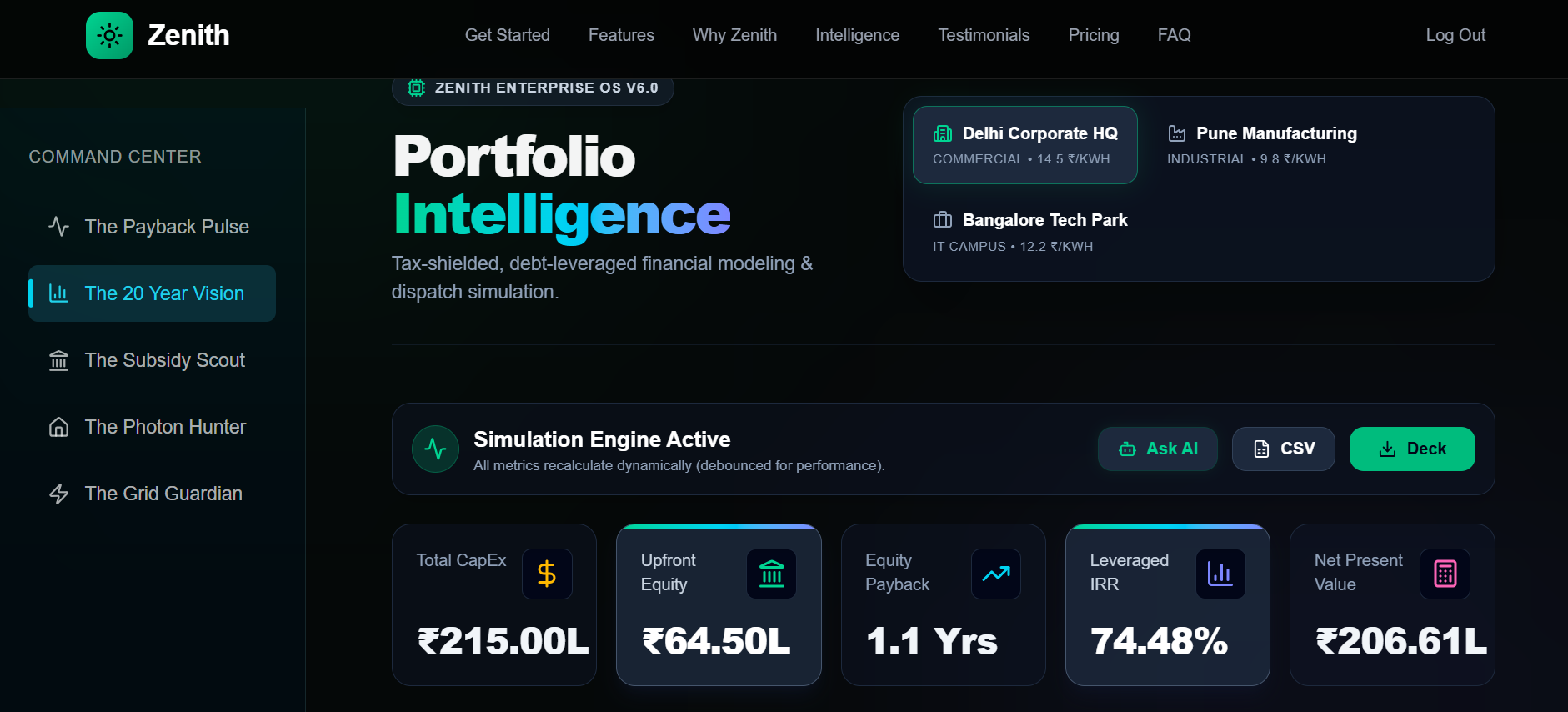
- Calculates installation cost, savings, and payback
- Applies government subsidies
- Provides AI-generated explanations for decision clarity
At the community level, Zenith introduces Lumen Logic, a microgrid optimization engine that powers the GridGuardian interface, a visual control center for real-time energy flow across connected homes:
- Connects multiple homes into a shared energy network
- Enables peer-to-peer energy sharing
- Uses optimization algorithms to route energy efficiently
- Minimizes grid dependency and electricity costs
This transforms solar energy from a passive system into an intelligent, adaptive network.
Implementation
Zenith is designed as a modular, full-stack system combining frontend experience, AI reasoning, and mathematical optimization.
Frontend:
- Next.js + Tailwind CSS
- Clean, dashboard-style UI focused on clarity and usability
AI Layer:
- Gemini API for human-readable explanations
- Bill parsing and insight generation
Core Solar Model:
- System sizing and financial calculations based on real-world assumptions
- Outputs include system size, cost, savings, payback period, and lifetime profit
Optimization Engine (Lumen Logic):
- Built using Linear Programming (PuLP)
- Models energy flow between multiple homes
- Minimizes total cost by balancing grid usage and peer-to-peer energy exchange
- Produces measurable outputs like cost savings and efficiency gains
The core system is functional, with real-time interaction between the frontend and backend optimization engine. Some advanced features are currently demonstrated using controlled simulations to showcase the system’s potential.
Codebase
The complete codebase is available in the project repository.
- Frontend: Next.js + Tailwind CSS
- Backend: Python-based optimization engine (PuLP)
- API integration between frontend and optimization engine
Repository Link: https://github.com/Kataki-Niv/Zenith
Documentation
System Architecture
Zenith is built as a layered system combining frontend interaction, AI reasoning, and optimization logic.
Frontend Layer
- Built using Next.js and Tailwind CSS
- Provides interactive dashboards like GridGuardian
- Handles user input and visualizes optimization results
API Layer
- Acts as a bridge between frontend and backend
- Sends user inputs to the optimization engine
- Returns computed results in JSON format
Optimization Layer (Lumen Logic)
- Implemented in Python using Linear Programming (PuLP)
- Executed via API integration (Next.js → Python runtime)
- Models energy flow between homes
- Minimizes cost by optimizing grid usage and peer-to-peer exchange
AI Layer
- Uses Gemini API for explanations and bill parsing
- Converts technical outputs into user-friendly insights
Demo Access
To explore the platform:
- Website: https://zenith-phi-six.vercel.app/
- Username: [email protected]
- Password: zenith123
Note: This is a demo account with pre-configured data for evaluation purposes.
Data Flow
User Input → Frontend (Next.js) → API Route → Python Optimization Engine (run.py) → JSON Output → UI Visualization (GridGuardian)
Challenges we ran into
The biggest challenge was bridging two different layers of complexity:
- Individual solar decision-making
- Community-level energy optimization
We had to ensure that:
- The system remains technically accurate
- The interface stays simple and intuitive
- Users can understand both financial insights and system-level behavior
Another challenge was integrating optimization logic into a user-friendly workflow. Translating mathematical outputs into meaningful insights required careful design and AI-assisted explanation.
Accomplishments that we're proud of
We are proud that Zenith is not just a concept, but a working system with real-world logic.
We built:
- A functional solar feasibility engine
- Financial forecasting with realistic assumptions
- Subsidy-aware calculations
- AI-powered explanation layer
- A Linear Programming-based optimization engine for microgrid energy flow
Most importantly, we extended the system beyond individual analysis into community-level intelligence, which is rarely addressed in typical solar tools.
What we learned
We learned that renewable energy adoption is not just about installation — it is about optimization.
Solar systems today are underutilized because they lack coordination. By combining structured mathematical models with AI explanations, we were able to bridge the gap between complex optimization and human understanding.
We also learned the importance of designing systems that are both technically sound and accessible to non-expert users.
Practical Relevance
Zenith can be applied in real-world scenarios such as:
- Residential solar communities
- Smart grid systems
- Housing societies with shared energy infrastructure
- Rural microgrids and decentralized energy networks
It enables:
- Reduced electricity costs
- Better utilization of renewable energy
- Lower dependency on centralized grids
This makes it highly relevant for sustainable urban development and future smart cities.
What's next for Zenith
The next step is to make the system more dynamic and scalable.
We plan to:
- Introduce real-time simulation with changing demand and weather
- Improve battery modeling and storage optimization
- Expand from 3-node simulation to larger microgrids
- Integrate live data sources for real-world deployment
- Enhance rooftop analysis accuracy
Our long-term vision is to evolve Zenith into a decentralized energy intelligence platform that powers smart, self-sustaining communities.
Team Information
- Nivedana – Backend Development, Optimization Engine (Lumen Logic), System Design
- Ayush– Frontend Development, UI/UX (GridGuardian Interface)
Built With
- framer-motion
- google-gemini-api
- next.js
- pulp-(linear-programming)
- python
- react
- react-three-fiber
- recharts
- tailwind-css
- three.js
- typescript
- vercel

Log in or sign up for Devpost to join the conversation.