About Zen AI: A Journey into Digital Wisdom
Inspiration
The inspiration behind Zen AI stemmed from a deep-seated belief that profound spiritual guidance and self-understanding shouldn't be a luxury, but accessible to everyone. Many people grapple with life's big questions: seeking purpose, navigating challenges, yearning for happiness, harmonious relationships, and success. We often search for answers in various places, but when questions become truly complex, the wisdom of a seasoned mentor or guru is invaluable. However, such guidance is not always within reach, leaving individuals to face their problems alone or try disparate advice with limited success.
Zen AI was conceived to bridge this gap. The vision was to create a personal, digital guru – an AI companion that could synthesize ancient wisdom with modern technology to offer truly personalized insights. I wanted to build a tool that could understand an individual on a deep level, much like a real-life mentor, and provide tailored advice to help them navigate their unique path.
What I Learned
This project has been an incredible learning journey, both technically and conceptually:
- The Power of AI for Personalization: Working with the Gemini API revealed the immense potential of Large Language Models to process complex, multi-faceted information and generate nuanced, human-like responses. Crafting prompts to guide the AI to act as an empathetic and wise spiritual mentor was a fascinating challenge in itself.
- Integrating Diverse Esoteric Systems: Bringing together astrology (natal charts, transits), numerology (life path, soul numbers), chakra diagnostics, and Zen philosophy into a cohesive analytical framework was a core learning. It required understanding the essence of each system and finding ways for the AI to cross-reference and synthesize insights from all of them.
- UI/UX for Spiritual Exploration: Designing an interface that is both intuitive for inputting personal data and engaging for exploring complex spiritual results was crucial. The goal was to make the journey of self-discovery feel welcoming, insightful, and not overwhelming. This involved iterating on how to present information like chakra states, life event probabilities, and personalized recommendations.
- The Importance of Responsible AI: Developing an application that touches upon such personal and sensitive aspects of a user's life underscored the importance of ethical considerations, data privacy, and framing AI-generated advice responsibly (e.g., health disclaimers, emphasizing probabilities over certainties).
- Frontend Development with React & TypeScript: Building the application with React, TypeScript, and Tailwind CSS provided a robust and scalable foundation. Implementing features like internationalization (i18n), dynamic content loading, and state management for a multi-screen application solidified many frontend development skills.
- Localization Challenges: Ensuring the app and its AI-generated content could be effectively localized (initially for Russian and English) involved careful planning of translation keys and ensuring the AI could adhere to language instructions for its output.
How Zen AI Was Built
Zen AI is a React-based single-page application (SPA) built with TypeScript for type safety and enhanced developer experience.
Core Technology:
- Frontend: React, TypeScript, Tailwind CSS for styling.
- AI Engine: The Google Gemini API (
gemini-2.5-flash-preview-04-17model) is the heart of the application, used for both generating the comprehensive spiritual profile and powering the interactive chat. - Astrology Data
Key Features & Implementation:
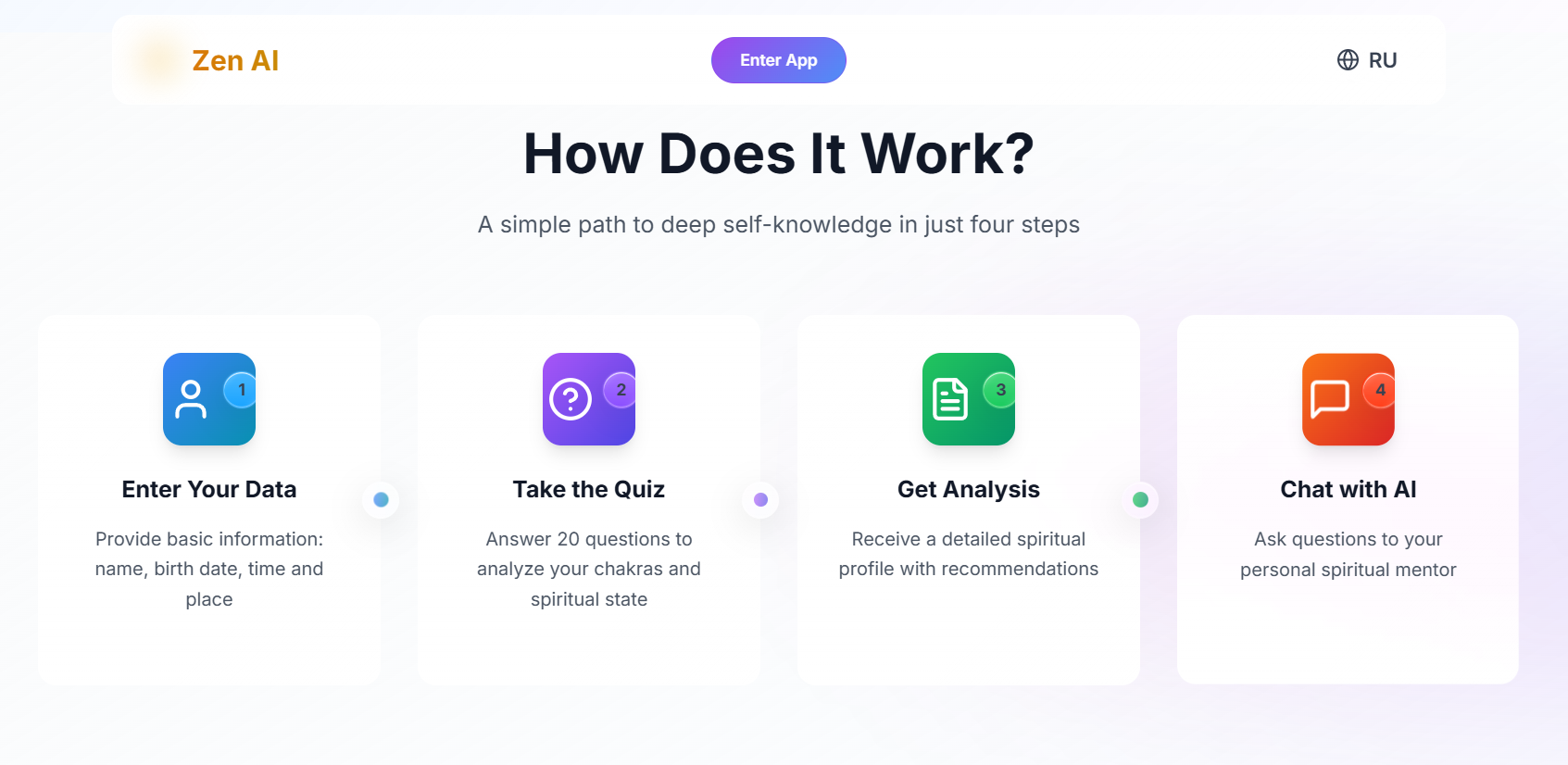
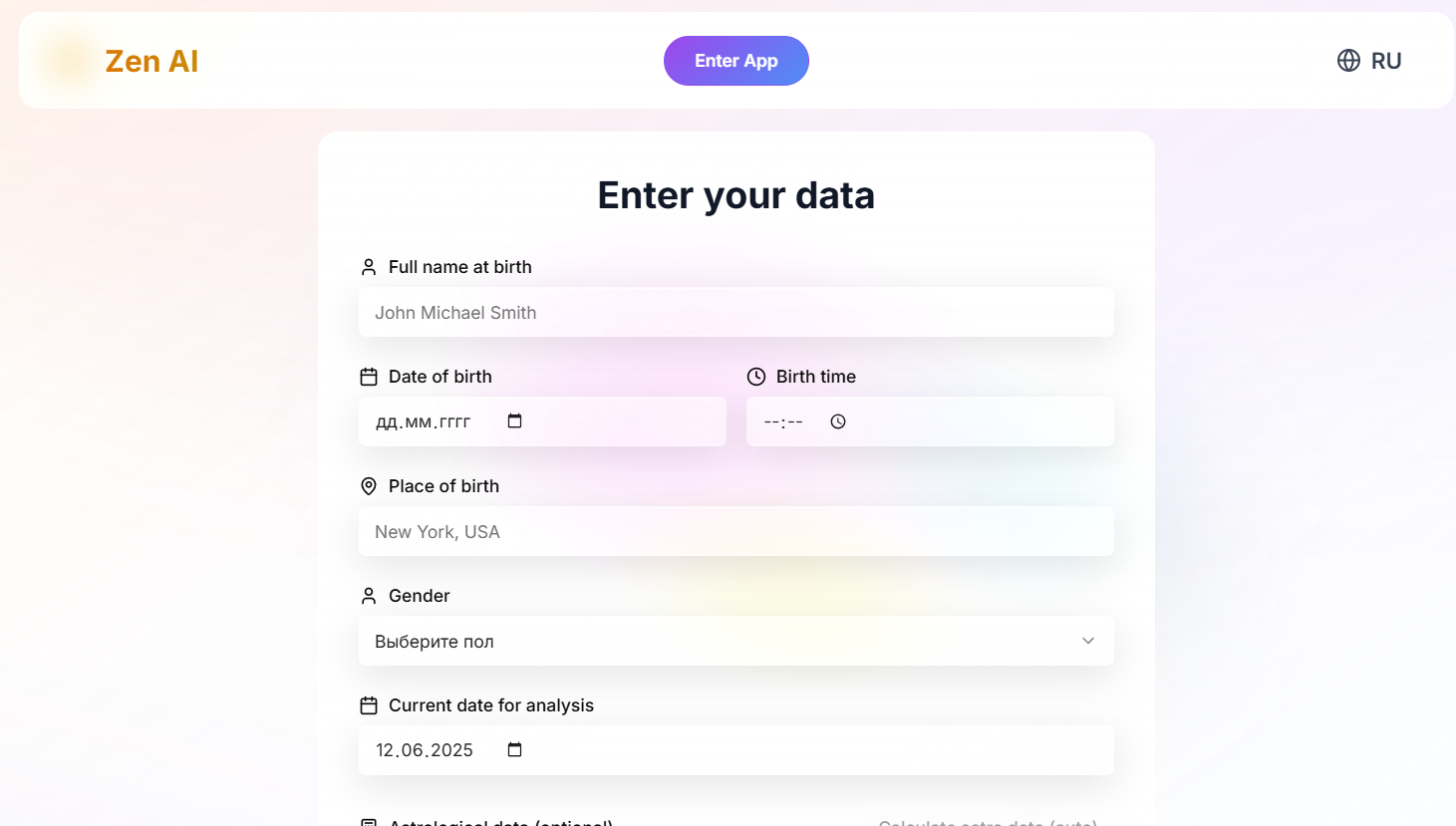
- User Data Input: A multi-field form captures birth data, name, and gender, which are crucial for astrological and numerological calculations.
- Questionnaire: A series of 20 carefully crafted questions helps the AI assess the user's current state concerning Zen principles and chakra energies. Each question and its options are designed to provide specific data points for the AI.
- AI Prompt Engineering: Extensive prompt engineering was undertaken to instruct the Gemini API to:
- Synthesize information from user data (birth details, astrological input, numerology) and questionnaire answers.
- Adhere to a specific JSON output structure for the spiritual profile, covering various sections like spiritual level, chakra analysis, past life insights, life areas, forecasts, and recommendations.
- Adapt its analysis and language for minors.
- Maintain an empathetic, wise, and supportive tone.
- Handle localization for its responses.
- Spiritual Profile Generation: Based on the aggregated data, the AI generates a detailed spiritual profile.
- Chakra Analysis: The AI provides an overall summary and individual analysis for each of the 7 major chakras, including their state, potential issues, and recommendations. This is dynamically updated via chat if new insights emerge.
- Interactive Chat: A dedicated chat interface allows users to ask follow-up questions. The Gemini API (Chat model) uses the generated spiritual profile as context to provide relevant and personalized answers. The chat can also dynamically update parts of the spiritual profile.
- Results Display: A comprehensive UI presents the spiritual profile in an organized and readable manner, with expandable sections for detailed information.
- Localization: The application supports English and Russian, with UI strings managed via an
I18nContextand JSON files. The AI is also instructed to respond in the selected language. - Save/Restore Profile: Users can save their complete profile (user data, answers, AI-generated profile, chat history) as a JSON file and restore it later, allowing them to continue their journey.
- PDF Export: Functionality to export the spiritual profile content to a PDF document using
jsPDFandhtml2canvas.
Challenges Faced
- Complex Prompt Engineering: Getting the AI to consistently produce the desired depth of analysis, adhere to the complex JSON structure, handle conditional logic (like for minors or skipped questions), and maintain the persona of a "Zen Guru" across different languages required significant iteration and refinement of the prompts.
- Balancing Esoteric Systems: Ensuring that no single system (astrology, numerology, chakras, Zen) overly dominated the analysis and that the AI could create a truly holistic synthesis was a constant balancing act.
- Ethical AI and Responsible Guidance: Providing spiritual advice through AI carries responsibility. It was challenging to ensure the AI's responses were supportive, non-judgmental, avoided making definitive medical or fated claims, and encouraged users to seek professional help when necessary. Disclaimers and careful wording were key.
- UI for Complex Information: Presenting a large amount of deeply personal and sometimes abstract information in a way that is digestible, engaging, and not overwhelming was a significant UI/UX challenge. The use of expandable sections, clear headings, and visual cues (like for chakras) was part of the solution.
- State Management in React: Managing the application's state across data input, multiple question screens, results display, and an interactive chat (which can update the results) required careful state management.
- API Key Management (Conceptual): While the API key is handled via environment variables as per guidelines, the conceptual challenge is always ensuring such sensitive information is managed securely in any deployment scenario.
- Astrological Data Integration:
Despite these challenges, building Zen AI has been a deeply rewarding experience, pushing the boundaries of how AI can be used for personal growth and spiritual exploration.
Built With
- clsx
- date-fns
- form
- framer
- gemini)
- hook
- lucide
- next.js
- rapidapi
- shadcn/ui
- sonner
- tailwind
- typescript
- zod

Log in or sign up for Devpost to join the conversation.