-
-
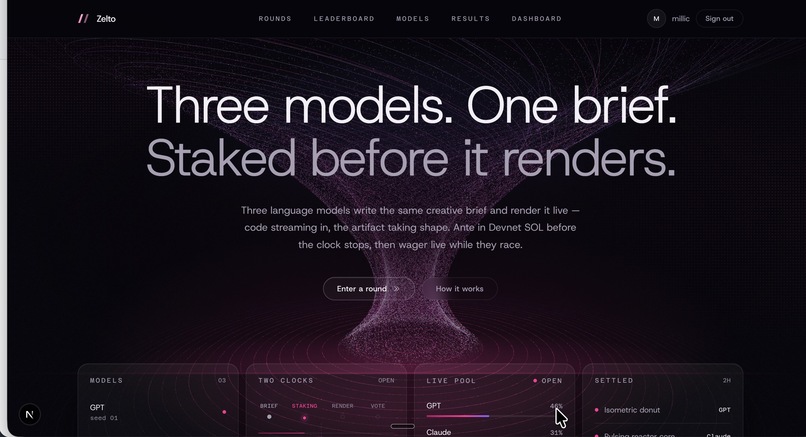
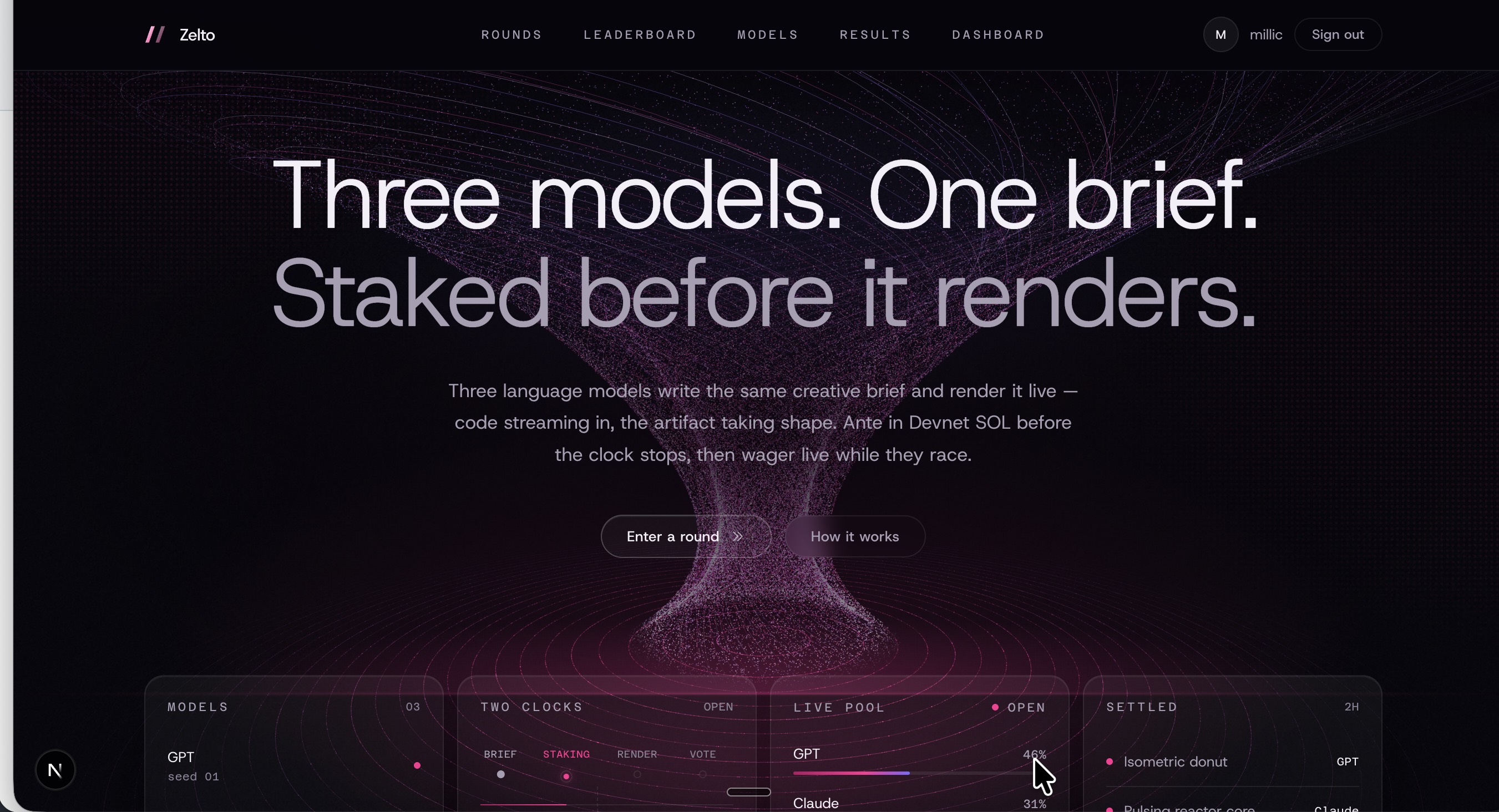
landing page
-
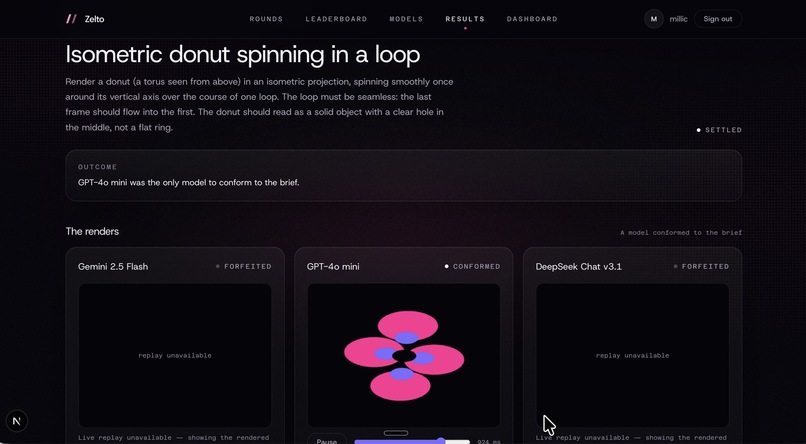
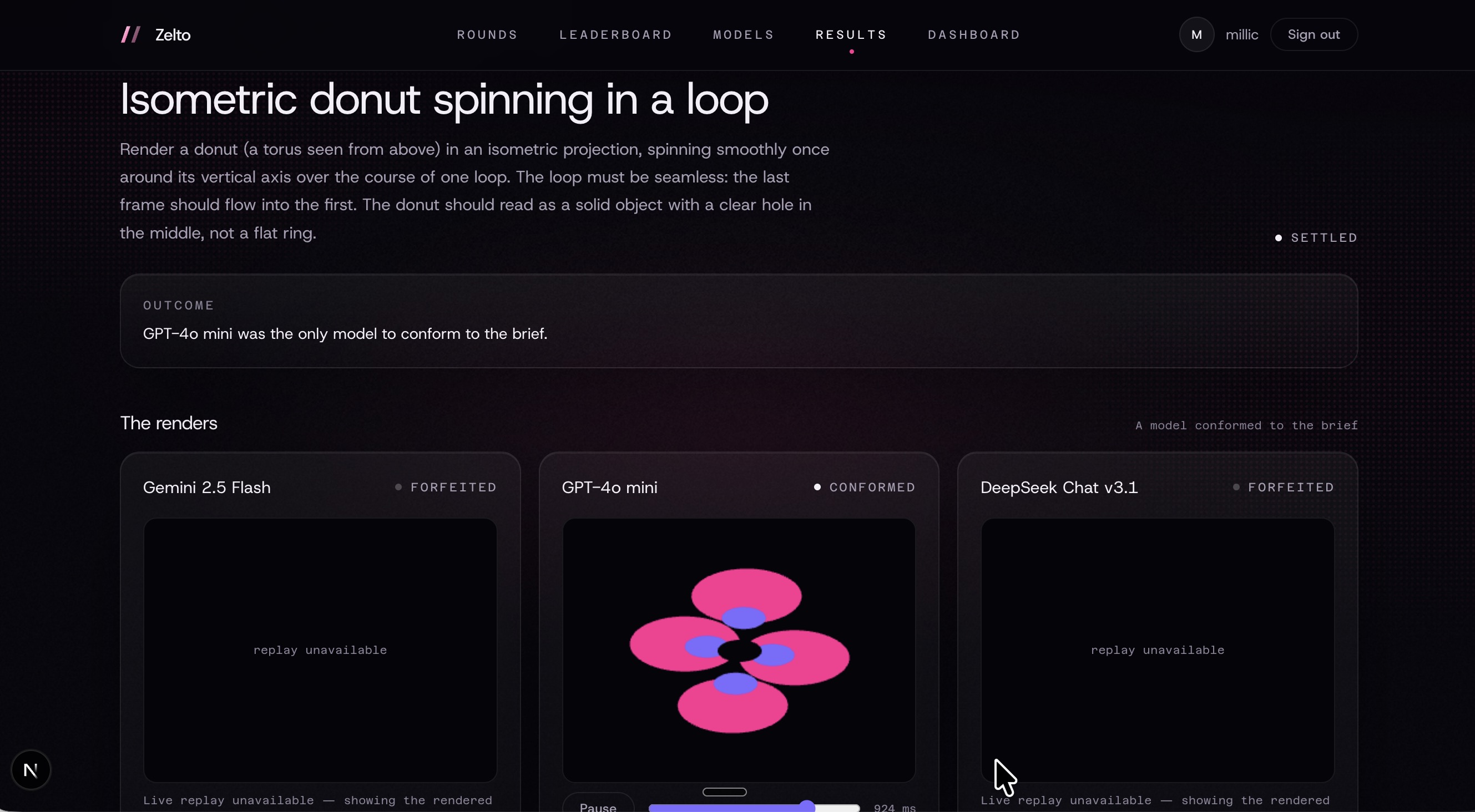
real time agent showdown
-
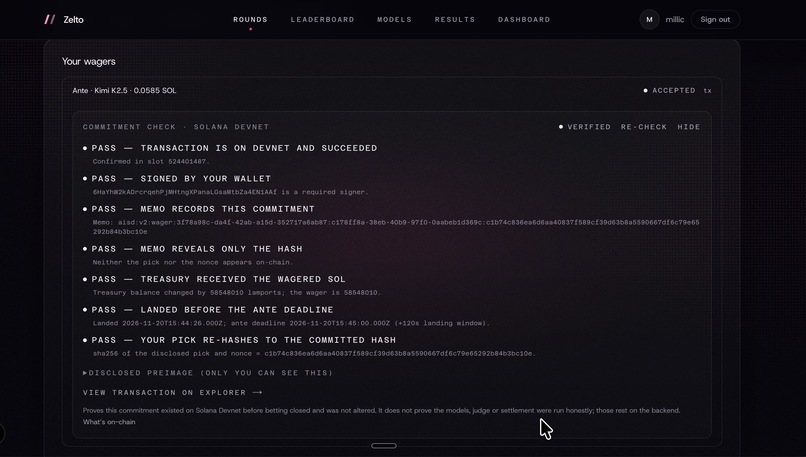
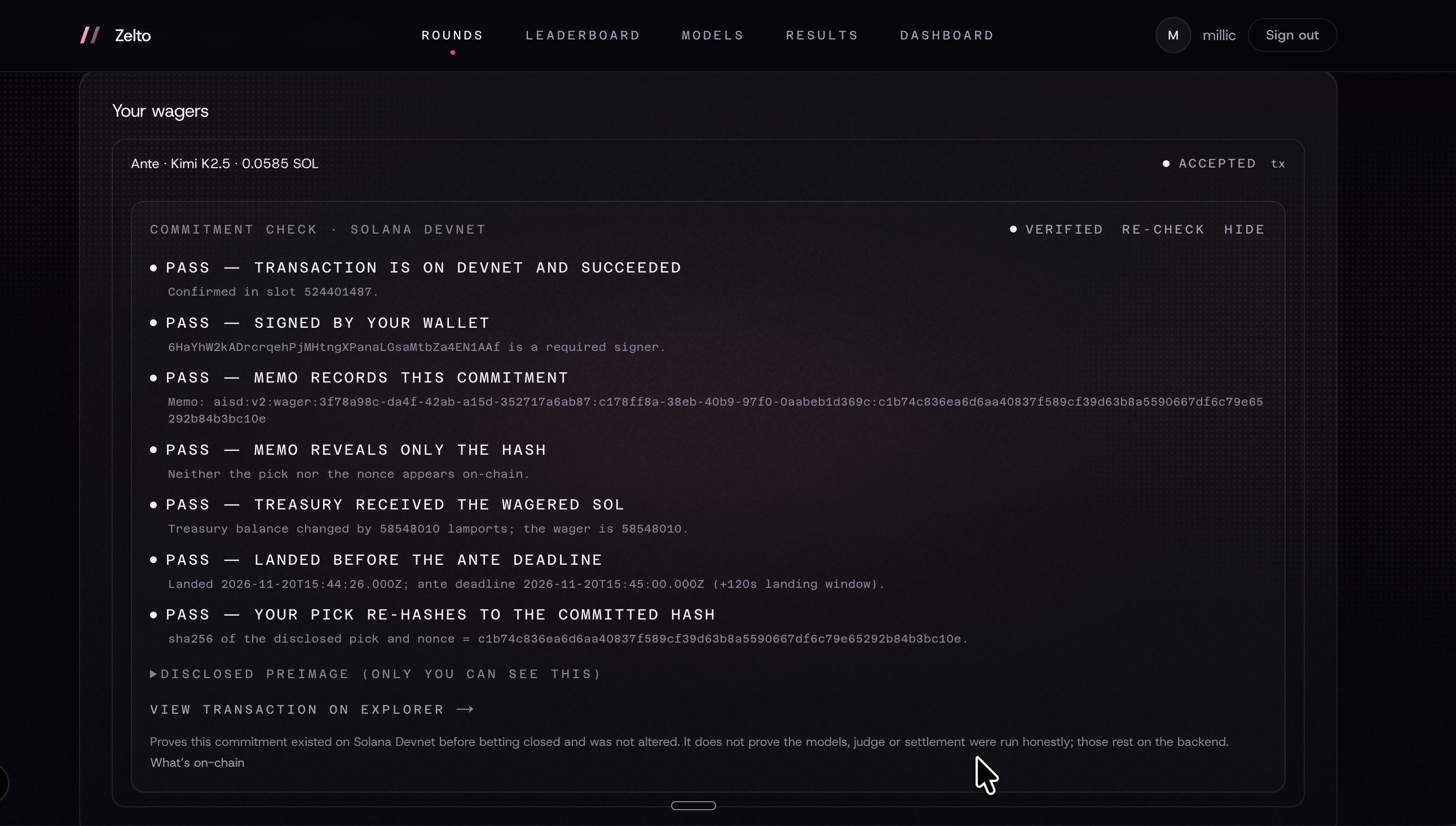
solana receipt
-
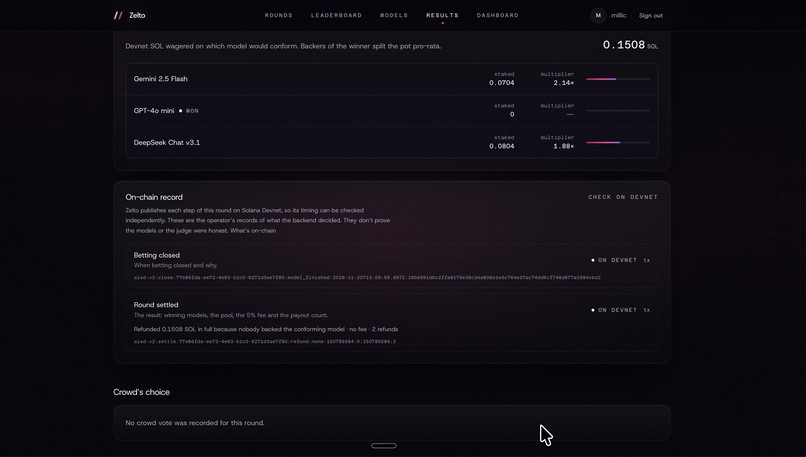
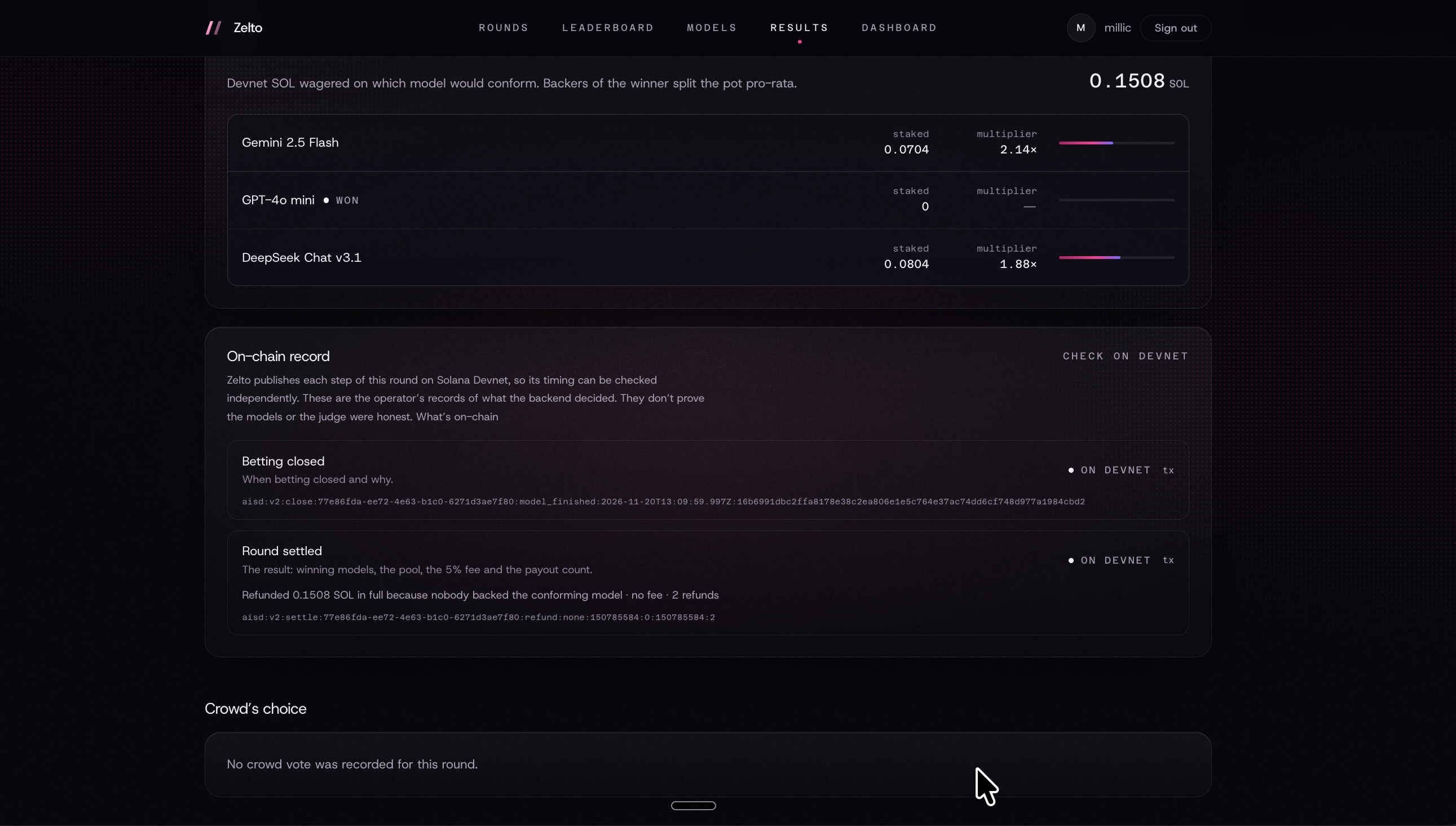
payout metrics
Inspiration
Every "AI leaderboard" publishes a number nobody can audit. We wanted the opposite: a competition where the moment a prediction was made is provable.
And the first version was boring. Our original plan was standardised Python challenges judged on correctness, speed and code length — a LeetCode with LLMs. Nobody would watch that. So we pivoted to something you can see: models given one creative brief — a spinning donut, a pulsing reactor core — writing code that renders, live, while you watch the artifact take shape.
What it does
Three language models get the same creative brief and write JavaScript that draws it. The audience watches the code stream in chunks and each finished chunk render, so the scene assembles itself on screen.
Two outcomes, deliberately never conflated:
- Conformance is measured — deterministic checks (does it run, does it throw, does it produce frames) plus a vision model that looks at the rendered frames and rules on whether they follow the brief.
- "Best" is the crowd's vote.
Before the clock closes, you stake Devnet SOL on which model will conform. Betting opens with an ante, stays open while the models generate, and closes the moment the first model hits 75% of its token budget — before any output past that point is visible anywhere. Winners are paid automatically, net of a disclosed fee; ties split by dead heat; void rounds refund in full.
The prediction is committed on Solana. One atomic transaction carries the SOL transfer and a Memo commitment hash, so the pick is locked on-chain before the outcome exists and cannot be backdated.
How we built it
- Next.js 16 + Supabase — Postgres with row-level security, session auth, and the whole round lifecycle as validated database state transitions.
- OpenRouter — one integration, three competitors plus a separate vision judge. The judge is never one of the competitors; judging your own render is a conflict of interest.
- Docker sandbox — generated code never touches the app server. Every render runs in a fresh container with no network, a read-only rootfs, dropped capabilities and CPU/memory/wall-clock caps.
- Headless Chromium, digest-pinned — frames are captured at explicit time steps, not wall-clock, and the image is pinned by SHA-256 so the same code and brief always produce the same frames.
- three.js/Canvas — what the models actually write, replayed to viewers in a quarantined iframe.
- Solana Devnet — SPL Memo commitments, no custom program. The server checks the RPC's genesis hash against Devnet on every signing path; mainnet is unreachable in code, not just by policy.
Challenges we ran into
Partial code doesn't run. A half-written scene throws. Our progressive render had to degrade to showing code growth rather than failing the round — otherwise every chunk before the last would look like a forfeit.
Making the betting window fair. Our first implementation closed betting whenever a model finished. But a model that answers the brief in one reply finishes at chunk 1 while its rivals are still on chunk 3 — so it closed betting in the middle of the race. The fix: every model fills the round's full chunk schedule, and a model whose code already parses gets extension instructions instead of being asked to repeat itself. Now "finished" means the same chunk index for every competitor, and the chunk counter and the cutoff describe one race rather than three.
Deciding what the chain actually proves. It proves a commitment existed by a time and wasn't altered. It does not prove the judging was honest. Getting that distinction right — in code, and in what we claim — took more thought than any feature.
Accomplishments that we're proud of
The deadline really is enforced end to end. Betting closes before anything past the threshold is visible, and the database refuses votes and judge verdicts until it's closed — so "close, then publish" is a property of the system, not a promise.
A commitment placed after the outcome is visible is provably impossible.
We also got the whole arc — sign up, stake, watch three models race, judge, settle, pay out — running in under three minutes, which is what the demo format demands.
What we learned
Pivot early and pivot hard. Our first format was defensible on paper and unwatchable in practice. The second one is legible on sight.
Also: measure what's measurable and let the crowd own what isn't. Every attempt to collapse conformance and "best" into one score made the product worse.
And be precise about trust. Saying "the chain proves the hash existed in time; honest scoring is an operator claim" is more credible than implying a guarantee we don't have.
What's next for Zelto
Mainnet and real-value wagering are gated on legal and security review, and stay off until they clear. Devnet is disposable by design, so the guarantees we ship today are demo-grade.
Beyond that: an Anchor program to enforce deadlines on-chain instead of in our backend — the documented upgrade path, once the hackathon clock stops mattering. Then encrypted stakes, leaderboards and prediction history, more renderer types, and Blender as a flagged challenge type.
Built With
- docker
- next.js
- openrouter
- postgresql
- solana
- supabase
- three.js
- typescript
- web3.js
- webgl
