Zeltho: Building an AI Security Agent That Humans Can Actually Trust
Inspiration
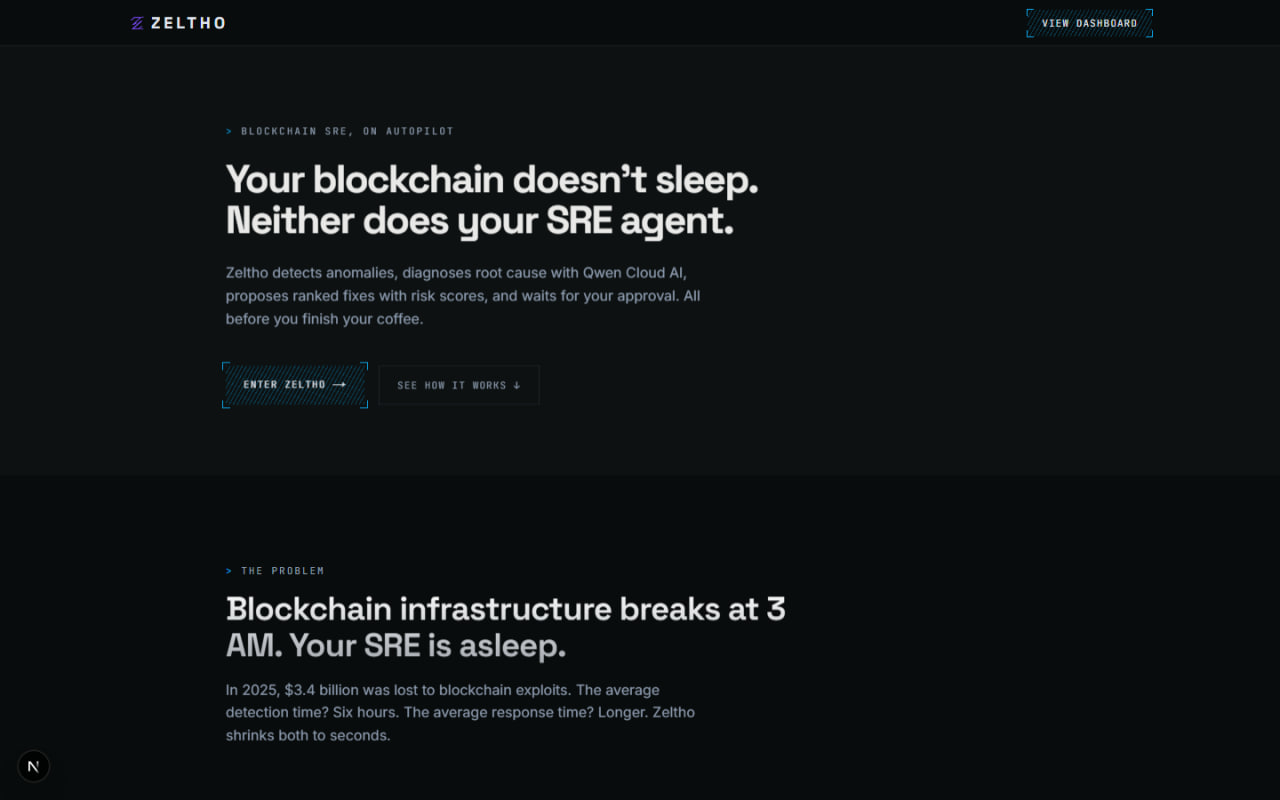
According to Chainalysis, more than $3.4 billion was stolen from crypto protocols in 2025. Most exploits are detected in hours, not seconds, leaving security teams reacting long after funds have already moved.
While researching existing security tooling, we noticed another problem. Most automated response systems operate like black boxes. They may recommend a fix, but they rarely explain why that fix was chosen. That makes it difficult for teams to trust autonomous systems with infrastructure that protects real assets.
We wanted to build something different.
Our goal was an AI security agent that responds fast enough to matter while remaining transparent enough that a human stays in control of every irreversible action.
What Zeltho Does
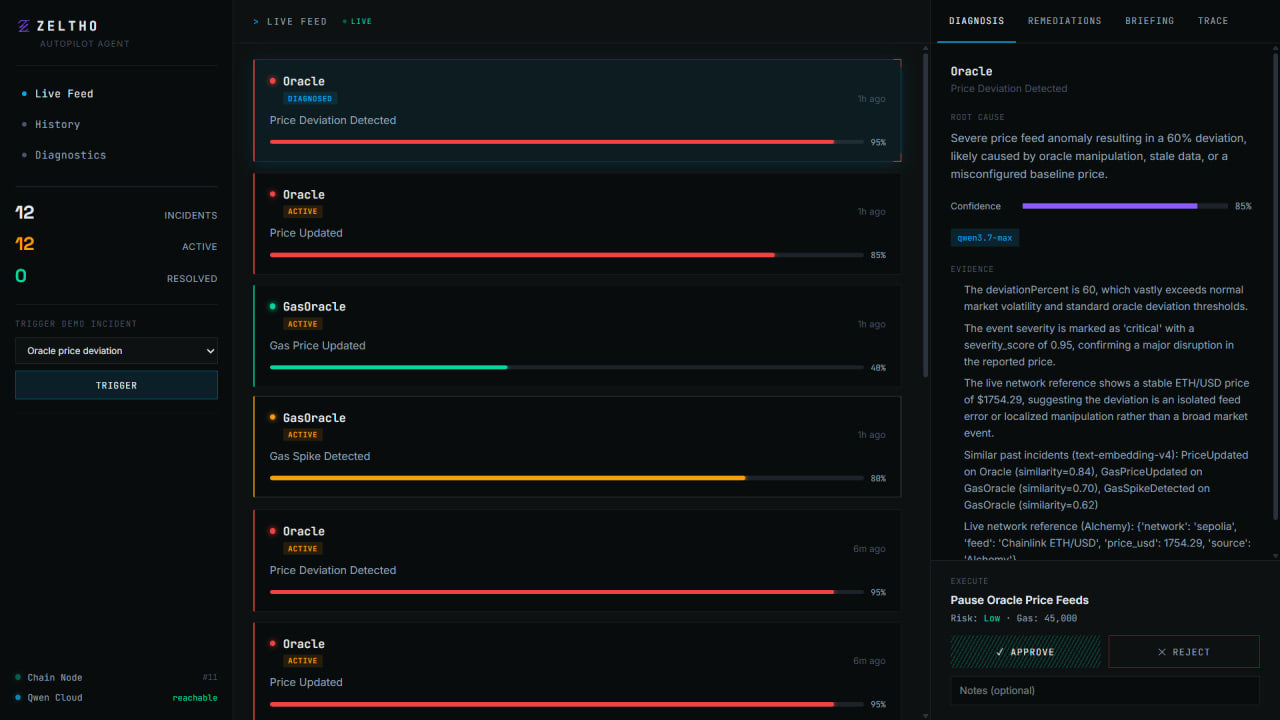
Zeltho is an end-to-end incident response agent that operates on real blockchain infrastructure through a five-stage pipeline:
Detect → Diagnose → Remediate → Approve → Execute
Instead of relying on static datasets or simulated responses, every stage interacts with live services.
The event listener continuously polls the blockchain every two seconds and performs an initial severity classification using Qwen 3.6 Flash.
For deeper investigation, Qwen 3.7 Max performs root-cause analysis using:
- Live Alchemy reference data
- Real Sepolia gas prices
- Live Chainlink ETH/USD pricing
- Historical incident retrieval using text-embedding-v4
- Incident ranking with Qwen 3 Rerank
Once the incident is understood, Qwen 3.7 Plus generates three ranked remediation strategies, each including:
- Risk score
- Estimated gas cost
- Recommended execution path
Most importantly, nothing executes automatically.
Every irreversible action requires explicit human approval before any transaction is submitted.
To demonstrate the entire workflow, the dashboard includes a "Trigger Demo Incident" button that submits a genuine on-chain transaction, allowing anyone to watch the complete pipeline execute in real time.
How We Built It
Our stack combines modern web technologies with multiple AI systems working together.
Frontend
- Next.js 16
- Vercel
Backend
- FastAPI
- Python 3.11
- Railway with persistent storage
Blockchain
- Hardhat
- Five Solidity smart contracts
AI Stack
Five independent Qwen Cloud models perform specialized tasks instead of sharing a single responsibility.
Additional components include:
- Hermes Agent (NousResearch) using Alibaba's documented
provider="alibaba"integration - Direct Alchemy JSON-RPC calls
- Live Chainlink price feeds
Hermes is responsible for generating plain-English incident briefings that summarize technical findings for operators.
Proof of Alibaba Cloud integration is available in:
backend/config.pybackend/hermes_briefing.py
The complete system architecture is documented in:
README.mddocs/ARCHITECTURE.md
Challenges We Faced
Building a production-quality security workflow uncovered several real engineering problems.
External security audits identified multiple issues, including:
- A CORS middleware ordering bug that caused our own error responses to bypass CORS entirely.
- Railway's edge proxy rewriting client IP addresses, silently defeating our rate limiter until we correctly handled
X-Forwarded-For. - A nonce race condition in the demo incident trigger, resolved by assigning separate accounts to each scenario.
- A production outage caused by a Railway dashboard misconfiguration, which we recovered from and verified.
- Ephemeral storage that erased application state after every deployment, solved by migrating to persistent volumes and validating persistence through trigger → redeploy → recovery testing.
Rather than simply patching these issues, every fix was verified against the live deployment.
What We Learned
The biggest lesson wasn't about AI—it was about trust.
Adding a human approval button is easy.
Designing a system where every step leading up to that approval is transparent, explainable, and capable of failing loudly instead of silently is much harder.
The CORS bug and rate-limiting issue reinforced how seemingly small infrastructure problems can quietly undermine an otherwise reliable AI pipeline.
Building trustworthy AI requires just as much attention to operational engineering as it does to model quality.
Accomplishments We're Proud Of
Some highlights from the project include:
- Five specialised Qwen Cloud models collaborating across the pipeline.
- A real Hermes Agent integration powered by Alibaba Cloud.
- Live blockchain and market reference data instead of fabricated values.
- Multiple vulnerabilities were discovered through independent security reviews and verified as fixed in production.
- A fully observable, human-in-the-loop workflow where every critical action remains under operator control.
What's Next
Our roadmap focuses on making Zeltho even more production-ready.
Upcoming work includes:
- Deploying to Alibaba Cloud ECS alongside the existing infrastructure.
- Building a fully responsive mobile dashboard.
- Expanding anomaly detection beyond the current five demonstration scenarios.
- Performing large-scale concurrent load testing.
- Continuing to improve explainability so operators understand not only what Zeltho recommends, but why it recommends it.
Built With
- alchemyapi
- dashscope
- ether.js
- fastapi
- hardhat
- hermes-agent
- next.js
- python
- qwen
- railway
- react
- solidity
- typescript
- vercel
- web3py


Log in or sign up for Devpost to join the conversation.