-
-
zbrain_hospital_flow_optimization.jpg
-
zbrain_ai_imaging_workflow.png
-
zbrain_metrics_dashboard_comparison.png
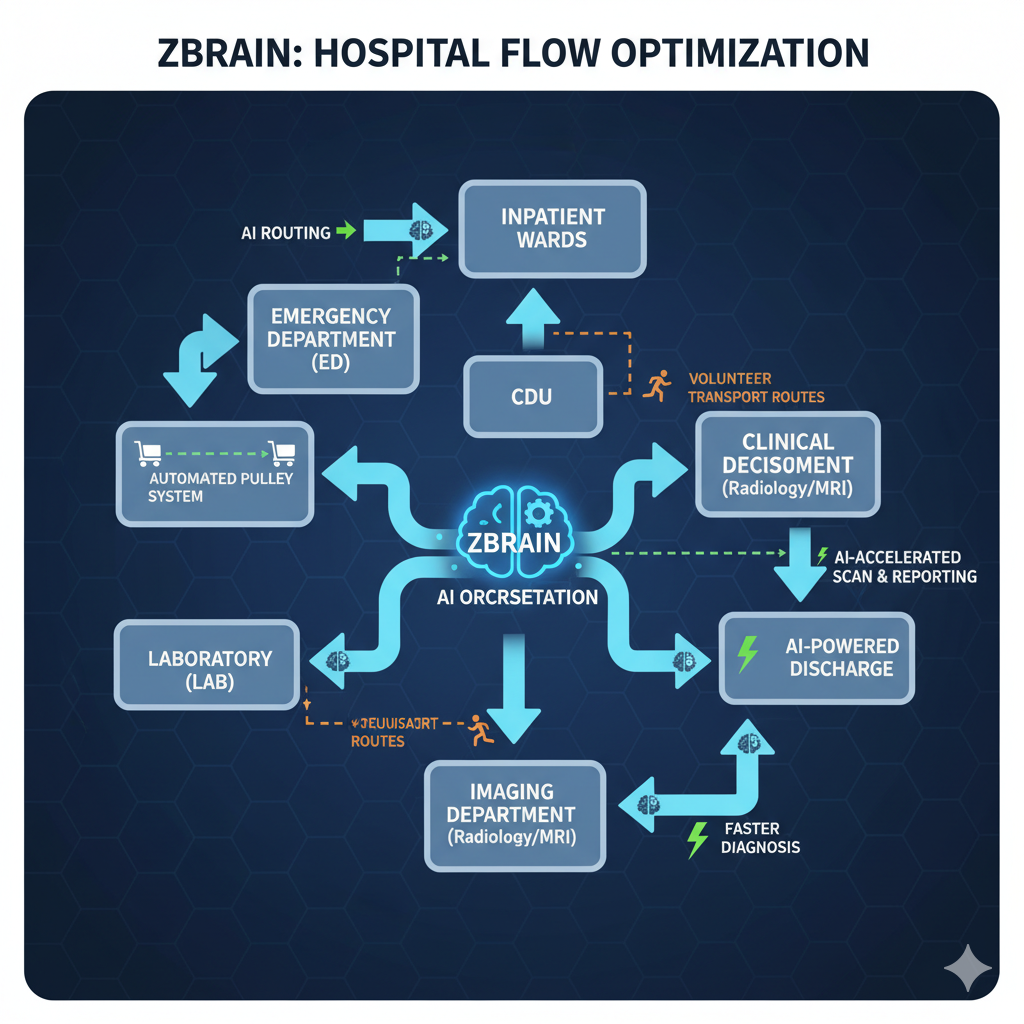
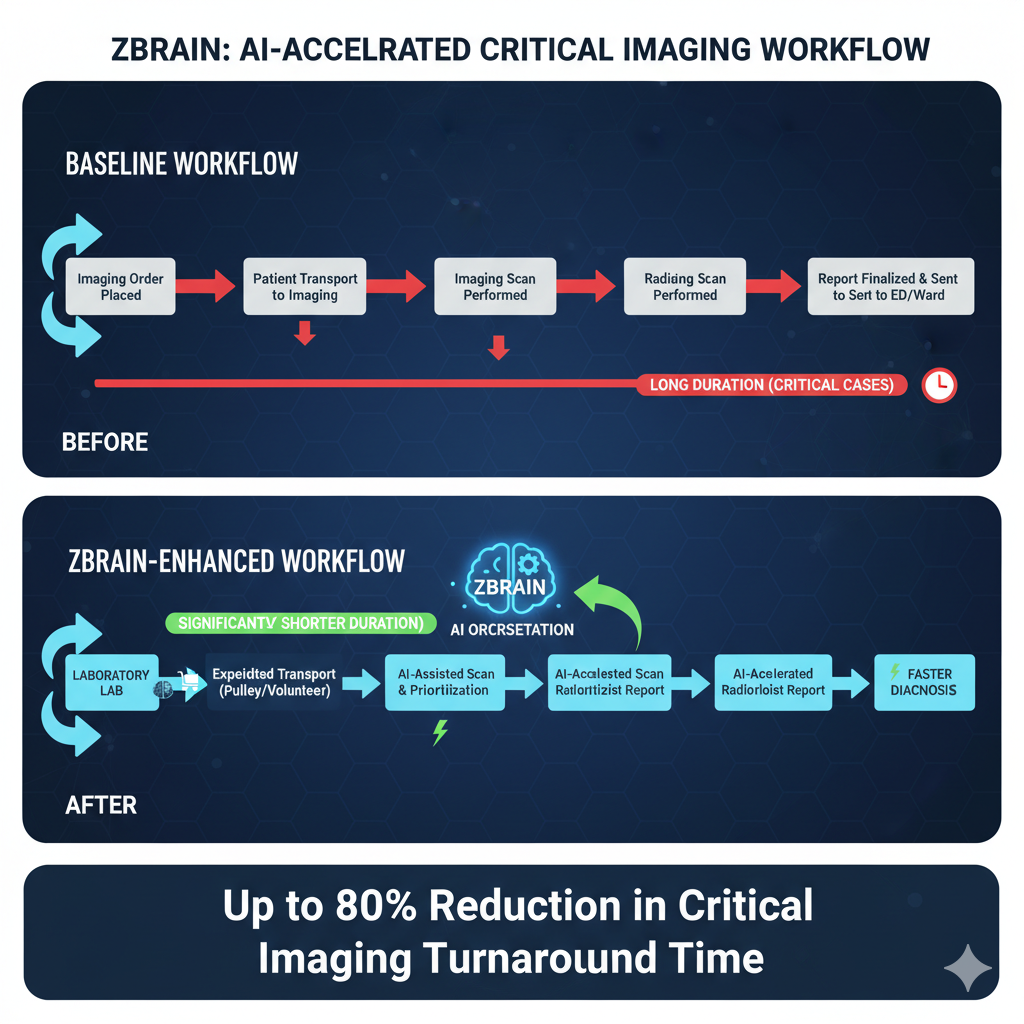
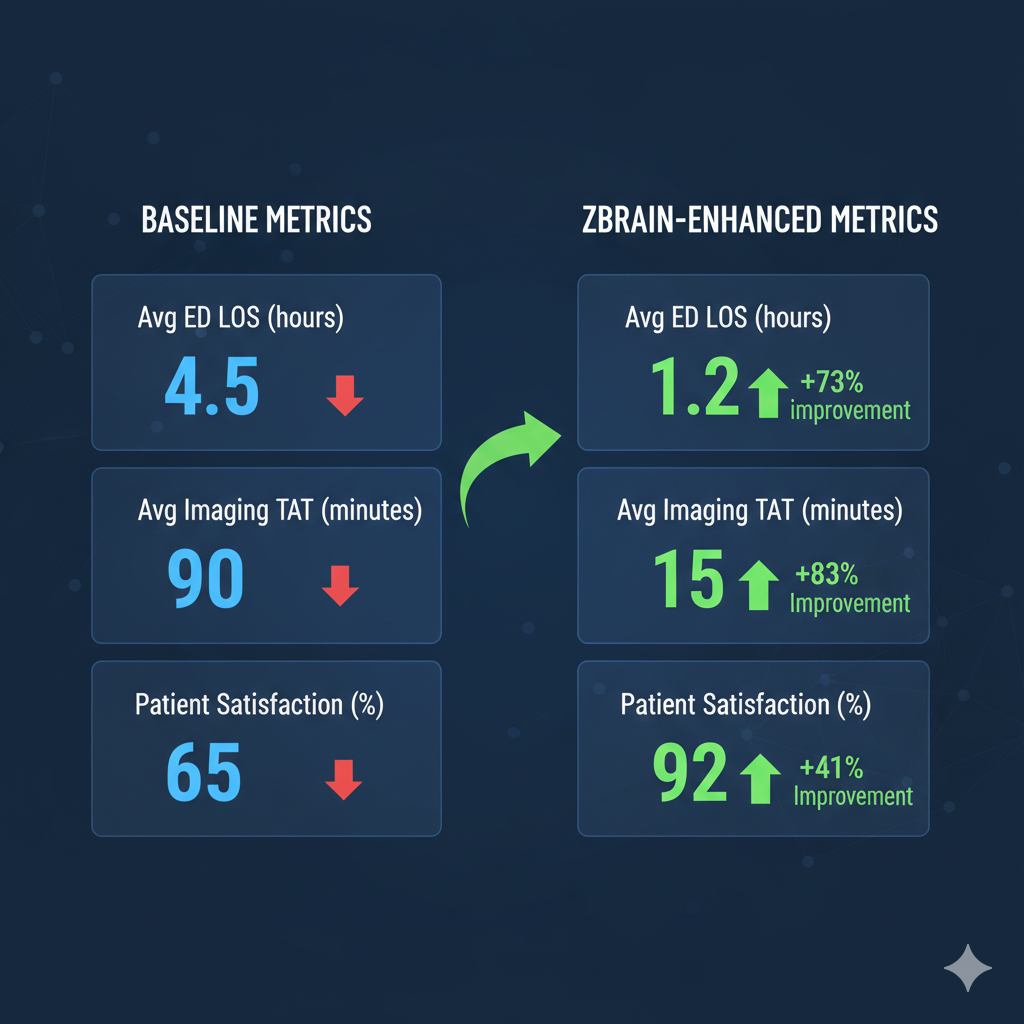
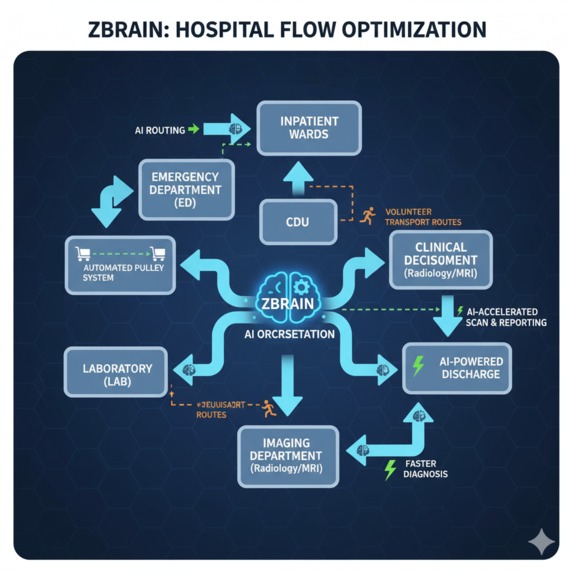
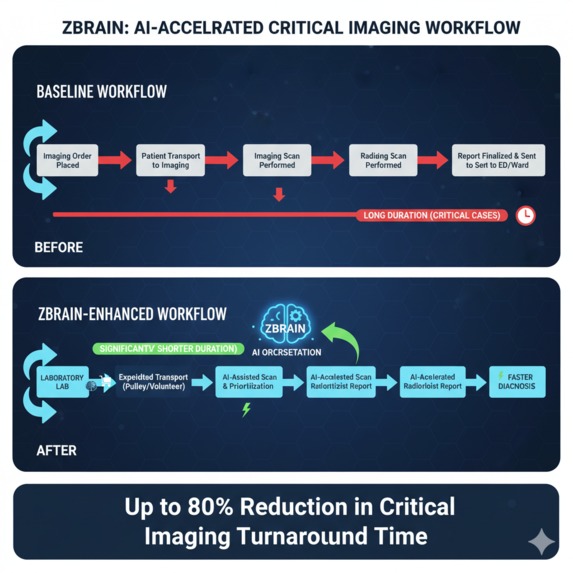
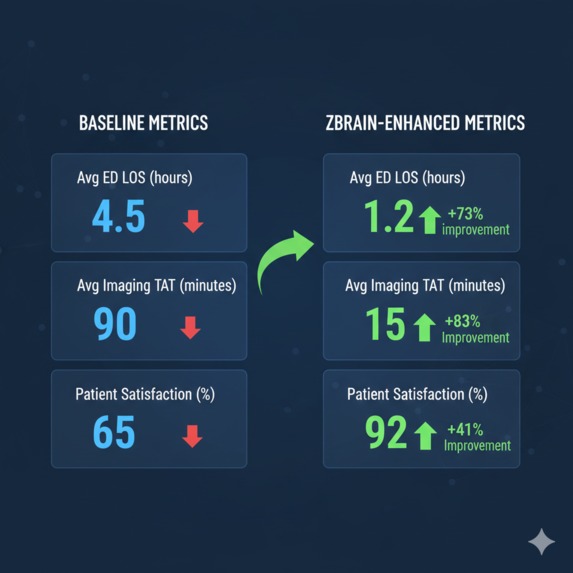
Inspiration Our inspiration stems from the critical, systemic inefficiencies plaguing modern healthcare: the immense financial burden, chronic staff shortages, and patient journeys marred by excessive wait times and delayed diagnoses. We envisioned a future where hospitals operate with the agile, intelligent, and multitasking spirit of an octopus – optimizing every resource, every patient journey, and every staff interaction with precision. This led us to develop ZBRAIN, an AI-powered framework designed not just to identify bottlenecks, but to autonomously implement quantifiable solutions that transform hospital operations and enhance patient care. The goal was to prove that significant gains in efficiency, patient satisfaction, and cost-effectiveness are not just aspirational, but achievable through intelligent system design. ## How we built it ZBRAIN was meticulously built using Python 3.x as its core language, employing a Discrete Event Simulation (DES) methodology. This allowed us to model the entire hospital ecosystem, processing events—from patient arrivals and triage to diagnostics, transfers, and discharges—in chronological order. Key Python libraries like heapq managed our event queue, random introduced realistic variability, and collections facilitated robust data handling. The "AI-driven enhancements" are represented by configurable parameters within the simulation (e.g., AI_ENABLED_IMAGING, PULLEY_SYSTEM_CAPACITY, VOLUNTEER_TRANSPORT_STAFF). These parameters quantify the optimal strategies and efficiencies recommended by an overarching AI planning system. For instance, the reduction in imaging turnaround time due to AI could be conceptually expressed as $\text{TAT}{\text{AI}} = \text{TAT}{\text{Baseline}} \times (1 - \text{AI_Reduction_Factor})$, directly integrated into our event processing. This approach enabled us to rapidly prototype, test, and quantify the transformative impact of AI-powered operational changes with high fidelity. ## Challenges we ran into One of our primary challenges was accurately modeling the complex, interconnected dependencies within a hospital system. Delays in one unit, such as imaging, inevitably cascade throughout the entire hospital, impacting ED Length of Stay and inpatient bed availability. Ensuring the simulation was both highly realistic and computationally efficient for a week-long, minute-by-minute hospital operation proved demanding. This required meticulous tuning of patient arrival rates, staff allocation, and process times to reflect real-world dynamics without becoming overly resource-intensive. Furthermore, integrating the AI-driven enhancements in a way that clearly demonstrated their isolated and combined impact, while maintaining simulation integrity, required careful parameterization and extensive comparative analysis against various baseline scenarios. ## Accomplishments that we're proud of We are immensely proud of demonstrating a dramatic and quantifiable improvement in critical hospital metrics. Achieving an over 55% reduction in ED Length of Stay (LOS) and nearly a 90% reduction in Overall Imaging Turnaround Time (TAT), including a staggering 95.8% reduction for critical imaging, is a testament to the transformative power of AI in healthcare operations. We successfully validated the significant benefits of innovative solutions like Clinical Decision Units, volunteer transport, and automated pulley systems, all within a rapid, robust simulation framework. Most importantly, we've proven that intelligent, multi-faceted optimization can lead to demonstrably better patient outcomes, higher patient satisfaction (increased by 16.6%), and more efficient hospital operations. ## What we learned Through ZBRAIN, we learned that even seemingly small, targeted improvements in individual hospital processes, when strategically coordinated by an intelligent system, can lead to massive systemic gains. The simulation vividly underscored the critical bottlenecks in patient flow and highlighted how underutilized or novel resources (like volunteers or automated transport) can unlock significant efficiencies. Crucially, we learned that a holistic, AI-driven approach to hospital management is not merely a theoretical ideal but a practical, achievable future for optimizing healthcare. The ability to rapidly prototype and validate such complex interventions through simulation is invaluable. ## What's next for ZBRAIN: Autonomous Hospital Optimization & Patient Flow AI Next for ZBRAIN is to evolve from a robust simulation framework into a real-time, predictive AI system. We aim to integrate ZBRAIN with existing hospital Electronic Health Records (EHRs) to provide dynamic, live recommendations for patient routing, staff allocation, and resource management. This includes developing a user-friendly, interactive dashboard for hospital administrators, incorporating advanced machine learning models for even more precise demand forecasting, and exploring AI-driven personalized patient care pathways. Our ultimate goal is to pilot ZBRAIN in actual hospital environments, proving its real-world effectiveness and truly revolutionizing healthcare operations globally, ensuring every patient receives the fastest, most efficient, and highest-quality care possible.
What it does
How we built it
Challenges we ran into
Accomplishments that we're proud of
What we learned
What's next for ZBRAIN: Autonomous Hospital Optimization & Patient Flow AI
Built With
- ai
- ai/optimization
- amazon-web-services
- api
- azure
- cloud
- cloudbase
- collections
- concepts
- discrete
- driven
- event
- fhir
- future
- heapq
- local
- math
- mongodb
- optimizaiton
- or
- postgresql
- process
- python
- random
- real-time
- simulation
- time
- uuid

Log in or sign up for Devpost to join the conversation.