-
-
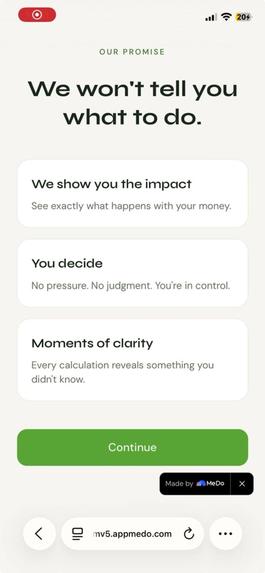
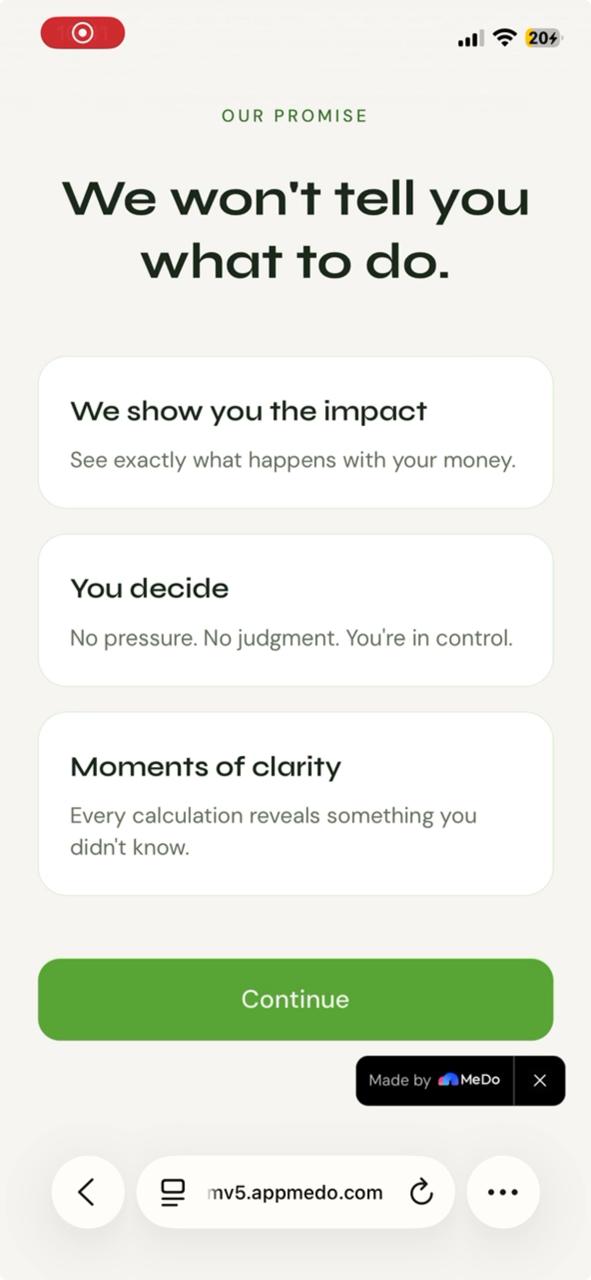
Our Promise
-

Welcome Screen
-
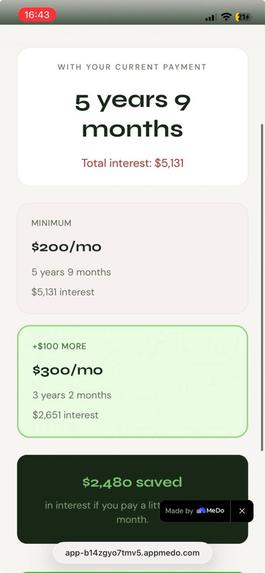
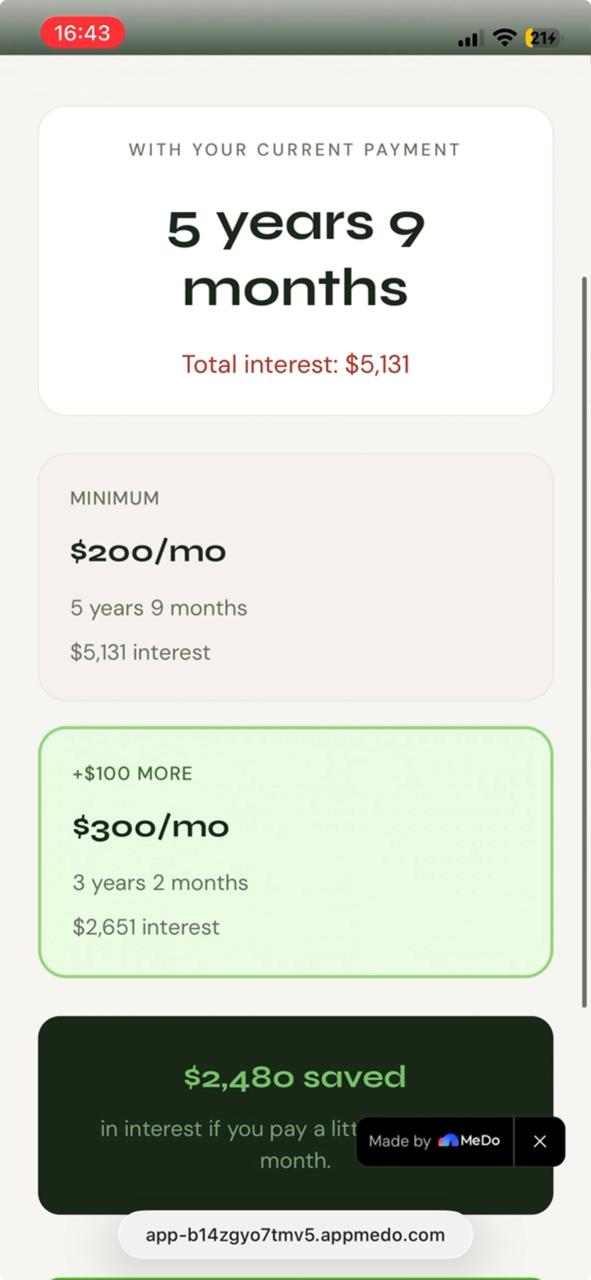
Zas Moment
-
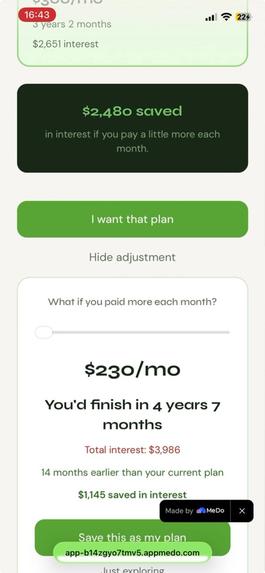
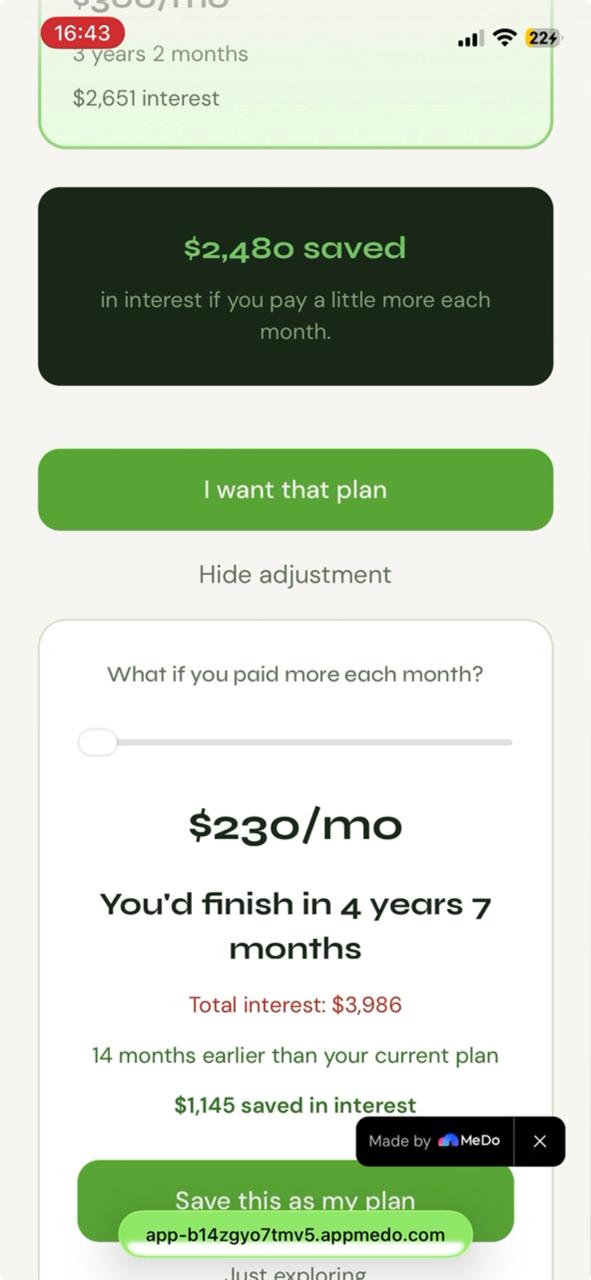
Explore Changes
-
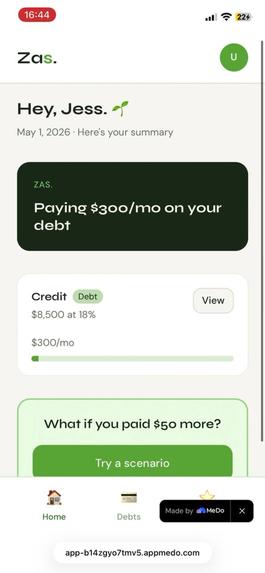
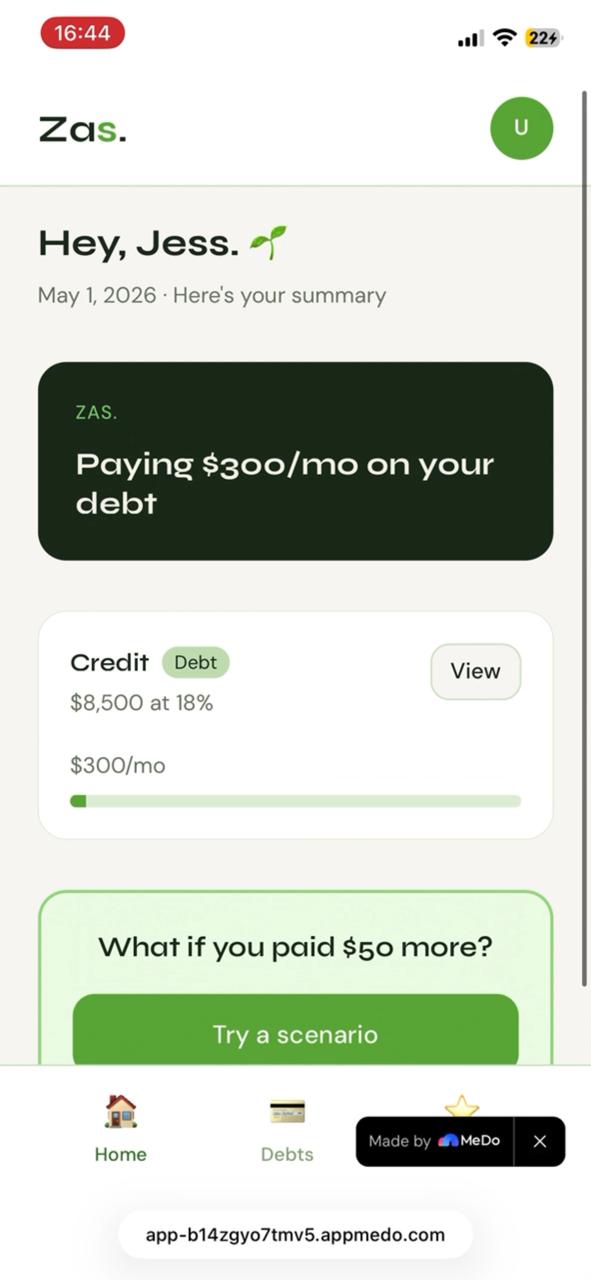
Home Screen

Inspiration
This app started with three people in my life.
My parents are approaching retirement. They're not bad with money — they pay their debts — but they've been re-enrolling in credit cycles for years: buying on credit, paying it off when their paycheck comes in, leaning on their year-end bonuses to chip away at bigger debts. It works now. But when they retire, those bonuses disappear. If they don't break that cycle before then, the math stops working. The problem isn't discipline — it's that nobody has ever shown them clearly what that cycle is actually costing them, or what would happen if they changed it.
My aunt just got her first car loan. Her first real credit. She wants to understand: if one month she can pay a little more than the minimum, how does that actually affect her? Does it matter? By how much? She doesn't need a financial advisor — she needs one clear answer.
Me — I'm just starting my career. I've watched people around me get trapped in debt cycles and I don't want that. I want to build savings first. But I know at some point I'll need credit, and that scares me a little. I want to understand the rules before I'm inside the game.
I couldn't find an app that answered these questions simply. So I built one.
What it does
Zas is a mobile-first financial awareness app for people who feel like their finances are happening to them rather than being driven by them.
It doesn't track your spending. It doesn't judge your habits. It does one thing: it shows you the real impact of your financial decisions — in seconds — through what we call "Zas moments": short, clear, sometimes surprising realizations:
- "Zas. At this pace, you'll still be paying this off in 4 years — and $3,200 of that is pure interest."
- "Zas. One extra payment per month means you finish 18 months earlier and save $1,500."
- "Zas. You won't reach your savings goal at this pace — but $50 more per month gets you there on time."
Users enter three things — balance, monthly payment, interest rate — and Zas runs a full amortization simulation and delivers a clear insight plus a real-time comparison between their current plan and a better scenario. An adjustment slider lets users explore "what if I pay more?" without leaving the screen.
The app also handles savings goals: set a target amount, a date, and a monthly contribution, and Zas tells you if your plan is realistic — and exactly what to adjust if it isn't.
No financial jargon. No judgment. Just clarity.
How we built it
Zas was built entirely through MeDo using multi-turn conversations to design, build, and deploy the full application.
1. Architecture through conversation. I described the core concept — a card-based financial awareness tool with step-by-step flows — and MeDo helped structure the complete app: authentication, onboarding, debt flow, savings flow, a home feed, and a playground for "what if" scenarios.
2. Financial logic. The most technically demanding part was the amortization engine. Through conversations with MeDo I built:
- A month-by-month debt payoff simulator that handles edge cases like negative amortization and very small remaining balances
- A prior payments simulator that reconstructs how much a user has already paid, how much went to interest vs. principal, and what the true remaining balance is
- A savings goal calculator with optional compound yield for users with investment accounts (SOFIPOs, etc.)
3. Full-stack generation. MeDo generated the React frontend, Supabase integration (authentication + database with Row Level Security on all tables), and deployment — all from natural language descriptions of the features I wanted.
4. Iterative refinement. Features like the real-time adjustment slider on the Zas Moment screen, the goal completion celebration, the "Won" section for paid-off debts, the account deletion flow, and the re-engagement flow after completing a goal were all built through follow-up conversations refining the experience step by step.
Tech stack: React · Supabase (Auth + PostgreSQL + RLS) · MeDo deployment
Live app: https://app-b14zgyo7tmv5.appmedo.com
Challenges we ran into
The biggest technical challenge was the prior payments simulator — reconstructing the true financial state of a debt that someone has been paying for months or years. Real-world debt is messier than a simple calculator assumes: people pay different amounts at different times, and sometimes the remaining balance is higher than they think because early payments barely covered the interest.
Getting that right required many iterations with MeDo, testing edge cases like negative amortization and payments smaller than the monthly interest. The final version shows users a full breakdown — how much they've paid, how much went to interest, how much reduced the principal — and that breakdown alone tends to be a Zas moment for most people.
The other challenge was design, not code: deciding what not to show. Every time I was tempted to add another number or another option, I had to ask — does this create a Zas moment, or does it create noise? Showing less, on purpose, is harder than it sounds.
Accomplishments that we're proud of
The Zas Moment screen — the heart of the entire app. It takes raw financial inputs, runs a full simulation, and delivers a clear emotional insight plus a real-time comparison, all without navigating away from the screen. Getting that level of complexity to feel simple and non-technical is what this project is most about.
We're also proud of the re-engagement flow: when a user pays off a debt or reaches a savings goal, the app celebrates with them — and then asks if they want to start fresh or archive it. It's a small detail, but it's the kind of thing that makes an app feel human rather than transactional.
And honestly — shipping a complete, functional app with auth, real financial calculations, and a thoughtful UX, built entirely through conversation with MeDo, as someone just starting their career. That feels like an accomplishment worth naming.
What we learned
The most important thing I learned is that the hardest part of a financial app isn't the math — it's the language. Getting the calculations right took time, but making them feel human took longer. Every number on screen had to answer the question a real person would actually ask, not the question a spreadsheet would answer.
I also learned that building with MeDo rewards clarity of thought more than technical knowledge. The better I could describe the experience I wanted a user to have, the better the result. That's a different skill than coding — and in some ways a more transferable one.
What's next for Zas - Financial Awareness App
- Multiple debt management — Snowball and Avalanche strategies explained simply, so users can see which order to pay off debts saves them the most
- Monthly summaries — "In March you paid $X. $Y went to interest. You're 2 months ahead of your plan."
- Smart reminders — a gentle nudge when the month passes without logging a payment
- Sustainable business model — exploring monetization options that keep the core experience free for everyone who needs it
- Native mobile app — to reach the people who need this most, on the device they use most
Built With
- postgresql
- react
- supabase

Log in or sign up for Devpost to join the conversation.