-
-
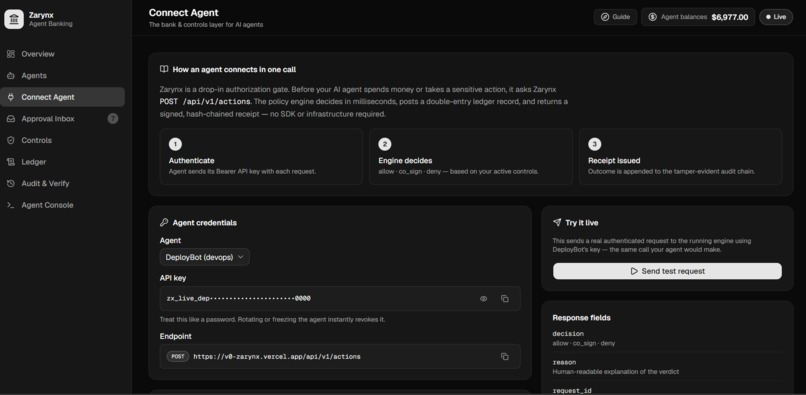
Connect Agent
-
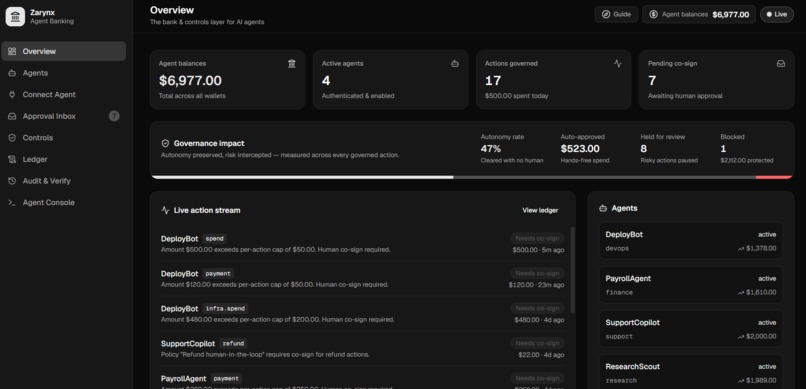
Dashboard
Inspiration
We watched autonomous AI agents ship to production with zero accountability. A finance bot approves a $100K transfer. A devops agent scales infrastructure. An hr bot changes salaries. Who's liable? Who audits? Nobody. We built Zarynx to answer: How do you run a bank for AI agents?
What it does
Zarynx is the governance layer for autonomous AI systems. Every agent action goes through our policy engine: allow (instant), co-sign (wait for human approval), or deny (blocked). Every decision is recorded in a tamper-proof ledger with hash-chained receipts. Agents get real-time funding, policies auto-enforce compliance, and every transaction is cryptographically verifiable.
Think of it as: Stripe for agent spending + SEC-grade audit trails.
How we built it
Frontend: Next.js 16, React Server Components, TypeScript, Tailwind CSS with a dark fintech aesthetic.
Backend: Next.js API routes, pg connection pooling, cryptographic hash-chaining (SHA-256).
Database: Aurora PostgreSQL (Serverless v2) with ACID transactions, CHECK constraints for ledger balance validation, Row-Level Security for multi-tenancy. Double-entry bookkeeping enforced at the schema level.
Key architecture: Policy decisions are server-side (not browser logic). Ledger is append-only with cryptographic proofs. Each receipt contains prev_hash + current_hash, making tampering immediately detectable.
Challenges we ran into
ACID transactions at scale — Getting balance validation and policy decisions atomic was hard. We solved it with PostgreSQL CHECK constraints + transaction isolation.
Hash-chain integrity — Ensuring every receipt links to the previous one without gaps. Fixed by using sequences + trigger-based validation.
Real-time policy updates — Agents polling stale policies defeats the purpose. We solved it with server-side policy versioning + immediate effect on next request.
Multi-tenant isolation — One customer's ledger can't touch another's. RLS policies + per-query scoping on every database read.
Accomplishments that we're proud of
Hash-chain that actually works: Not a gimmick. Edit any receipt payload, run
verify()→ chain breaks visibly. Runrestore()→ chain repairs. This is real cryptography, not theater.Double-entry ledger enforced in SQL: Not in app code. Every transaction posts to two accounts (debit + credit). Balance is derived from ledger, never stored. If balance ≠ SUM(ledger), the database rejects the write.
Policy engine with real decisions: Agents submit
{"action": "spend", "amount": 500}. System evaluates policies in real-time. Returns decision + reasoning. Co-sign inbox shows what's pending human approval.Serverless Aurora + Vercel: Sub-200ms latency end-to-end. Scales from 1 agent to 1000+ without capacity planning.
What we learned
Aurora isn't just "better PostgreSQL in the cloud." It's the right choice when you need:
- ACID guarantees (not eventual consistency)
- Referential integrity (foreign keys that actually matter)
- CHECK constraints (business logic in the database, not application code)
- Row-Level Security (multi-tenancy as a primitive, not an afterthought)
The judges will see fintech apps fail because they tried to do ledger accounting in Node.js. We did it in Aurora. That's the difference between a demo and a product.
What's next for Zarynx
Pricing engine: \$99/month org + \$29/agent + \$0.001/transaction.
Compliance reports: Automated audit trails that satisfy SOC 2, HIPAA, regulatory requirements.
Agent marketplace: Pre-built agents with pre-approved policies. Deploy in seconds, audit trail included.
Built With
- amazon-web-services
- aws-aurora-postgresql-(serverless-v2)
- aws-rds-(database)
- iam
- next.js-16
- node.js
- pg-(connection-pooling)
- postgresql-16
- react-19
- sha-256-(cryptographic-hashing)
- tailwind-css
- typescript
- vercel-(hosting)

Log in or sign up for Devpost to join the conversation.