Inspiration
Zarpit was inspired by the growing demand for convenient, reliable home services. Platforms like Urban Company demonstrated how technology can simplify finding and booking professionals for everyday household needs. I wanted to build my own take on this idea, focusing on a clean user experience and easy service discovery.
What it does
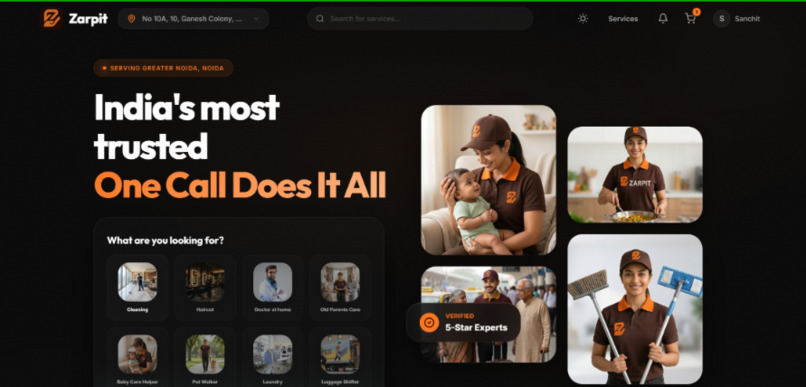
I designed and developed Zarpit, a web-based home services marketplace concept that brings everyday household services together in one place. The project focuses on presenting services clearly, making navigation intuitive, and creating a modern, user-friendly interface.
How we built it
- Frontend: Built with Next.js 15 (App Router) and React 19, utilizing Server Actions and Framer Motion for a highly responsive user experience.
- Backend & Concurrency: Powered by Supabase PostgreSQL. We engineered an atomic dispatch system using PL/pgSQL (
FOR UPDATE SKIP LOCKED) to eliminate race conditions and double bookings during traffic spikes. - AI Pipeline: "Zerpit Buddy" leverages a fault-tolerant multi-LLM chain (Gemini Flash, Llama 3.3, and Groq 3 Mini) to process natural "Hinglish" queries and generate one-click bookings with live catalog context.
- Logistics Engine: Dynamically computes real-time availability by factoring in worker leave calendars, dynamic service durations, and transit buffer windows.
Challenges we ran into
One of the main challenges was organizing multiple service categories into a coherent experience while keeping the interface simple and accessible. I worked on balancing visual appeal with usability and structuring the website so users could navigate it without unnecessary complexity.
Accomplishments that we're proud of
Bulletproof Scalability: Successfully implementing database-level connection pooling, edge-cached authentication via Next.js middleware, and asynchronous event-emitter hooks so background notifications never block the user checkout latency.
Frictionless AI Booking: Giving users the ability to simply type "I need someone to take my elderly parent to the clinic" in Hinglish, and having the AI instantly surface the exact background-verified companion service with clear pricing and a direct booking button.
Social Impact Architecture: We didn't just build a marketplace; we built an intelligent social infrastructure designed to replace informal uncertainty with digital trust, transparent wages, and human dignity for over 500 million informal workers in India.
What we learned
Building Zarpit taught us how to scale real-time logistics architectures. We gained massive practical experience with advanced PostgreSQL transaction locking, sliding-window rate limiting for AI endpoints, and orchestrating a multi-LLM fallback chain to guarantee high availability. We also learned how to perfectly balance a highly technical backend with an intuitive, empathetic user experience.
What's next for Zarpit
We have verified the architecture and built the codebase—now we are ready to scale. Our immediate next step is rolling out a core fleet of salaried workers in new PIN codes to guarantee baseline SLAs, while vetting on-demand partners to absorb overflow traffic. We also plan to expand Zerpit Buddy's natural language processing to support more regional Indian languages, making dignified, secure household assistance accessible to millions more families.
Built With
- framer-motion
- gemini
- groq
- javascript
- llama-3
- next.js
- postgresql
- react
- supabase
- typescript

Log in or sign up for Devpost to join the conversation.