Inspiration
Many people suffer from Alzheimer's, ADHD, depression, Parkinson's, etc., since brain disorders are on the increase in the modern day. And because our family is affected by Parkinson's and MS, we are aware of the issues that these individuals encounter. All of these people hope that researchers find new solutions and on the other hand large volumes of biosignals are required by researchers working on therapies for these disorders. We believe that the community with the help of researchers can contribute to the creation of a world free of brain disorders.
What it does
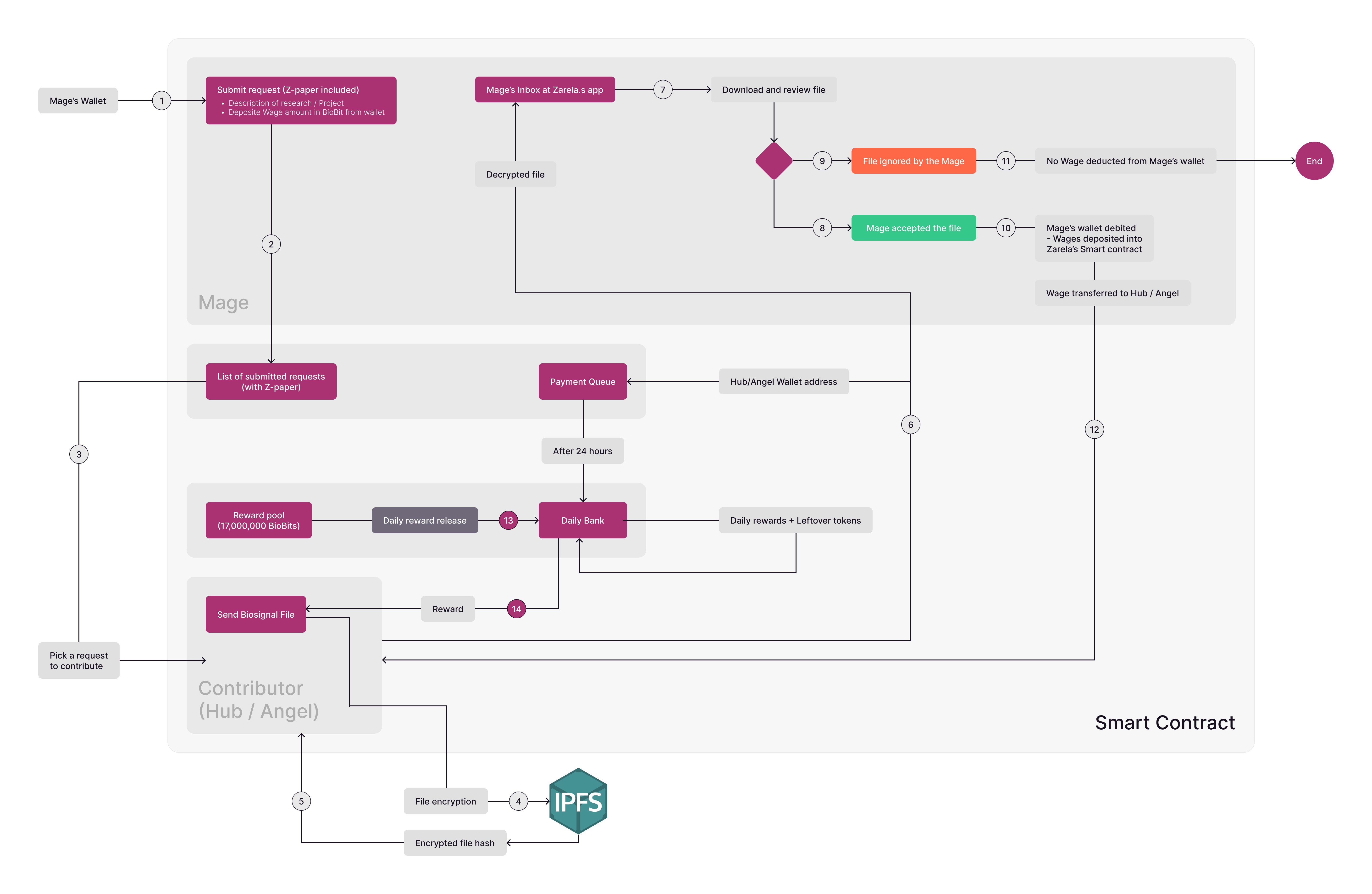
Targeted data collection is a global challenge and a barrier in the Neurotechnology ecosystem. Zarela tackles this issue by enabling researchers to collect data more rapidly and cheaply in order to help individuals enhance their longevity and quality of life. Zarela is a free, borderless, open-source platform for collecting and delivering human biosignals to researchers and entities demanding biosignal data. People suffering from brain disorders can contribute anonymously to the Zarela dApp and send their biosignals to earn tokens using the Proof of Contribution mechanism. In addition to gaining money by providing Biosignals to researchers on a peer-to-peer basis, they contribute to the development of medicinal treatments, applications, and games.
How we built it
Data collection has always been a significant issue in the Neurotechnology sector. It is both an expensive and time-consuming process. Also, individuals require motivation to collaborate with the scientist. As a P2P data platform, Zarela resolved these challenges. On the platform, a scientist can make a request and describe a scenario for collecting EEG data, and anyone can contribute to his request. Then, in addition to earning money by supplying Biosignals from contributors to researchers on a peer-to-peer basis, they contribute to the creation of medicinal treatments, applications, and games. In the Zarela token economy, a reward pool containing 85 percent of the total supply of tokens is used to distribute tokens to contributors based on Proof of Contribution (PoC), thereby solving the motivational issue. Additionally, the platform approach assisted in resolving the cost and time issues by bringing more individuals and neuroscience hubs from various nations.
Challenges we ran into
Solving the mathematical formula underlying the Proof of Contribution model in order to establish a long-lasting incentive mechanism was a significant obstacle we overcame.
Accomplishments that we're proud of
Initially, our first accomplishment is using neuroscience technology to help people with brain problems recover. We allocated a percentage of tokens as a grant to researchers for the purpose of funding neurotherapeutics research. Then, after the Covid epidemic, we learned how to work entirely online, and we are now an online company.
What we learned
We have acquired knowledge of DeFi, blockchain, and proof techniques. We believe that studying something cannot provide the same level of in-depth knowledge as doing it. We are aware that blockchain is a technology and set of tools for resolving certain difficulties, and we should use it to solve actual problems, not just because it's trendy.
What's next for Zarela
In the next step, we intend to address the issue of scalability in neuroscience treatments. As these therapeutic services are dependent on therapists, they could not be scaled up. We are creating a system called Bioverse to serve these services in an engaging manner and automate these functions using artificial intelligence.


Log in or sign up for Devpost to join the conversation.