Inspiration Every factory, building site and restaurant already has cameras, but turning them into "tell me when someone is not wearing a hard hat" still means a data-labelling contract and an ML engineer. Off-the-shelf zero-shot detectors are easy to try but slow and unreliable, and nobody tells you how wrong they are on your camera.
What it does ZALU turns one sentence and a few minutes of your own footage into a small, fast vision model, and tells you honestly how good it is:
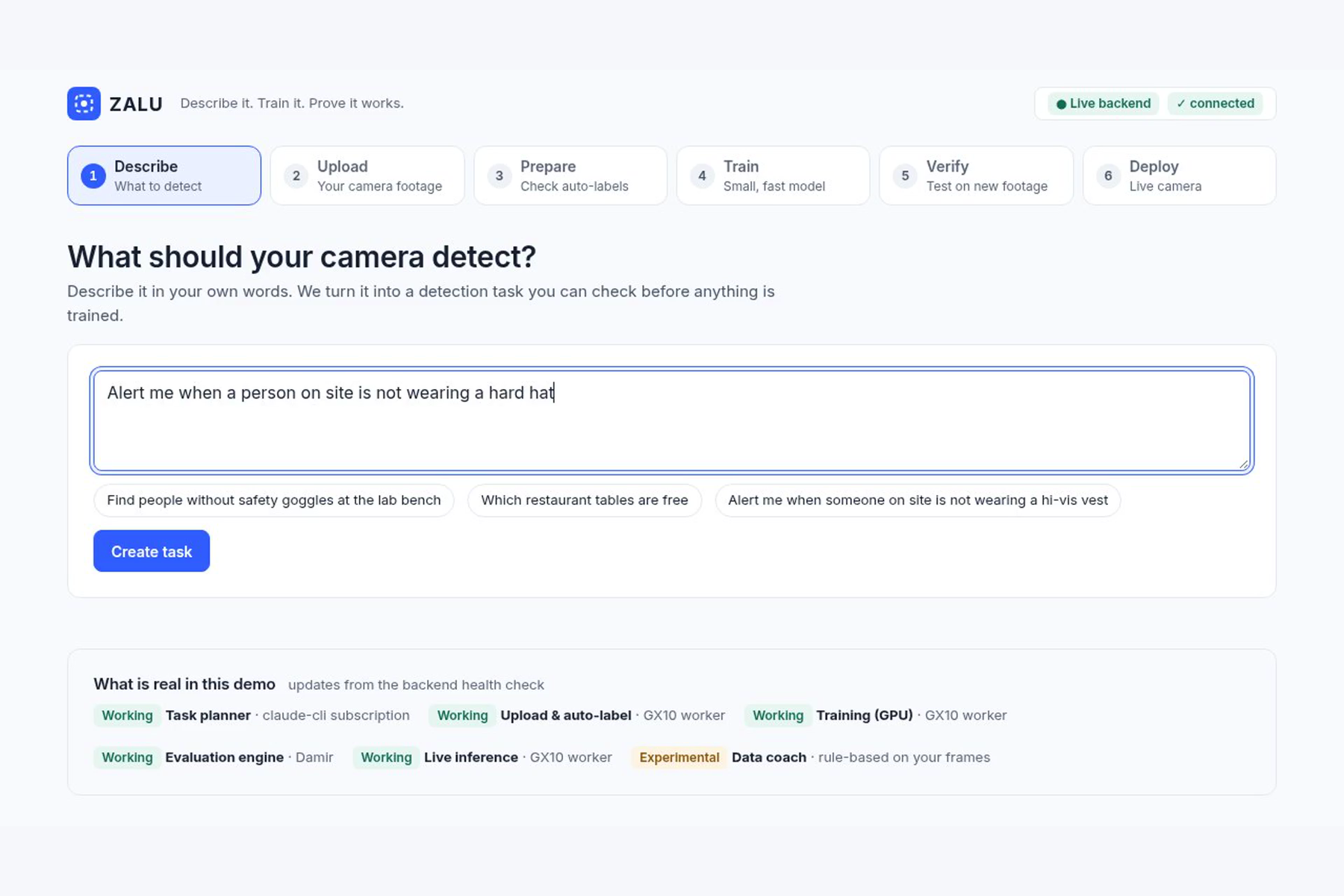
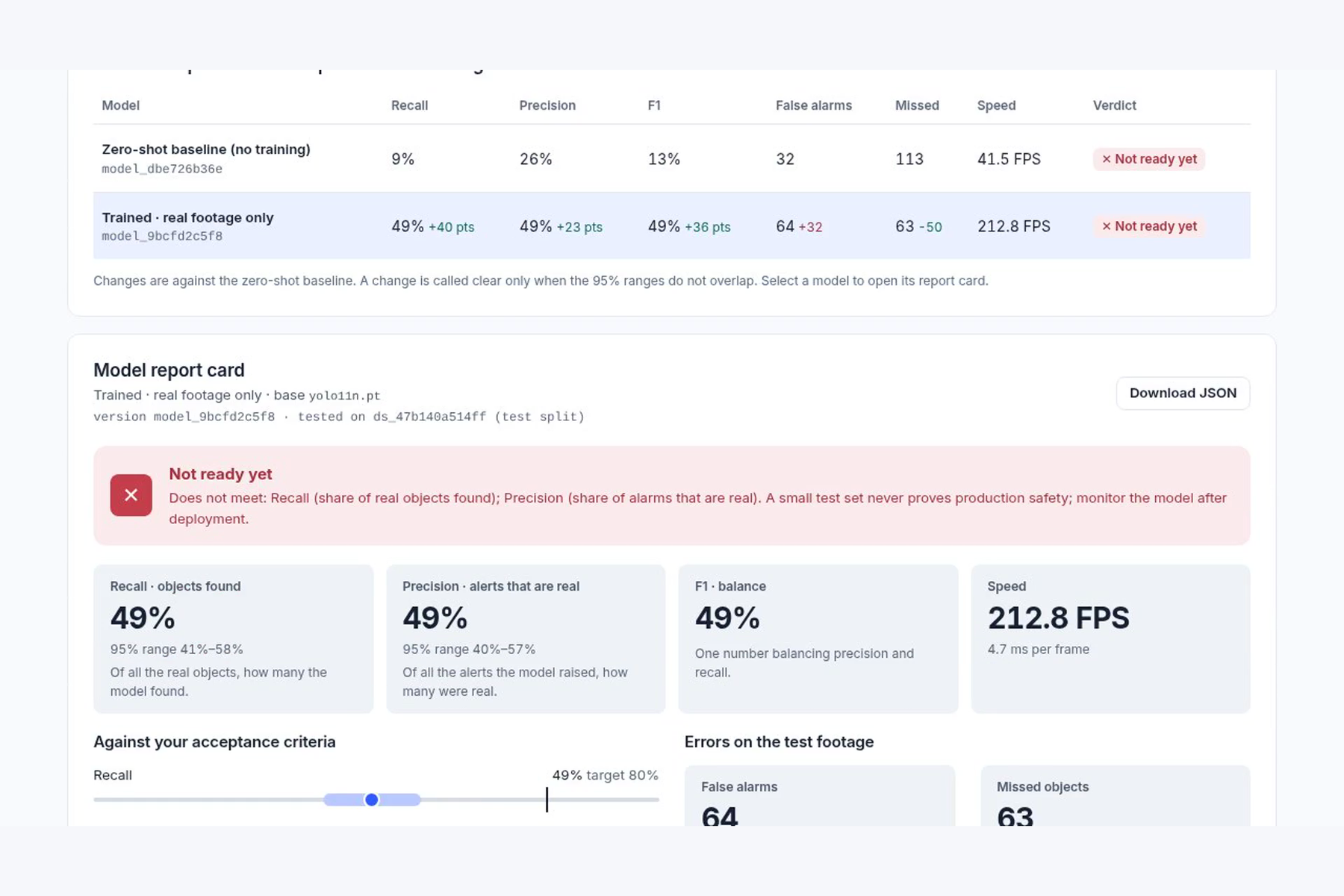
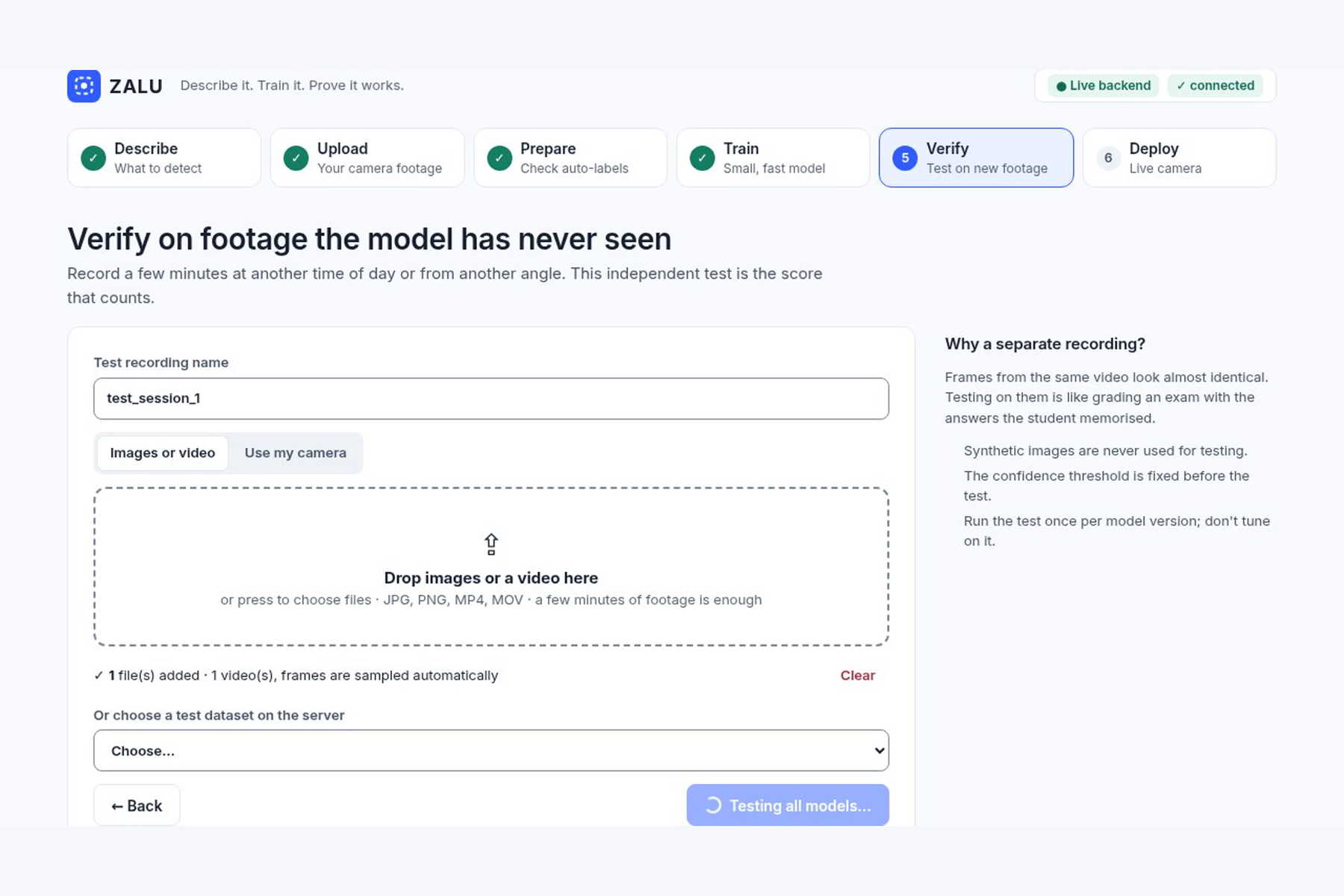
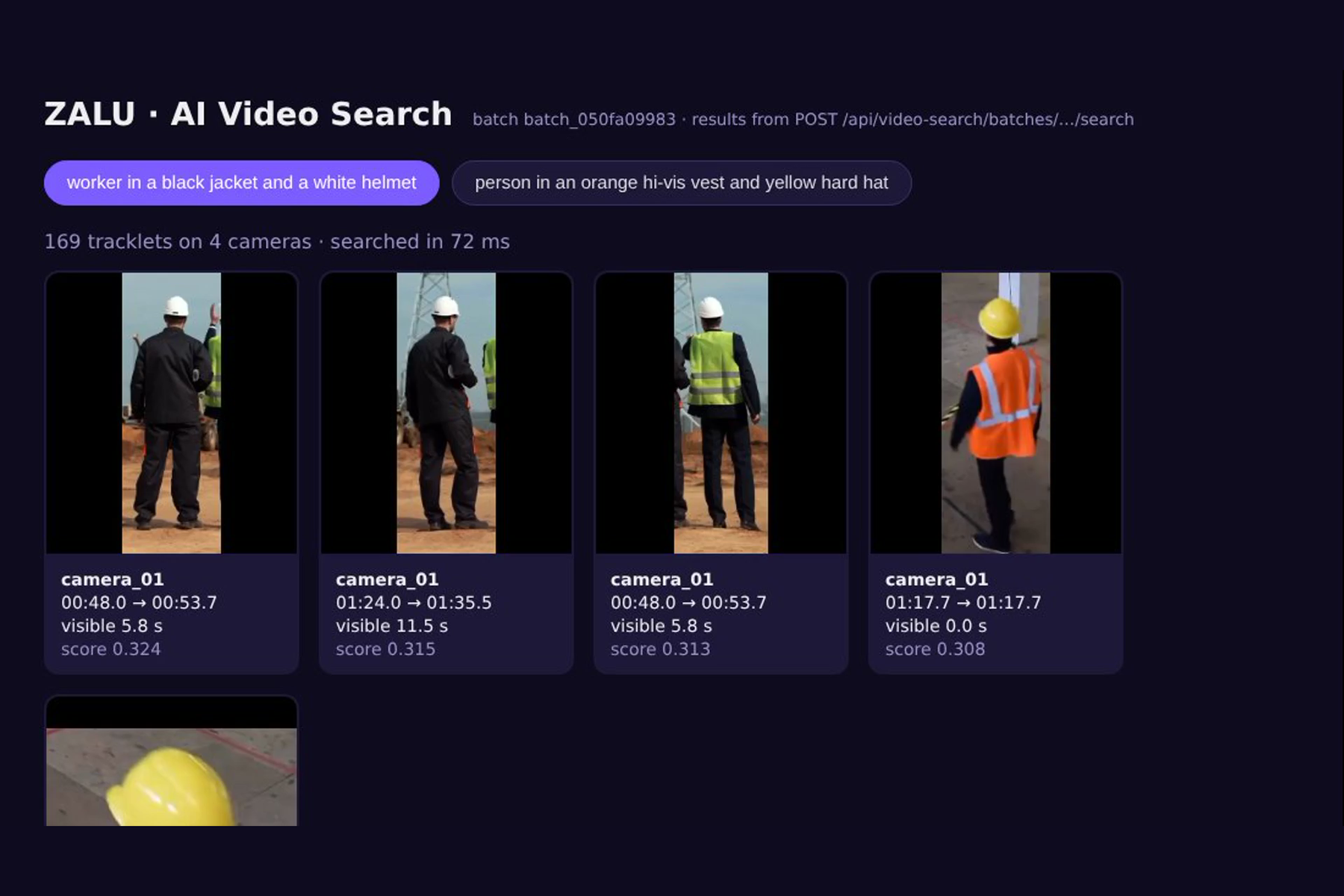
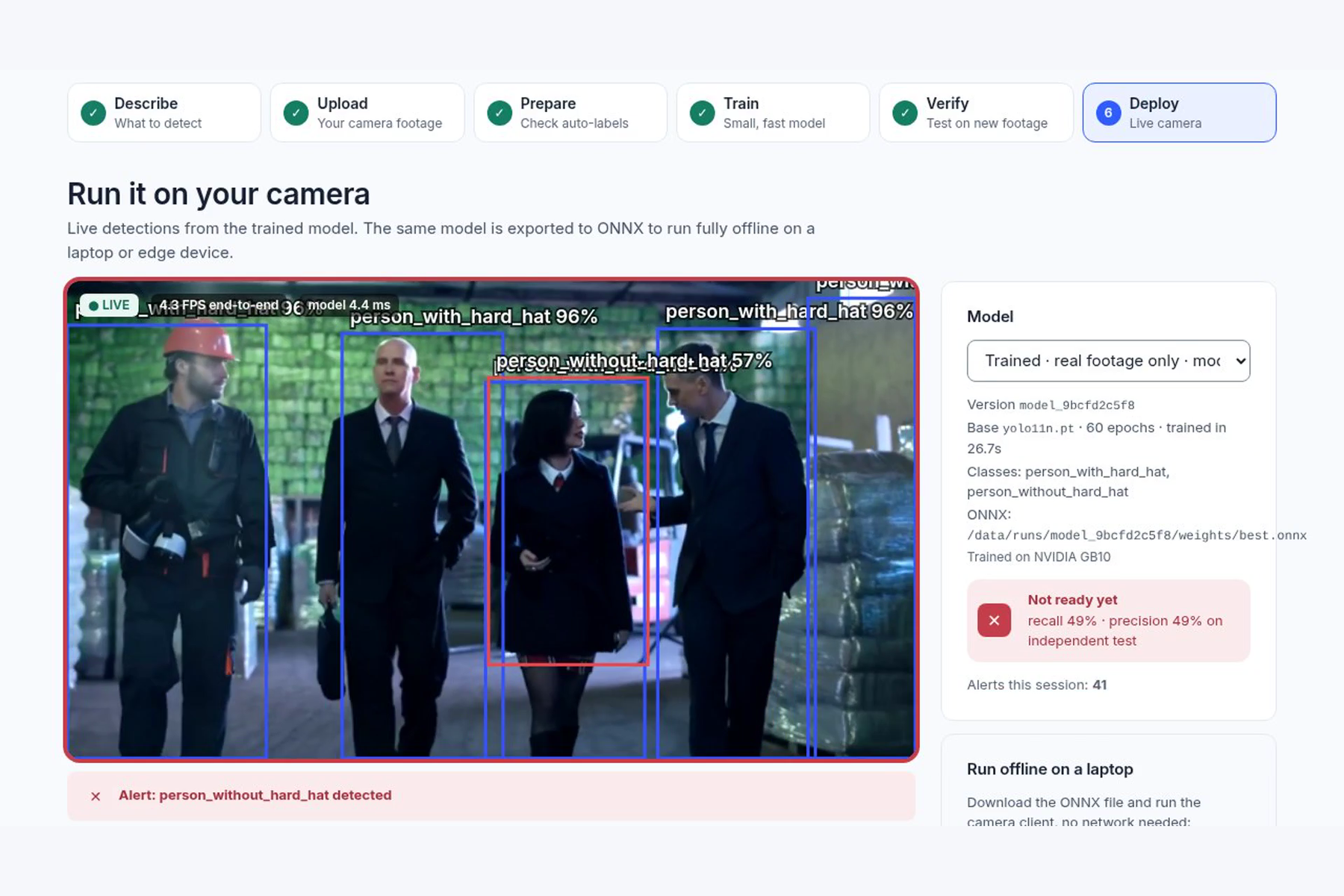
Describe: "Alert me when a person on site is not wearing a hard hat". Claude turns it into a task spec (classes, negative classes, the alert event). Upload: attach camera footage; frames are sampled and split. Prepare: an open-vocabulary detector (YOLO-World) labels every frame from the text; you fix what's wrong. Train: a YOLO11n model trains on our NVIDIA GX10 GPU in about 30 seconds. Verify: on a separate video the model has never seen, ZALU compares it with the zero-shot baseline: precision, recall, F1, FPS, a failure gallery and a "ready / not ready" verdict. Deploy: download ONNX or run live inference. On top of the same backend: AI dashboards (describe the dashboard you want, Claude plans it from the detections) and AI Video Search (upload up to 10 camera recordings, type "worker in a black jacket and a white helmet", get every appearance with camera, timestamps and how long the person was visible).
How we built it Frontend: Next.js, React, TypeScript, Motion; design tokens synced from Figma. App API: FastAPI on a Raspberry Pi 5, exposed with Tailscale Funnel; Claude (via the Claude Code CLI, structured JSON output) for the Task Engine and Dashboard Planner. GPU worker: FastAPI in Docker on an NVIDIA GX10 (GB10), reached through an SSH tunnel: YOLO-World auto-labelling, Ultralytics YOLO11n training, YOLOE zero-shot baseline, ONNX export and check, CLIP ViT-B/32 for video search. Honest evaluation by design: the backend refuses a dataset where the same image appears in two splits. Challenges we ran into Auto-labels lie in convincing ways (overalls labelled as hi-vis vests), so the test set must be reviewed by a human; we built that review into the Prepare step. If all training footage shows people with the safety gear, the model never learns what "without" looks like; we had to rebuild our sample footage to mix both. A GPU dataloader deadlock (Docker's 64 MB shared memory) and a Raspberry Pi frozen by writing 11 GB into a RAM disk. Accomplishments that we're proud of Prompt → trained model with ONNX in 63 seconds through the API (about 3.5 minutes clicking through the UI). Hard-hat scenario on unseen footage: F1 0.49–0.50 vs 0.13 for the zero-shot baseline, 213 vs 41 FPS. AI Video Search: 4 recordings indexed in 71 s, text search over 169 tracks in 78 ms. It's live: judges can use the real product on our GPU right now. What we learned A model is only as trustworthy as the test it is measured on. Showing "not ready" honestly is more useful than a pretty number on frames the model already saw.
What's next Active learning (send the frames the model is least sure about back to Prepare), a small local planner model instead of Claude, cross-camera identity for Video Search, and on-device deployment to camera hardware.
