-
-

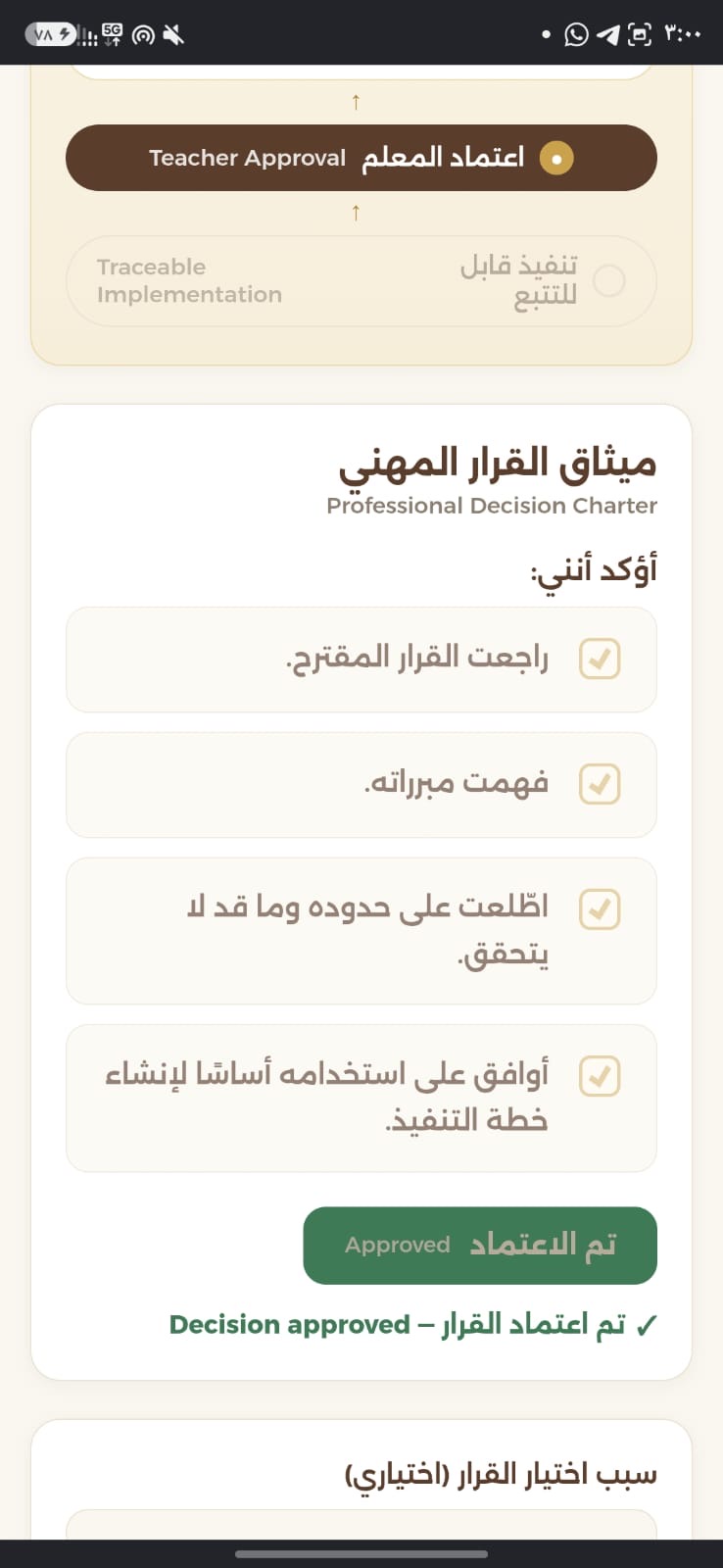
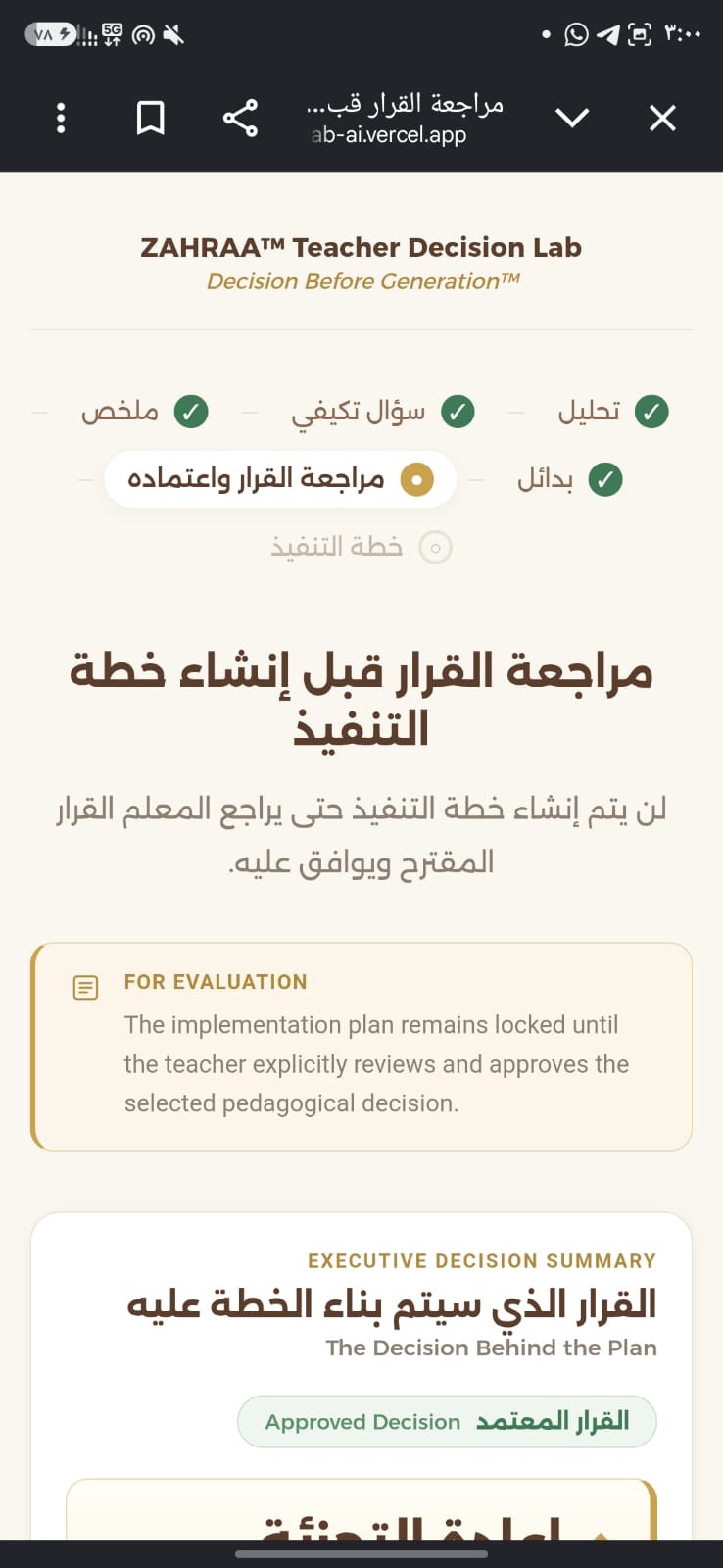
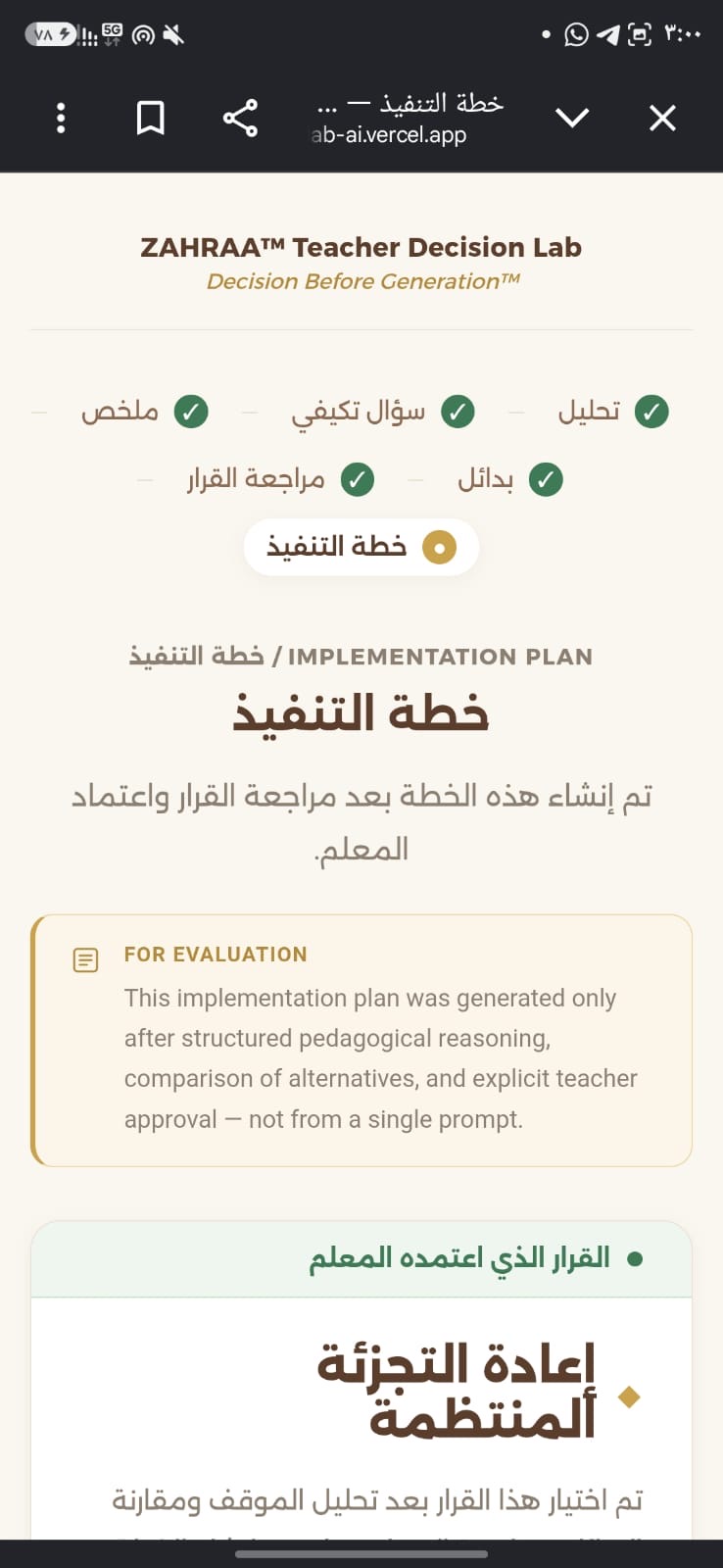
Human-in-the-loop governance: the teacher explicitly reviews and approves the pedagogical decision.
-

Decision Before Generation — DataHub-powered pedagogical decision workflow.
-
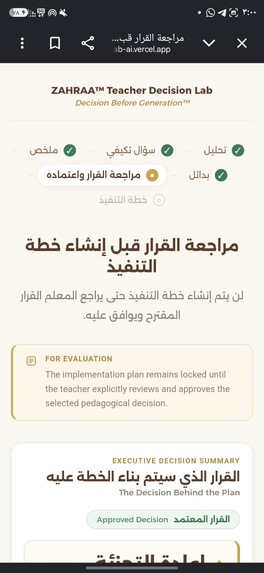
Curriculum evidence guides AI-assisted reasoning before pedagogical alternatives are generated.
-
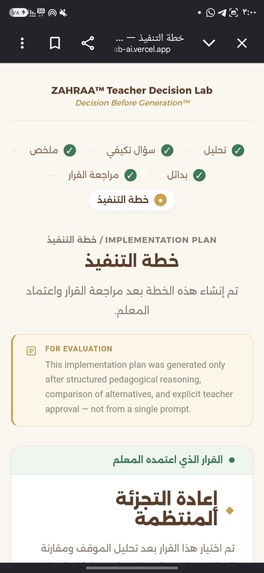
The implementation plan remains locked until the teacher reviews the proposed decision.
-
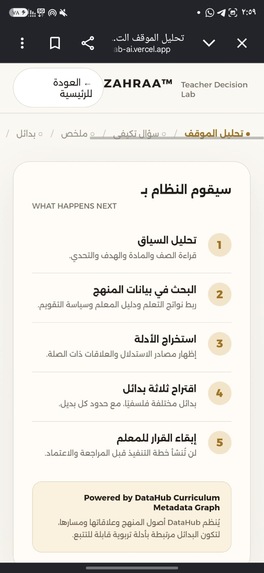
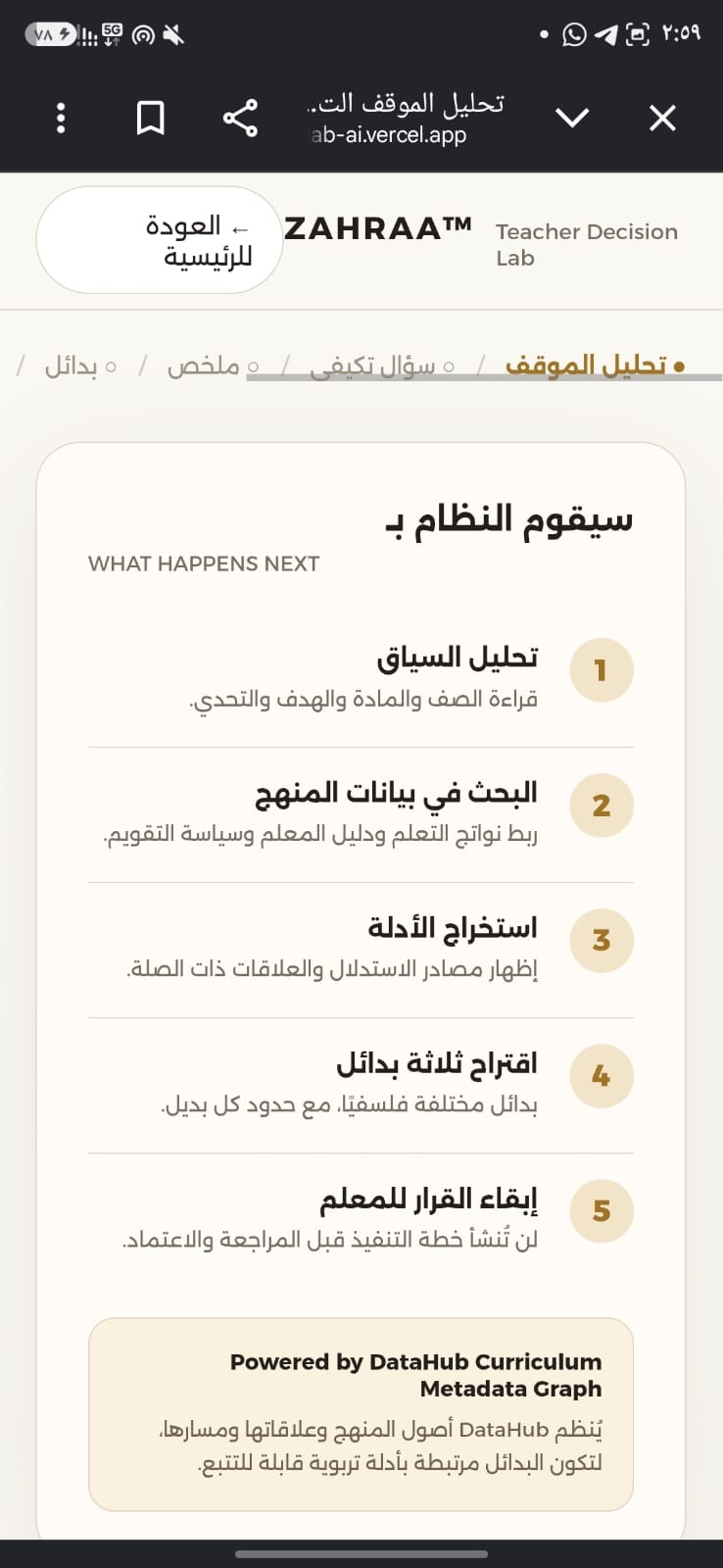
Three pedagogically distinct alternatives are compared before the teacher makes a decision.

ZAHRAA™ Teacher Decision Lab
Decision Before Generation
Most AI tools for education begin with the same question:
What should AI generate for the teacher?
A lesson plan. An activity. A quiz. A worksheet.
ZAHRAA™ Teacher Decision Lab begins with a different question:
What if AI had to support the teacher's decision before it was allowed to generate the lesson?
That question led us to build a human-centered pedagogical decision-support system where curriculum evidence, AI-assisted reasoning, and teacher professional judgment work together.
Our core principle is simple:
AI suggests. Teachers decide.
Inspiration
Generative AI can produce educational content extremely quickly.
But speed creates a deeper challenge.
A technically impressive lesson can still be pedagogically inappropriate if it ignores curriculum outcomes, assessment expectations, teacher guidance, learner context, or professional judgment.
We therefore wanted to explore a different architecture for educational AI:
Instead of allowing generation to become the decision, could we create an evidence-grounded workflow in which the teacher remains the final pedagogical authority?
This became the foundation of ZAHRAA™ Teacher Decision Lab.
What it does
ZAHRAA™ Teacher Decision Lab guides a teacher through a governed pedagogical decision workflow before an implementation plan is generated.
The workflow is:
Classroom Situation → Curriculum Evidence → AI-Assisted Reasoning → Pedagogical Alternatives → Teacher Review → Teacher Approval → Traceable Implementation Plan
The process begins with a classroom situation.
Relevant curriculum evidence is then retrieved and surfaced to support the decision.
AI uses both the classroom context and curriculum evidence to analyze the situation and propose distinct pedagogical alternatives.
The teacher reviews those alternatives, compares their implications, and explicitly approves the pedagogical decision.
Only after teacher approval can the system move to implementation.
This creates a deliberate boundary between:
AI reasoning and AI generation.
How we built it
The prototype separates the system into three core responsibilities:
1. DataHub → Evidence
DataHub provides the curriculum evidence infrastructure.
Curriculum metadata can include:
- learning outcomes
- curriculum relationships
- teacher guidance
- assessment policy
- instructional constraints
- source relationships and lineage
Instead of leaving this metadata in a passive catalog, the prototype brings relevant evidence into the teacher's decision workflow.
2. Gemini → Reasoning
Gemini uses the classroom situation together with retrieved curriculum evidence to support pedagogical analysis.
Its role is not to make the final decision.
Its role is to help analyze the situation and propose meaningful instructional alternatives that the teacher can compare.
3. Teacher → Decision
The teacher remains the final authority.
The system requires explicit teacher approval before the workflow can proceed from pedagogical reasoning to implementation.
This creates a human-in-the-loop governance layer between AI reasoning and AI generation.
The prototype is implemented as a web-based decision workflow and deployed on Vercel.
How we use DataHub
DataHub is not used merely as a metadata catalog.
In ZAHRAA™ Teacher Decision Lab, it acts as the live curriculum evidence layer for pedagogical decision-making.
At runtime, the teacher's classroom context triggers a DataHub metadata search.
Relevant curriculum evidence — including learning outcomes, teacher guidance, assessment policy, curriculum relationships, and lineage — is retrieved and passed into the pedagogical reasoning workflow.
Gemini then reasons over both:
the classroom context + the retrieved DataHub evidence
to generate pedagogically distinct instructional alternatives.
The teacher reviews those alternatives and explicitly approves the pedagogical decision before an implementation plan can be generated.
Runtime decision path
Teacher Context → DataHub Metadata Search → Live Curriculum Evidence → AI-Assisted Pedagogical Reasoning → Pedagogical Alternatives → Teacher Review → Teacher Approval → Traceable Implementation Plan
This turns curriculum metadata from passive documentation into actionable, traceable evidence used directly in the decision process.
DataHub therefore does more than organize curriculum assets.
It provides the evidence infrastructure connecting curriculum metadata to AI-assisted reasoning, teacher judgment, and the resulting implementation plan.
Why DataHub matters to the architecture
Without an evidence layer, an AI system can reason primarily from the user's prompt and the model's general knowledge.
For educational decision-making, that is not enough.
Curriculum decisions should be connected to structured evidence.
DataHub allows the prototype to treat curriculum metadata as part of the reasoning context rather than as background documentation.
The architecture therefore separates three different forms of authority:
DataHub provides evidence.
AI supports reasoning.
The teacher makes the decision.
That separation is central to the design of ZAHRAA™ Teacher Decision Lab.
Challenges we ran into
The central challenge was not generating educational content.
Generative AI already does that well.
The harder challenge was designing a workflow that deliberately prevents generation from becoming the decision itself.
We needed to separate:
evidence → reasoning → alternatives → teacher judgment → approval → implementation
while keeping the experience understandable and practical for a teacher.
Another important challenge was making DataHub meaningful to the educational workflow rather than adding it as a superficial integration.
Our solution was to make curriculum metadata participate directly in the decision path as evidence used before pedagogical approval.
We also had to preserve traceability across the workflow so that the final implementation could be connected back to the evidence, reasoning, alternatives, and teacher decision that preceded it.
Accomplishments that we're proud of
We are proud that the prototype does not treat human-in-the-loop as a confirmation button added after AI generation.
Teacher authority is part of the architecture.
The system cannot legitimately move from AI-assisted reasoning to implementation without an explicit pedagogical decision.
We also created a traceable decision path connecting:
curriculum evidence → AI-assisted reasoning → pedagogical alternatives → teacher approval → implementation
Another important accomplishment is giving curriculum metadata an active role.
Instead of simply displaying metadata, the prototype uses it as evidence that can inform pedagogical reasoning.
This changes the role of metadata from something that is stored and searched into something that can participate in an AI-assisted decision workflow.
What we learned
The project changed the question we were asking about AI in education.
The important question may not be:
How can AI generate better lessons?
It may be:
How can AI help teachers make better, evidence-grounded decisions while preserving professional judgment?
We also learned that metadata infrastructure such as DataHub can play a much more active role in AI systems.
When metadata becomes evidence for reasoning, it moves beyond cataloging and discovery.
It becomes part of the intelligence architecture.
And we learned that human-in-the-loop systems are strongest when human authority is not added at the end.
It should be designed into the workflow from the beginning.
What's next for ZAHRAA™ Teacher Decision Lab
The current prototype demonstrates the core architecture through a pedagogical decision workflow.
The next step is to expand it into a reusable curriculum intelligence layer capable of supporting multiple subjects, grade levels, curriculum frameworks, and instructional contexts.
Future development will focus on:
- richer DataHub metadata relationships and lineage
- stronger curriculum evidence retrieval
- broader curriculum ingestion
- decision history and traceability
- evaluation of pedagogical alternatives
- institutional governance rules
- support for multiple curriculum frameworks
- evidence-grounded teacher agents
In the longer term, the same architecture could support decisions beyond lesson planning, including curriculum alignment, assessment design, instructional intervention, and curriculum quality review.
The long-term vision remains simple:
AI suggests. Teachers decide.
Built With
- DataHub
- Gemini
- JavaScript
- HTML
- CSS
- Vercel
- Curriculum Metadata
- AI-Assisted Pedagogical Reasoning
- Human-in-the-Loop Governance
- Data Lineage
- Evidence-Grounded AI
Try it out
Explore the live ZAHRAA™ Teacher Decision Lab prototype and follow the complete decision journey:
Classroom Situation → DataHub Evidence → AI Reasoning → Alternatives → Teacher Approval → Implementation
The prototype demonstrates one central idea:
Generation should be the result of a pedagogical decision — not a substitute for one.
ZAHRAA™ Teacher Decision Lab Decision Before Generation.
Built With
- ai-agents
- curriculum-design
- data-lineage
- datahub
- educational-technology
- explainable-ai
- human-in-the-loop
- knowledge-graph
- large-language-models
- metadata


Log in or sign up for Devpost to join the conversation.