-
-
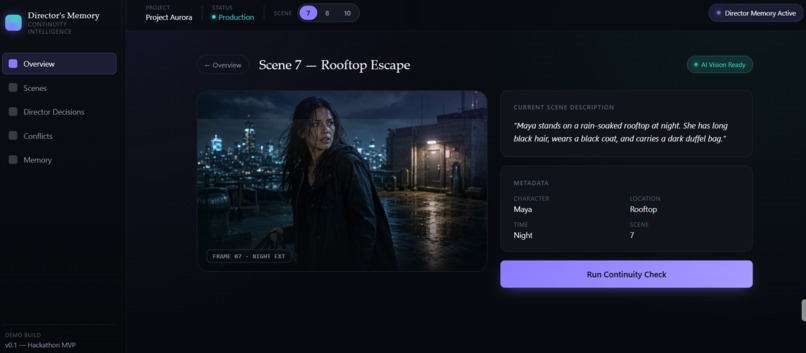
Live Demo — Director’s Memory
-
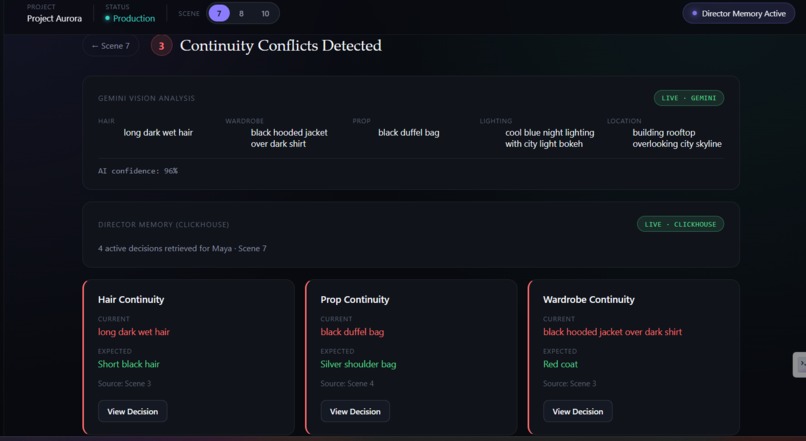
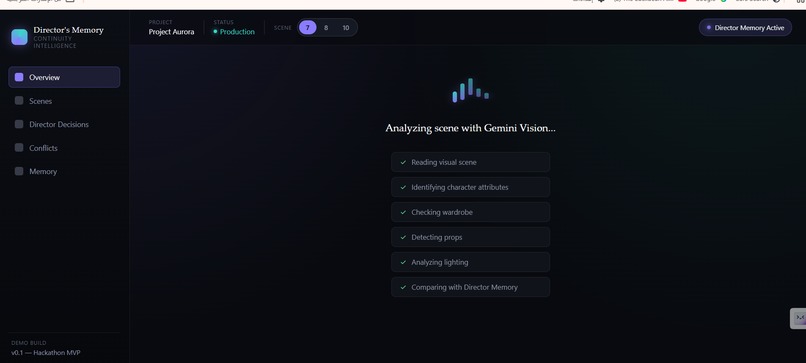
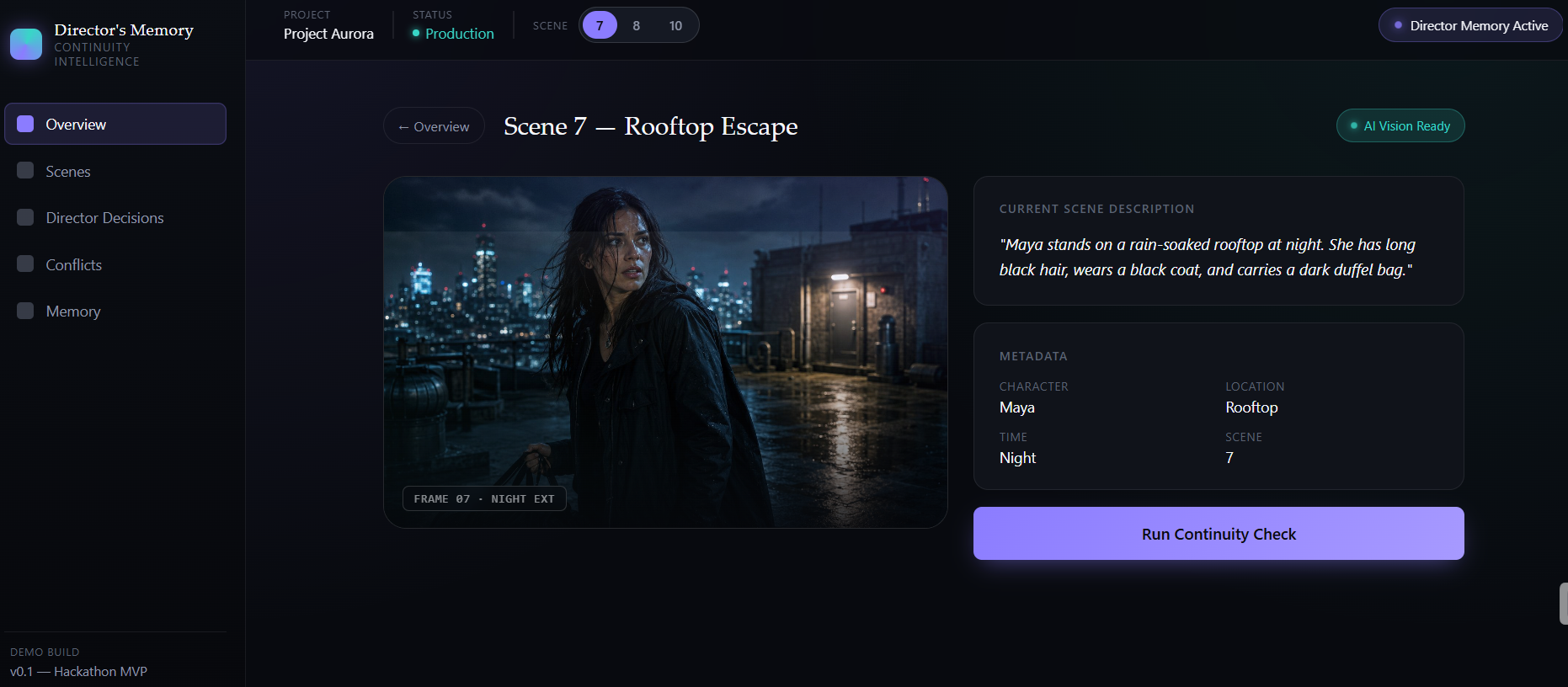
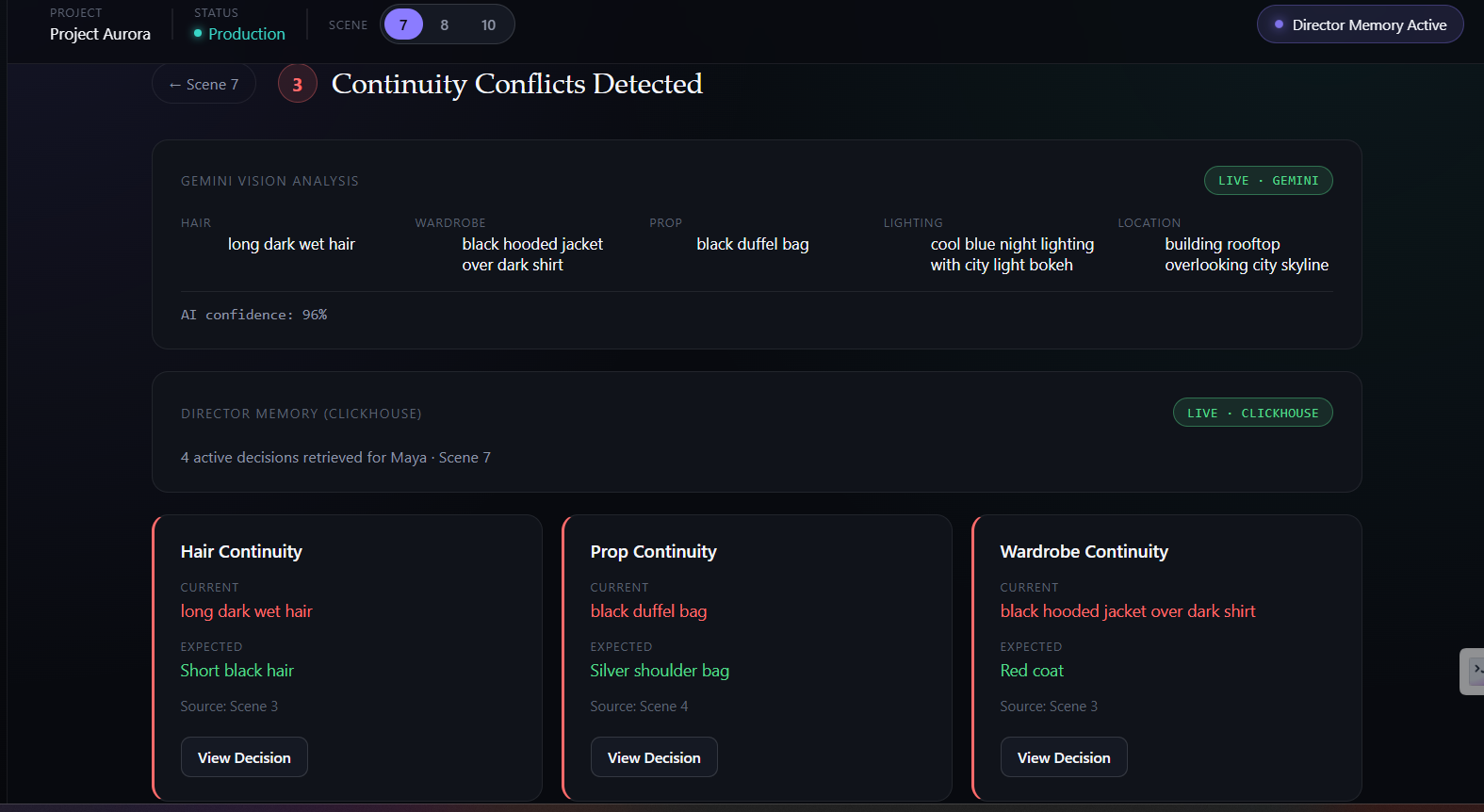
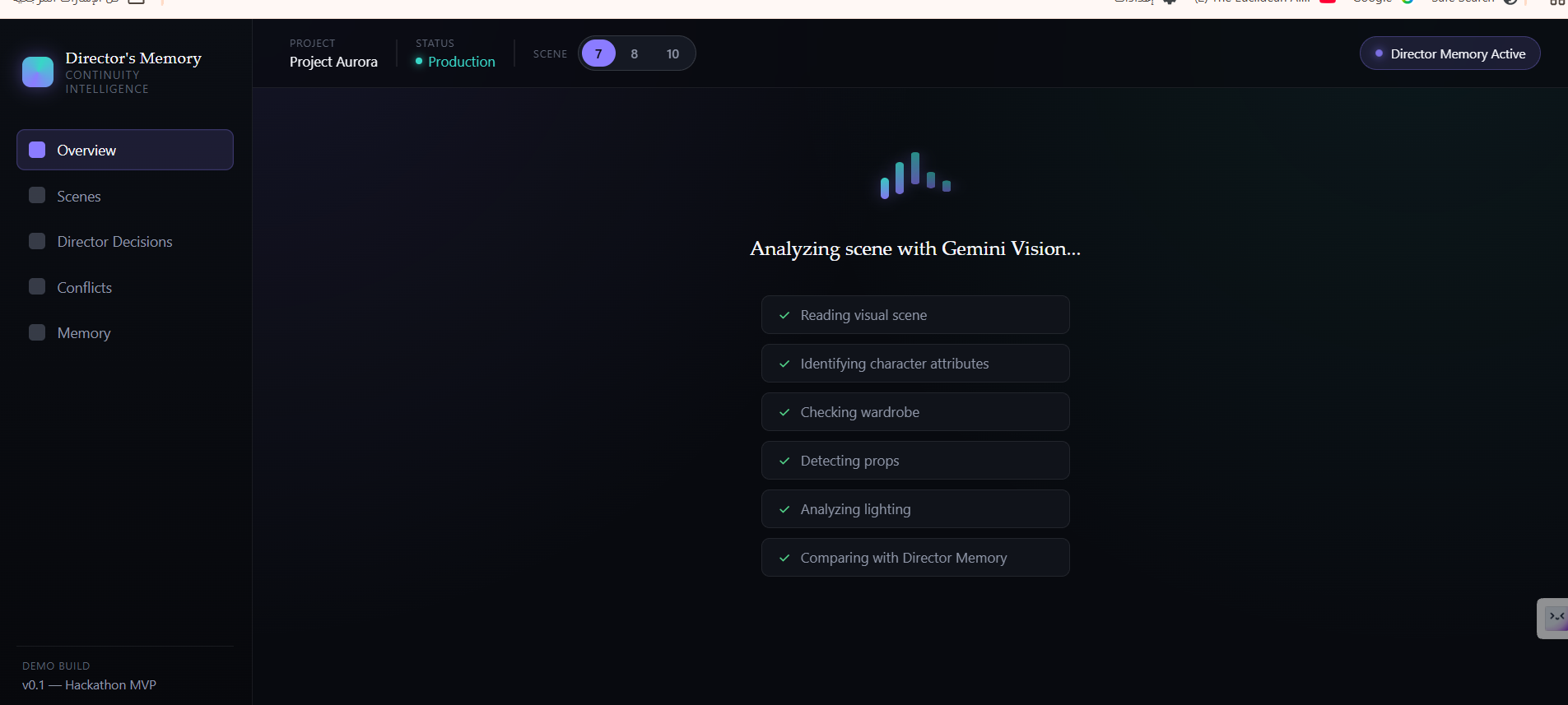
Scene 7 — Live Gemini + ClickHouse Continuity Check
-
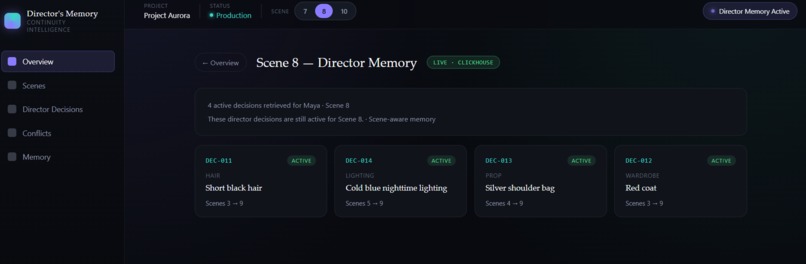
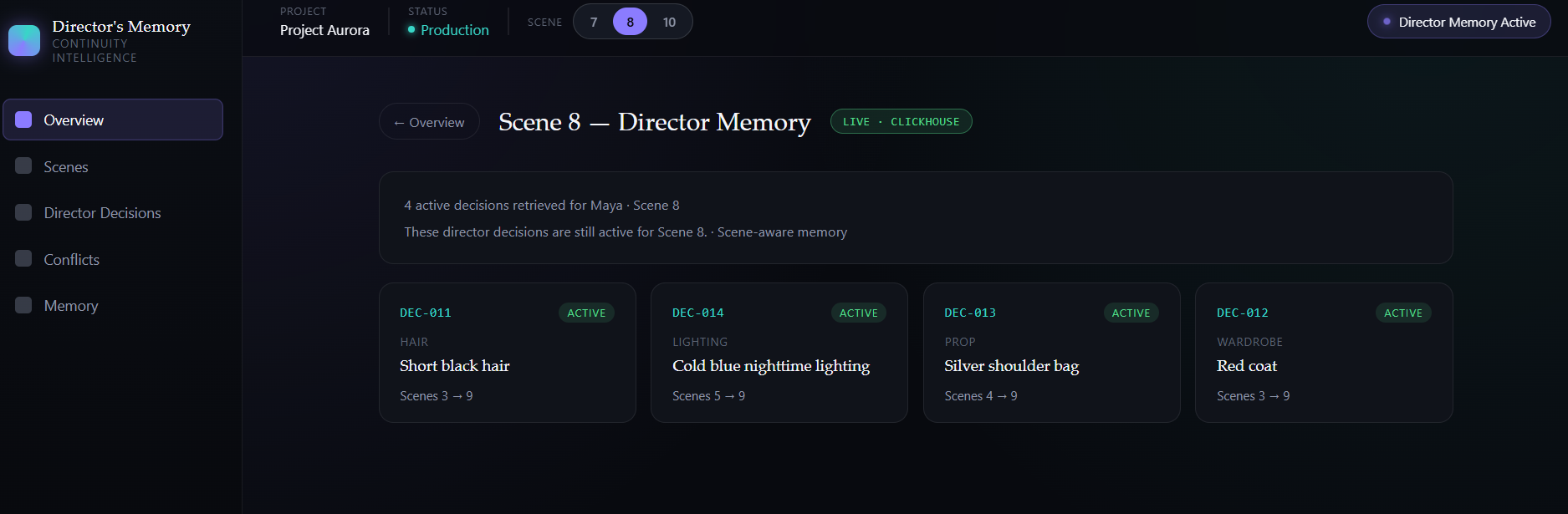
Scene 8 — Live ClickHouse Memory Retrieval
-
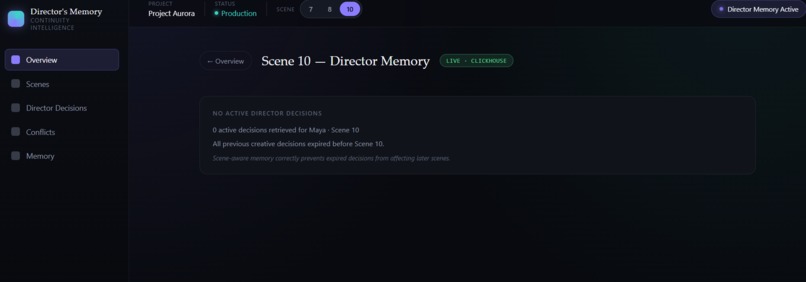
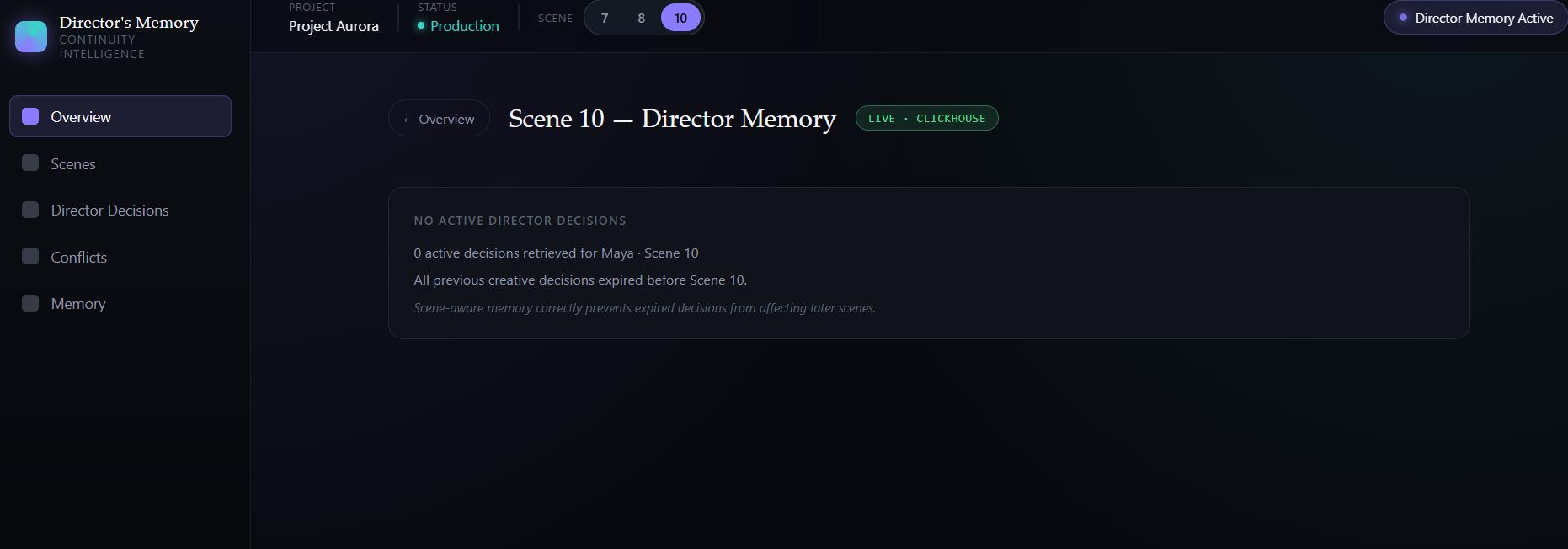
Scene 10 — Temporal Memory Expiration via ClickHouse
-
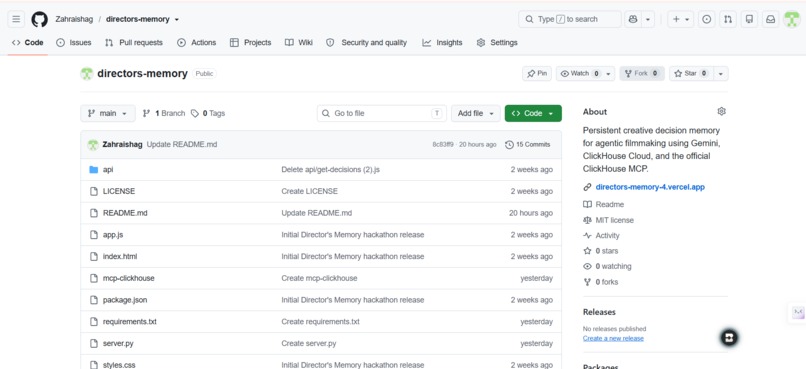
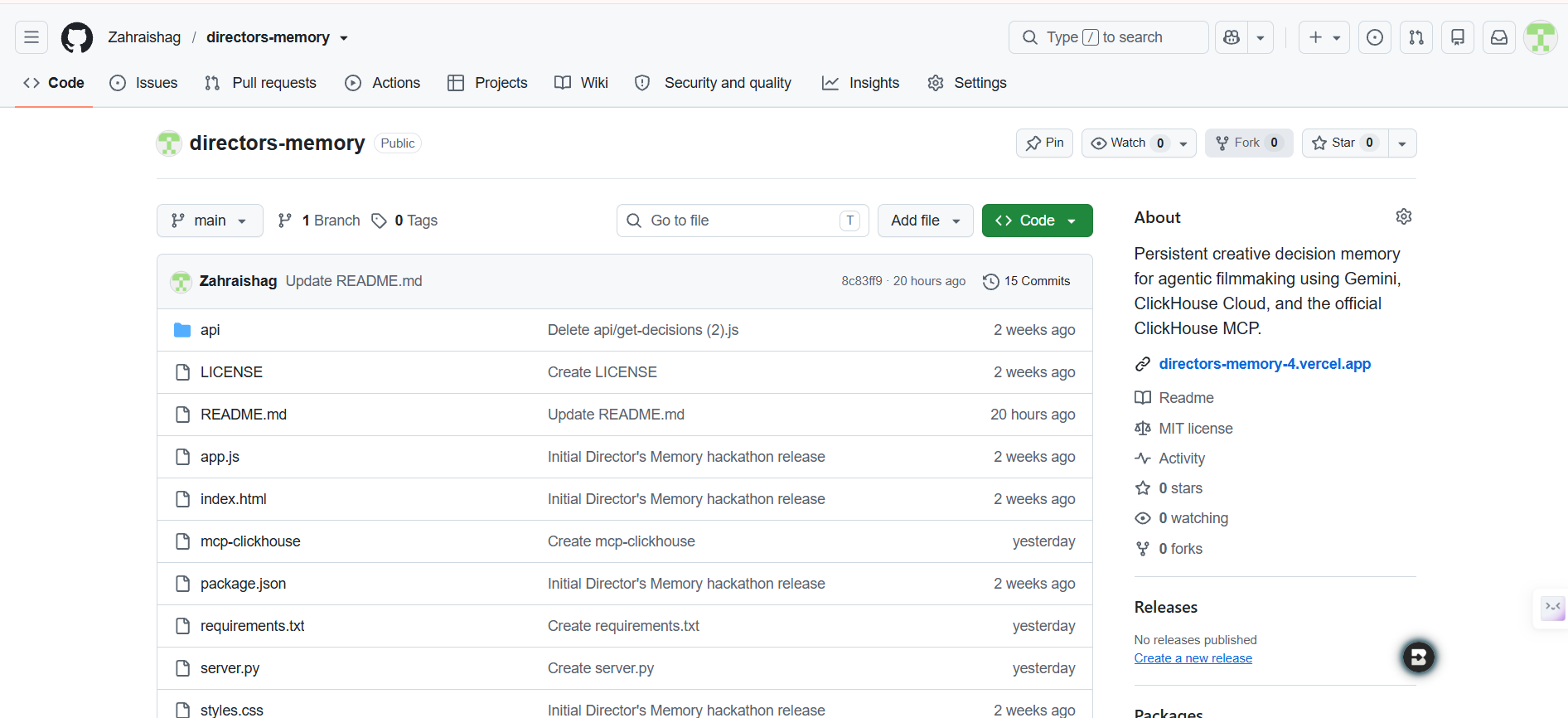
GitHub repository
-
ADK Production Memory Summary
Inspiration
AI filmmaking is becoming remarkably good at generating individual shots, but long-form productions still face a deeper problem: AI forgets what the director already decided.
A character's hair, wardrobe, props, lighting, or other visual details may drift from one scene to another. But not every change is an error — some changes are intentional creative decisions.
Director's Memory was inspired by one question:
How can an AI filmmaking system remember the director's approved creative intent across scenes without replacing the director's authority?
Our answer is to give filmmaking agents a persistent, structured memory of approved production decisions, including when each decision becomes active and when it expires.
What it does
Director's Memory is a persistent creative-decision memory and continuity system for agentic filmmaking.
It:
- Uses Gemini to analyze the current scene and extract structured visual attributes.
- Retrieves the director's active creative decisions from ClickHouse Cloud.
- Uses the official ClickHouse MCP server and its
run_querytool at runtime. - Applies temporal scope so only decisions relevant to the current scene are retrieved.
- Compares the current scene against approved director memory.
- Detects continuity conflicts.
- Shows the underlying creative decision behind each conflict.
- Generates a suggested continuity fix while keeping the human director as the creative authority.
The core principle is:
Gemini observes. ClickHouse remembers. The Continuity Engine judges.
How we built it
Director's Memory is built as a lightweight agentic filmmaking prototype with a clear separation between observation, memory, and decision logic.
Gemini analyzes the current scene and returns structured attributes such as:
- Hair
- Wardrobe
- Props
- Lighting
- Location
- Time of day
ClickHouse Cloud stores approved directing decisions as persistent structured memory.
Each decision contains fields such as:
- Character
- Attribute
- Approved value
- Effective scene range
- Status
- Source
- Reasoning
For runtime memory retrieval, the application uses the official ClickHouse MCP server.
The production memory path is:
Director's Memory → Vercel API → MCP Client → Official ClickHouse MCP → run_query → ClickHouse Cloud
The /api/get-decisions endpoint queries ClickHouse through MCP as its primary path and exposes:
"memory_transport": "mcp"
so the runtime integration can be verified directly.
Google ADK provides the agent layer used to retrieve and reason over production memory during evaluation and testing.
We also retain a direct ClickHouse backend fallback for resilience if the MCP service becomes temporarily unavailable.
The frontend and serverless API are deployed on Vercel, while the official ClickHouse MCP service runs on Render.
Challenges we ran into
One of the biggest challenges was distinguishing between simple memory and temporally valid creative memory.
A decision should not affect every future scene forever.
For example, Maya's red coat may be approved only through Scene 9.
Scene 8 should retrieve it, while Scene 10 should not.
We therefore had to design memory around:
- Effective scene ranges
- Active versus expired decisions
- Attribute-specific retrieval
- Character-specific retrieval
- Supersession
- Safe fallback behavior
Another challenge was integrating the official ClickHouse MCP server as a true runtime path rather than using it only for a health check.
We also had to solve deployment and connection issues across Vercel, Render, and ClickHouse Cloud while keeping secrets server-side.
A further challenge was validating the complete agent workflow through Google ADK and ensuring that the agent could retrieve production memory from the live backend rather than from a local or simulated source.
Accomplishments that we're proud of
We are especially proud that Director's Memory now demonstrates a real end-to-end persistent memory workflow.
In production, Scene 8 retrieves four active director decisions through the official ClickHouse MCP runtime path:
- Short black hair
- Red coat
- Silver shoulder bag
- Cold blue nighttime lighting
The API confirms:
"memory_transport": "mcp"
Google ADK also successfully retrieved Maya's production memory through the live backend, confirming the end-to-end agent workflow.
Scene 10 also successfully queries ClickHouse through MCP, but returns:
"decisions": []
because all four decisions expired after Scene 9.
This demonstrates that the system does not merely remember creative decisions — it understands when they should and should not apply.
We are also proud that Gemini, ClickHouse memory, and the continuity engine remain clearly separated instead of allowing the AI model to become the creative source of truth.
What we learned
The biggest lesson was that continuity is not simply visual sameness.
Good filmmaking often contains intentional change.
A useful filmmaking agent therefore needs more than image comparison or chat history. It needs structured knowledge of:
- What the director approved
- When the decision became active
- When it expires
- Which character or attribute it applies to
- Why the decision exists
We also learned that persistent memory becomes much more powerful when it is queryable and scoped rather than stored as unstructured conversation history.
We learned that MCP is most valuable when it is part of the real runtime architecture, not merely a demonstration layer.
We also learned that agent frameworks such as Google ADK become much more useful when they operate on structured, persistent, externally verifiable memory rather than relying only on conversation context.
Most importantly, AI should not become the authority over creative intent.
The director decides. The system remembers.
What's next for Director's Memory
Next steps include:
- Multi-character continuity memory
- Director approval and override workflows
- Camera and lens decisions
- Costume and prop lifecycle tracking
- Location and set continuity
- Automatic screenplay-to-memory ingestion
- Cross-scene visual verification
- Production approval history
- Multi-agent filmmaking workflows
- Shared creative provenance across production agents
- Deeper Google ADK orchestration for specialized filmmaking agents
- Expanded MCP-based memory tools for production workflows
The long-term vision is for Director's Memory to become a shared persistent creative-memory layer that multiple filmmaking agents can consult before taking autonomous production actions.
Generative AI knows how to create the next scene. Director's Memory helps it remember the film it is already making.
Built With
- clickhouse
- cloud
- css3
- gemini
- html5
- javascript
- mcp
- render
- vercel


Log in or sign up for Devpost to join the conversation.