-
-
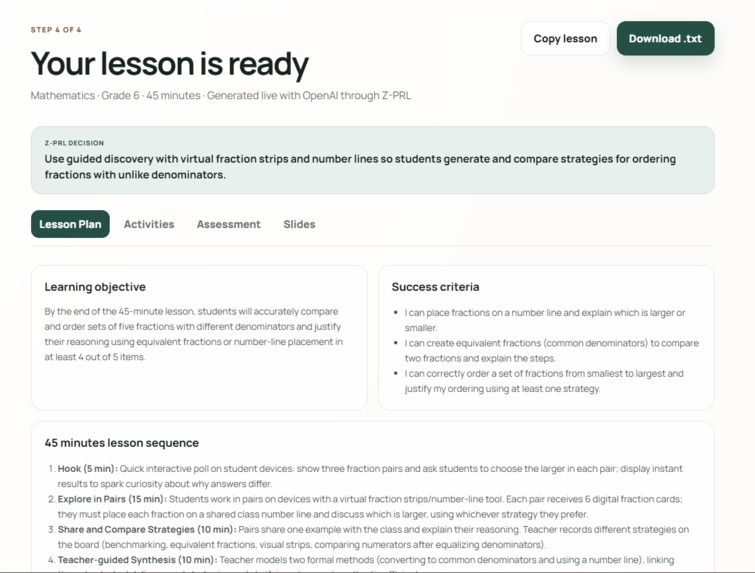
Live lesson generated with OpenAI through the ZAHRAA™ Pedagogical Reasoning Layer.
-
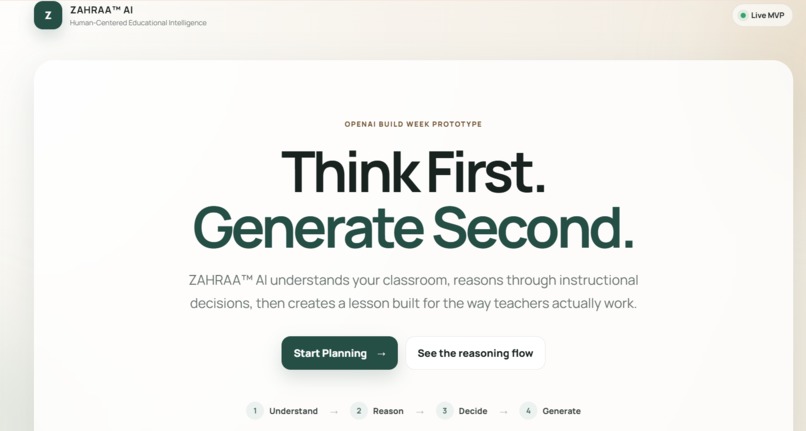
ZAHRAA™ AI understands the classroom before generating content.
Inspiration
Most educational AI tools begin generating content immediately after receiving a prompt. But effective teaching requires more than content generation. Teachers must consider learner needs, classroom constraints, available resources, instructional strategies, assessment methods, and differentiation before designing a lesson.
ZAHRAA™ AI was inspired by a simple principle:
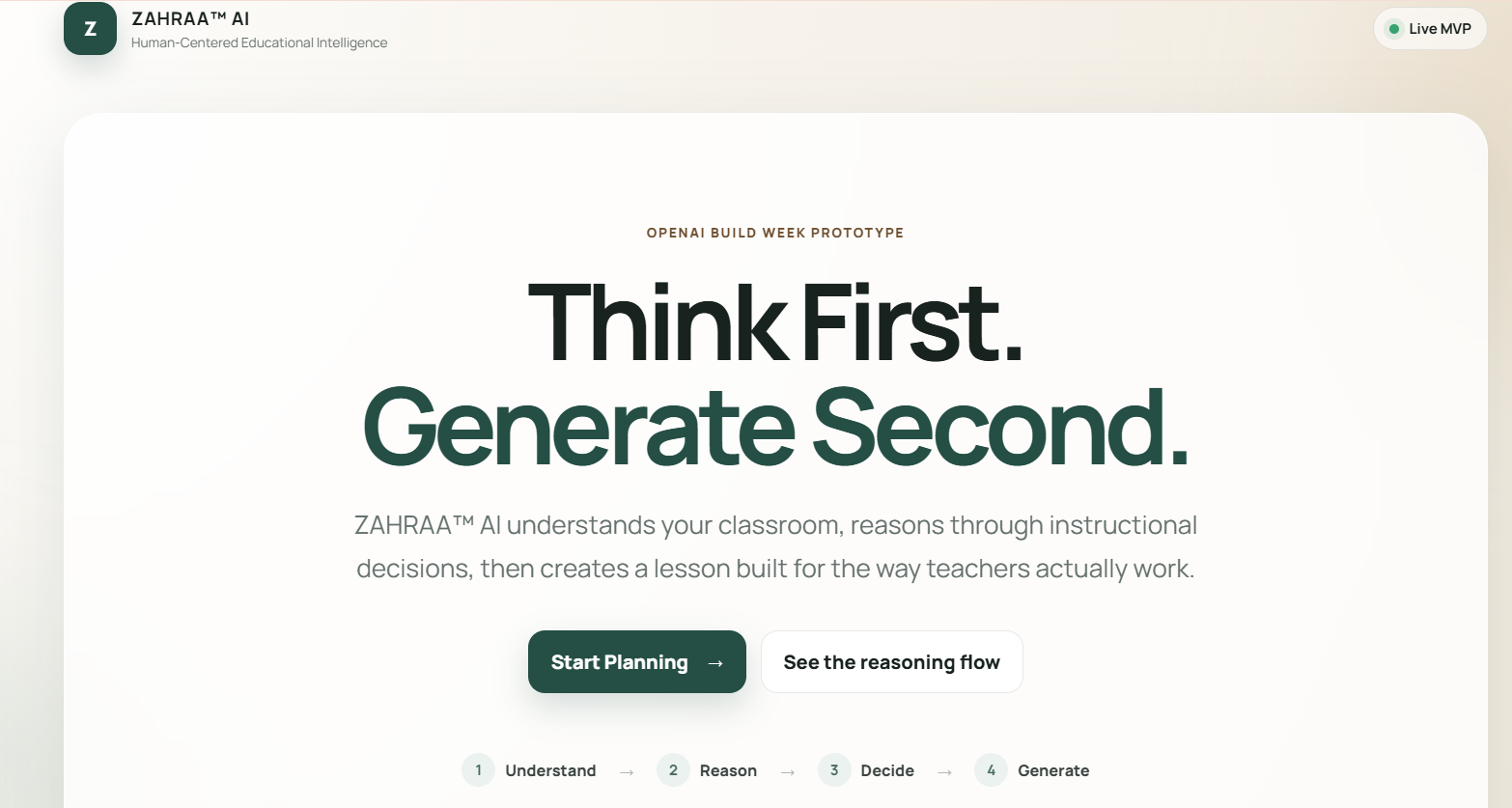
Think First. Generate Second.
The project aims to make educational AI reason with teachers instead of replacing their professional judgment.
What it does
ZAHRAA™ AI helps teachers design context-aware lessons through a four-stage workflow:
- Understand the teacher’s request and classroom context.
- Reason through learner needs, teaching strategy, assessment approach, and available resources.
- Decide on an appropriate instructional design.
- Generate a complete educational lesson using OpenAI.
Before generating the lesson, the system asks focused questions about:
- learner support needs,
- preferred teaching strategy,
- assessment approach,
- classroom resources and constraints.
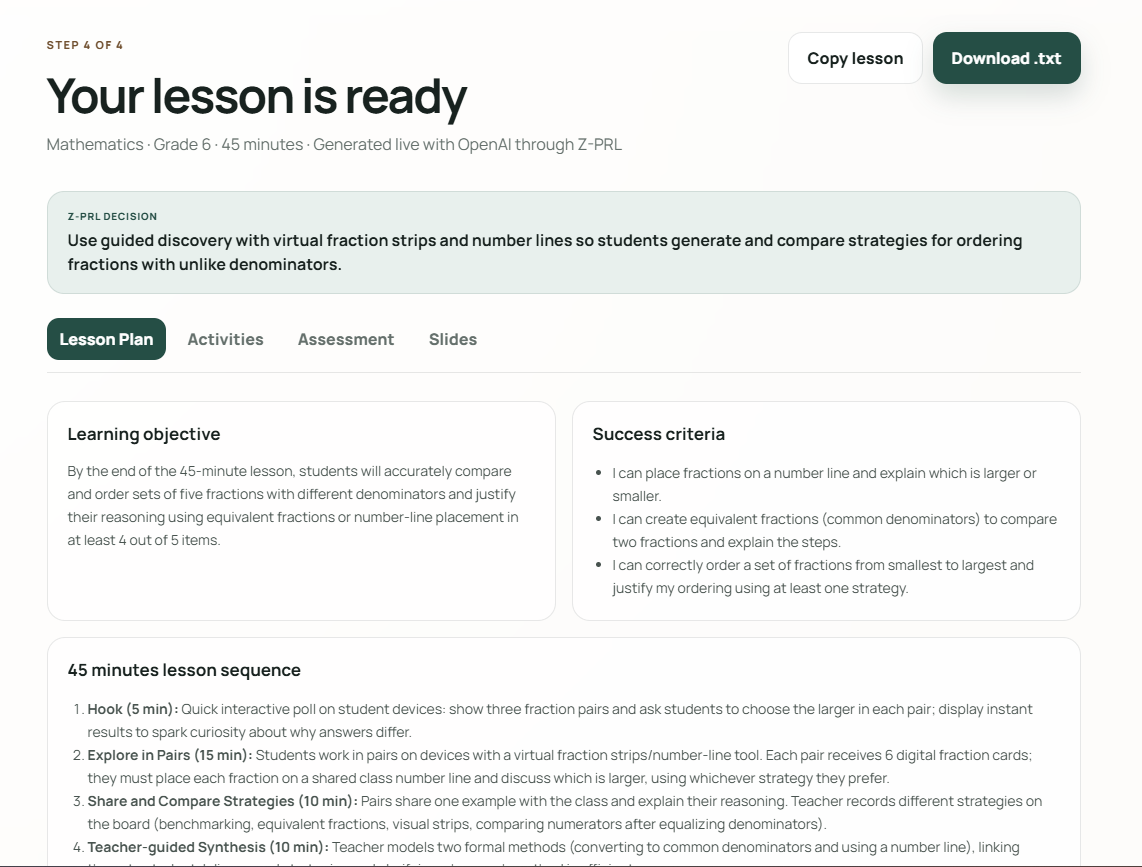
The ZAHRAA™ Pedagogical Reasoning Layer, or Z-PRL, uses these answers to create an instructional decision. The application then generates:
- a measurable learning objective,
- success criteria,
- a structured lesson plan,
- differentiated activities,
- formative and final assessments,
- suggested presentation slides.
How we built it
The project was built as a responsive web application using HTML, CSS, and JavaScript.
The front end collects the teacher’s lesson information and classroom context. It then sends this information to a secure Vercel serverless function.
The serverless function connects to the OpenAI Responses API using a protected environment variable. The API key is never exposed in the browser or stored in the public repository.
OpenAI generates a structured lesson based on:
- subject,
- grade level,
- learning goal,
- lesson duration,
- class size,
- learner support needs,
- teaching strategy,
- assessment approach,
- available classroom resources.
The application also includes a transparent local fallback. If the OpenAI connection is unavailable, the interface clearly states that a local fallback is being shown and does not claim that the output was generated by OpenAI.
Challenges we ran into
One major challenge was ensuring that ZAHRAA™ AI was more than a visually attractive lesson generator.
The first prototype used rule-based JavaScript logic and contained lesson content designed around one mathematics example. During technical review, we identified that this did not fully support the project’s claims.
We therefore rebuilt the generation workflow to:
- connect to the OpenAI Responses API,
- protect the API key through a serverless function,
- dynamically generate activities and assessments for different subjects,
- distinguish clearly between OpenAI output and local fallback output,
- ensure that the reasoning screen reflects a real API request.
Another challenge was designing a simple user experience that demonstrates pedagogical reasoning without overwhelming the teacher with too many questions.
Accomplishments that we’re proud of
We are proud that ZAHRAA™ AI:
- asks pedagogically meaningful questions before generating content,
- connects classroom context to instructional decisions,
- generates subject-specific lessons live with OpenAI,
- protects the OpenAI API key on the server,
- provides a transparent fallback instead of hiding technical failure,
- works on both desktop and mobile,
- produces lesson plans, activities, assessments, and slide outlines in one workflow.
We successfully tested the system with different subjects, including Mathematics and History. A live History test generated a lesson about the causes of World War I and displayed:
Generated live with OpenAI through Z-PRL.
What we learned
We learned that responsible educational AI requires more than a strong prompt.
The quality of the result depends on the quality of the instructional decisions made before generation.
We also learned that transparency is essential. A system should clearly distinguish between AI-generated output and locally generated fallback content.
Most importantly, we learned that teachers should remain active decision-makers. AI should support their reasoning, not replace it.
What’s next for ZAHRAA™ AI
The next version of ZAHRAA™ AI will include:
- Arabic and multilingual interfaces,
- adaptive follow-up questions based on previous answers,
- teacher editing and approval before final generation,
- export to PDF, Word, and PowerPoint,
- saved teacher profiles and classroom preferences,
- curriculum alignment,
- accessibility and inclusive learning recommendations,
- assessment analytics,
- student performance feedback,
- integration with learning management systems.
Our long-term vision is for ZAHRAA™ AI to become a human-centered operating system for educational planning.
Think First. Reason with Teachers. Generate Second.


Log in or sign up for Devpost to join the conversation.