-
-
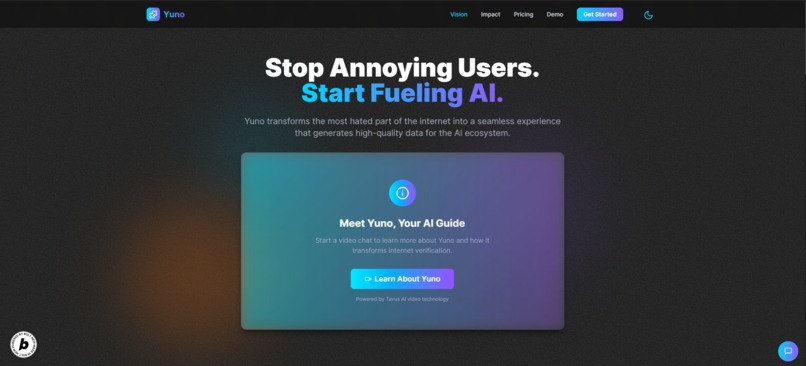
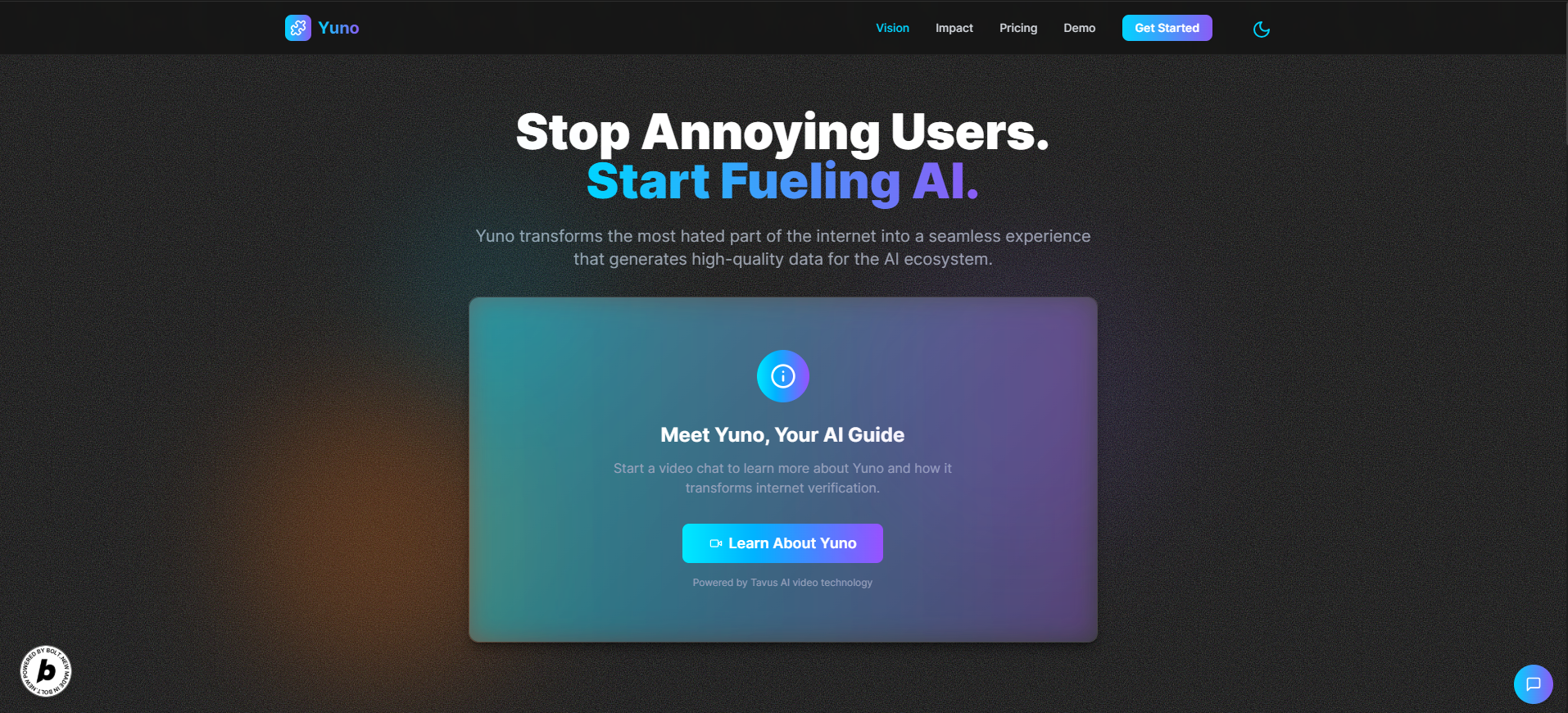
Stop Annoying Users. Start Fueling AI.
-
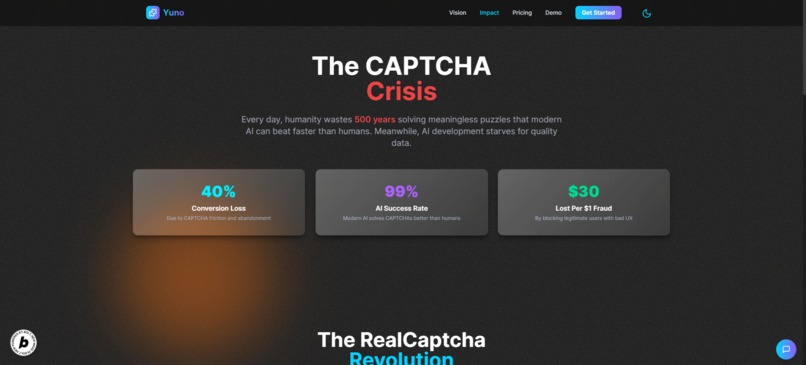
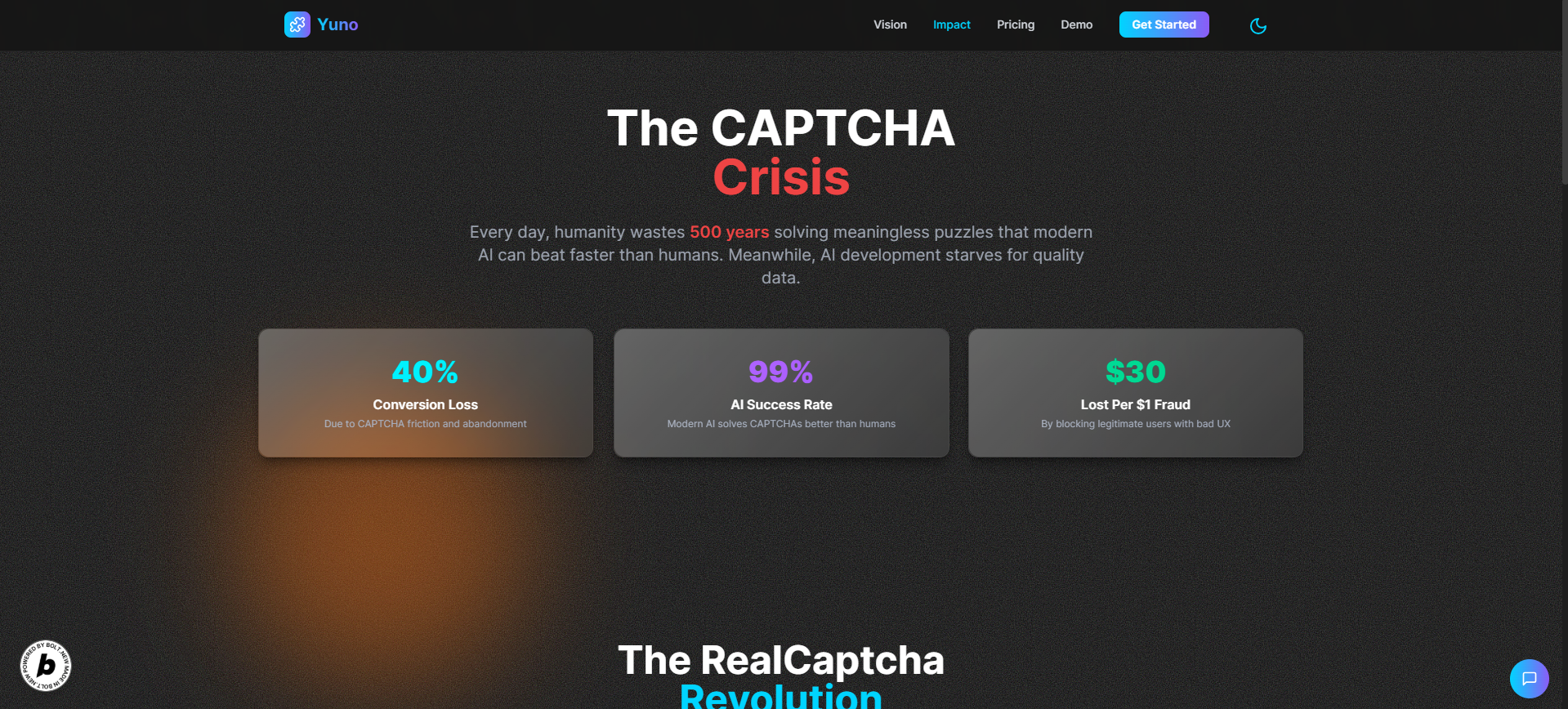
The CAPTCHA Crisis
-
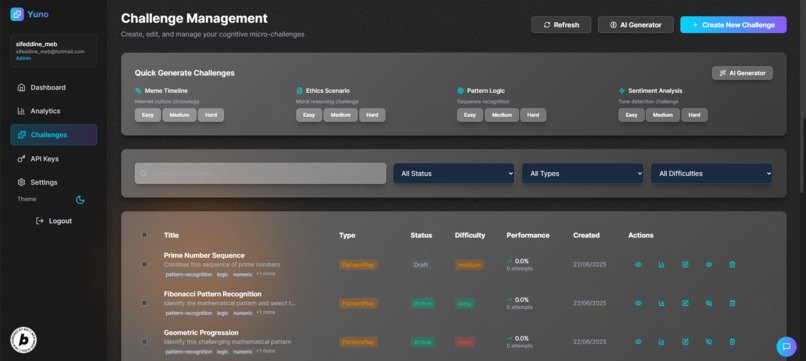
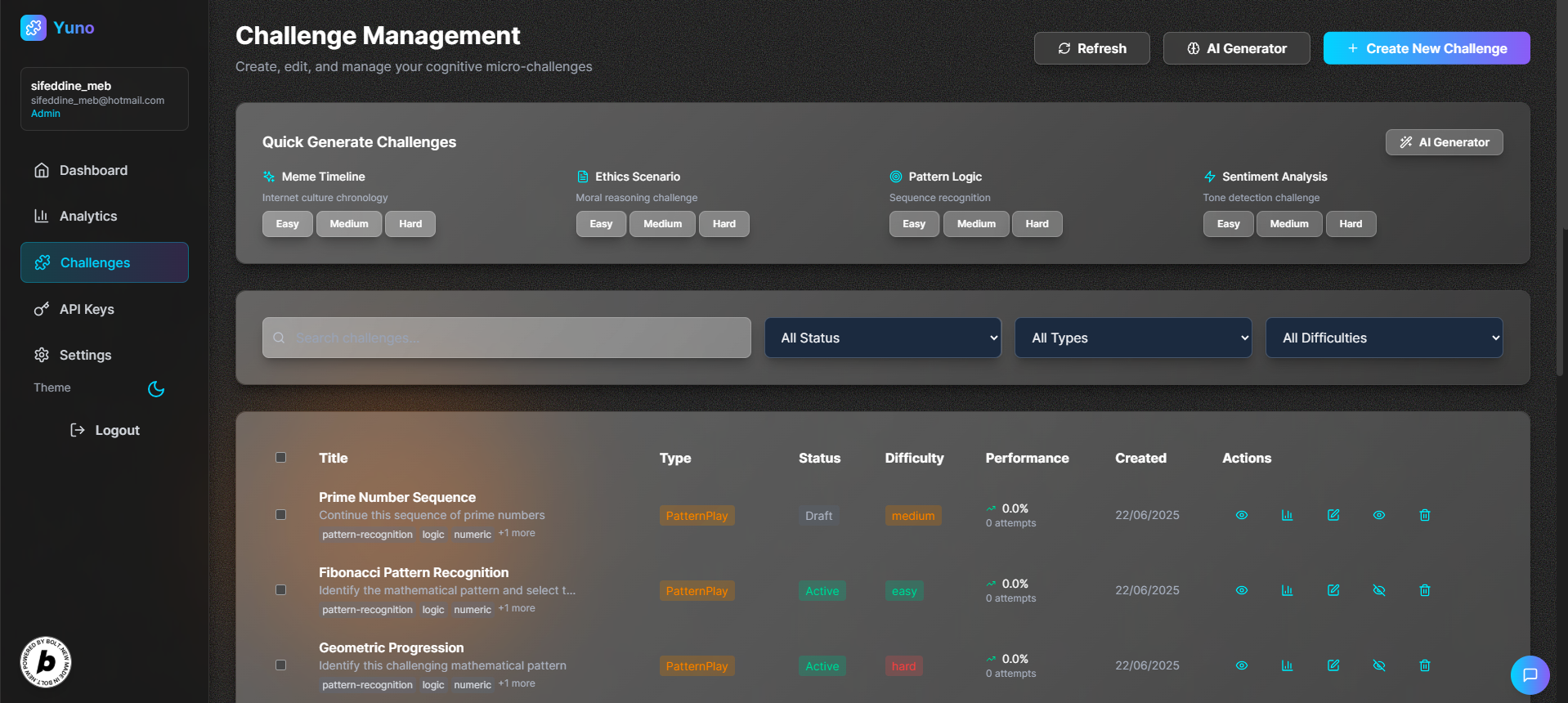
Challenges Management
-
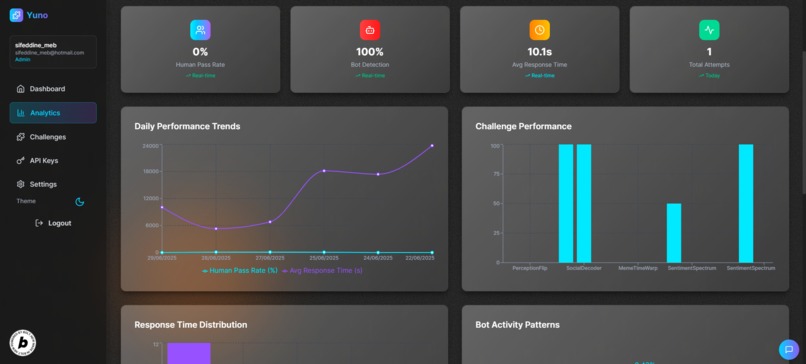
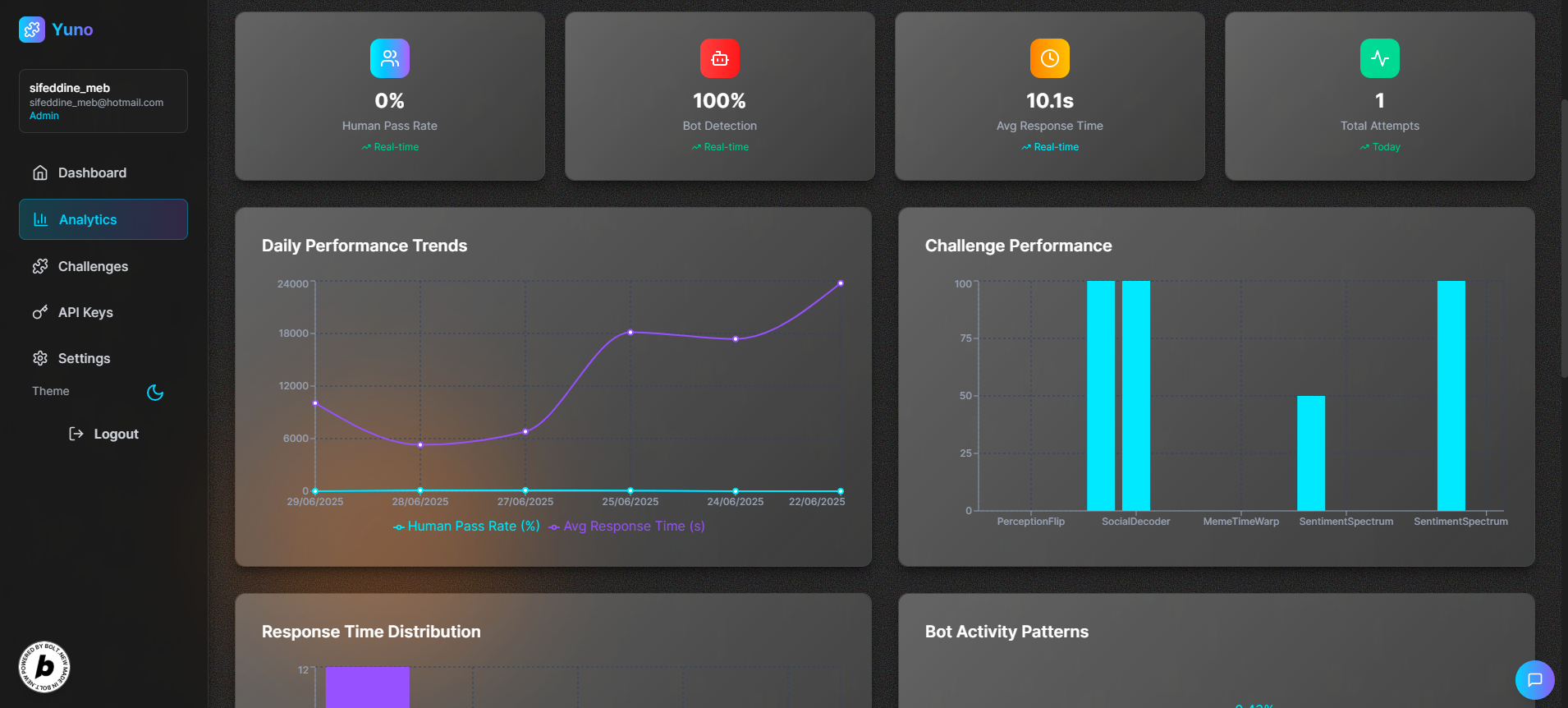
Admin Analytics
-
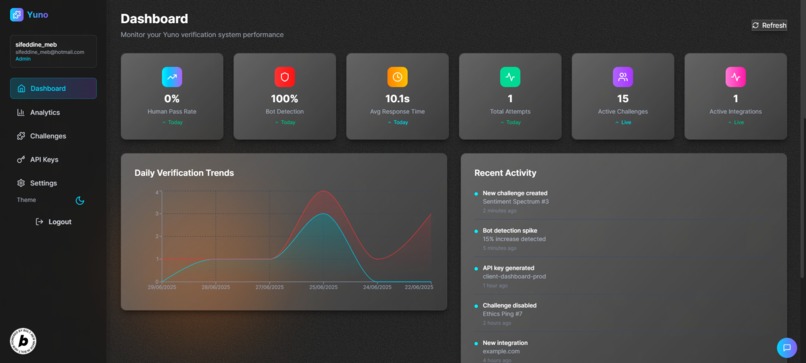
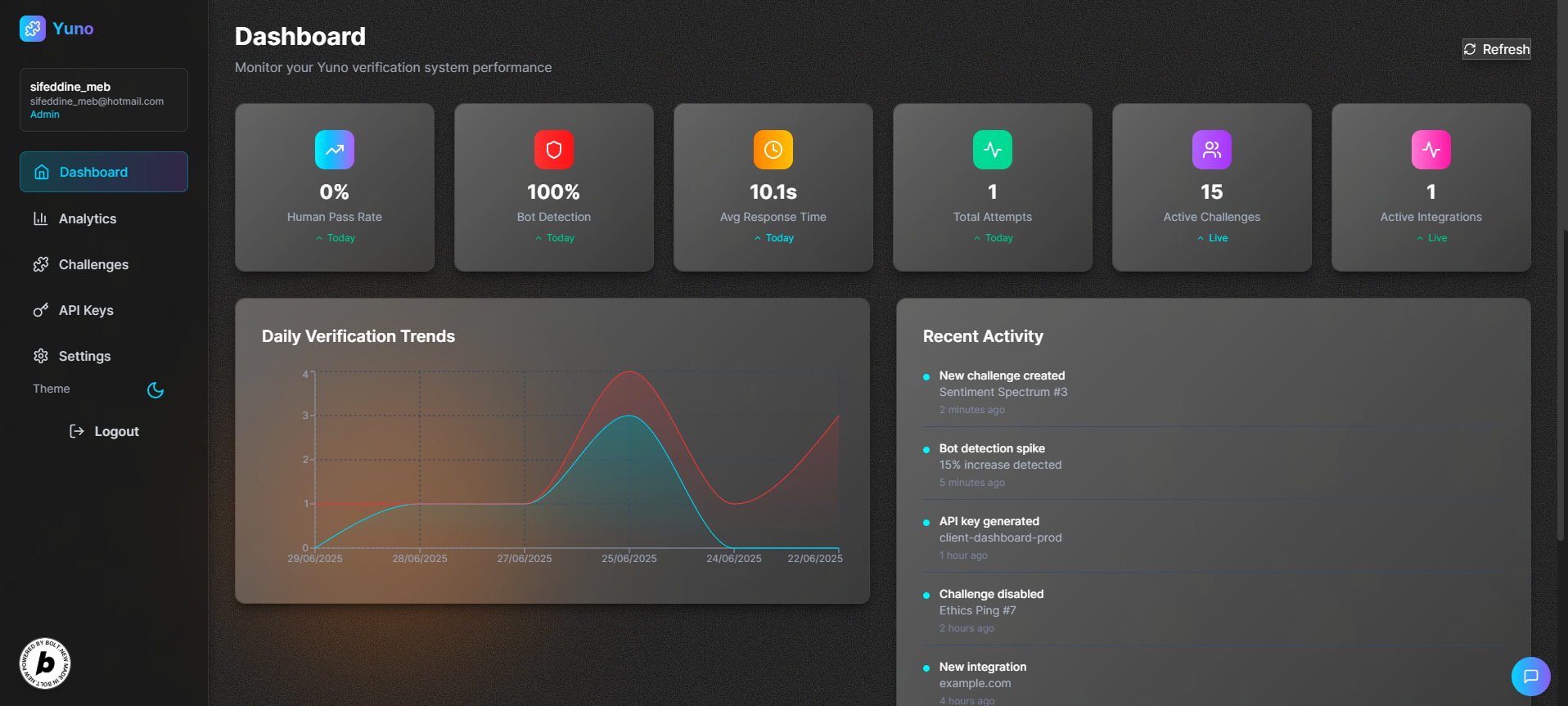
Admin Dashboard
🧠 Yuno: The Internet's Human Intelligence Layer – My Project Story
Hey everyone! This is the story of Yuno, a solo project born from a big idea: making the internet a bit more human, and a lot smarter.
Inspiration
You know those CAPTCHAs? I realized they were basically getting free labor from us to digitize books. That sparked a thought: what if we could flip that? What if proving you're human could directly generate valuable data to train next-gen AI, data hungry for real human reasoning?
Then, a funny bit of inspiration hit me from a local Algerian policy on informal trade: instead of just blocking something inevitable, why not learn from it and make it work? That's bots. They're getting incredibly smart! So, instead of a futile blocking war, Yuno's philosophy is simple: we don't just block bots; we learn from them. Every bot attempt refines our defenses, turning friction into fuel.
What it does
At its heart, Yuno is my "Proof of Mind" layer for the internet. I'm trying to replace frustrating CAPTCHAs with quick, fun, cognitive micro-challenges.
- Human Verification: Engage in 5-10 second games (like ordering memes or detecting sarcasm) that truly test human cognition, not just robot-like pattern matching. The Voice/Avatar Check challenge, where users chat with an AI avatar, is now implemented and leverages the Tavus API.
- AI Training Data Generation: Every human success generates high-quality, human-labeled data on reasoning, emotion, and cultural nuance for AI training.
- Adaptive Bot Detection: Bot attempts feed a "bot stream," analyzed to understand evolving strategies, making Yuno's security smarter.
- Comprehensive Admin Platform: A neat dashboard allows administrators to manage challenges and view real-time analytics. The interface for AI-assisted challenge generation is implemented and uses the Google Gemini API, but I'm still actively refining its backend functionality for consistent, high-quality output.
How I built it
Here's the wild part: I genuinely didn't write a single line of code for this whole, full-stack application. It was an incredible journey as a solo builder, powered entirely by meticulously prompting and guiding my AI coding companions: Bolt.new and Windsurf (formerly Codex). This project is a testament to the unprecedented power of AI-assisted development.
My build process was a bit of a dance, orchestrated by a unique AI-driven workflow that I developed. This workflow, which I've linked below for anyone to use, allowed me to manage complexity and maintain context across both AI tools.
Phase 1: Blueprinting & Documentation with Bolt.new: I started by feeding Bolt.new a "Universal Codebase Documentation Prompt" (
1-UNIVERSAL CODEBASE DOCUMENTATION PROMPT.md). This instructed it to scan my initial boilerplate and generate a comprehensive set of project documentation. This step was crucial; it created a shared "memory" for the AI, translating the codebase into a human-readable format for me, a non-programmer.Phase 2: Strategic Planning & Sprint Definition with Bolt.new: Next, using a "Strategic Execution Phase Prompt" (
2-STRATEGIC EXECUTION PHASE.md), I guided Bolt.new to analyze the newly generated documentation. It distilled all findings into a tacticalplan.md, prioritizing fixes and features. Then, with a "Build Execution Prompt" (3-BUILD EXECUTION PROMPT.md), I had it translate that plan into a detailedsprints.mdroadmap, breaking the entire project into 8 manageable sprints.Phase 3: Iterative Execution & Core Build with Bolt.new: This was the main build phase. For each of the 8 sprints, I used "Sprint Initiation Protocol" (
4-SPRINT INITIATION PROTOCOL.md) and "Next Sprint — Standard Execution Prompt" (5-NEXT SPRINT — STANDARD EXECUTION PROMPT.md). Crucially, with every single prompt in this phase, I pasted "The Ten Commandments" (my custom guidelines for the AI). This ensured Bolt.new consistently updated documentation, maintained code quality, and preserved functionality. During these 8 sprints, Bolt.new generated:- The entire frontend aesthetic (dark theme, minimal, glassmorphism, grainy background, vibrant icons) and all public, auth, and admin pages.
- My robust backend using Supabase (PostgreSQL, RLS, Edge Functions) [cite: sprints.md, technical-reference.md], and integrated the Yuno Widget.
- All seven diverse cognitive micro-challenge types [cite: sprints.md, technical-reference.md].
- Advanced ML-based bot detection algorithms [cite: sprints.md, technical-reference.md].
- The interface for Google Gemini API integration for AI content generation [cite: sprints.md, technical-reference.md].
- The Tavus API integration for the Voice/Avatar Check challenge.
Phase 4: Post-Development Refinement & Documentation with Windsurf (formerly Codex): After 8 intensive sprints, Yuno's complexity and size (especially with detailed documentation) pushed Bolt.new to its 10 million token limit, causing performance issues. So, I exported the complete project and transitioned to Windsurf. Using a refined set of 3 prompts (based on my original 5), Windsurf took on the task of:
- Generating new, updated documentation based on the completed codebase.
- Implementing crucial performance optimizations (like lazy loading, code splitting, and caching).
- Adding accessibility improvements (enhanced focus styles, theme-color meta tags, improved contrast).
- Performing the crucial final UI/UX polishing and critical bug fixes (like perfecting glassmorphism and fixing layout overflows) that Bolt.new was struggling with at scale.
This strategic, dual-AI approach allowed me to orchestrate a complex, full-stack application from concept to polish, entirely through prompting, adapting my workflow to leverage each AI's strengths at different stages of the project's journey.
Challenges I ran into
Building Yuno solely through AI prompting was an amazing ride, but it definitely had its tricky moments:
- Bolt.new's Scaling Limits: The biggest head-scratcher was when Bolt.new started slowing down and eventually hit its token limit as the project got truly big after 8 full sprints. It was a learning curve, figuring out when to pivot and how to smoothly transition the whole codebase to a different AI.
- AI Challenge Generation Refinement: While the interface for AI-assisted challenge generation is built and uses the Gemini API, getting it to consistently spit out perfectly nuanced, diverse, and challenge-ready content, and ensuring its seamless integration, has proven to be complex. I'm actively refining this – AI nuance is tricky!
- Supabase Edge Function Integration: Integrating with Supabase Edge Functions for secure API key retrieval proved challenging due to import resolution issues and ensuring robust error handling for non-2xx responses.
- Persistent UI Quirks: Minor theme switching contrast bugs, table overflows, and achieving perfectly consistent glassmorphism required incredibly precise, iterative prompts. It was a pixel-by-pixel dance with the AI.
- Prompting for Perfection: My job became less about coding and more about incredibly precise "AI whispering." Learning how to break down complex tasks and troubleshoot AI output for subtle UI polish or nuanced logic was a constant education.
- "Final 1%" Polish: Those little touches that make an app feel truly polished – like a quick "copy to clipboard" for IDs, a save button that sticks to the bottom of the screen, or graphs that look vibrant with sample data – each required dedicated prompts and meticulous checks.
- Demonstrating Empty States: Initial graphs appeared empty. I had to specifically prompt the AI to generate realistic sample data for demonstration purposes, making the analytics immediately compelling.
Accomplishments that I'm proud of
I'm genuinely chuffed about a few things with Yuno:
- Zero Lines of Code Written by Me: This still blows my mind! Conceptualizing, designing, and orchestrating this entire, complex, full-stack application purely through AI prompting is something I'm incredibly proud of. It really shows what's possible now.
- Full-Stack Powerhouse: I managed to build a complete, integrated platform – from that slick, lightweight widget to a robust backend and a super comprehensive set of admin dashboards – all within a hackathon timeframe!
- Ambitious AI Features Implemented: Successfully integrating ML-based bot detection, Google Gemini API for AI-assisted challenge generation (though still refining), and Tavus API for video verification showcases ambitious technical depth and a vision for continuous learning and adaptation.
- Comprehensive Challenge Library: Crafting seven unique cognitive micro-challenge types that genuinely test human intelligence and provide rich, valuable data is something I really enjoyed.
- Exceptional UI/UX: Achieving a highly polished, intuitive, glassmorphic dark-themed interface with flawless dark/light mode switching and meticulous attention to detail, as evidenced by the live demo. This also includes new performance optimizations and accessibility improvements.
- Tiered Pricing Page: Successfully implemented a new public-facing pricing page.
- Real Impact, Big Vision: Solving a common user frustration while simultaneously generating invaluable data for ethical AI training at scale.
What I learned
This project has been a profound, hands-on masterclass in the future of software development:
- AIs as True Teammates: Bolt.new and Windsurf aren't just tools; they're transformative partners. They've shown me that a solo builder can truly achieve the scope and quality that used to require a whole team. It's liberating!
- Navigating AI Tool Limitations: Understanding when to transition between AI tools (e.g., from Bolt.new for core build to Windsurf for post-build refinement/documentation/some fixes) due to scaling limits is a crucial skill for efficient AI-assisted development.
- The Art of Product Thinking: When AI handles the coding, the human's role shifts to crystal-clear product definition, strategic prompting, and meticulous quality assurance. The "what" and "why" become my superpowers.
- Iterative Prompting is Key: Complex systems are built not with a single magic prompt, but through a series of precise, iterative instructions, constant review, and refinement of AI output.
- The Value of Detailed Requirements: A well-defined Product Requirements Document (PRD) is crucial for guiding AI development effectively and ensuring the final product aligns with the initial vision.
What's next for Yuno
Yuno is just getting started! I'm super determined to push this vision forward. My immediate roadmap is packed:
- Finalizing AI Challenge Generation: My absolute top priority is to fully perfect the AI-assisted challenge generation system, ensuring seamless integration and consistent, high-quality content output.
- Security Hardening (Sprint 9): Time to make Yuno rock-solid for the real world! I'll be focusing on input validation, XSS/CSRF protection, secure API key management, and robust rate limiting.
- Real-time Analytics (Sprint 9/Post-MVP): Imagine seeing bot activity and human verifications update live! I'm looking at WebSocket integrations for real-time charts and live monitoring.
- Performance Optimization (Sprint 10): I want Yuno to be lightning-fast. That means focusing on bundle size reduction, image optimization, and smart caching to ensure my widget loads in a blink and scales beautifully.
- Comprehensive Testing (Sprint 11): Building a full suite of unit, integration, and end-to-end tests will ensure Yuno is super robust and reliable.
- Launch Preparation (Sprint 12): Getting ready for prime time! Finalizing deployment pipelines, setting up monitoring, and creating user-friendly documentation for my clients.
- Future Expansions: I'm already dreaming big! Exploring more widget customization, bringing Yuno to a global audience with internationalization, and maybe even native mobile apps. Plus, I'm really excited about leveraging Tavus further – not just for the challenge itself, but as an AI documentation guide for the platform. Imagine users just chatting with an AI avatar to get support and learn all about Yuno!
Yuno is more than just a project; it's a living system ready to evolve and redefine how humans and AI interact across the internet.
A massive thank you to everyone who participated in this journey, especially the incredible Vibe Coding community. Wishing everyone the best of luck with their projects – may your code be bug-free and your demos be flawless!
Thank you for allowing us to be creative.


Log in or sign up for Devpost to join the conversation.