Yuh Hear Dem ADK - Parliamentary Intelligence System
Inspiration
This project started as a father-daughter collaboration between Matt and Katie, designed as a mentoring journey into the world of Agentic AI. What began as an educational project to teach Katie about AI agents and their capabilities evolved into something much more meaningful when we realized the real-world impact we could have on democratic transparency.
Katie, coming from a background in education and learning, brought a unique perspective to the project - understanding how people actually learn and process information. This educational lens proved invaluable when designing user interfaces that make complex parliamentary data accessible to everyday citizens. Her expertise in learning psychology helped shape how we present information in digestible, engaging formats.
Democracy thrives on transparency, but accessing parliamentary information often feels like navigating a maze. Citizens struggle to find what their representatives actually said about issues that matter to them, while traditional parliamentary archives are buried in lengthy videos and documents. Through our mentoring sessions, we became inspired by the need to make democratic discourse truly accessible to everyday Barbadians - turning a learning opportunity into a mission for civic engagement.
The name "Yuh Hear Dem" comes from Bajan dialect meaning "Did you hear them?" - perfectly capturing our mission to help citizens actually hear what their MPs are saying. We wanted to build something that would transform hours of parliamentary footage into instant, quotable insights that any citizen could access and understand, while simultaneously providing Katie with hands-on experience in cutting-edge AI agent development.
What it does
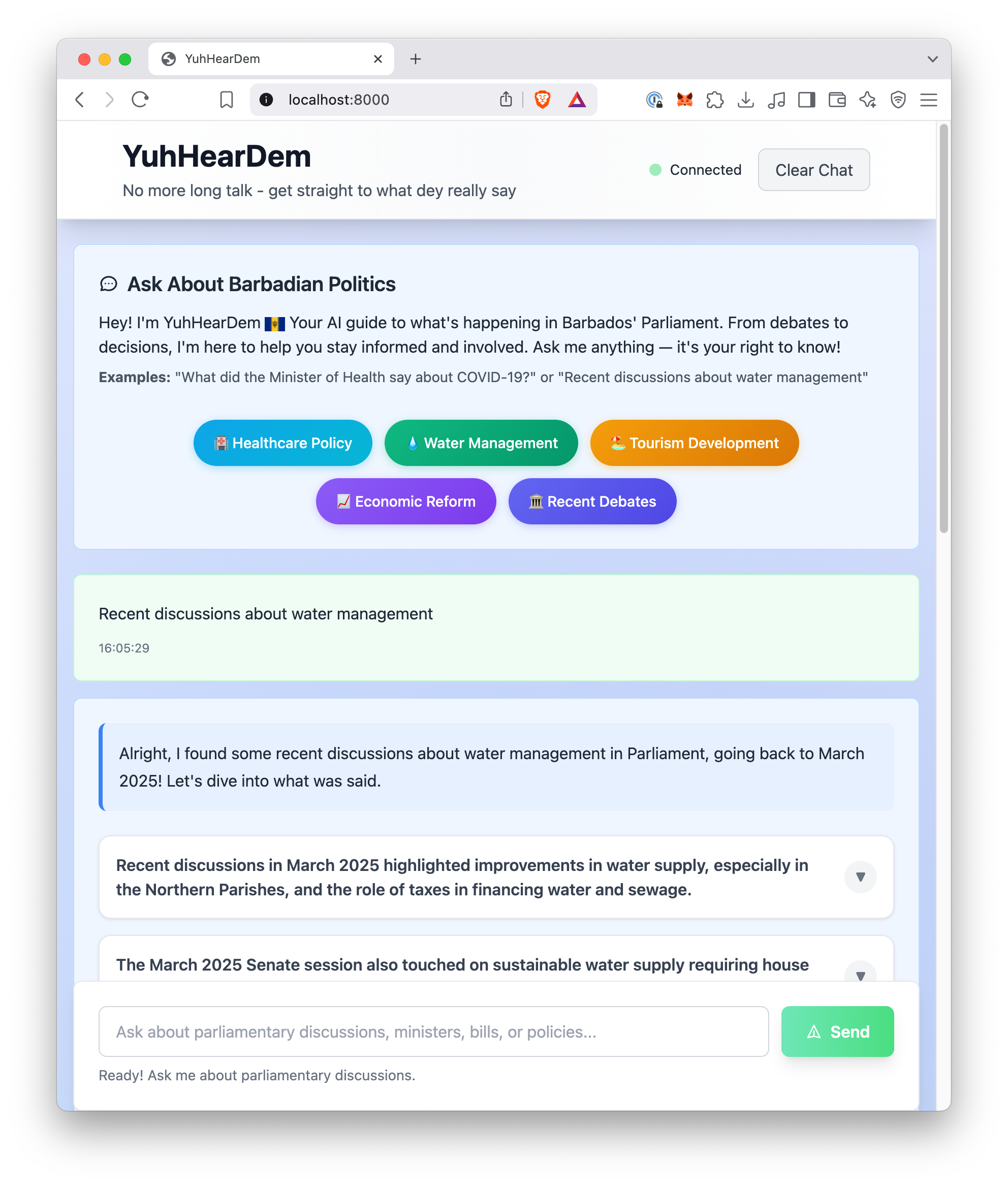
Yuh Hear Dem is an intelligent parliamentary research assistant that makes Barbados Parliament accessible through natural conversation. Built with Google's Agent Development Kit (ADK) as part of Katie's introduction to agentic AI systems, it delivers comprehensive parliamentary intelligence through:
Core Features:
- Direct Quote Extraction: Finds exact statements from MPs, ministers, and officials with full attribution
- Temporal Awareness: Prioritizes recent developments while maintaining historical context
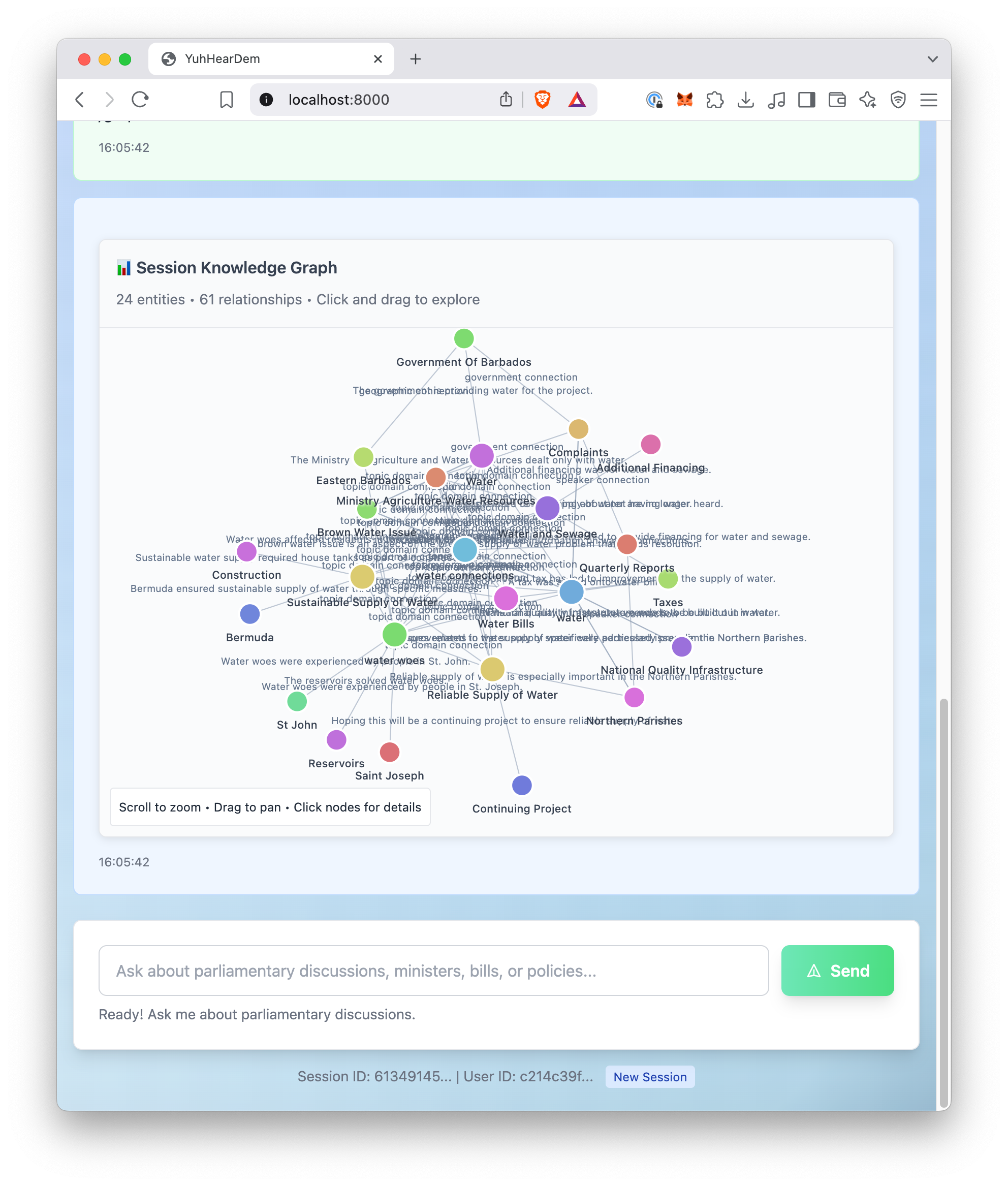
- Interactive Knowledge Graphs: Visualizes parliamentary relationships and topic evolution
- Session Memory: Builds cumulative understanding across conversations
- Provenance Tracking: Links every quote to timestamped video sources
- Educational UI Design: Katie's front-end leverages learning principles to make complex information digestible
The System Architecture: Our system uses a sophisticated single ADK agent with specialized function tools that coordinate seamlessly:
- Parliamentary Search Tool: Performs hybrid vector/text search across parliamentary data
- Knowledge Graph Management: Builds and maintains session-specific relationship maps
- Graph Visualization Tool: Creates interactive network visualizations
- Session State Management: Ensures accurate context and memory persistence
User Experience: Katie designed the front-end interface with expandable information cards, progressive disclosure, and intuitive navigation - applying educational design principles to make parliamentary information approachable for citizens of all backgrounds. Users can ask questions like "What did the Minister of Transport say about electric buses?" and receive direct quotes, video links with timestamps, and related context - all presented through Katie's thoughtfully designed conversational interface.
How we built it
Father-Daughter Learning Journey: This project served as Katie's introduction to agentic AI development, with Matt providing mentorship on enterprise-grade AI system design while Katie contributed her educational expertise and front-end development skills. Together, we explored concepts like agent orchestration, tool integration, and conversational AI while building something that could make a real difference in civic engagement.
Division of Responsibilities:
- Matt: Backend AI architecture, ADK agent development, database design, and parliamentary data processing
- Katie: Front-end interface design, user experience optimization, educational content presentation, and learning-focused interaction patterns
Agent Development Kit Foundation: We built the system using Google's ADK with a single intelligent agent that orchestrates multiple specialized function tools:
self.agent = LlmAgent(
    name="YuhHearDem",
    model="gemini-2.5-flash-preview-05-20",
    description="AI assistant for Barbados Parliament with cumulative graph memory",
    planner=BuiltInPlanner(),
    tools=[
        FunctionTool(search_parliament_hybrid),
        FunctionTool(clear_session_graph),
        FunctionTool(get_session_graph_stats),
        FunctionTool(visualize_knowledge_graph)
    ]
)
Technology Stack:
- Backend (Matt): ADK (Python), MongoDB, Vector Search, Knowledge Graphs (RDF/Turtle), FastAPI
- Frontend (Katie): HTML/CSS/JavaScript, D3.js for interactive visualizations, responsive design principles
- Integration: RESTful APIs with streaming capabilities, real-time graph updates
Katie's Educational Design Approach: Drawing from her background in education and learning, Katie designed the front-end with several key principles:
- Progressive Disclosure: Information is revealed in manageable chunks through expandable cards
- Visual Learning: Interactive knowledge graphs help users understand relationships between parliamentary concepts
- Contextual Help: Follow-up suggestions guide users to related information
- Accessible Language: Complex parliamentary procedures are explained in everyday terms
Evolution from Multi-Agent to Single-Agent Architecture: As part of Katie's learning experience, we initially designed a true multi-agent system with separate specialized agents:
- ConversationalAgent: Root agent handling conversation flow
- ResearchPipeline: Sequential pipeline with ResearcherAgent, ProvenanceAgent, and WriterAgent
- Custom ProvenanceAgent: Video source enrichment
However, we encountered significant challenges with ADK's session state management and context passing between agents (related to this GitHub issue). Context wasn't being properly maintained between agent interactions, and the session service had reliability issues. This became a valuable learning moment about the practical challenges of multi-agent systems.
The Solution: We refactored to a single intelligent agent with specialized function tools, which actually proved more effective and taught Katie important lessons about system design pragmatism:
- Better Context Management: Single agent maintains conversation state consistently
- Cleaner Tool Orchestration: Function tools are called synchronously with proper state management
- More Reliable: No complex inter-agent communication that could fail
- Still Modular: Each function tool handles specialized tasks (search, graph management, visualization)
Data Pipeline: We processed parliamentary video transcripts through entity extraction, relationship mapping, and temporal indexing. The system maintains provenance from every statement back to specific video moments with timestamps.
Challenges we ran into
ADK Multi-Agent Context Sharing Issues: Our biggest challenge - and Katie's most important learning experience - was with ADK's session management when using multiple agents. We discovered that context and session state weren't being properly shared between agents in our sequential pipeline. The ResearcherAgent would collect data, but the ProvenanceAgent and WriterAgent couldn't reliably access that data from the session state. This led to incomplete responses and broken workflows, teaching us valuable lessons about the current limitations of multi-agent frameworks.
Frontend-Backend Integration Complexity: Katie faced challenges integrating her educational-focused frontend with the complex backend AI systems. Learning to handle streaming responses, real-time graph updates, and dynamic content presentation while maintaining educational design principles required iterative refinement and close collaboration.
Session Service Reliability: We encountered issues with ADK's InMemorySessionService where session state would sometimes be lost or corrupted between agent calls, making our multi-agent pipeline unreliable in production scenarios. This became a great teaching moment about the importance of robust state management in AI systems.
Knowledge Graph Performance: As parliamentary data grew, graph traversal and visualization became performance bottlenecks. We implemented smart filtering algorithms that prioritize high-relevance connections and avoid hub node explosions while maintaining graph connectivity. Katie had to optimize the frontend visualization to handle large datasets smoothly.
Making Complex Information Accessible: Katie's biggest challenge was translating complex parliamentary procedures and AI-generated insights into formats that citizens could easily understand and navigate, requiring multiple iterations on the UI design and information architecture.
Accomplishments that we're proud of
Successful Father-Daughter AI Collaboration: We're most proud that this project successfully introduced Katie to enterprise-level agentic AI development while creating something that could genuinely benefit society. The mentoring aspect worked beautifully, with Katie contributing meaningfully to both the technical architecture and user experience design.
Educational-First Frontend Design: Katie successfully created a frontend that makes parliamentary information genuinely accessible to everyday citizens. Her background in education and learning shines through in the interface design, which uses progressive disclosure, visual learning aids, and intuitive navigation to make complex political information digestible.
Breakthrough in Parliamentary Accessibility: We've created the first conversational AI system that makes parliamentary proceedings truly accessible to citizens, turning hours of video into instant, quotable insights through both sophisticated AI and thoughtful user experience design.
Successful ADK Implementation Despite Challenges: We successfully worked around ADK's multi-agent limitations to create a robust single-agent system that still maintains modular, specialized functionality through well-designed function tools. This taught Katie valuable lessons about adapting to framework constraints while maintaining system goals.
Innovative Knowledge Graph Integration: Developed a unique approach to cumulative session memory using knowledge graphs that grow with each conversation, with Katie creating interactive visualizations that make these complex relationships understandable to end users.
Temporal Intelligence: Built sophisticated temporal awareness that prioritizes recent developments while maintaining historical context - crucial for understanding evolving political positions, presented through Katie's chronologically-organized interface design.
Production-Ready System: Deployed a fully functional system with proper session management, audit compliance, and scalable architecture that could serve an entire nation's citizens, with a polished frontend that demonstrates the power of combining AI sophistication with educational design principles.
What we learned
The Value of Mentorship in AI Development: This project proved that complex AI systems can be excellent vehicles for learning and mentorship. Katie gained hands-on experience with cutting-edge AI frameworks while contributing her unique educational perspective to create genuinely user-friendly interfaces.
Educational Design Enhances AI Accessibility: Katie's background in education and learning proved invaluable in making AI-generated content accessible. Her approach to progressive disclosure, visual learning, and contextual guidance significantly improved how users interact with complex parliamentary information.
ADK's Strengths and Limitations: Working with ADK taught us that while the framework has powerful capabilities for agent orchestration, the current multi-agent session management has reliability issues. However, ADK's single-agent model with function tools is extremely robust and well-suited for complex workflows.
The Power of Function Tools: We learned that ADK's function tools can be just as powerful as separate agents when properly designed. Our refactored architecture actually became more reliable and maintainable while preserving all the specialized functionality we needed.
Frontend-Backend Collaboration in AI Systems: Katie learned how to effectively bridge the gap between complex AI backends and user-friendly frontends, while Matt gained appreciation for how educational design principles can dramatically improve AI system usability.
Context Management in Conversational AI: Parliamentary intelligence requires maintaining complex context across conversations. We learned that effective AI systems need robust state management, and sometimes a simpler architecture (single agent) can be more reliable than a complex one (multi-agent).
What's next for Yuh Hear Dem ADK
Continued Learning and Development: As Katie continues her journey in AI development and frontend design, we plan to expand the system's capabilities while using it as a platform for exploring new agentic AI concepts and advanced educational interface techniques.
Enhanced Educational Features: Building on Katie's expertise, we plan to add:
- Learning Pathways: Guided tours through parliamentary processes for civic education
- Interactive Tutorials: Step-by-step guides for understanding government operations
- Gamified Civic Engagement: Educational elements that make learning about parliament engaging
Multi-Agent Architecture Retry: As ADK's multi-agent session management improves, we plan to revisit our original multi-agent architecture. We have the complete codebase ready to deploy once the session state sharing issues are resolved, which will provide Katie with another valuable learning opportunity in complex system integration.
Advanced Frontend Capabilities: Katie plans to expand the frontend with:
- Personalized Learning Dashboards: Tailored interfaces based on user interests and knowledge level
- Collaborative Features: Tools for citizens to share and discuss parliamentary findings
- Mobile-First Design: Responsive interfaces optimized for smartphone civic engagement
- Accessibility Enhancements: Ensuring the platform works for users with varying abilities
Enhanced Specialized Tools: Expand our function tool arsenal with additional specialized capabilities:
- Fact-Checking Tool: Real-time verification of parliamentary claims
- Policy Impact Analysis Tool: Analysis of policy implementation and outcomes
- Citizen Engagement Tool: Proactive notifications about relevant parliamentary activities
- Legislation Tracking Tool: Bill progress monitoring and change analysis
Multi-Parliament Expansion: Extend the system to handle multiple Caribbean parliaments, with Katie designing scalable frontend architectures that can adapt to different parliamentary systems while maintaining consistent educational principles.
Educational Outreach: Leverage Katie's educational background to develop training materials and workshops that help other developers understand how to make AI systems more accessible and educational.
The future of Yuh Hear Dem lies in both expanding our current robust single-agent approach and eventually returning to our original multi-agent vision once ADK's session management capabilities mature. We're positioned to scale in either direction while continuing to make democracy more accessible and transparent for all citizens, and providing Katie with ongoing opportunities to advance both her AI development skills and her impact in educational technology.

Log in or sign up for Devpost to join the conversation.