-
-
05-safety-first-architecture
-
04-community-and-continuity
-
03-evidence-based-learning
-
01-yuerschool-ai-cover
-
02-personalized-ai-guidance
Inspiration
Breastfeeding is natural, but successful breastfeeding is rarely effortless.
Many families begin with the intention to breastfeed exclusively, yet quickly encounter conflicting advice, anxiety, pain, concerns about milk supply, infant jaundice, medication safety, and a lack of timely professional support. Information is abundant, but it is fragmented, difficult to evaluate, and rarely adapted to a family's specific situation.
Fathers and other caregivers are also often excluded from breastfeeding education, even though their understanding and support can significantly affect the mother's confidence and persistence.
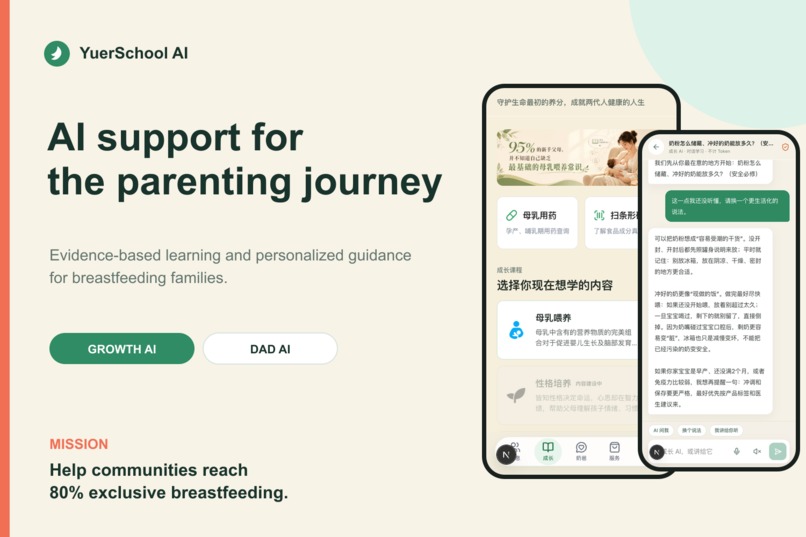
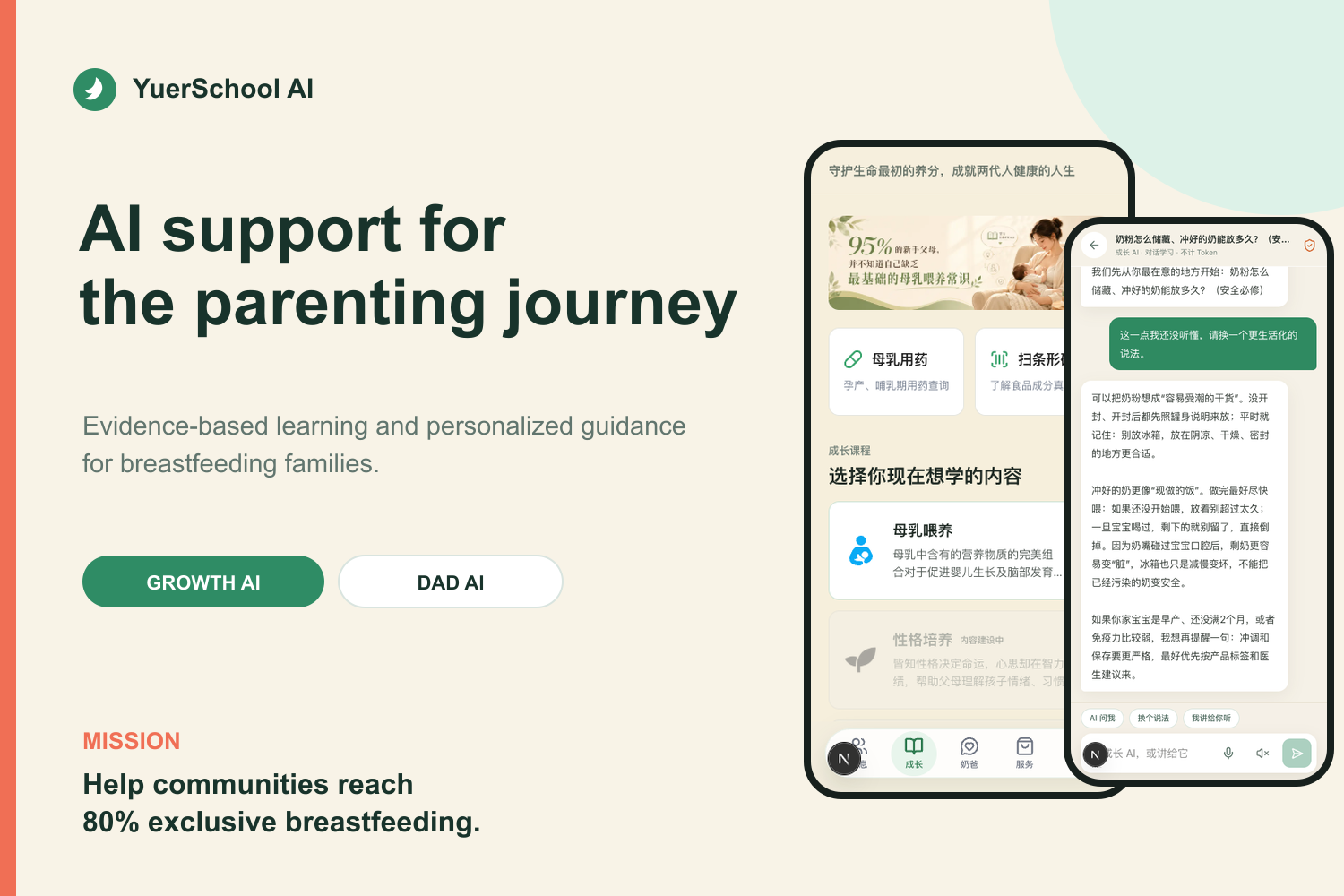
We built YuerSchool AI around a long-term mission: help communities raise the exclusive breastfeeding rate to 80%. Our goal is not to replace doctors or lactation professionals. It is to give parents reliable education, personalized guidance, and a clear path to professional care when warning signs appear.
What it does
YuerSchool AI is an AI-powered parenting and breastfeeding support platform with two complementary experiences:
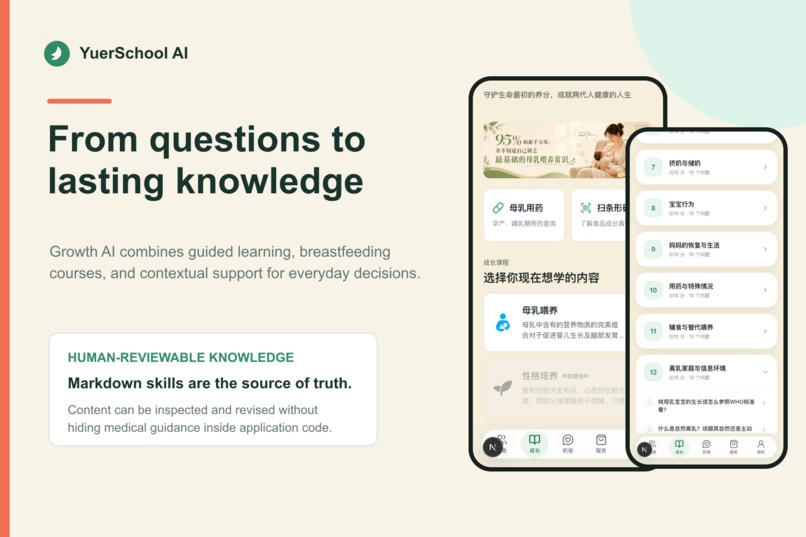
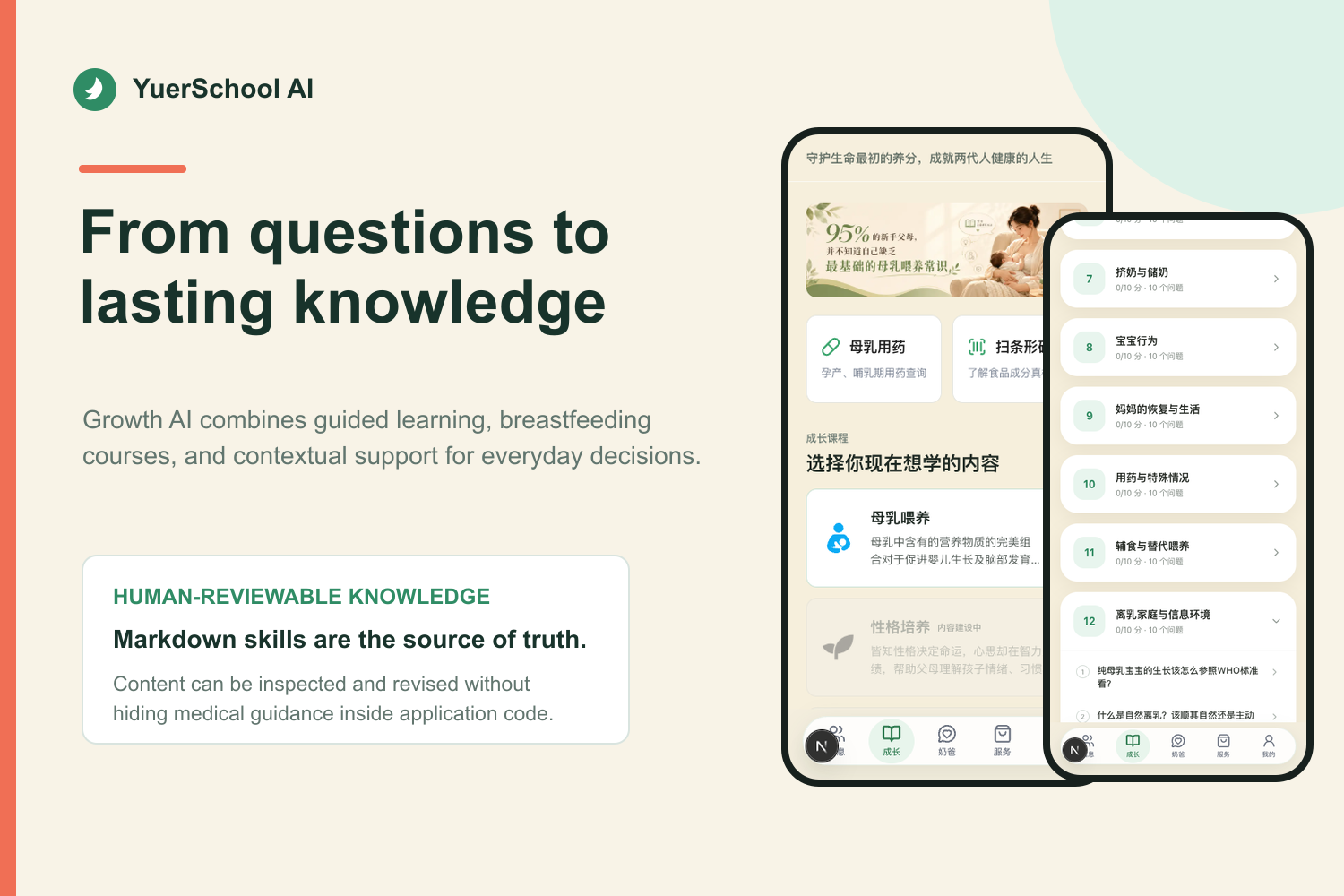
- Growth AI turns evidence-based knowledge into structured, accessible learning for parents.
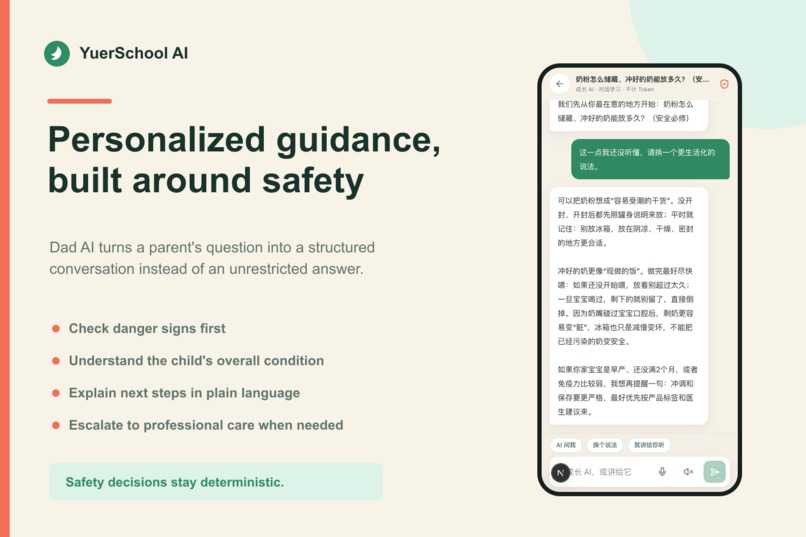
- Dad AI provides personalized, 24/7 parenting guidance through a conversational interface designed to involve the whole family.
The current product includes:
- Personalized conversations about breastfeeding, jaundice, fever, pneumonia, diarrhea, and other early-parenting concerns
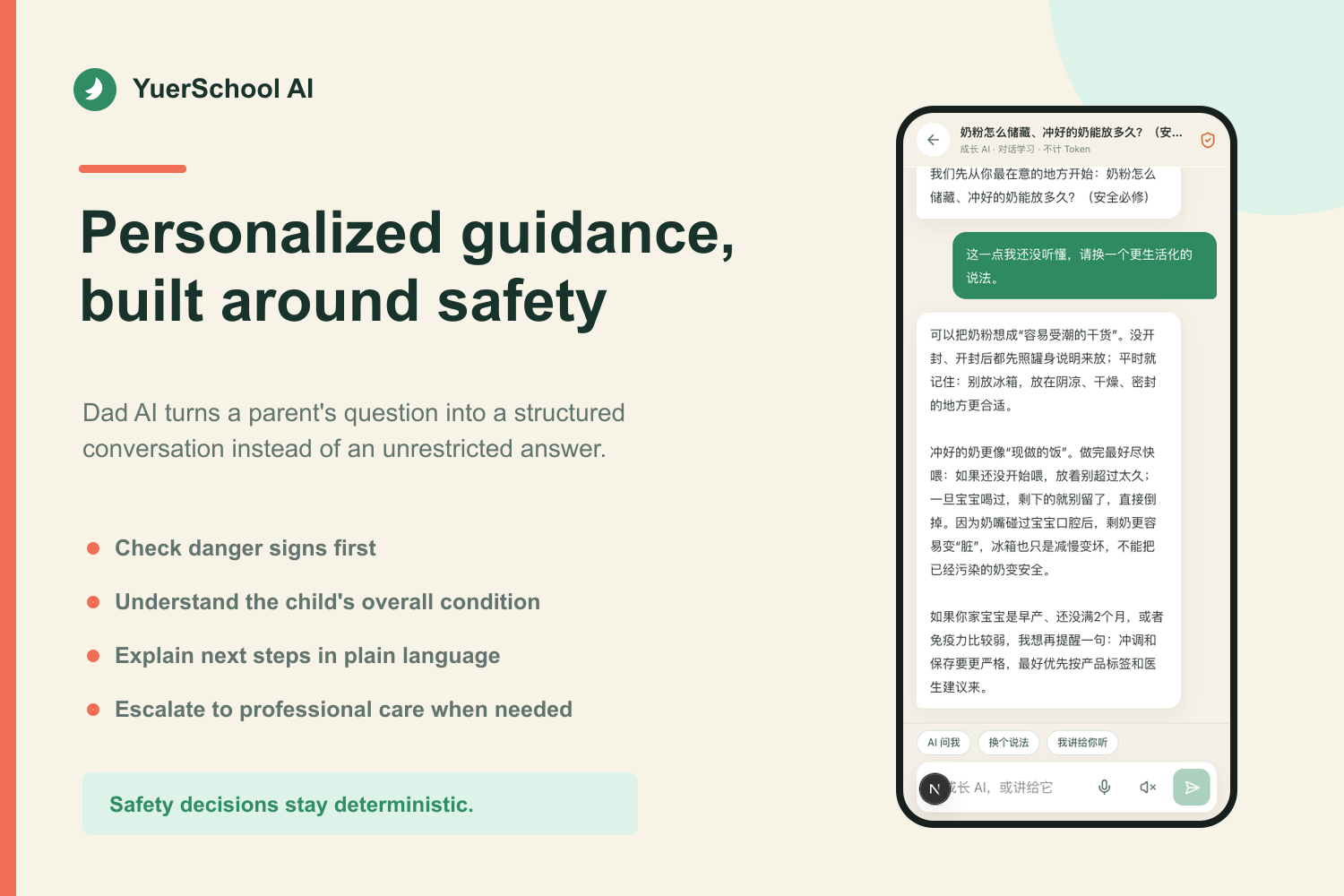
- Structured safety checks that identify danger signs before providing general guidance
- Evidence-based knowledge stored in reviewable Markdown skills
- A searchable lactation medication database containing 1,068 entries
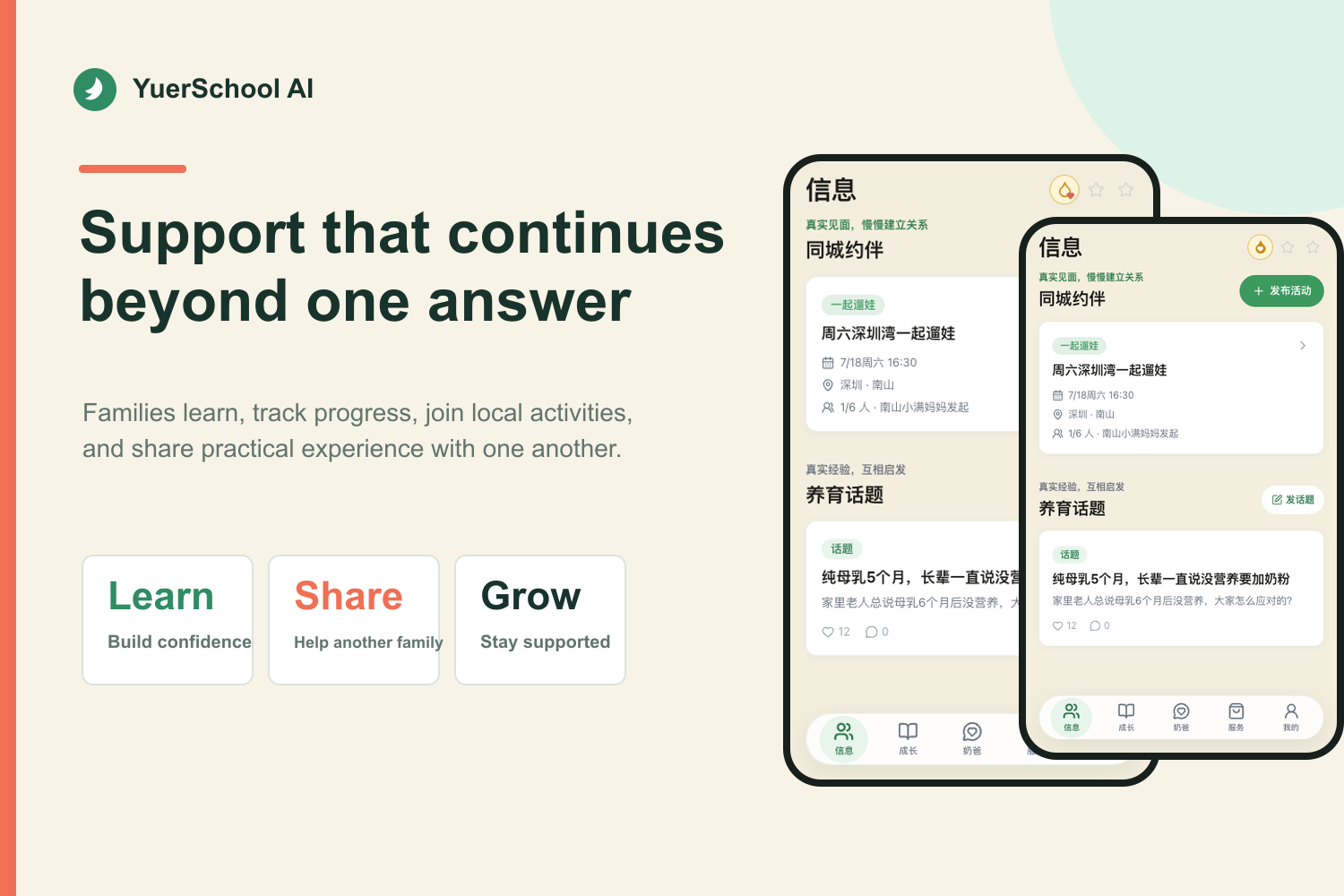
- Baby growth records and continuous follow-up experiences
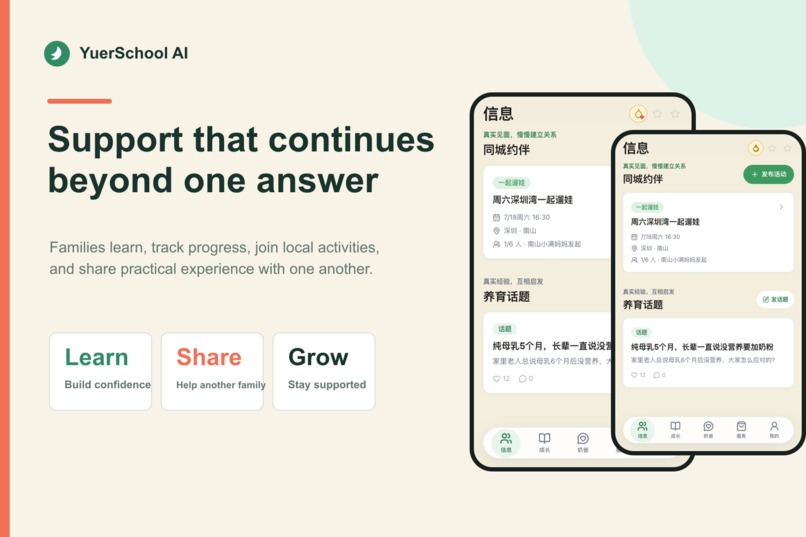
- Parenting courses, community activities, and local family services
- A mobile-first Progressive Web App covering learning, AI support, services, community, and personal records
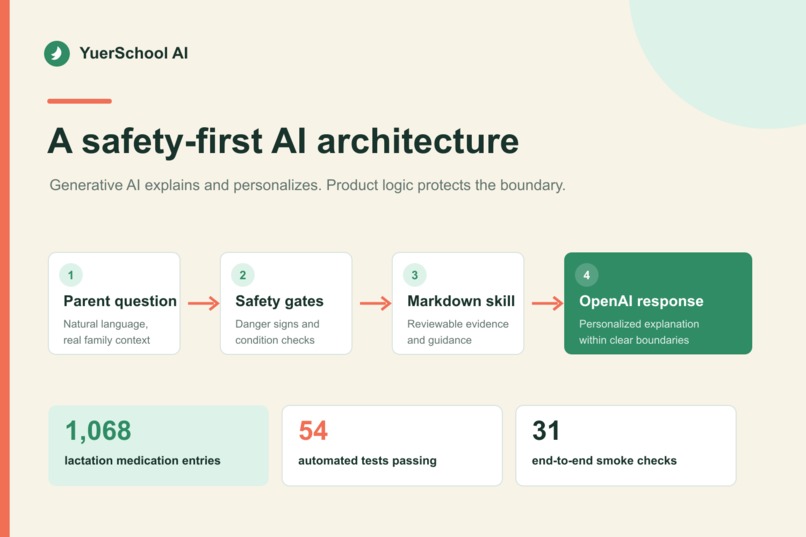
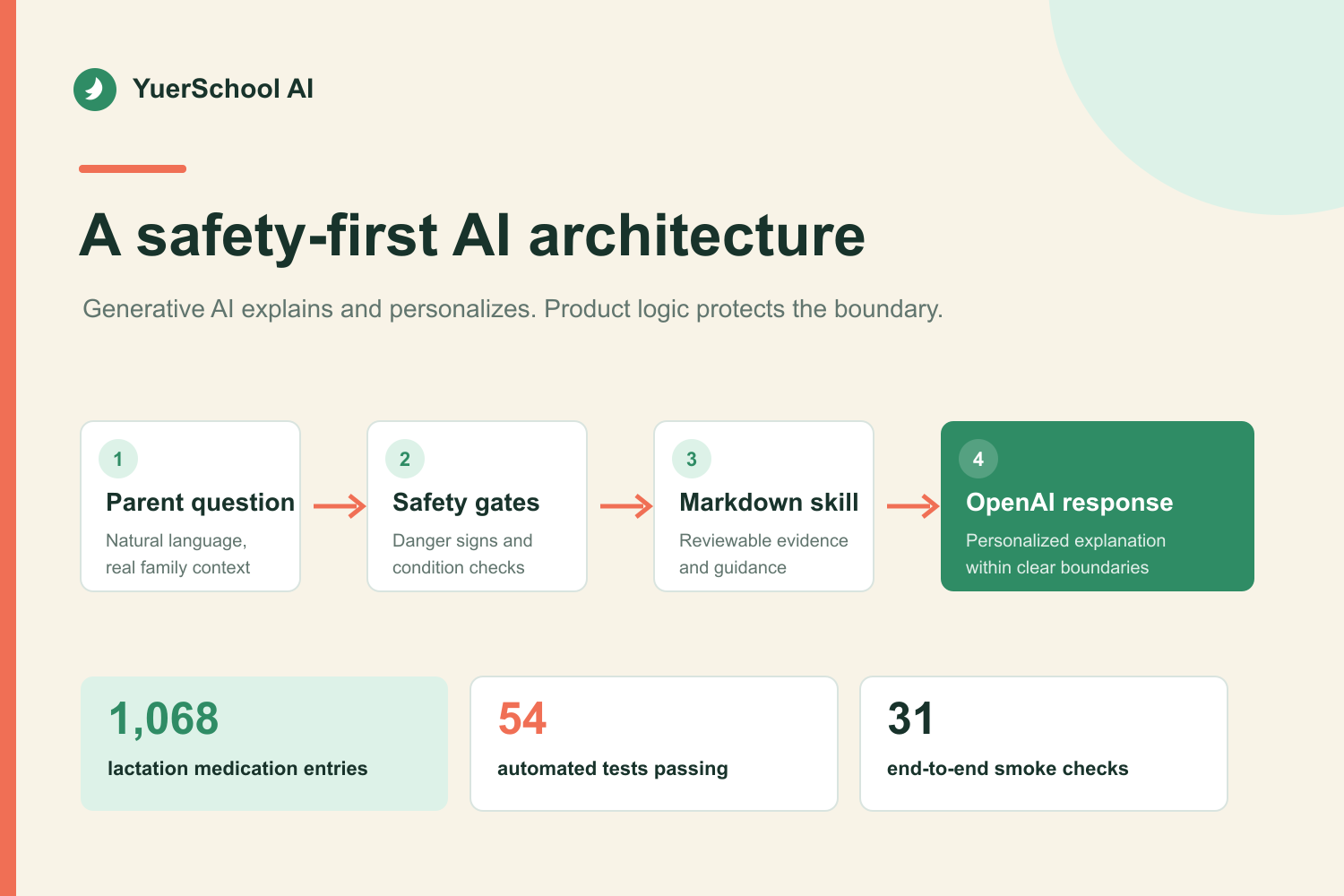
The AI does not simply generate an unrestricted answer. For health-related conversations, the product follows a controlled workflow:
- Check for danger signs
- Assess the child's overall condition
- Understand the caregiver's main concern
- Provide evidence-based guidance
- Recommend medical care when appropriate
- Arrange follow-up when continued observation is suitable
Critical safety questions must be answered through explicit options, so they cannot be bypassed by free-form text.
How we built it
We built YuerSchool AI as a mobile-first web application using:
- Next.js 16
- React 19
- TypeScript
- Tailwind CSS
- Vitest
- OpenAI-compatible APIs through a unified AI gateway
Our AI layer uses a gateway architecture that separates the product experience from the underlying model provider. This allows us to use an OpenAI model in production while retaining a deterministic mock implementation for development and testing.
Instead of embedding medical and parenting knowledge directly inside large prompts, we created a skill system in which reviewed Markdown documents are the knowledge source of truth. Each skill contains topic triggers, safety boundaries, checklists, and evidence-based guidance. The application routes a parent's question to the relevant skill and supplies the appropriate section to the model.
We also converted a lactation medication reference into a structured database of 1,068 medications. Parents can search by medication name and receive a simple risk classification, together with guidance encouraging professional confirmation when needed.
The platform uses a repository-based data architecture so that local fixtures can be replaced by a production database without rewriting the product's business logic.
Challenges we faced
Making AI useful without making it dangerously confident
Parenting and health questions often lack complete context. A fluent answer can sound authoritative even when urgent clinical information is missing. We addressed this by separating safety decisions from generative responses. Danger-sign checks and escalation rules are deterministic, while the model is used for explanation, personalization, and supportive conversation.
Turning expert knowledge into a maintainable AI system
A single system prompt quickly becomes difficult to review and update. We moved domain knowledge into individual Markdown skills so that medical reviewers can inspect and revise the source material without navigating application code.
Balancing reassurance with escalation
New parents need emotional support, but reassurance must never hide a genuine warning sign. We designed Dad AI to first understand the child's overall condition, clearly communicate its limits, and recommend medical care when the available information crosses a safety boundary.
Handling fragmented medication information
Medication safety during breastfeeding is a common source of unnecessary interruption. Transforming reference material into structured, searchable data required normalization, classification, and careful presentation. We learned that a useful answer must communicate uncertainty rather than reduce every medication to an unconditional “safe” or “unsafe” label.
Building for future growth without blocking the MVP
The long-term vision includes live databases, professional services, local activities, commerce, and family growth records. We created replaceable storage and AI interfaces so these systems can evolve independently, while keeping the current MVP testable and usable.
What we learned
The most important lesson was that a parenting AI should not be judged only by the quality of its answers. It should be judged by the quality of the decisions it helps families make.
We learned that:
- Safety-critical product logic should not depend entirely on model behavior.
- Evidence-based content needs a clear, human-reviewable source of truth.
- Fathers become more effective supporters when guidance speaks directly to them.
- Parents benefit from continuous learning and follow-up, not isolated answers.
- AI is most valuable when it connects education, personal context, safety checks, and real-world support.
We also learned that sustainable impact requires more than an AI chatbot. YuerSchool AI is designed to retain and support families through baby growth records, local activities, trusted services, and parent-to-parent sharing.
Accomplishments
During development, we completed:
- A unified AI gateway connected to an OpenAI-compatible API
- Structured breastfeeding and neonatal jaundice skills
- Deterministic safety workflows for health-related conversations
- A lactation medication search experience with 1,068 entries
- A five-section mobile-first parenting platform
- Automated unit, build, and end-to-end smoke-test coverage
What's next
Our next steps are to:
- Have clinicians and lactation professionals formally review each medical skill
- Connect Dad AI directly to the medication search tool
- Add multimodal support for appropriate parenting scenarios
- Improve personalized follow-up using baby growth records
- Launch local parent activities and trusted family services
- Measure whether the platform improves breastfeeding knowledge, confidence, continuation, and exclusive breastfeeding outcomes
Our vision is to make reliable parenting support available at the moment a family needs it, while keeping professionals, evidence, and safety at the center of every AI interaction.

Log in or sign up for Devpost to join the conversation.