-
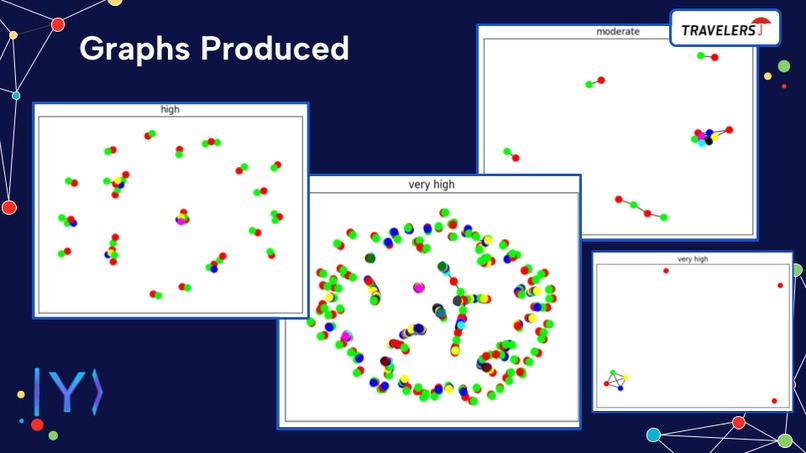
Graphs Produced thorugh Classical approach of using MIS
Inspiration
Our basic idea is that households in the same area are at the risk of the same fires, and therefore the risk of investing into many households in a similar way in one area is high. The idea is that if you diversify the locations of households you are invested in in a certain way, you can diversify your portfolio, lower the overall risk, and best help your customers in the case of a catastrophe.
What it does
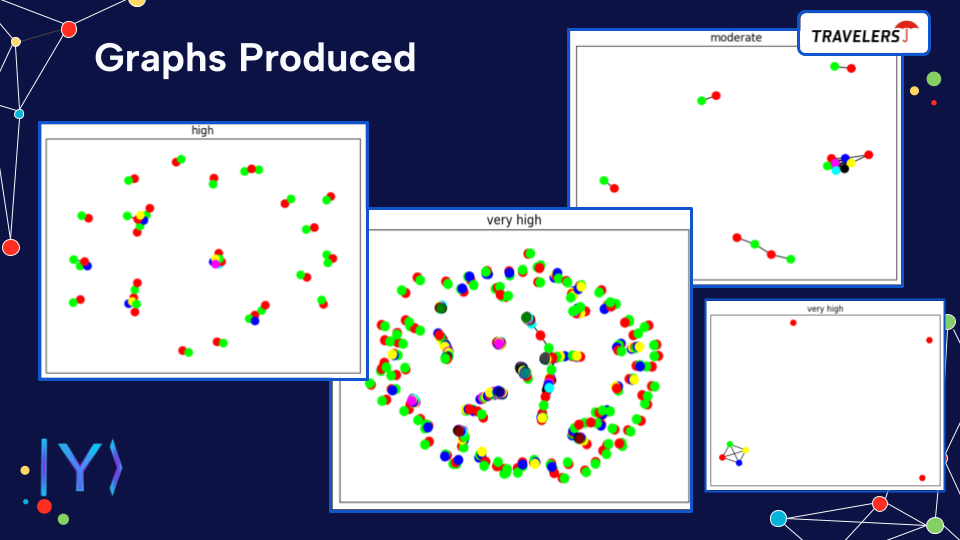
For our approach, we take a dataset of information (in our example it's the Los Angeles County Fire Hazard Zones), and we convert a sample of the real world positions of zones to an abstract graph position based on their proximities to each other. We then use the data to give each point an appropriate hazard level and identify locations which can be held safely together. The coloring indicates different categories of portfolios, made to minimize risk by avoiding being over-exposed to one area.
How we built it
We used the Bloqade Julia library to create our maximum independent set function. We then created a recursive search function in Julia to try out the best MIS possibilities and take the minimum. We imported our graph data from the Los Angeles County Fire Hazard Zone database and converted the latitude/longitude data into a graph with a given distance which must obey the graph coloring principle. To see more technical details about our project, see our GitHub repository, which is fully annotated with a readme and two notebooks which concern the wildfire risk dataset we used and how it can help Travelers minimize its risk as well as the technical implementation details of our quantum algorithm.
Challenges we ran into
Julia is a very difficult language, we've spent a lot of time debugging it. It was also hard to find a dataset we could use as we needed the correct data (location, risk factors, etc.) and we needed it in a workable format. We ended up using the LA County Fire Hazard Zone database and had to change the data formatting to make it easier to graph. However, we are really proud of the work we were able to do in converting the database into a usable form for the type of risk minimization Travelers performs at scale!
Accomplishments that we're proud of
Ultimately, while we were able to create a quantum approach to use MIS and recursive search to find an optimal graph coloring, we are more proud of how we were able to connect our algorithm to real wildfire data and create the foundations of what could be an applicable use case for Travelers to better minimize risk and help their customers in the case of a catastrophe. We created graphs based on samples of zones with the same wildfire hazard level designation, which could represent the subset of zones with Travelers customers for a given area and hazard level. Travelers would want to make sure that the portfolio categories of similar enough clients (both in hazard level and location) are distinct to best minimize risk. We feel that this example really exemplifies the real-world use of our quantum-enhanced graph coloring algorithm.
What we learned
We learned a lot about quantum computing, how it can be used in insurance, and the experience of doing a sort of preliminary market research for a large company like Travelers. None of us were familiar with this approach of using MIS for graph coloring, so we really enjoyed learning about it. Furthermore, we all come from an academic background, so it was a really cool experience to do something reminiscent to preliminary market research and suggest further consideration of this quantum approach to minimize risk in the insurance industry.
What's next for Quantum Extinguisher
We would like to explore more datasets, or work with Travelers with their datasets as the quantum algorithms are scalable. Additionally, we didn't have time to test our approach on actual neutral-atom quantum hardware like Aquila, so our examples were limited to small cases that are possible to simulate. In the future, especially as neutral-atom quantum hardware gets stronger, we would like to test our approach on actual quantum hardware. However, since it is just computing MIS, we are confident that our approach would work effectively on neutral-atom quantum hardware as it scales up in the future.


Log in or sign up for Devpost to join the conversation.