Inspiration
Creating YouTube Shorts involves many repetitive steps—researching topics, writing scripts, generating narration, finding visuals, adding subtitles, editing, and publishing. We wanted to turn this entire workflow into an automated AI pipeline so creators can focus on ideas rather than manual production.
What it does
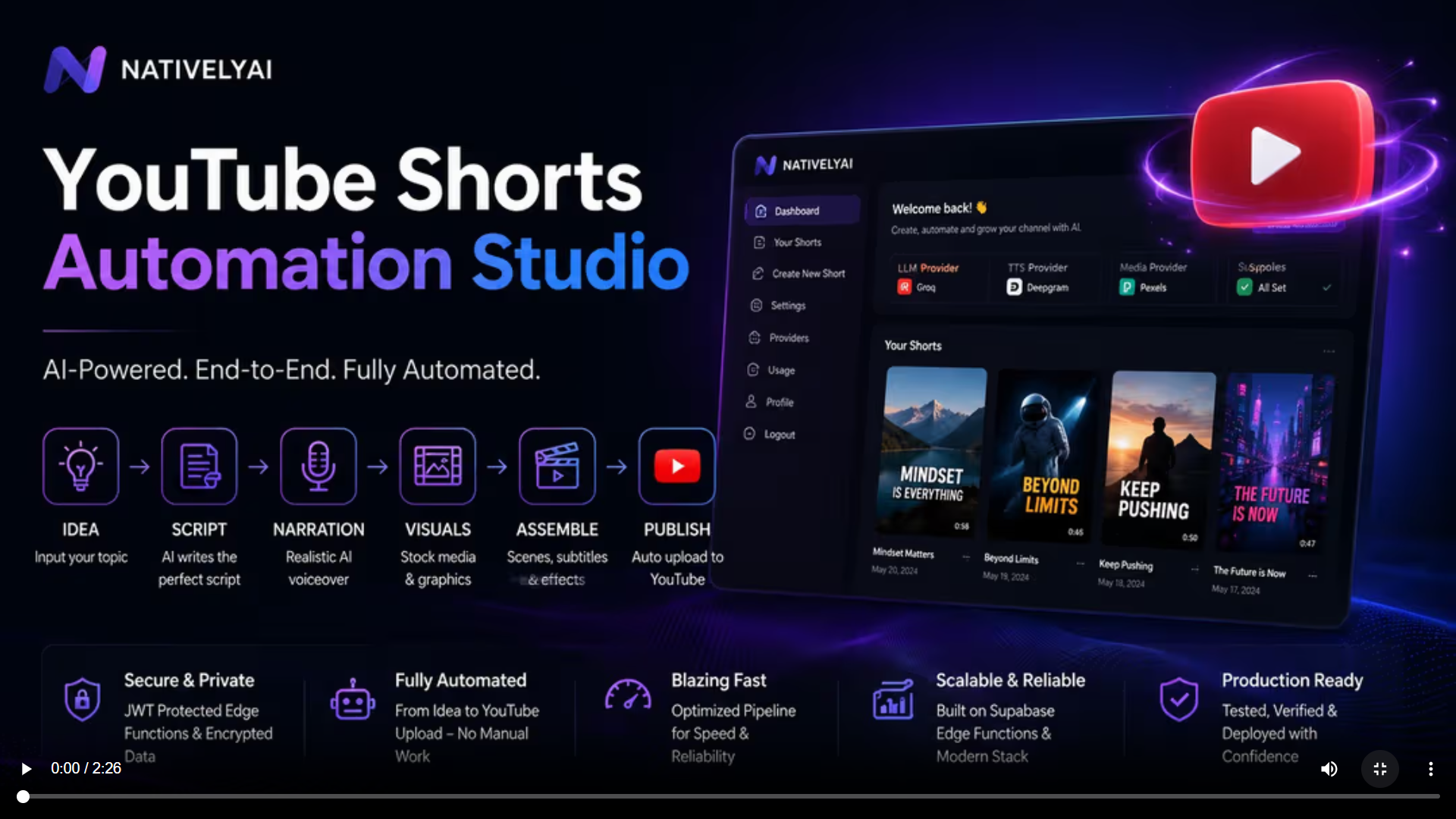
YouTube Shorts Automation Studio allows users to enter a topic and generate a complete short video automatically. The platform handles:
- AI-powered script generation
- Scene and visual planning
- AI voice narration
- Visual asset retrieval
- Automatic subtitles
- Video assembly
- Automated publishing to YouTube
- Custom content style and duration
How we built it
We built the platform using React, TypeScript, Vite, Supabase, PostgreSQL, and Edge Functions. AI capabilities are powered through multiple providers including OpenAI, Groq, and OpenRouter.
The system uses a modular architecture where AI providers can be swapped easily. Server-side functions securely manage API credentials, while asynchronous processing handles resource-intensive video generation tasks.
Challenges we ran into
The biggest challenge was coordinating multiple AI services into one reliable pipeline. Script generation, narration, visual retrieval, subtitles, and video rendering all have different processing times and failure scenarios.
We also had to handle large media files, asynchronous jobs, API failures, provider limitations, and secure API-key management while keeping the user experience simple.
Accomplishments that we're proud of
We're proud of building an end-to-end automated workflow rather than just another AI content generator. A single topic can move through multiple stages and become a publish-ready YouTube Short with minimal user intervention.
The modular provider architecture also makes the system flexible and allows us to switch between AI providers without redesigning the entire application.
What we learned
We learned that building AI applications at scale requires much more than connecting an LLM to a frontend. Reliable orchestration, asynchronous processing, error handling, provider abstraction, secure credentials, and efficient media processing are equally important.
We also learned how different AI models can be combined together, with each provider being used for the task where it performs best.
What's next for YouTube Shorts Automation Studio
Next, we plan to add:
- Automated trend and topic discovery
- Multiple Shorts generation in batches
- AI-powered thumbnail generation
- Advanced video templates and animations
- Performance analytics and content optimization
- Automatic A/B testing of titles and hooks
- Smarter publishing schedules
- Personalized content strategies based on channel performance
Built With
- deepgram
- edge-functions
- edge-tts
- elevenlabs
- groq
- openai
- openrouter
- pexels
- pixabay
- plawright
- postgresql
- react
- supabase
- supabase-storage
- tailwind-css
- typescript
- vite

Log in or sign up for Devpost to join the conversation.