Inspiration
Filmmaking is usually expensive, time-consuming, and dependent on large teams of people with different skills.
We asked a simple question:
What if a filmmaker could have an entire AI production crew working alongside them?
Instead of using AI only to generate a script or a video, we wanted to build a system where specialized AI agents could think, plan, collaborate, execute, evaluate, and recover from failures like a real production team.
This idea led to CinePilot — an autonomous AI film studio designed to turn a simple creative idea into a complete cinematic production.
What it does
CinePilot turns a filmmaker's idea into a structured film-production workflow using a team of specialized AI agents.
The user provides an idea, and CinePilot can:
- Research the concept
- Develop the story
- Create characters and a world
- Write the screenplay
- Break the screenplay into scenes and shots
- Create storyboards and cinematic shot plans
- Coordinate production tasks
- Check continuity and quality
- Detect failed production tasks
- Automatically repair failed tasks
- Track the entire production in real time
- Analyze production performance
- Learn from previous productions
The human remains the Director, while the AI agents act as the production crew.
The key idea is not simply "AI generates a video."
It is:
Human Director + Autonomous AI Production Crew = Faster, smarter filmmaking.
How we built it
We designed CinePilot as a multi-agent production system rather than a single AI model.
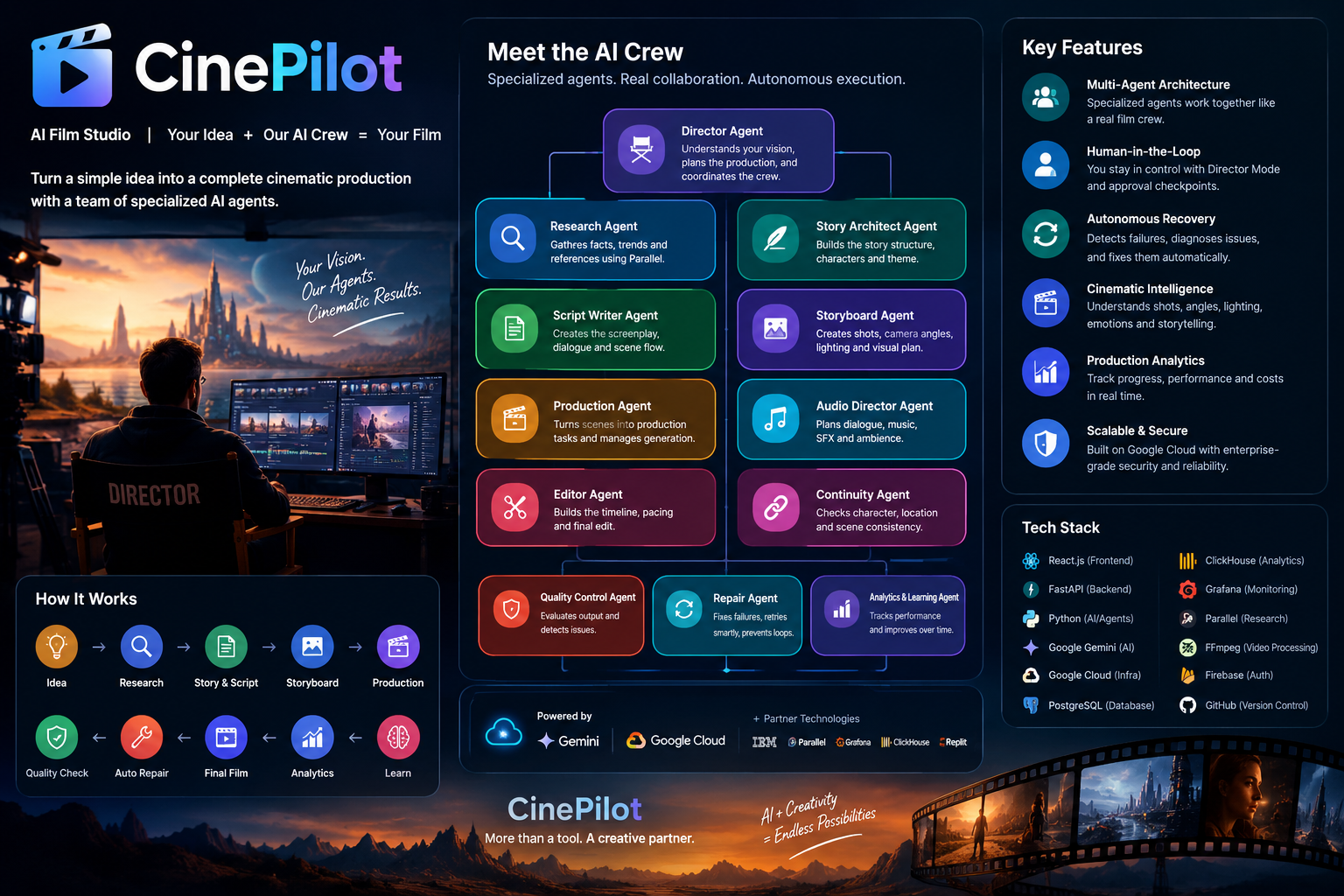
A central Director Agent understands the filmmaker's goal and coordinates specialized agents such as the Research Agent, Story Architect, Script Writer, Storyboard Agent, Production Agent, Continuity Agent, Quality Control Agent, Repair Agent, Analytics Agent, and Learning Agent.
The agents communicate through structured production state and task workflows instead of isolated AI requests.
We also designed the platform around modern cloud and AI infrastructure, with Gemini and Google Cloud at the core, while integrating external partner technologies for research, observability, analytics, and deployment.
Production events are tracked throughout the workflow so we can understand what every agent is doing, where failures occur, how long tasks take, and how the system improves over time.
The result is an AI production pipeline that behaves more like a digital film studio than a traditional AI content generator.
Challenges we ran into
The biggest challenge was not generating content — it was making multiple AI agents work together reliably.
We had to solve problems such as:
- Coordinating multiple agents without losing context
- Maintaining character and story continuity across scenes
- Handling failed generation tasks
- Preventing infinite retries and agent loops
- Managing large production states
- Designing reliable communication between agents
- Tracking production events and performance
- Keeping humans in control of important creative decisions
- Balancing cinematic creativity with technical reliability
- Integrating multiple technologies without creating artificial or unnecessary complexity
The hardest realization was that an autonomous system needs more than intelligence.
It needs planning, memory, validation, observability, recovery, and feedback loops.
Accomplishments that we're proud of
We are proud that CinePilot goes beyond simple AI generation and attempts to model an actual filmmaking workflow.
Our biggest accomplishments are:
- Built a multi-agent AI film-production architecture
- Created specialized AI roles inspired by real filmmaking departments
- Added autonomous task orchestration
- Designed human-in-the-loop Director Mode
- Added quality-control and continuity checks
- Designed autonomous failure detection and repair
- Created production observability and analytics
- Connected production events to measurable metrics
- Designed the system to learn from previous productions
- Combined filmmaking concepts with modern agentic AI architecture
Most importantly, we transformed the idea of an AI video generator into a vision for an autonomous AI film studio.
What we learned
We learned that building an agentic system is fundamentally different from building a normal AI application.
A good AI agent is not simply an LLM with a prompt.
It needs to:
Understand → Plan → Act → Observe → Evaluate → Recover → Learn.
We also learned that filmmaking is a perfect environment for agentic AI because a film naturally contains interconnected creative decisions — story, characters, camera, sound, editing, pacing, continuity, and audience response.
The biggest lesson was that the future of AI filmmaking may not be about replacing filmmakers.
It may be about giving every filmmaker an intelligent production crew.
What's next for CinePilot— The Autonomous AI Film Studio
Our next goal is to evolve CinePilot from a hackathon prototype into a true AI production platform.
We want to enable creators to produce:
- Short films
- Advertisements
- Music videos
- Trailers
- YouTube content
- Animated stories
- Experimental films
We also want CinePilot to develop stronger cinematic memory, better character consistency, more sophisticated cinematography planning, improved audio and editing intelligence, and deeper audience-feedback loops.
Our long-term vision is simple:
Give a filmmaker an idea. CinePilot provides the crew. The filmmaker provides the vision. Together, they make the film.
Built With
- apis
- cloud
- css
- fastapi
- ffmpeg
- google-cloud-agent-builder
- google-gemini
- grafana
- html
- javascript
- multi-agent-architecture
- python
- react.js
- rest
- run
- websockets


Log in or sign up for Devpost to join the conversation.