Inspiration
Non-profit organizations face a paradox: they do life-changing work, but they often struggle to prove it. While front-line staff are busy mentoring youth, they rarely have time to write detailed reports. As a result, Executive Directors lack the hard data needed to secure grants, leading to a "funding gap." We wanted to solve the "Rich Stories, Poor Data" problem by building a tool that bridges the gap between daily human interactions and high-level grant metrics.
What it does
Youth Impact Tracker is an intelligent data ecosystem designed for youth development programs. It transforms messy, qualitative daily notes into structured, quantitative grant data.
Smart Data Entry: Staff use intelligent forms with conditional logic. For example, selecting "Job Training" automatically unlocks specific modules (like the "Cafe Module"), ensuring relevant data is captured without cluttering the interface.
Evidence-Based Scoring: The system tracks a youth’s journey across 5 key metrics (Stabilization, Skills, Economic, etc.) on a 0–100 Self-Sufficiency Matrix.
Real-Time Dashboards: Directors see a live view of every participant. An aggregated "Activity Log" provides the evidence trail needed to justify moving a youth’s score from "Crisis" (20) to "Thriving" (80).
How we built it
We prioritized a User-Centric Design approach, recognizing that social workers are not data analysts.
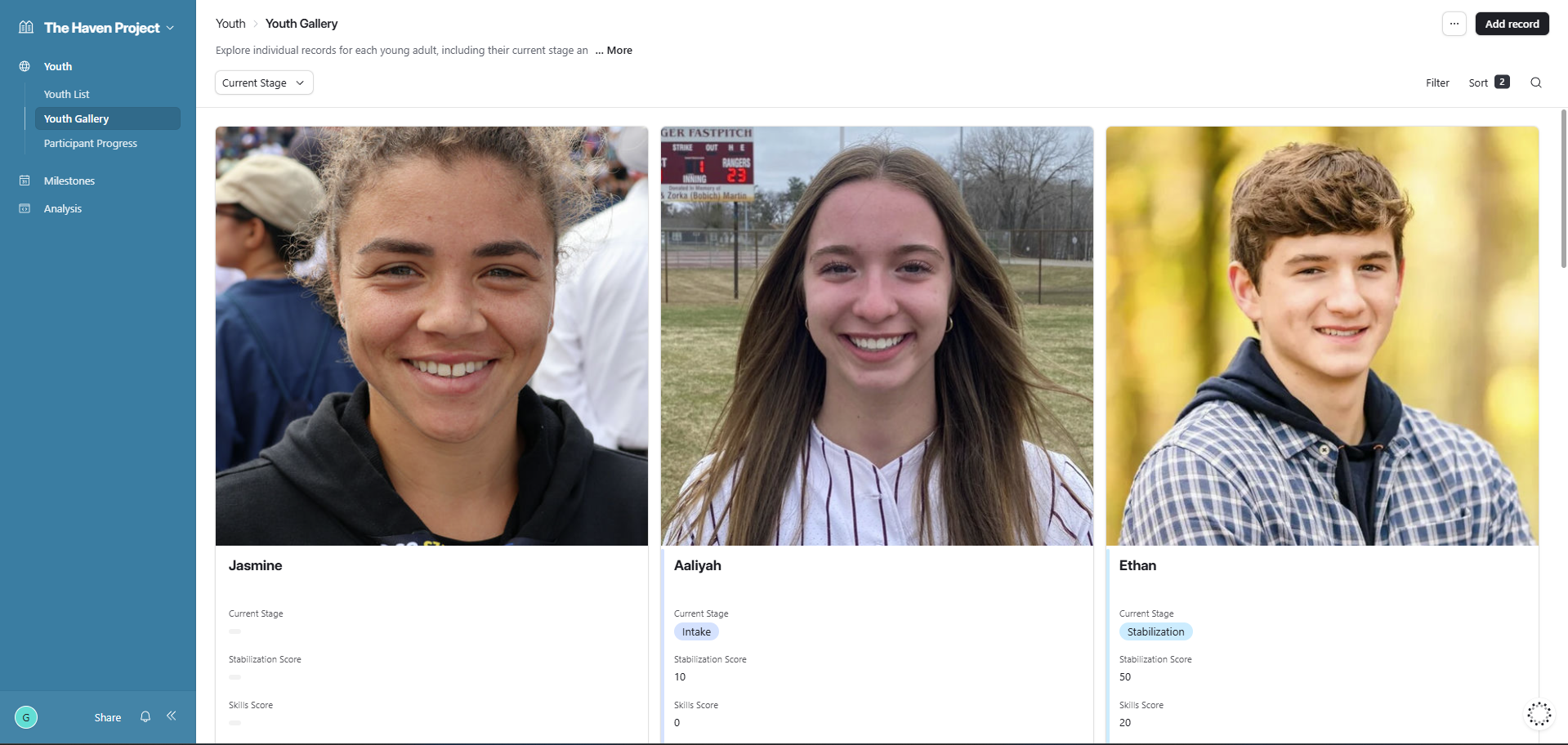
The Interface: We built a clean, visual dashboard that aggregates individual profiles, showing key metrics like "Skills Score" and "Education Status" at a glance.
The Logic: We implemented Conditional Form Logic to create the "Smart Forms." This ensures that the database schema remains structured in the background while keeping the user experience simple in the foreground.
The Intelligence: We designed the system to act as a "Decision Support System." It doesn't score the humans automatically (which can be unethical); instead, it aggregates the "Evidence" (logs) so the human Case Manager can make an informed decision on the score.
Challenges we ran into
Our biggest challenge was balancing flexibility vs. structure.
The Problem: If the form is too rigid, staff won't use it. If it's too loose, the data is useless for grants.
The Solution: We solved this with the Conditional Fields (the "Cafe Module"). This allows the system to be "infinite" in what it tracks (medical, housing, jobs) without overwhelming the user with a 100-question form.
Accomplishments that we're proud of
The "Trap Door" Logic: We successfully implemented a form that adapts in real-time based on the "Visit Goal," making data entry feel magical rather than administrative.
Ethical Tracking: We are proud of the "Evidence-Based Scoring" model. By placing the Activity Log directly below the Scorecard, we created a system that encourages accountability and accuracy in reporting human progress.
What we learned
We learned that in the social impact sector, time is the most valuable resource. A feature is only useful if it saves a Case Manager time. By automating the sorting and organizing of logs, we aren't just building a database; we are giving staff more time to actually work with the youth.
What's next for Youth Impact Tracker
AI Integration: We plan to add an LLM layer that can read the Activity Logs and automatically draft the narrative portion of grant reports for the Director.
Mobile App: A native mobile version for street outreach teams to log interactions offline.
Alumni Network: Adding a module to track youth after they graduate the program to measure long-term retention and success.

Log in or sign up for Devpost to join the conversation.