-
-
-
-
-
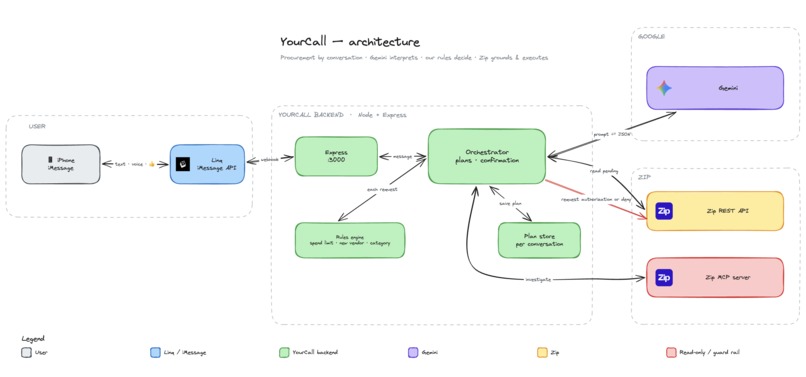
architecture
Enterprise software is supposed to make work easier. But somewhere along the way, doing the work became navigating the software.
Want to handle a purchase? Open the platform, find the request, inspect the vendor, check the amount, verify policy, make a decision, move to the next one, and repeat.
That's manageable for one request. It's a lot less manageable when you're boarding a flight with an entire procurement queue waiting.
What if you could just tell your company what you want done?
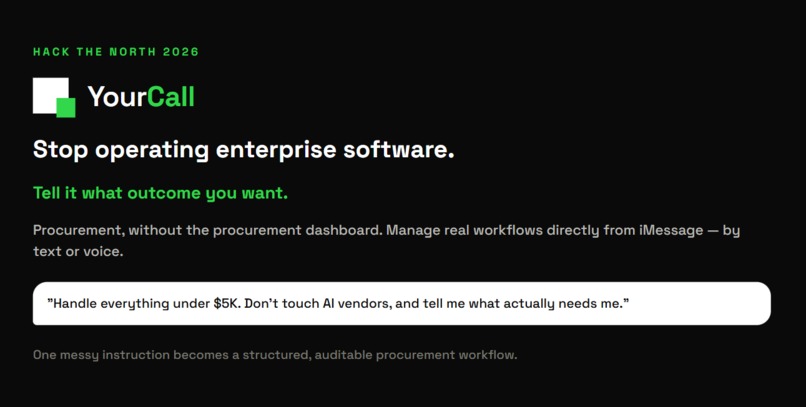
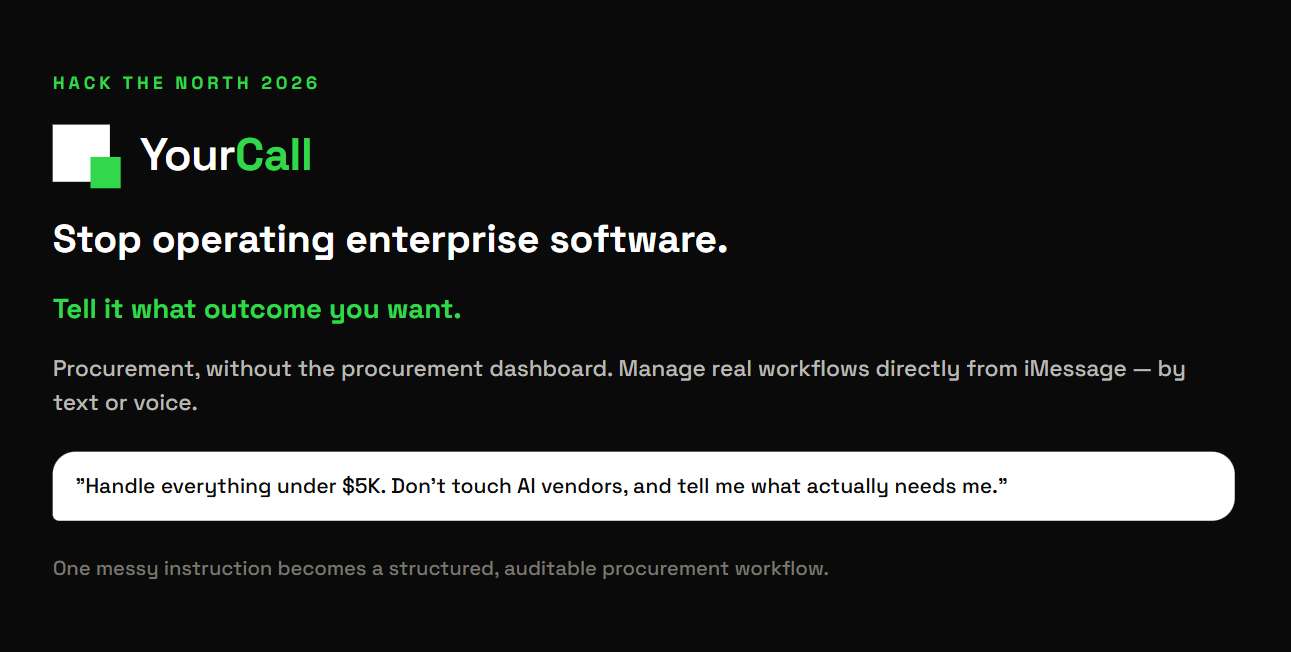
We built YourCall: an iMessage-powered enterprise agent that turns natural-language instructions into real, controlled actions in company software.
A manager can simply send a voice message:
“I'm boarding. Handle everything under $5k. Don't touch AI vendors, and tell me what actually needs me.”
From that one instruction, Gemini parses the manager's intent into structured constraints, YourCall pulls the live procurement queue from Zip, and our deterministic policy engine evaluates what qualifies and what needs attention.
Importantly, we don't evaluate requests in isolation.
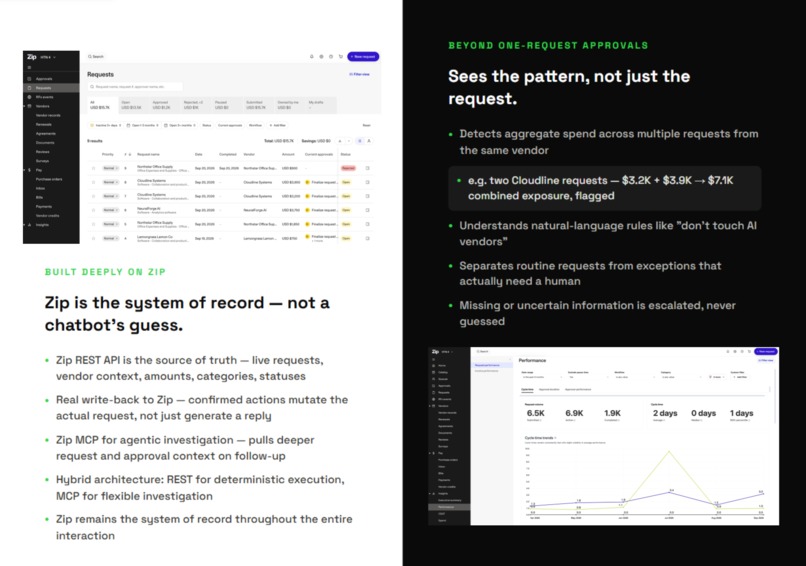
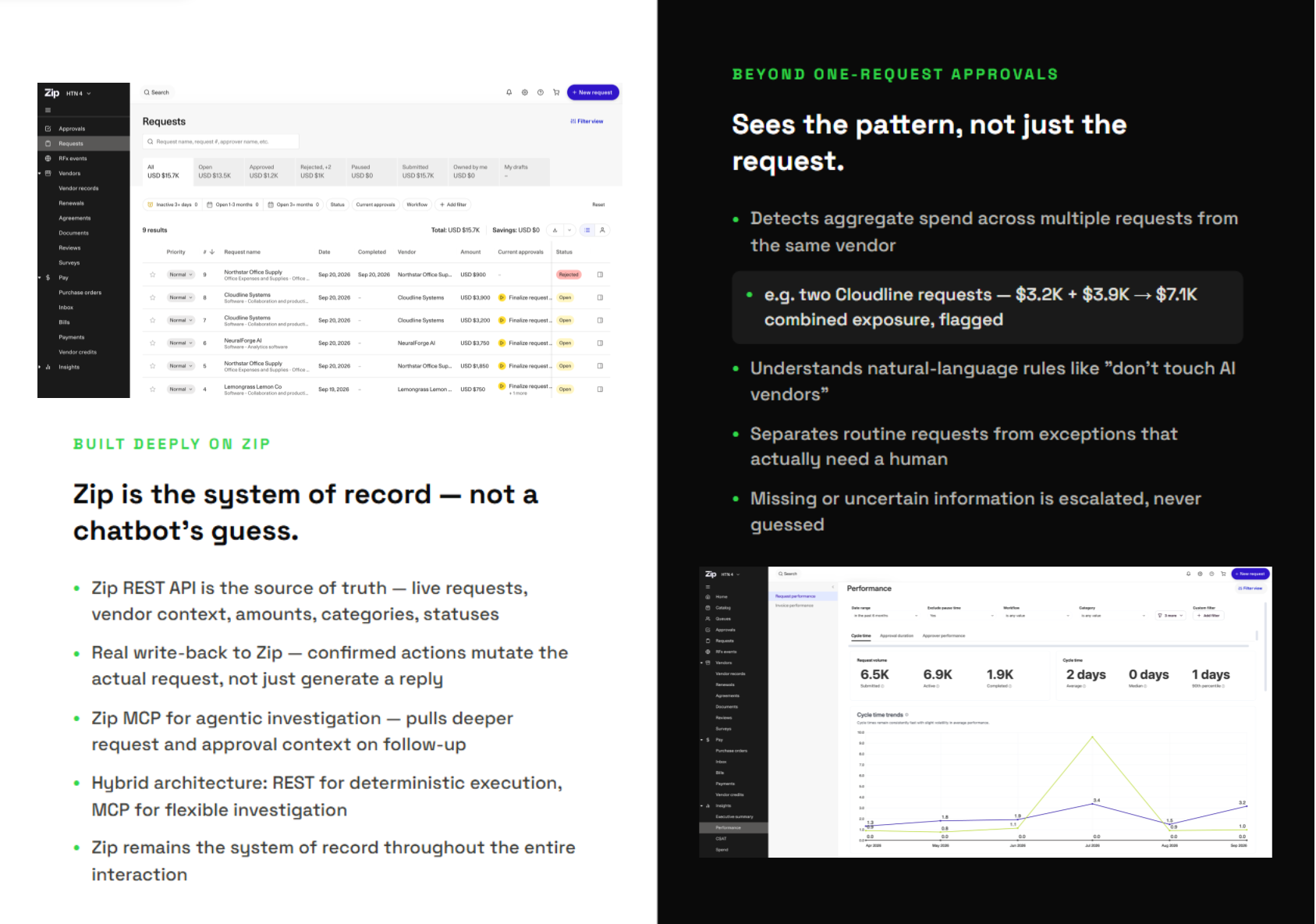
In our demo, Cloudline Systems has two pending requests: $3,200 and $3,900. Both individually satisfy the manager's $5,000 limit. Together, they're $7,100.
YourCall reasons across the Zip queue, catches that aggregate exposure, and escalates it. It also holds NeuralForge AI because the manager explicitly excluded AI vendors.
The manager can investigate an exception conversationally without losing the original pending plan—and nothing consequential happens without explicit confirmation.
You make the call. YourCall handles everything between intent and execution.
Under the hood
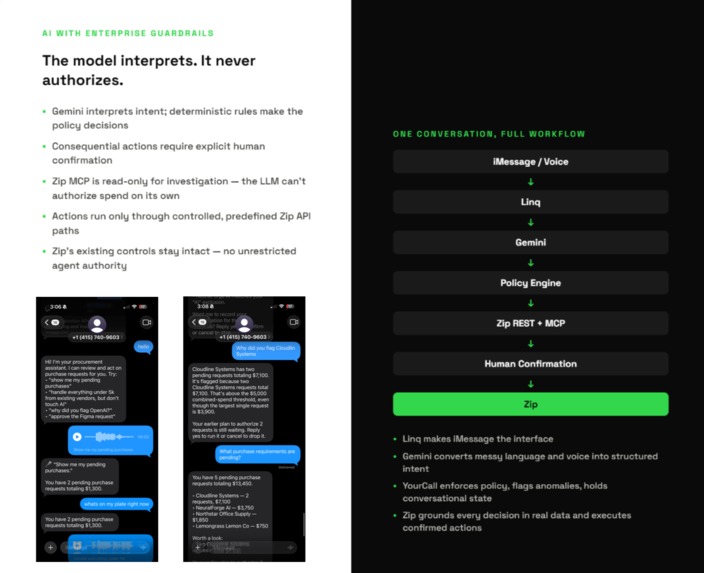
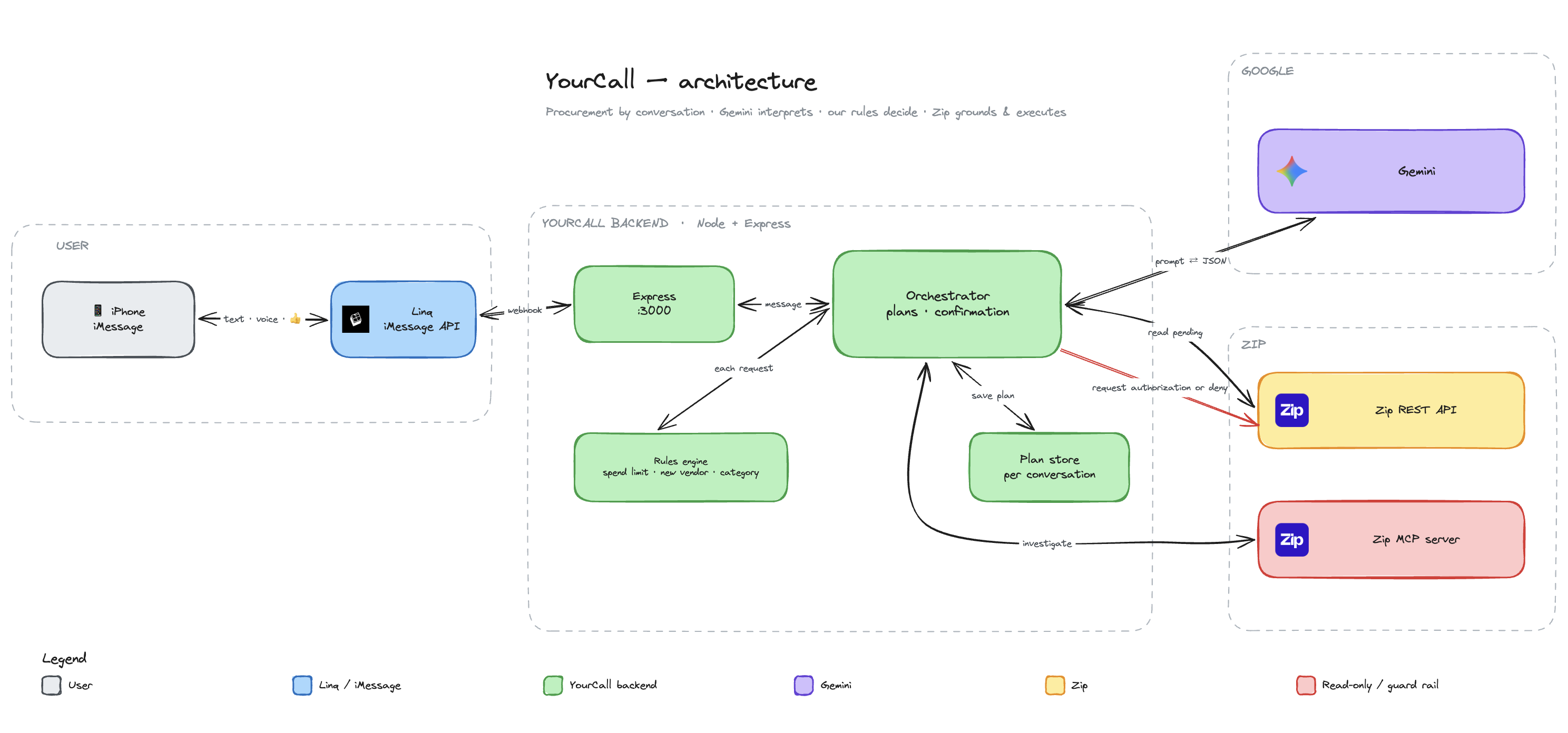
We deliberately separated understanding, policy, investigation, and execution instead of giving an LLM unrestricted control over procurement.
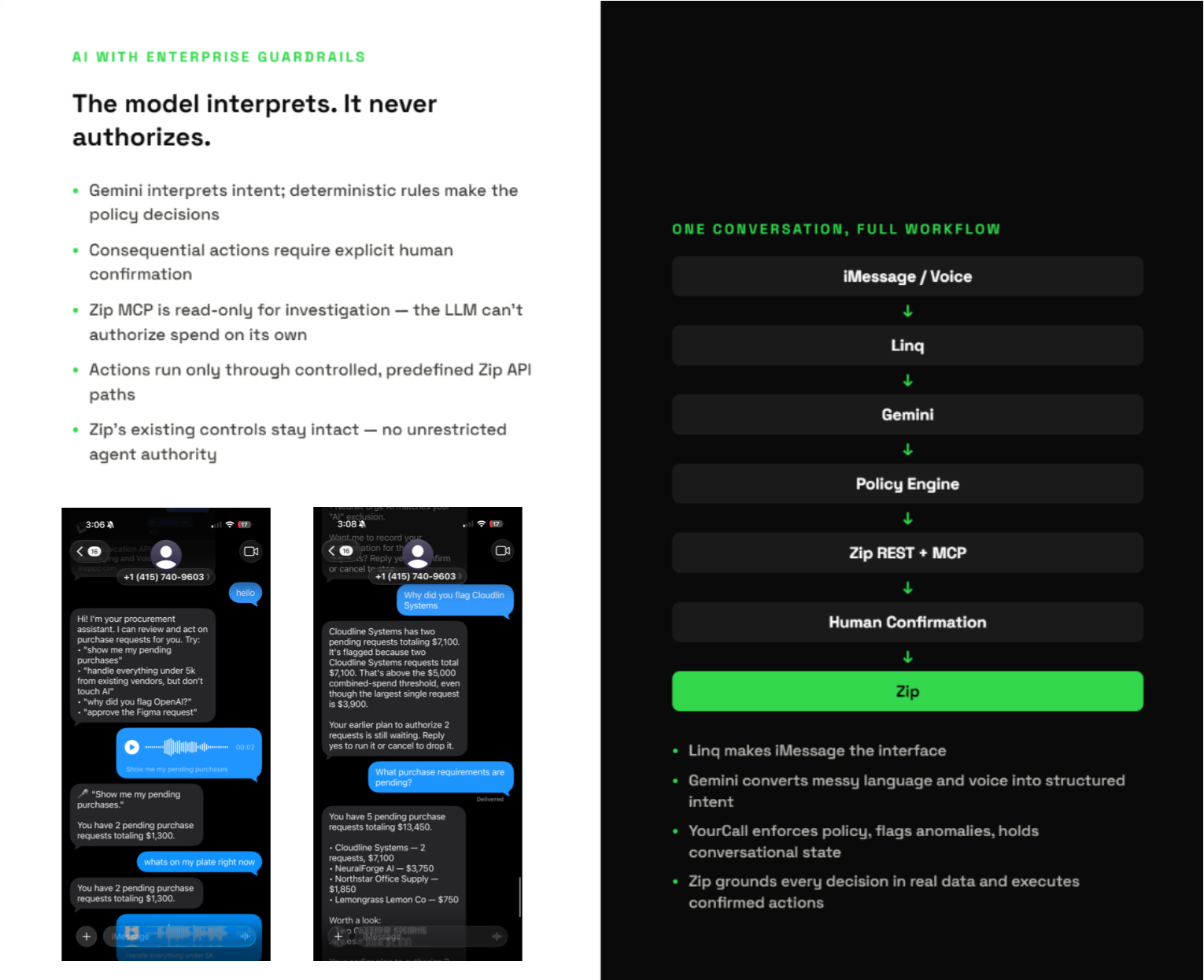
💬 Linq → iMessage transport. Text and voice enter through iMessage, flow through Linq webhooks into our Node/Express backend, and responses return in the same conversation.
🧠 Gemini → structured intent, not decisions. Gemini handles messy human language and extracts constraints such as spending limits and exclusions. It does not decide what gets acted on.
⚙️ Deterministic policy engine. Explicit code evaluates live Zip requests against those constraints. Missing or ambiguous information is handled conservatively instead of being guessed by the model.
🚩 Cross-request reasoning. We aggregate pending spend by vendor, allowing YourCall to catch patterns a request-by-request approval process can miss — like Cloudline's $3.2K + $3.9K = $7.1K exposure.
🤖 AI-spend governance. Natural-language restrictions such as “don't touch AI vendors” become policy conditions over real procurement data rather than suggestions to the LLM.
🔄 Stateful orchestration. A pending action plan survives conversational investigation. Managers can ask why something was flagged and then return to the original plan, confirm it, or cancel it entirely.
Two paths into Zip, for a reason: REST + MCP
We use Zip REST and Zip MCP for deliberately different jobs.
💳 Zip REST = structured state + controlled execution. REST grounds our policy engine in live requests, vendors, amounts, categories, and statuses. Confirmed actions travel through a separate controlled write path. In our demo, a manager can say “Deny the Northstar Office Supply request,” confirm with “yes,” refresh Zip, and see the real request become rejected.
For approvals, we preserve Zip's existing approval controls: YourCall records the manager's explicit authorization on the request, creating an auditable handoff rather than bypassing the existing workflow.
🔎 Zip MCP = flexible investigation. Zip MCP gives the agent a flexible, agentic interface for exploring richer request and approval context during open-ended investigations.
And we intentionally keep MCP read-only.
The agent can investigate freely without gaining the ability to act on its own conclusions. Any consequential action must cross a separate execution boundary and requires explicit human confirmation.
It can find out anything it needs to know, but it can't spend a dollar without you.
That separation lets us use agentic AI where flexibility is valuable while keeping enterprise actions deterministic, auditable, and human-controlled.
Accomplishments that we're proud of
We're especially proud that YourCall isn't another chatbot that simply talks about enterprise data. It closes the loop from intent to execution.
A voice message can travel through:
iMessage → Linq → Gemini → deterministic policy → live Zip state → cross-request reasoning → human confirmation → controlled Zip execution.
The hardest engineering problem wasn't making the AI more autonomous. It was deciding where autonomy should stop.
We combined natural-language understanding with deterministic policy, cross-request anomaly detection, stateful conversations, two distinct Zip integration paths, explicit confirmation, and real enterprise write-back — without letting the LLM become the authority over procurement.
AI handles ambiguity. Our code enforces policy. Zip grounds and executes.
Because sometimes the best enterprise interface isn't another dashboard.
It's just telling it what you want done.
What's next
🌐 Beyond procurement — extend the same outcome-based interface to expenses, IT, HR, CRM, and other enterprise workflows.
📋 Persistent delegation policies — “handle renewals under $2,000 unless pricing changes by more than 10%.”
🔔 Proactive intelligence — surface aggregate spend, unusual purchasing patterns, policy conflicts, and AI-spend anomalies before someone has to ask.
🧠 Richer organizational context — incorporate budgets, historical decisions, permissions, and company policy while preserving the same execution boundaries.
Stop operating enterprise software. Tell it what outcome you want.
You make the call. YourCall makes it happen.
Built With
- gemini
- geminiapi
- linq
- typescript
- zip


Log in or sign up for Devpost to join the conversation.