-
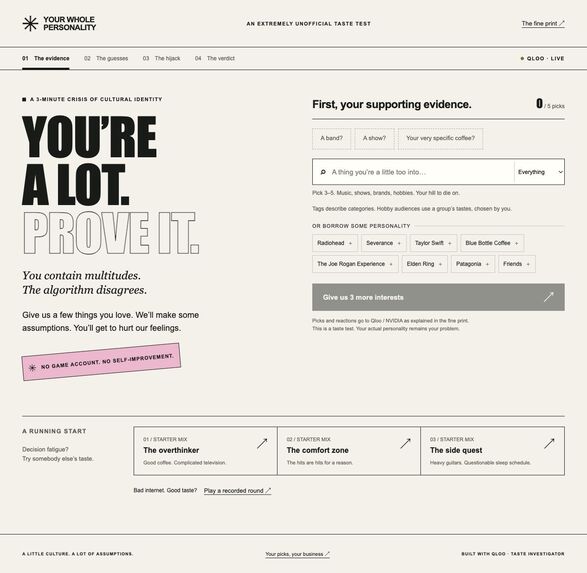
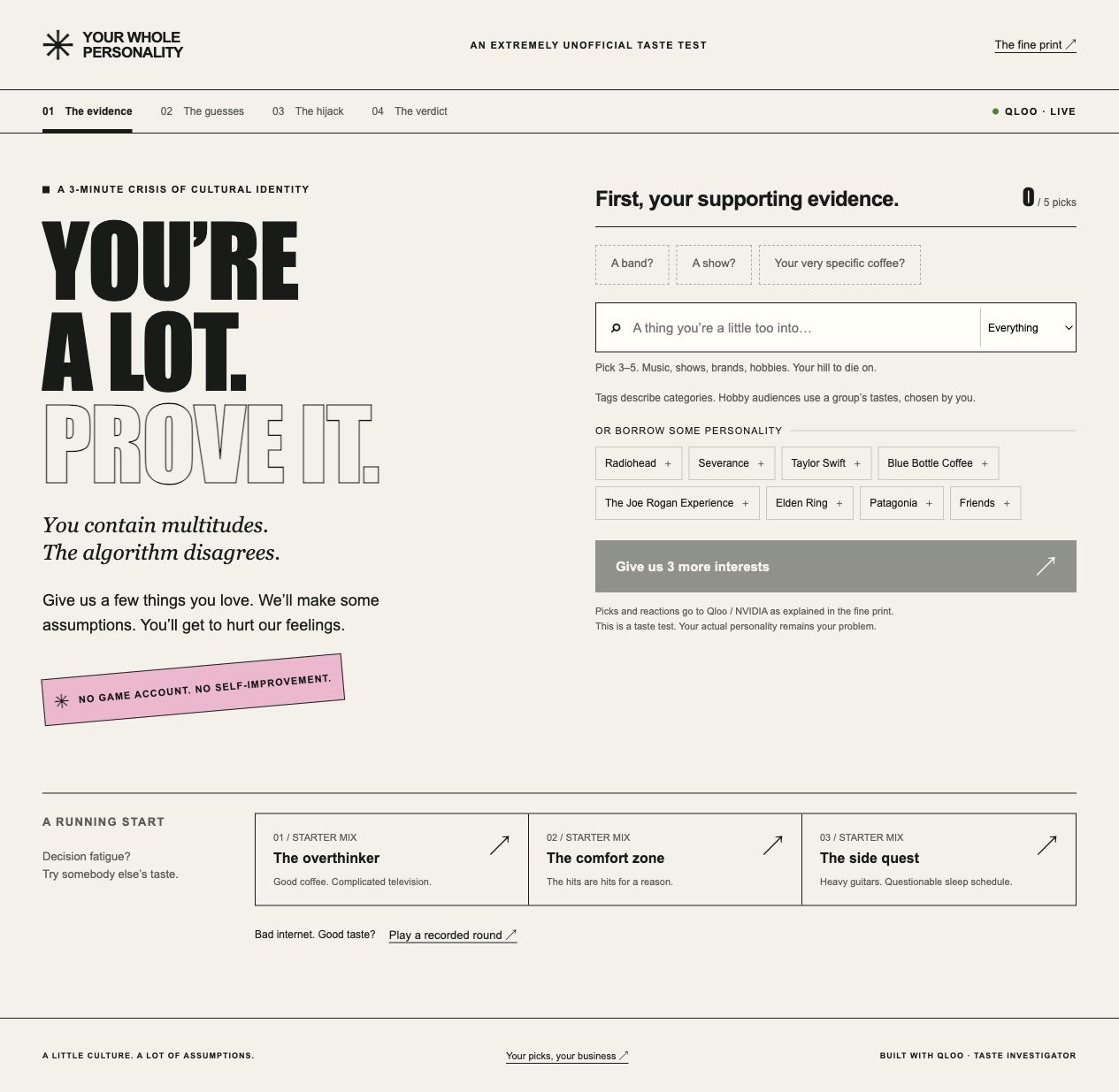
1. Landing page
-
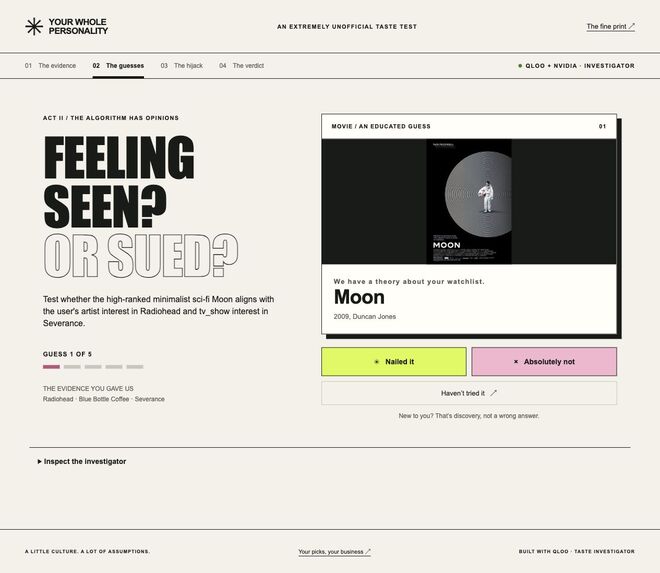
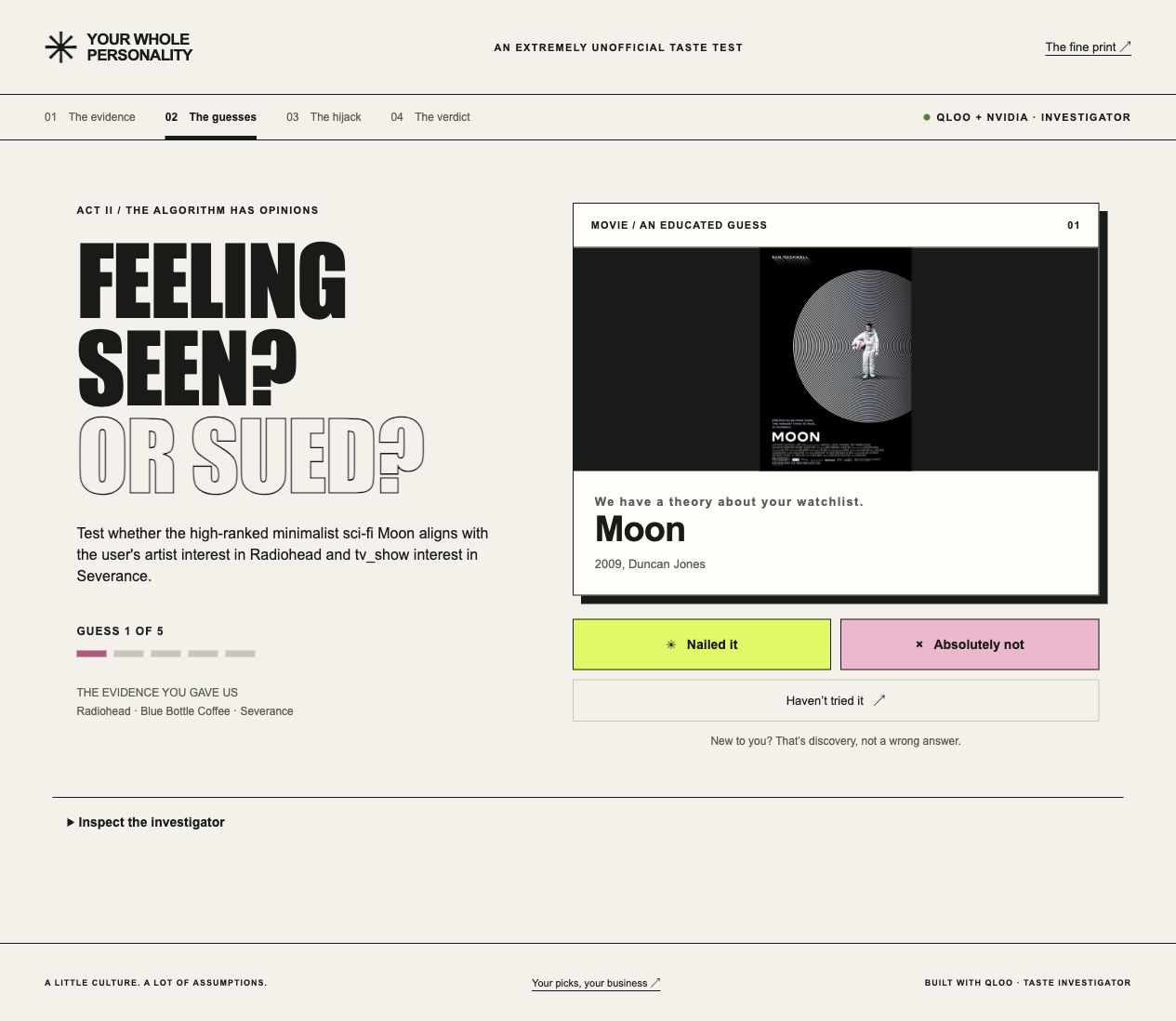
2. Live AI investigator
-
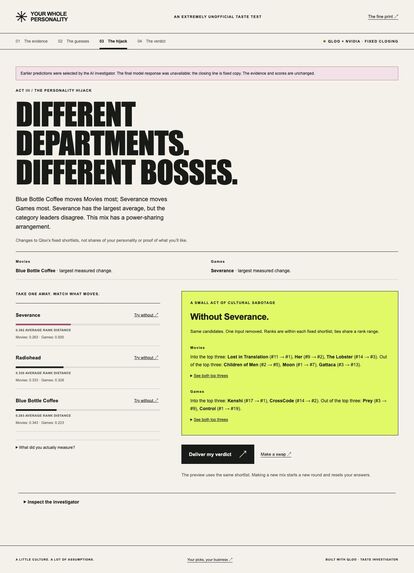
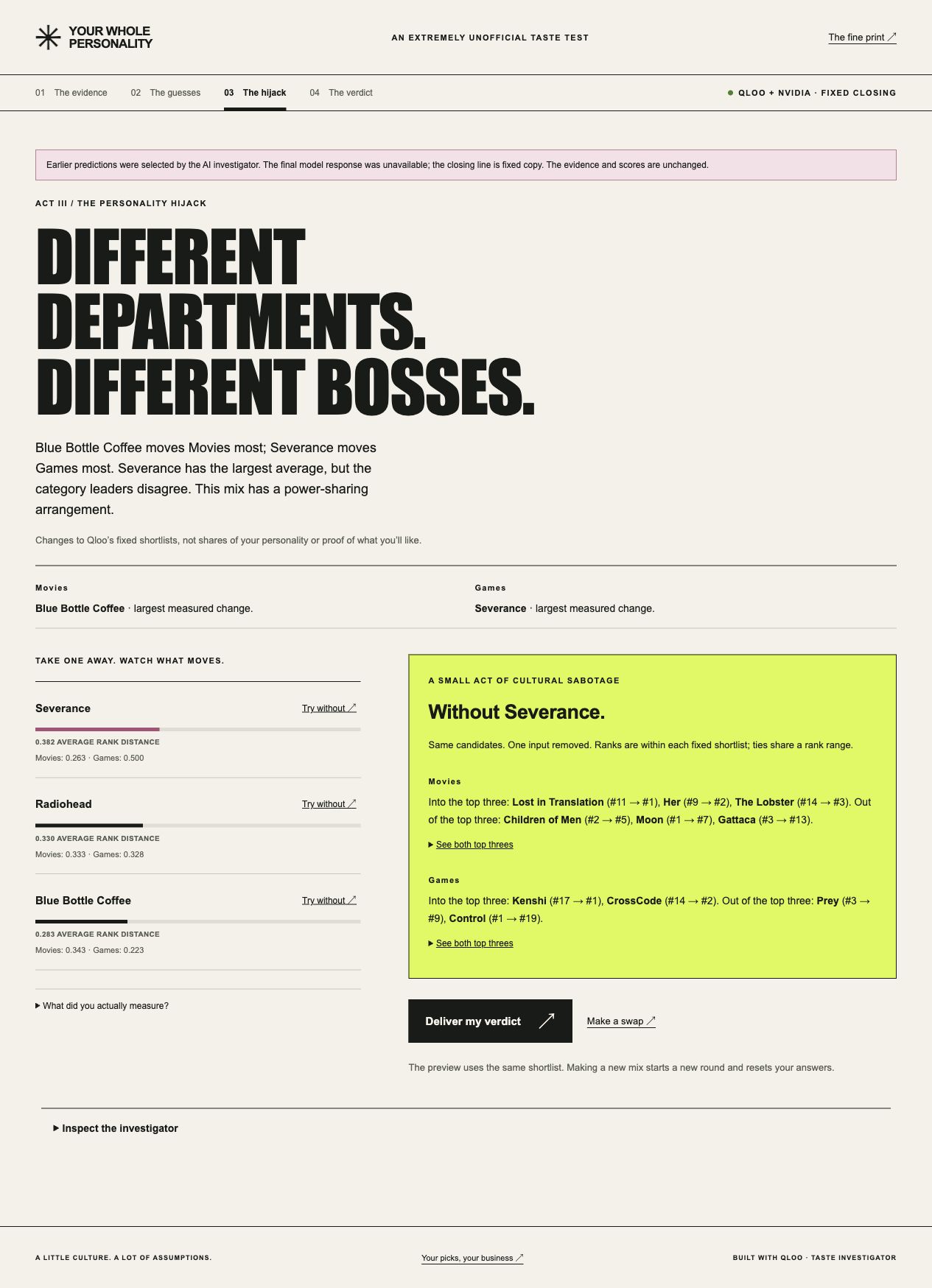
3. Act III influence reveal
-
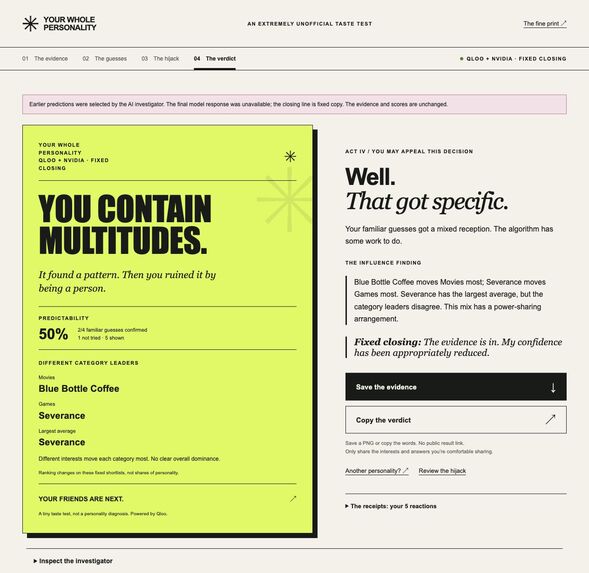
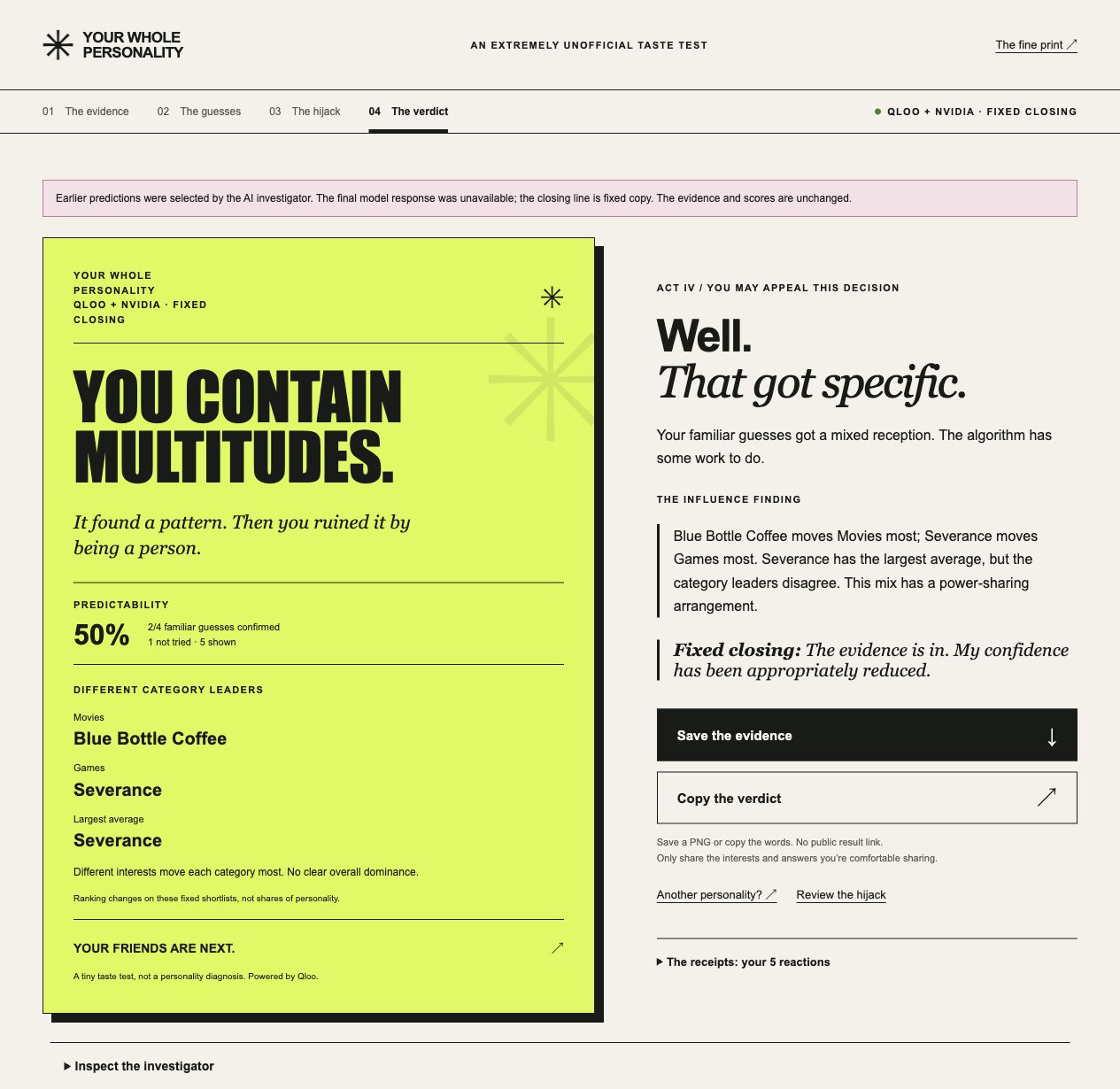
4. Final verdict and share card
Inspiration
“You’ve made that your whole personality” is usually a joke. We wanted to turn it into something you could actually investigate. Can a favorite artist predict the games you might enjoy? Does your coffee brand say more about your movie taste than your favorite show? And when an algorithm gets you right, which of your interests deserves the credit—or the blame? Your Whole Personality puts your taste on trial. It combines a playful cultural guessing game with a more serious question: how can we make personalized recommendations understandable, testable, and open to disagreement?
What it does
Your Whole Personality is a four-act game powered by Qloo and an AI Taste Investigator. You begin by choosing three to five interests: artists, shows, brands, books, games, or supported hobby audiences. Qloo supplies cross-category recommendations and affinity scores. The investigator examines that evidence, chooses predictions, and receives your feedback: nailed it, absolutely not, or haven’t tried it. Then comes the reveal. The game removes each interest in turn and measures how the recommendations change. It might find one clear influence, a leading influence without clear dominance, or different interests steering different categories. The receipts make the result concrete: removing one interest might move a movie from second to sixteenth place or knock a game off the top spot. The final card combines your prediction results with those named influences. Unfamiliar recommendations don’t count as wrong, and ranking influence is kept separate from prediction accuracy.
How we built it
Qloo provides the cultural evidence: resolving interests, discovering recommendations across categories, and scoring the full profile alongside each interest-removal comparison. An NVIDIA-hosted model acts as the investigator. It selects structured actions from a bounded toolset, using Qloo evidence and accumulated player feedback. It can test a prediction, investigate a contradiction, request additional Qloo evidence, or change domains. Validators ensure its choices refer to supported evidence rather than invented recommendations. The scoring is deterministic. We compare rankings on fixed recommendation panels using tie-aware Spearman correlation, preserving a strict dominance test while allowing more informative, qualified player-facing reveals. We first built a Python implementation, then migrated the deployed application to ChatGPT Sites using Vinext, Cloudflare Workers, and D1. The frontend uses JavaScript, HTML, CSS, and canvas-generated share cards. We checked scoring parity between the original Python implementation and the deployed JavaScript runtime.
Challenges we ran into
The hardest challenge was making the reveal entertaining without manufacturing certainty. Early results frequently ended with “no single culprit.” Investigation showed that this could mean several different things: shared influence, different category leaders, unstable comparisons, or genuinely insufficient evidence. We preserved the strict scoring and improved how those distinctions are explained. External API latency was another challenge. We added checkpointed operations, timeouts, quota protection, and clearly labeled fallback behavior. When the original NVIDIA model timed out during hosted testing, we verified a compatible alternative using the actual game’s structured-action schema. We also had to keep three ideas distinct: what the player likes, what changes Qloo’s rankings, and what the player considers part of their identity.
Accomplishments that we're proud of
A playable investigation with observable AI decisions, feedback receipts, and concrete recommendation changes. An Act III reveal that names actual influences without forcing a dominant winner. Consistent findings across the final result, copied text, and share card. 169 passing tests, including scoring parity across archived profiles and generated cases. Server-side credentials, bounded API usage, explicit export consent, and labeled recorded or fallback experiences.
What we learned
recommendation becomes more interesting when you can challenge it. Qloo’s cross-category scores let us build controlled comparisons rather than ask a language model to improvise an explanation. The investigator adds a decision-making layer; deterministic code keeps the measurements accountable.
What's next for Your Whole Personality
irst, we want to test with more players and measure which predictions and reveals feel accurate, surprising, or unconvincing. The longer-term idea is an evidence-based partnership research tool for brands and creators: identifying culturally relevant collaborators, then testing whether that relevance corresponds to self-reported identity attachment. That remains a hypothesis to validate. The game gives us a starting point for studying it without pretending that recommendation affinity already proves loyalty, retention, or commercial value.
Built With
- canvas
- chatgpt
- css3
- github
- html5
- javascript
- nvidia
- python
- qloo
- typescript
- vinext

Log in or sign up for Devpost to join the conversation.