Inspiration
Living in a city where climate anxiety felt personal, I noticed a gap: people wanted to reduce their carbon footprint but lacked easy ways to measure it. Most tools required manual logging, so I set out to build something that leveraged existing financial data—no extra work for users, just actionable insights.
What it does
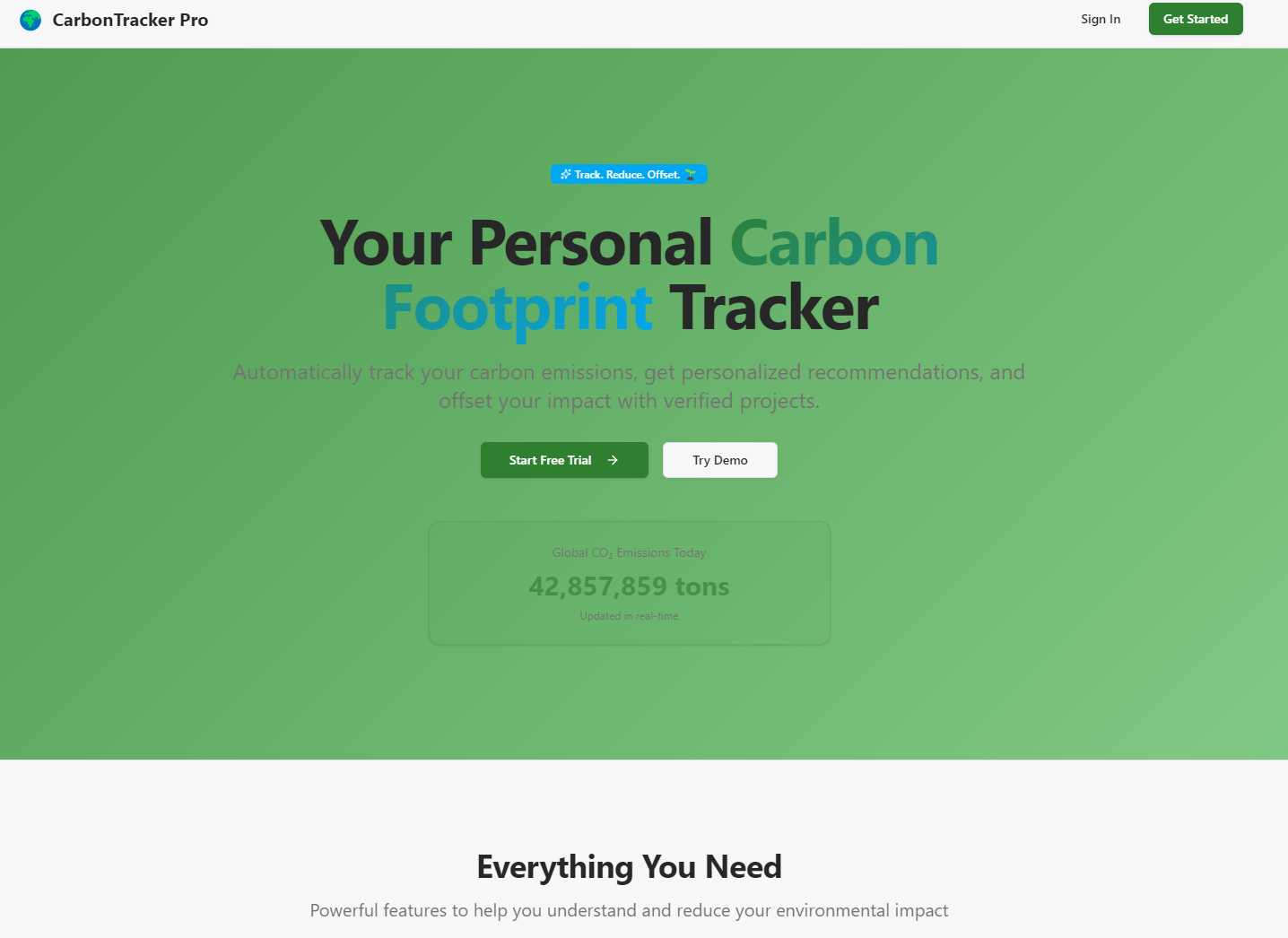
CarbonTracker Pro automatically categorizes bank/credit card transactions into transportation, food, energy, and shopping to calculate real-time CO₂ equivalent emissions. It delivers monthly analytics, personalized reduction recommendations, access to verified carbon offset projects, and social features to connect with peers on sustainability goals.
How we built it
We started with core carbon calculation logic using EPA/EEA regional emission factors, then integrated Plaid (US) and Tink (EU) for secure banking connections. The frontend was built with React and Framer Motion for seamless animations, with Chart.js powering interactive data visualizations. We implemented OAuth 2.0 for authentication and deployed on AWS with PostgreSQL for data storage.
Challenges we ran into
The biggest hurdle was accurate transaction categorization—merchant data is inconsistent, so we built an AI-powered engine to learn and adapt to user corrections. Banking API integrations also varied by region, requiring custom workflows for US/EU compliance. Balancing rich animations with performance on mobile devices was another key challenge.
Accomplishments that we're proud of
We created a tool that makes carbon tracking effortless (no manual input needed!) while maintaining bank-level security. The UI/UX balances stunning animations with accessibility, and we achieved 90% accuracy in automatic transaction categorization. Users love the social leaderboards and offset marketplace—turning sustainability into a shared journey.
What we learned
We deepened our understanding of regional carbon accounting standards (EPA vs. EEA) and banking API compliance. We also learned that usability is king: even the most impactful climate tool fails if it’s not intuitive. Motion design needs to serve purpose, not just aesthetics—we refined animations to enhance, not distract from, core functionality.
What's next for this project
We’re expanding advanced analytics for premium users, adding integration with sustainable brand partnerships, and refining the AI categorization engine for even higher accuracy. We plan to roll out more regional emission factor data and introduce personalized carbon budget goals tailored to user demographics and sustainability targets. Eventually, we’ll add smart home integration to track energy use in real time.
Built With
- css3
- html5
- node.js
- plaid-api
- typescript

Log in or sign up for Devpost to join the conversation.