-
-
Your Move — every task, a clear next move.
-
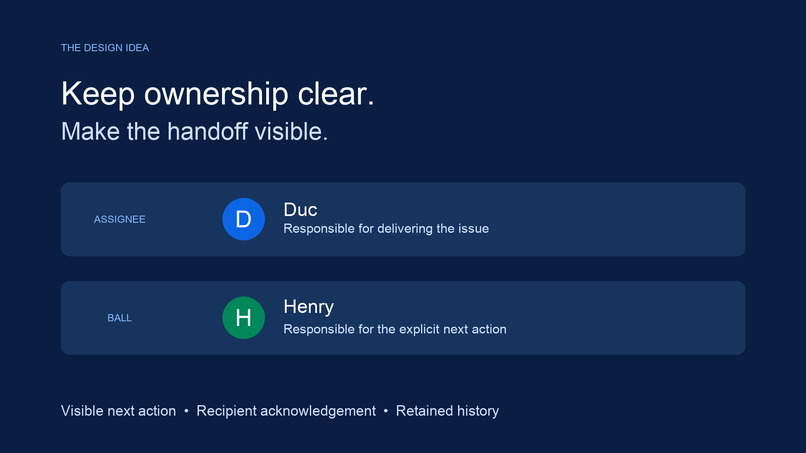
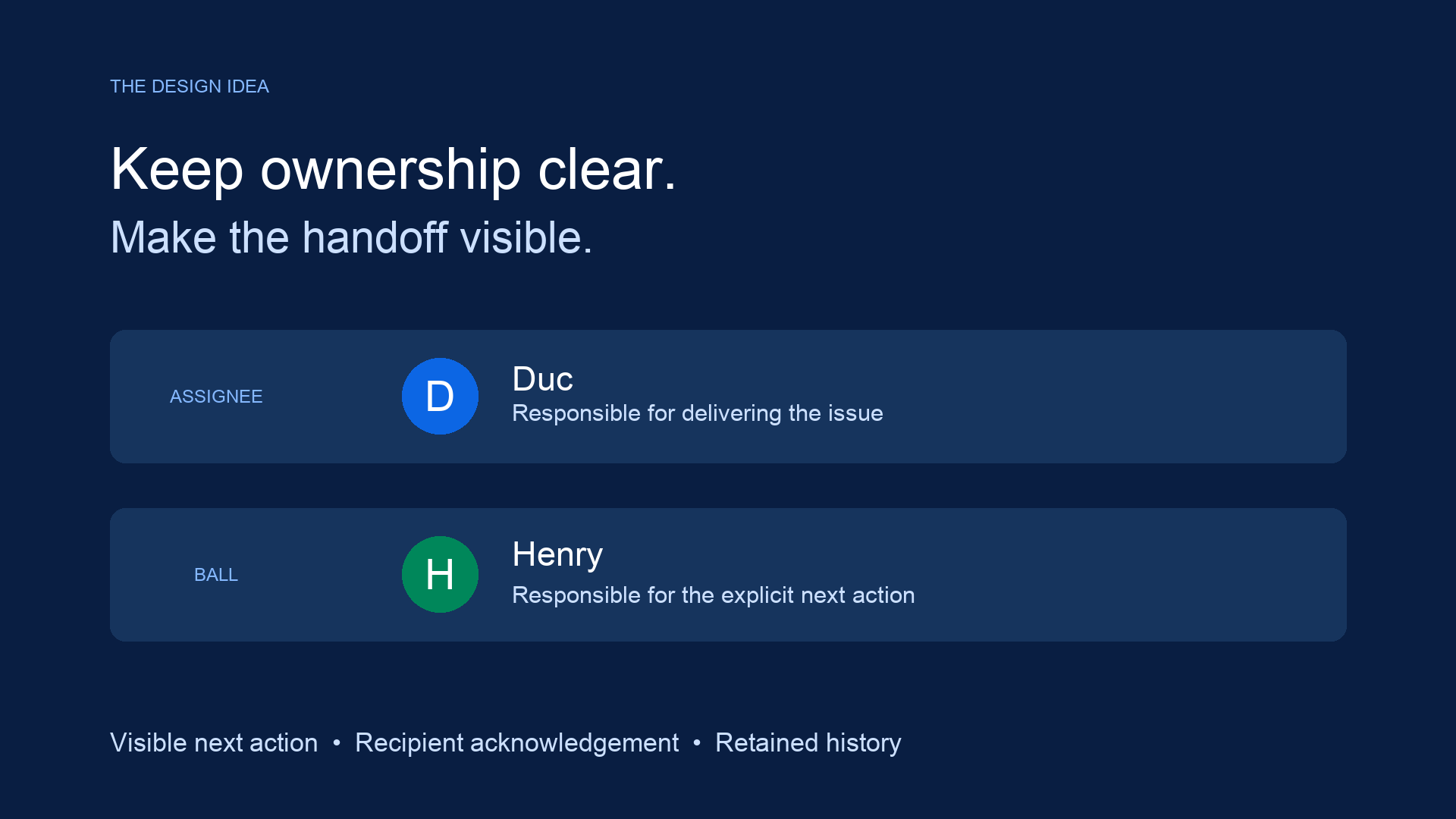
Assignee owns delivery; Ball identifies the person responsible for the next action.
Inspiration
A Jira issue can have a clear assignee while its next step is waiting on someone else. A developer owns delivery, but a teammate needs to confirm an acceptance criterion, review a decision or check a release scenario. Reassigning the entire issue for each small handoff can blur delivery ownership; leaving the request in a comment can make the next move hard to see.
Your Move gives that next action an explicit holder. The Jira assignee stays responsible for the issue, while Ball makes the next move visible, acknowledged and traceable.
What it does
Your Move adds a real, editable Ball multi-user field beside Assignee, a compact issue panel and a personal My court.
- Create several independent actions on one issue, each with a holder and optional context, due date and shared source comments.
- Notify the recipient through a dedicated Inbox. Opening a notice focuses the exact action; Pick up records acknowledgement.
- Pass an action with a handoff note while retaining its context and history.
- Review structured comment mentions as suggestions. A person chooses an action and explicitly confirms; a comment never transfers work automatically.
- Seed an initial action from the first assignee on an untouched issue. When the issue enters Jira's Done category, close open Balls and clear the field while retaining history.
Optional email defaults to Off for each person. The Inbox remains the durable record. Suggestions use deterministic rules, with no external AI model, API key or token budget.
How we built it
The application runs on Atlassian Forge, using Jira custom-field, issue-panel and global-page modules. React Custom UI uses Atlaskit components, design tokens, theming and motion. The backend runs on Node.js and integrates with Jira REST APIs.
Forge Custom Entity Store indexes actions by issue and holder. Server-side use cases obtain identity from trusted Jira context, check current issue access and Edit Issues permission, and validate eligible recipients. Conditional versions reject conflicting stored-action writes. A durable per-issue queue reconciles native field and lifecycle events against current Jira state.
Notification intents are committed with the action, then materialized into a recipient-scoped Inbox with recovery. Optional targeted email rechecks opt-in, current ownership, unread/open state and issue/recipient eligibility before requesting Jira delivery.
Challenges we addressed
The important distinction was between issue ownership and next-action ownership. Multiple actions had to remain independent, and changing a native field could not discard their context or rewrite their past.
We also needed to handle duplicate and late Jira events, stale confirmations, restricted comment sources and lost notification acknowledgements. This led to stable operation identifiers, conditional writes, source-revision fingerprints and explicit delivery states. The app does not treat a queued email acknowledgement as proof of receipt.
Accomplishments
The reviewed candidate passes 135 unit tests, 17 development browser flows and 7 optimized-bundle browser flows, a production build, manifest validation and Forge lint. Repository CI runs the source checks and browser suite.
The demo uses two real Jira accounts, Duc in Chrome and Henry in Safari. It demonstrates native Ball, independent actions, recipient Inbox, exact-action opening, pickup, a context-preserving return handoff, retained history, explicitly confirmed mention suggestions and closure when the issue is Done. Automatic recipient email was subsequently received in Henry’s real mailbox on production. Issue-level access revocation and restoration were also checked. The public installer was verified on a new Jira site, including native initialization, Done closure and retained history. Testing a stale handoff exposed an optimized-build rendering bug; it was fixed and the real-account conflict path was rechecked.
What we learned
A handoff needs more than a person's name: it needs a specific action, enough context, a recipient who knows about it, and a record of acknowledgement. Keeping suggestions reviewable is valuable even without AI. Permission checks and audit history belong on the server, and real-account testing provides evidence that simulated identities cannot.
What's next
Expand concurrency coverage beyond the tested overlapping handoff and stale-write scenarios before broader rollout, then improve recovery throughput and evaluate reminder preferences. Jira and Forge storage do not share an atomic transaction. The current release does not claim realtime push, a Rovo agent, an MCP server or Teamwork Graph integration.
Built With
- atlaskit
- atlassian-forge
- javascript
- jira
- node.js
- react
