-
-
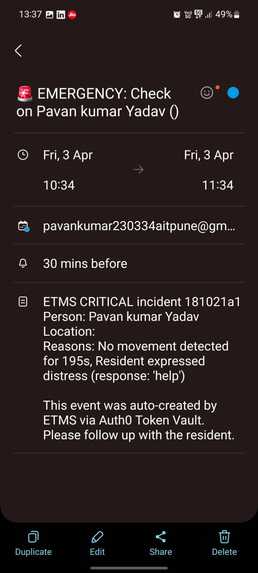
Calender event
-

Model person
-
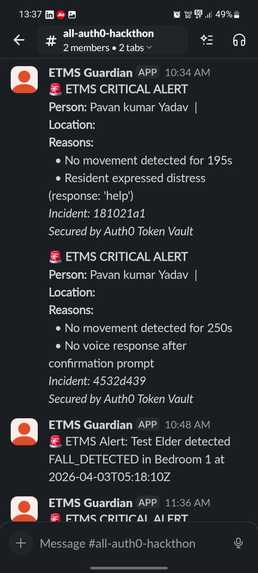
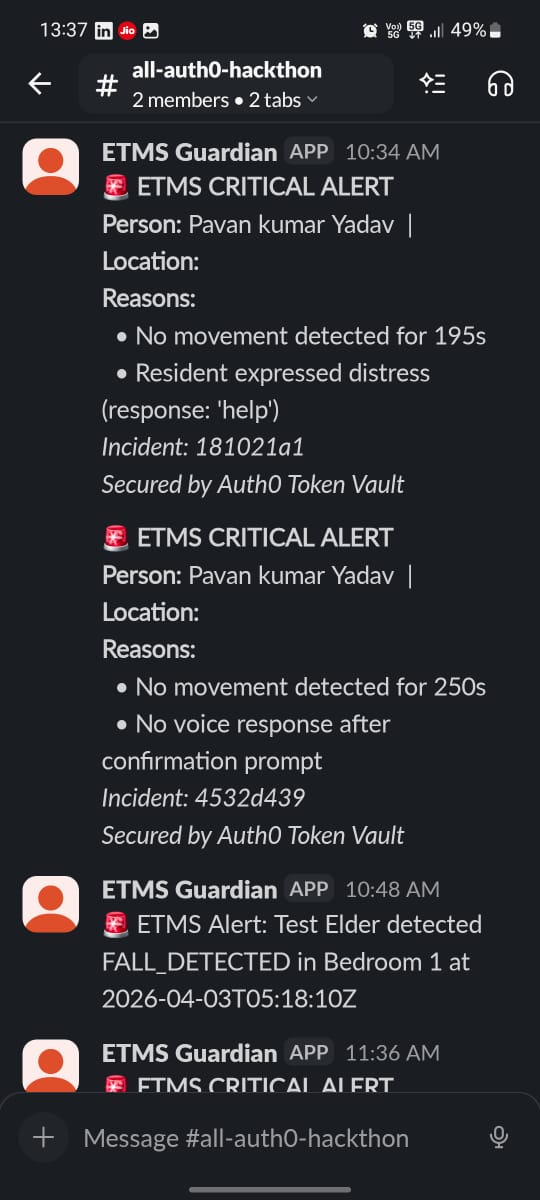
slack notification
-
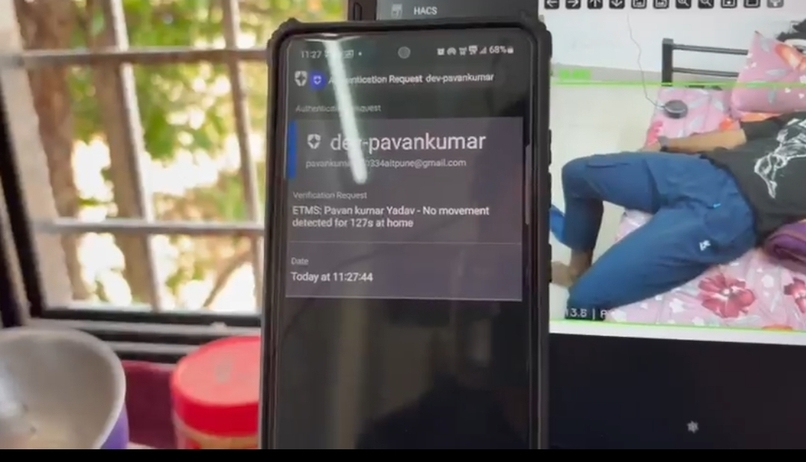
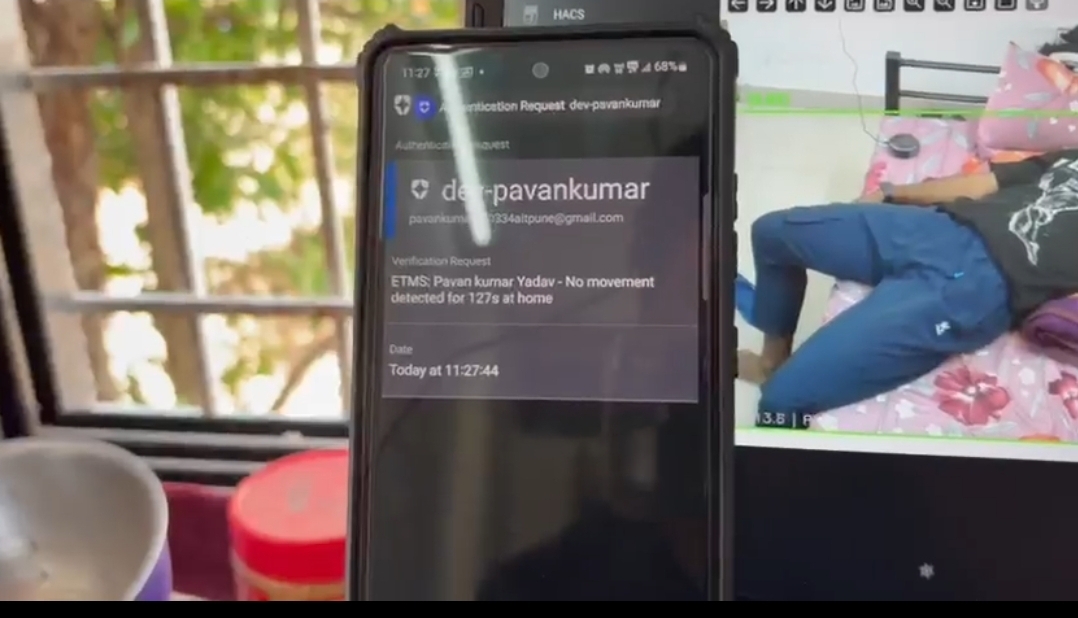
Auth0 CIBA
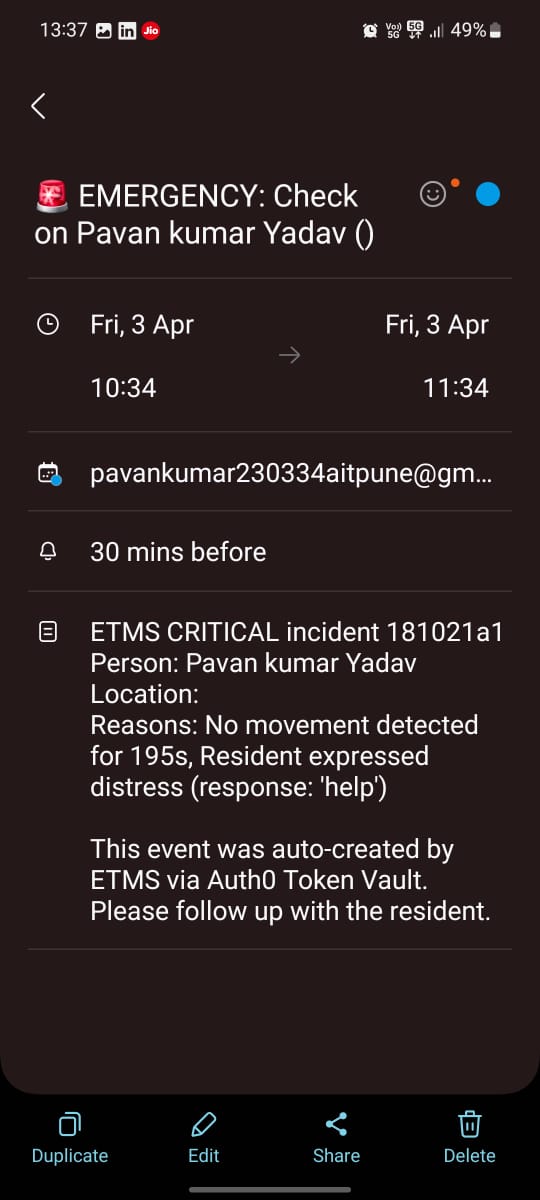

Inspiration
My grandmother wants to live independently in her own home, surrounded by memories, not in a care facility. But as her family, we lived with constant anxiety — what if she falls at night? What if her vitals drop while she is alone?
Read the full story here: AI for Safe Living: Your Invisible Guardian Angel at Home (Now Production-Grade with Auth0)
Traditional solutions felt unreliable or too invasive. This personal pain became the inspiration behind ETMS — Your Invisible Guardian Angel at Home, now made production-grade and truly secure with Auth0 for AI Agents.
What it does
ETMS is a privacy-first, edge-native multi-agent AI system that acts as an invisible guardian for elderly people living alone.
It monitors real-time video, wearables, and environmental sensors, intelligently detects falls, wandering, and vital anomalies, and takes secure actions while keeping all raw data local.
The system classifies risk into four levels using a weighted fusion model and securely alerts caregivers using Auth0-protected channels.
How We Built It
We designed ETMS as a modular multi-agent architecture, where each agent owns a distinct responsibility and communicates through a unified risk signal pipeline.
Agent Architecture
| Agent | Role |
|---|---|
| Vision Agent | Real-time YOLO inference with contextual scene reasoning |
| SmartGuard | Transformer autoencoder for personalized behavioral baseline learning |
| Fusion Engine | Aggregates all agent signals into a final composite risk score |
| OpenClaw | Policy and action execution engine |
| PicoClaw | Caregiver-facing voice and chat interface |
Risk Scoring Formula
The core risk calculation fuses probabilistic outputs from each agent using a weighted linear model:
Risk Score = w₁·P_vision + w₂·P_vitals + w₃·P_behavior + w₄·P_context
where w₁ + w₂ + w₃ + w₄ = 1 (weights are non-negative and sum to 1), and each P represents the normalized risk probability from its respective agent.
Auth0 for AI Agents Integration
For this hackathon, we deeply integrated Auth0 for AI Agents across the system:
- Token Vault — Secure credential management for external service calls (Google Calendar, Slack)
- FGA (Fine-Grained Authorization) — Strict permission boundaries enforced between agents
- Step-Up Authentication + CIBA — Human-in-the-loop approval flow for critical actions
Frontend
Built a real-time monitoring dashboard using Next.js 15, Framer Motion, and Tailwind CSS — with live risk score visualization, agent status panels, and caregiver alert timelines.
Challenges we ran into
- Achieving very low false negatives while maintaining privacy and performance on edge devices
- Implementing smooth real-time Token Vault exchanges without delaying critical alerts
- Designing an empathetic and trustworthy UI for caregivers (many in the 50+ age group)
- Properly configuring FGA policies and Step-Up flows in a multi-agent system
Accomplishments that we're proud of
- Built a complete end-to-end multi-agent system that started from a personal family need
- Successfully integrated Auth0 Token Vault, FGA, CIBA, and Step-Up Authentication in a real healthcare use case
- Created a production-grade, privacy-first architecture with beautiful UI/UX
- Combined edge AI, agentic orchestration, and enterprise security into one cohesive system
What we learned
We learned that in agentic AI systems, security and human control must be first-class citizens, not added later. Auth0 provided the perfect toolkit to make powerful agents safe and trustworthy.
We also deeply understood the importance of explainability and emotional design when building technology for elderly care.
What's next for Your Invisible Guardian Angel at Home with Auth0
We plan to:
- Add medication adherence and voice companionship agents
- Support multi-resident homes
- Explore deeper hospital system integration using Auth0
- Make the system even easier for non-technical families to deploy
Our ultimate goal is to give every elderly person who wishes to live independently a reliable, private, and caring Invisible Guardian Angel.

Log in or sign up for Devpost to join the conversation.