Inspiration
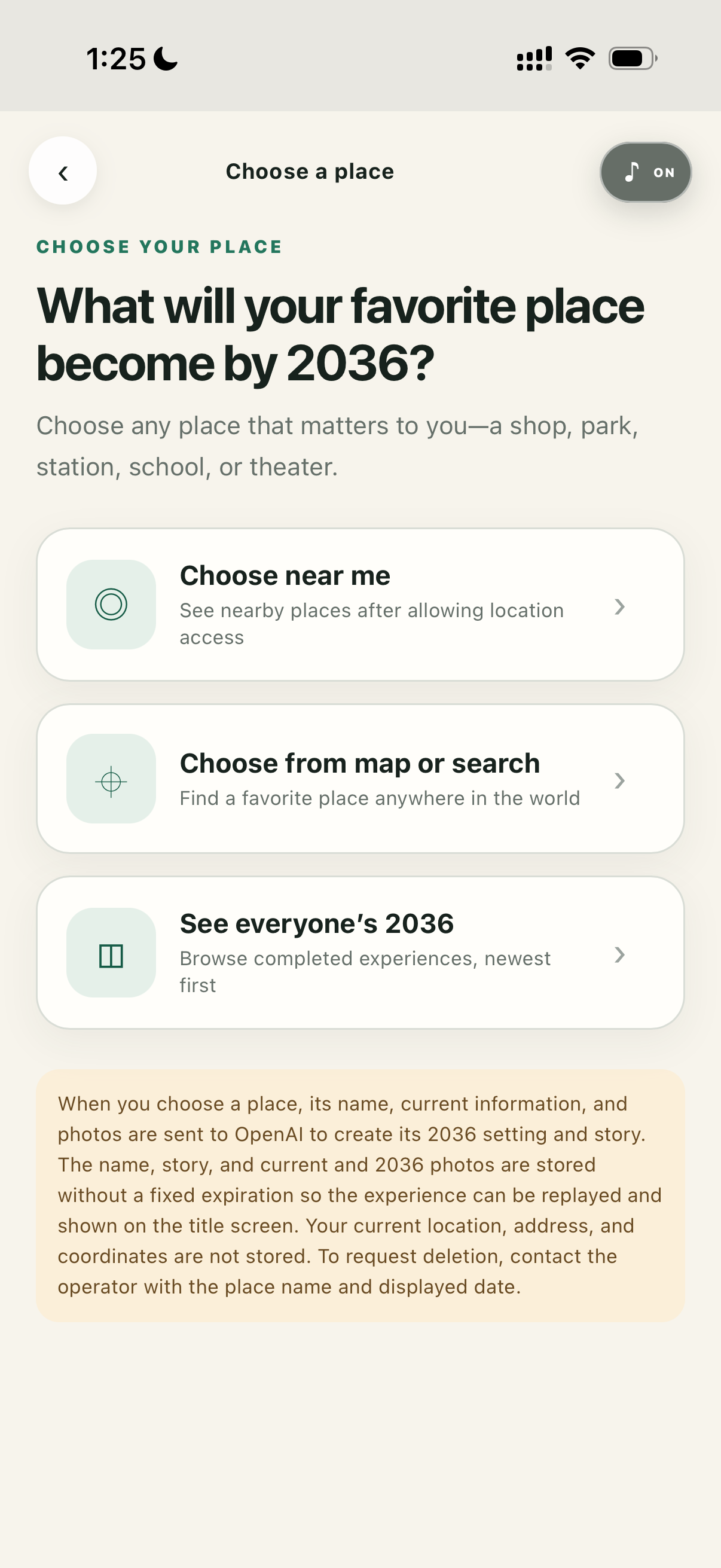
The places we love hold memories, routines, and relationships. But most visions of the future are generic: a futuristic city, a list of technologies, or someone else's prediction. I wanted to make the future personal. What would the café, park, station, school, theater, shop, or landmark that you already care about feel like ten years from now?
That question became Your Favorite Place in 2036, a mobile browser game that turns a real place into a playable science-fiction journey.
What it does
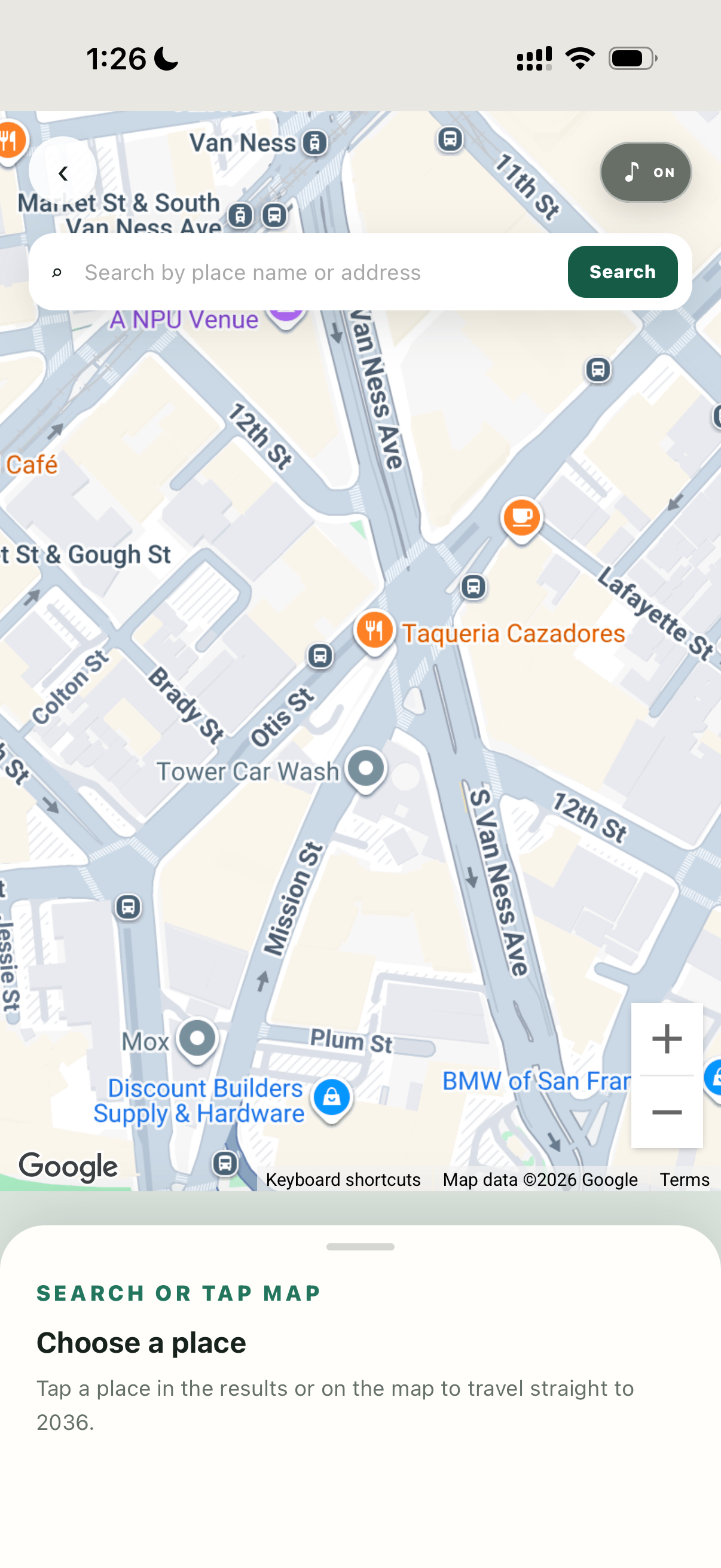
The player chooses any real place from nearby results or Google Maps. The game begins with the place's current photograph, then carries the player through a time-warp into a newly generated 2036 version of that exact location.
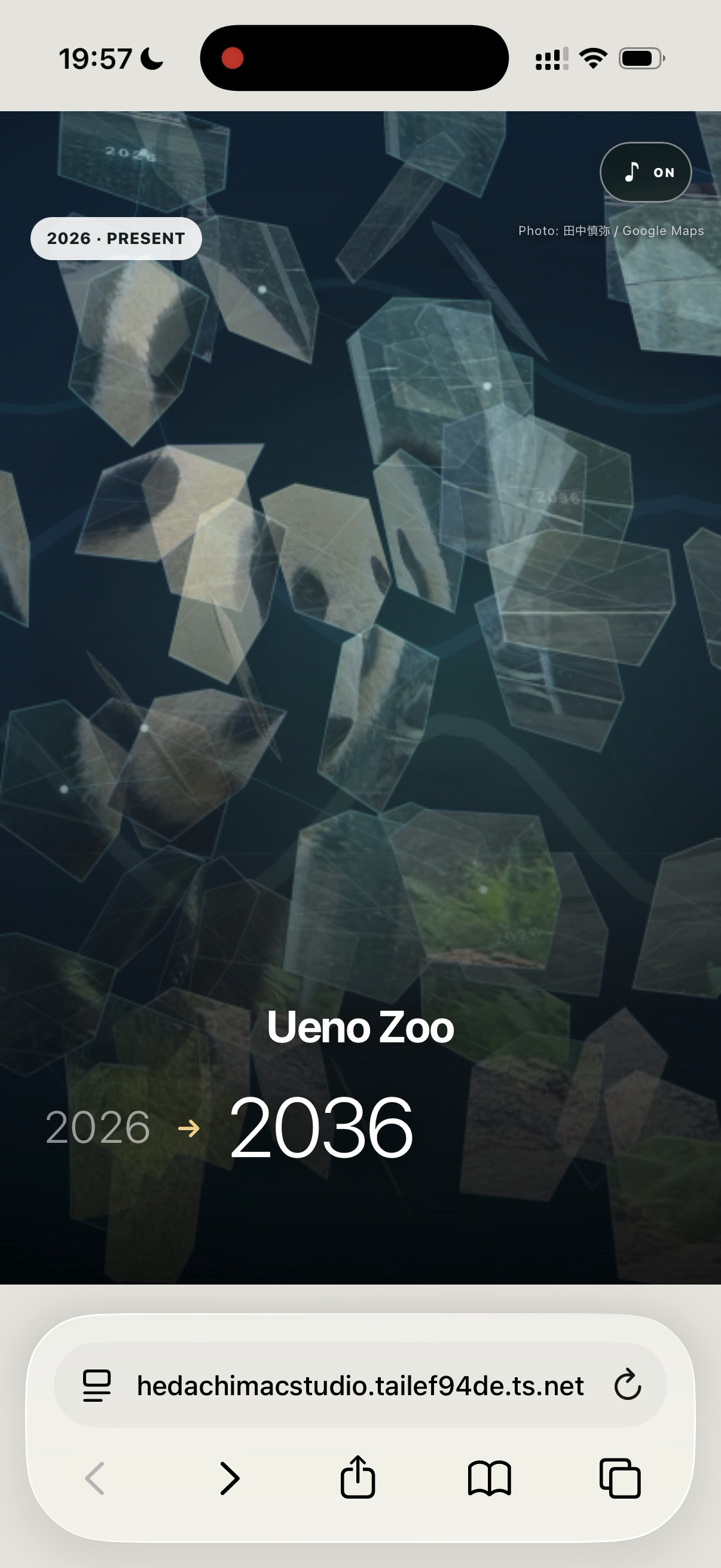
The result is not a generic future skin. The game preserves the place's identity and builds one location-specific experience around it. The player observes what changed, acts inside the place, encounters a story with emotional stakes, makes a meaningful choice, and lives with a consequence that cannot simply be undone.
For a two-minute judging path, choose See everyone’s 2036 on the title screen and open any completed journey. This immediately shows the transformation from the present-day place to 2036 and lets judges play through a full saved story. To see the core AI system working live, start a new journey from a place you personally know.
Why GPT-5.6 is essential
GPT-5.6 creates the content the player actually plays. It is not used for supporting copy or a decorative chatbot.
For every journey, GPT-5.6 receives the selected place's current Google Places information and photographs together with the project's detailed 2036 world rules. In one structured response, it:
- selects the photographs that best preserve the place's identity;
- decides how that exact place has changed by 2036;
- creates a location-specific central action instead of applying a generic future template;
- writes one coherent five-scene experience with an incident, two meaningful choices, and two distinct endings;
- returns structured game data that the browser immediately turns into scenes and interactions.
There is no menu of prewritten story routes behind this flow. Each selected place produces a new setting and a new playable story. gpt-image-2 then edits the two selected current photographs into the two key 2036 scenes—the arrival and the central action—in parallel, preserving recognizable features from the real place.
How I built it
The browser game uses JavaScript, HTML, and CSS. A Node.js server keeps provider credentials private, reads current place data and photographs through Google Places, calls GPT-5.6 through the OpenAI API, and creates the future visuals with gpt-image-2.
GPT-5.6 first creates the complete five-scene experience as structured data. The server validates the setting, objects, central action, choice, and both endings before any future image is made. gpt-image-2 then creates the arrival and central-action images in parallel from the selected current photographs. The current photograph stays visible inside a continuous time-warp instead of exposing a technical loading screen. Completed results receive stable replay URLs. The production service runs on AWS Lightsail behind HTTPS and is monitored throughout the judging period.
How I used Codex
I wrote the product vision, world rules, quality bar, and executable acceptance criteria in AGENTS.md, then used Codex Goal to pursue the work continuously. The representative Goal session ran for more than 20 hours.
During that session I was caring for my three-year-old son. Codex sent commit reports through Slack while it worked. I periodically opened the latest live build, judged the actual experience, and sent corrections through Slack. Those directions were written into a Pending Interrupts section in AGENTS.md; the running Goal session detected each instruction, changed course, implemented it, tested the result in a real browser, committed it, and continued.
Codex implemented and repeatedly refined the browser experience, server, OpenAI and Google integrations, structured generation pipeline, automated tests, real-Chrome end-to-end verification, performance logging, failure reporting, and production deployment.
The decisions I made
Codex accelerated execution, but I made the choices that define the product: making a person's own favorite place the emotional center; choosing 2036 as a future close enough to recognize; defining the shared world and its limits; rejecting generic explanatory stories; directing the mobile pacing, time-warp, visual tone, and interaction; reviewing live generations; and deciding whether each result was compelling enough to keep.
Challenges
- Preserving a real place's identity while changing it enough to create genuine surprise.
- Generating a story that belongs to one location instead of merely mentioning its name.
- Turning model latency into an intentional time-travel sequence.
- Producing meaningful choices rather than cosmetic branches.
- Keeping long model and image operations observable, retryable, private, and stable.
- Testing both restaurants and non-food locations across mobile layouts without leaking implementation language into the fiction.
What I learned
Long-running agent development works best when the goal, constraints, tests, logs, and interruption mechanism are durable. Codex can own implementation and verification for many hours, while a human still needs to judge the experience itself: whether a scene is surprising, whether a choice matters, and whether the result feels like the place the player loves.
The same division appears inside the finished game. GPT-5.6 provides generative breadth, but the product's rules, orchestration, validation, and interaction design turn that generation into a coherent experience.
What's next
During judging, the public service will remain available without login. The next step is to deepen the range of location-specific interactions while preserving the same promise: the future should feel personal because it begins somewhere you already love.
Built With
- codex
- gpt-5.6
- javascript
- node.js
- openai

Log in or sign up for Devpost to join the conversation.