-
-
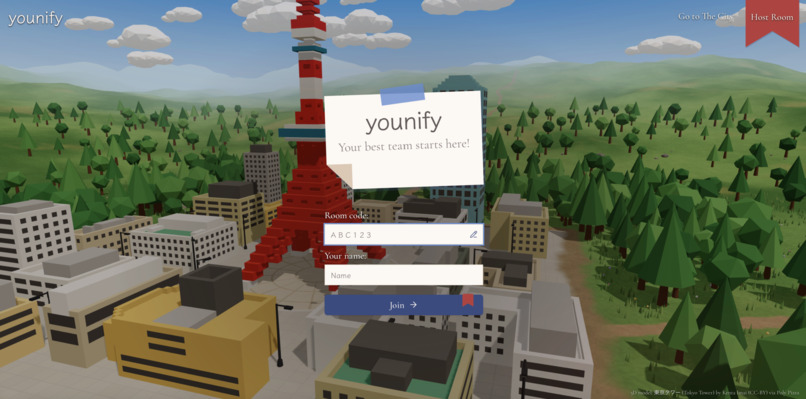
Home screen
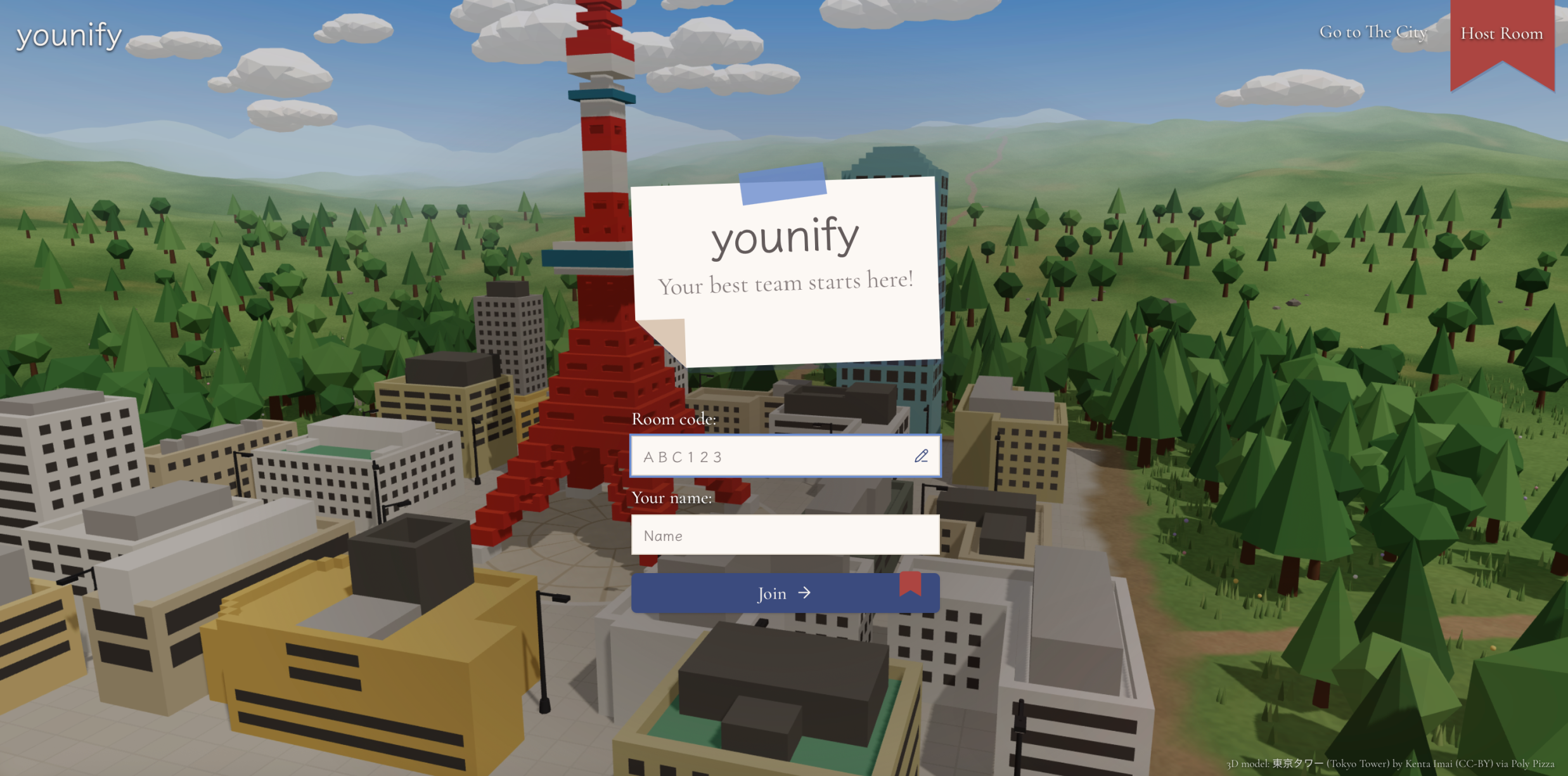
Inspiration
One of the most universal pain points for students (and everyone working in group projects) is the difficulty of finding people who work best with your own work habits. Yet, I think we can all agree that working together in a group effectively can be one of life's most special experiences. Often, groups are randomized, or we meet teammates without knowing much about how each other works.
What it does
Younify sorts any group into teams based on how people actually work, and it turns forming groups into a fun, game-like experience.
Hosts create a room and share a code, and participants enter as avatars in a shared 3D space.
Everyone answers quick questions about their work habits, such as their preferred work schedule, what role they take, and what they expect from teammates. While waiting for everyone to finish responding, participants can stay engaged and have fun by customizing their character's appearance!
Younify places each person into an interactive 3D biome that fits them best. For example, Night City is for people who work hard, move fast, and like to stay connected. Highlands is for people who prefer a steady, low-stress pace.
When exploring their biome, users can see the people who work like them. AI highlights what they have in common, their individual skills, and how they might work well together. Users can choose to connect in person (in physical spaces) or through the links in their profiles (e.g., in online class settings).
It's fun for students and easy for educators to set up!
How we built it
We started by addressing a real user issue, reading research articles and conducting surveys with other students. To make it a fun and interactive experience, we built the 3D world with React and React Three Fiber, and used a Node server with Socket.IO to keep everyone in the room in sync in real time. Gemini turns each person's quiz answers into a short working-style profile, which we store as a vector in Postgres with pgvector on Tiger Data and match to the closest biome.
Challenges we ran into
We had a practical solution (matching people together), but struggled with thinking of how to pair that with a visually appealing UI/UX that felt fun and intuitive to use. After considering multiple scenarios, we decided to focus on making Younify a way to make a difficult process easier and more fun. Forming groups happens all the time in classes, clubs, workshops and hackathons, and it is usually awkward. We often need to gamble on whether we'll work well together. We decided to build an engaging application and a low-stakes process to find potential teammates, something fun to use and easy for educators to set up.
Accomplishments that we're proud of
- Building a web app that's practical, visually appealing and fun to use
- Connecting a 3D multiplayer room, an AI profiling step, vector search and a sorting algorithm into one smooth flow
- Making the web app playable by everyone at once
- Creating the ability to customize characters
What we learned
- Research is an important step in figuring out how others would respond to the product. Asking students about their project experiences shaped our questionnaire and pushed us from a friend matcher to a team-forming tool.
- We learned to consider how the 3D world changes the user experience.
What's next for Younify
- Give hosts a final view of every group
- Test Younify with UBC clubs, course teaching teams and hackathons like HackCamp, where there is a larger number of users
- Add new biomes for different working styles so larger groups can be sorted with greater diversity (or customization, with more biomes for bigger groups)
- Mobile support and optimization
Built With
- cloudflare
- gemini
- git
- github
- node.js
- pgvector
- postgresql
- react
- react-three-fiber
- socket.io
- tailwindcss
- three.js
- tiger-data
- typescript
- zod
- zustand


