-
-
Landing Page
-
Example Quantum roadmap!!
Inspiration
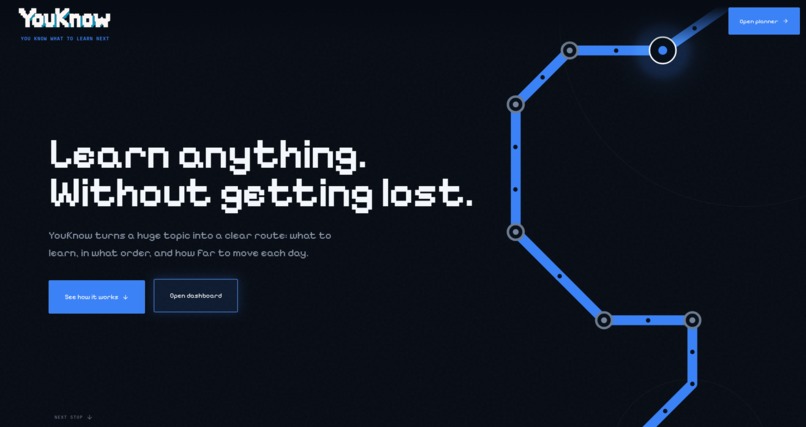
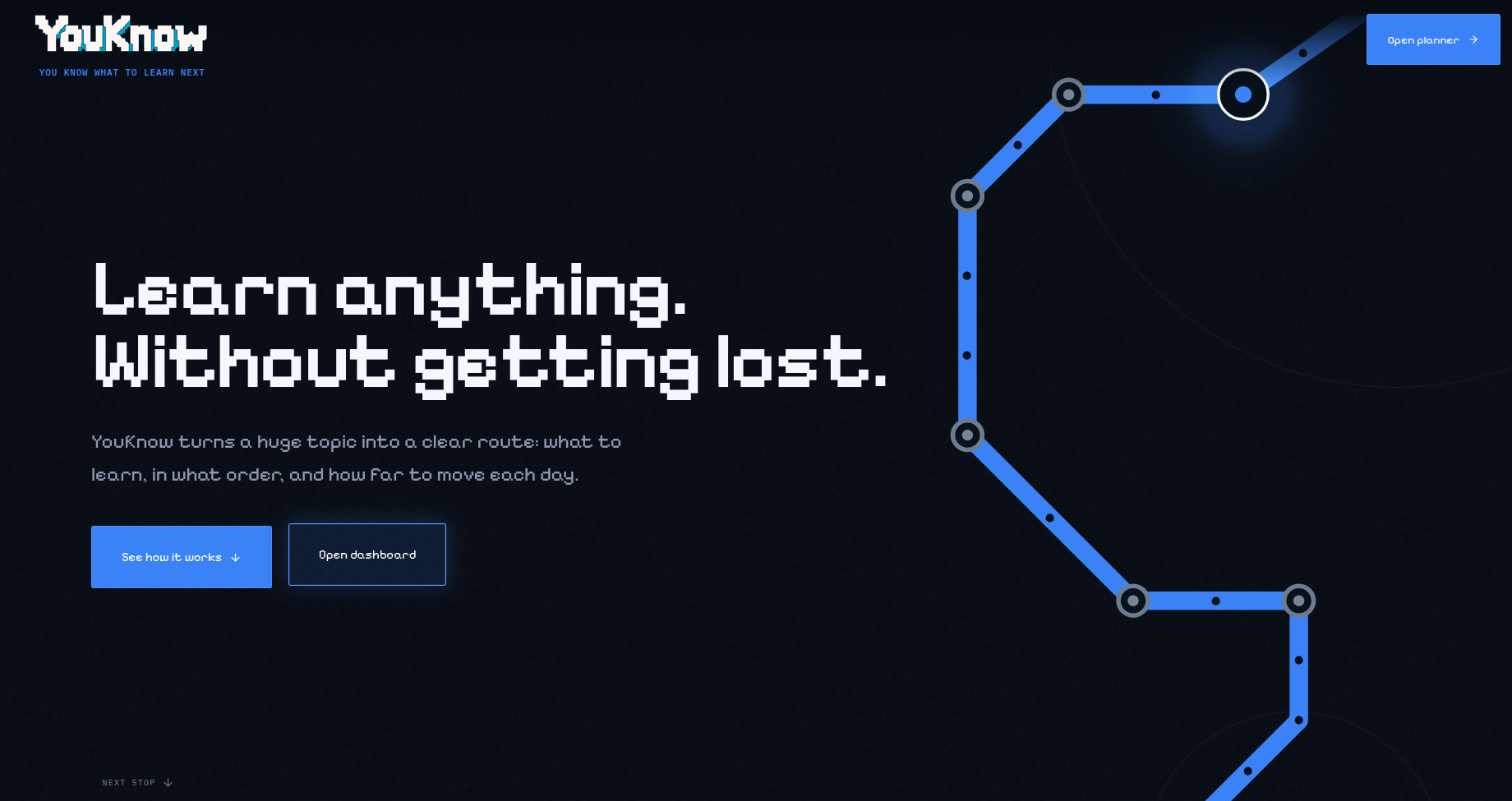
Learning a new topic is hard when you do not know where to start or what you are missing. Most planners organize your time; YouKnow organizes the knowledge first.
We wanted to make learning feel less like opening ten tabs and guessing what to study next, and more like following a route that actually makes sense.
What it does
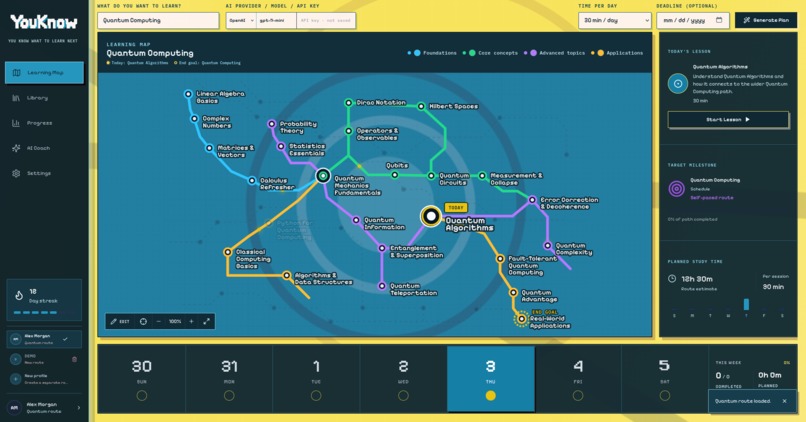
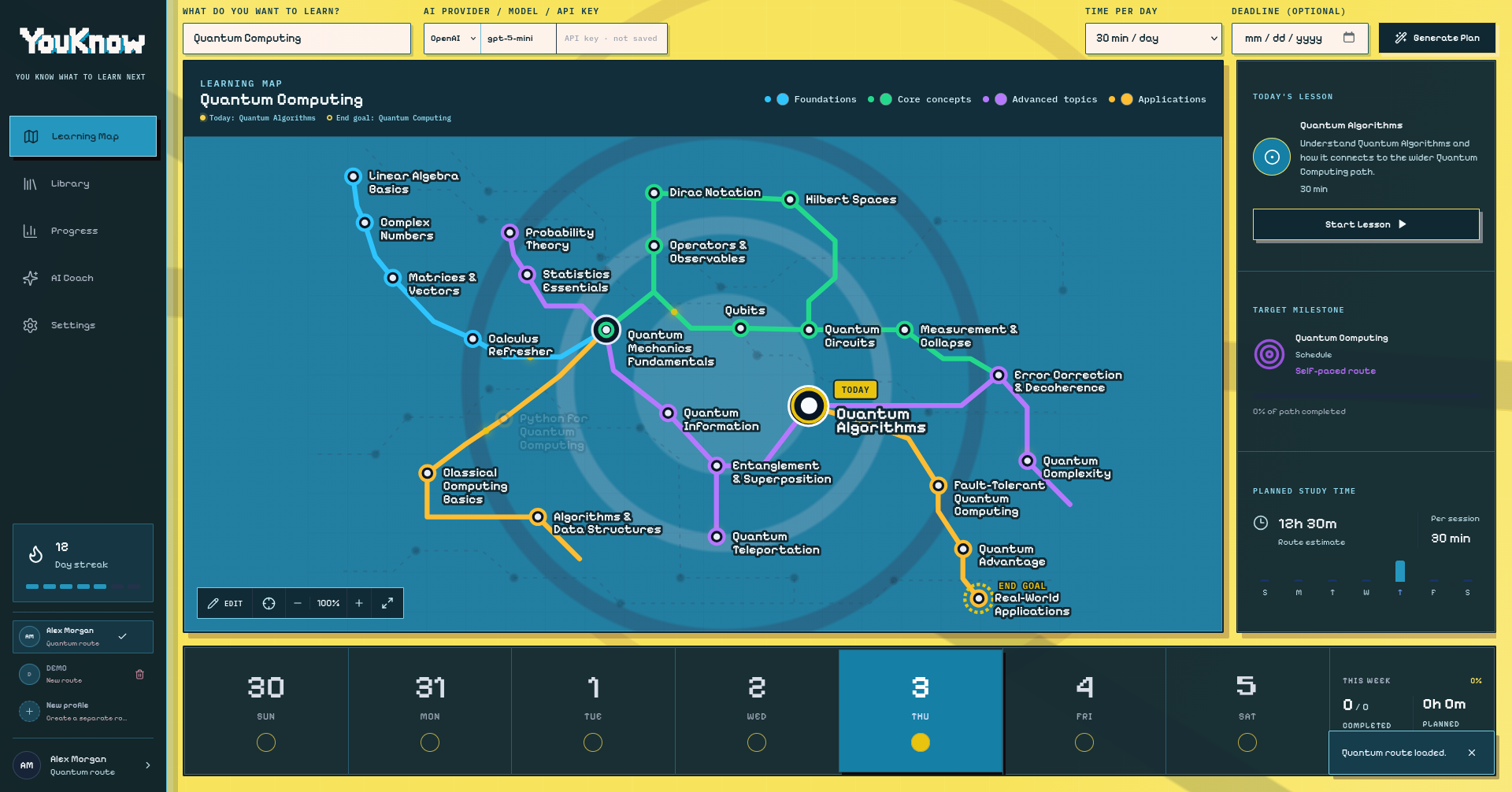
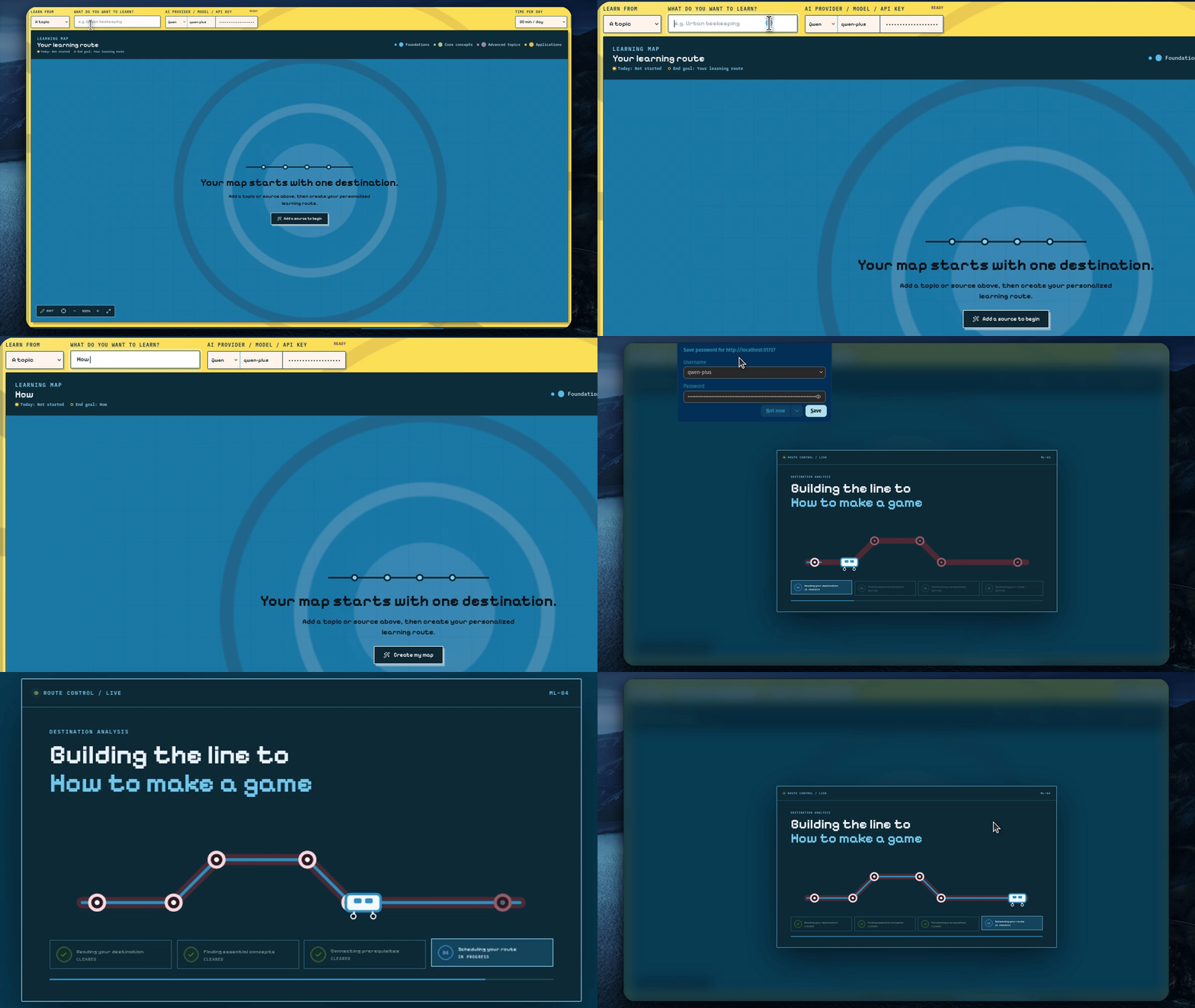
YouKnow takes a topic and turns it into a prerequisite-based learning route.
It identifies the key concepts, orders them from foundations to advanced ideas, and builds a study calendar around your available time. Instead of asking you to choose an arbitrary deadline, YouKnow estimates how long the full path will realistically take and gives you a predicted completion date.
From there, the roadmap becomes something you can actually work inside:
- Take notes directly inside each concept node.
- Expand any node to generate the prerequisites behind it and explore the topic in more depth.
- See your learning path and calendar as two views of the same plan.
- Customize the experience visually, including the background, route colors, and the color of each individual metro line.
The goal is not just to generate a roadmap, but to make it feel like your own learning space.
How we built it
YouKnow combines AI reasoning with deterministic graph logic.
The AI analyzes the topic, extracts meaningful concepts, and identifies prerequisite relationships between them. Those relationships are then converted into a dependency graph.
From there, deterministic logic validates the graph, prevents invalid learning orders, calculates concept levels, and generates a study sequence and schedule. The frontend visualizes that same structure as a metro-style knowledge map and a calendar.
The pipeline is roughly:
Topic → Concepts → Prerequisites → Dependency Graph → Learning Order → Study Schedule
We also wanted YouKnow to stay flexible instead of locking the user into one AI provider. You can configure the model you want to use and provide your own API key, so the app itself does not require a paid subscription.
API credentials are kept on the user's side, and YouKnow does not require an additional cloud account or proprietary backend to store your learning data. When an external AI provider is used, only the information required for that request is sent to the provider you chose.
Challenges we ran into
The biggest challenge was definitely making the generated knowledge graph look like an actual metro map.
A dependency graph is easy to represent as random nodes and edges. Making those same relationships form readable routes, intersections, stations, and branches without becoming visual chaos was much harder.
We had to balance two things at once: preserving the real prerequisite structure while still producing a map that feels intentionally designed rather than automatically generated.
Accomplishments that we're proud of
We are proud that AI is not just a chatbot added on top of the product.
The AI-generated knowledge structure powers the entire experience.
The metro map is not decorative: every station and route represents part of the learner's actual prerequisite graph, and the calendar is generated from that same structure.
We are also proud that YouKnow is something we genuinely want to use ourselves. Learning complex topics can feel overwhelming and mechanical, so we wanted the process itself to feel more visual, personal, and enjoyable.
What we learned
We learned that organizing knowledge and organizing time are two different problems.
AI is very useful for understanding concepts and relationships, while deterministic algorithms are much better for enforcing a reliable learning order and schedule.
We also learned that customization matters more than we initially expected. When a learning tool feels personal, your colors, your notes, your routes, your space, there is less friction in coming back to it and continuing where you left off.
What's next for YouKnow
We want YouKnow to become much more adaptive.
Next, we would like to:
- Detect what the learner already knows and skip unnecessary prerequisite branches.
- Automatically reschedule missed sessions.
- Add lightweight mastery checks.
- Combine multiple sources, such as books, videos, notes, and articles, into the same learning map.
- Add a chatbot that can interact with the learner's notes and knowledge graph instead of acting as a separate generic assistant.
We also have a more experimental idea we would love to explore: real metro mode.
The learner could choose an existing metro system, and YouKnow would generate a complex study roadmap constrained by that real network, turning actual stations and lines into concepts, prerequisites, branches, and milestones.
You choose what you want to master. YouKnow builds the route.
Built With
- fastapi
- networkx
- ollama
- openai-api
- pydantic
- pypdf
- python
- qwen
- react
- tailwind-css
- typescript
- uvicorn
- vercel
- vite
- youtube-transcript-api


Log in or sign up for Devpost to join the conversation.