Inspiration
Yougrep came from the frustration of hiring engineers for real teams. Every role needs a lot of context: the codebase, the team’s workflow, the company knowledge base, the actual expectations for the job, and the practical work candidates should be tested on. Building take-homes and onboarding candidates into that context is slow, and when a candidate drops off or an employee leaves, a lot of that knowledge disappears with them.
We wanted hiring to feel more like onboarding into a real team from the first interaction.
What it does
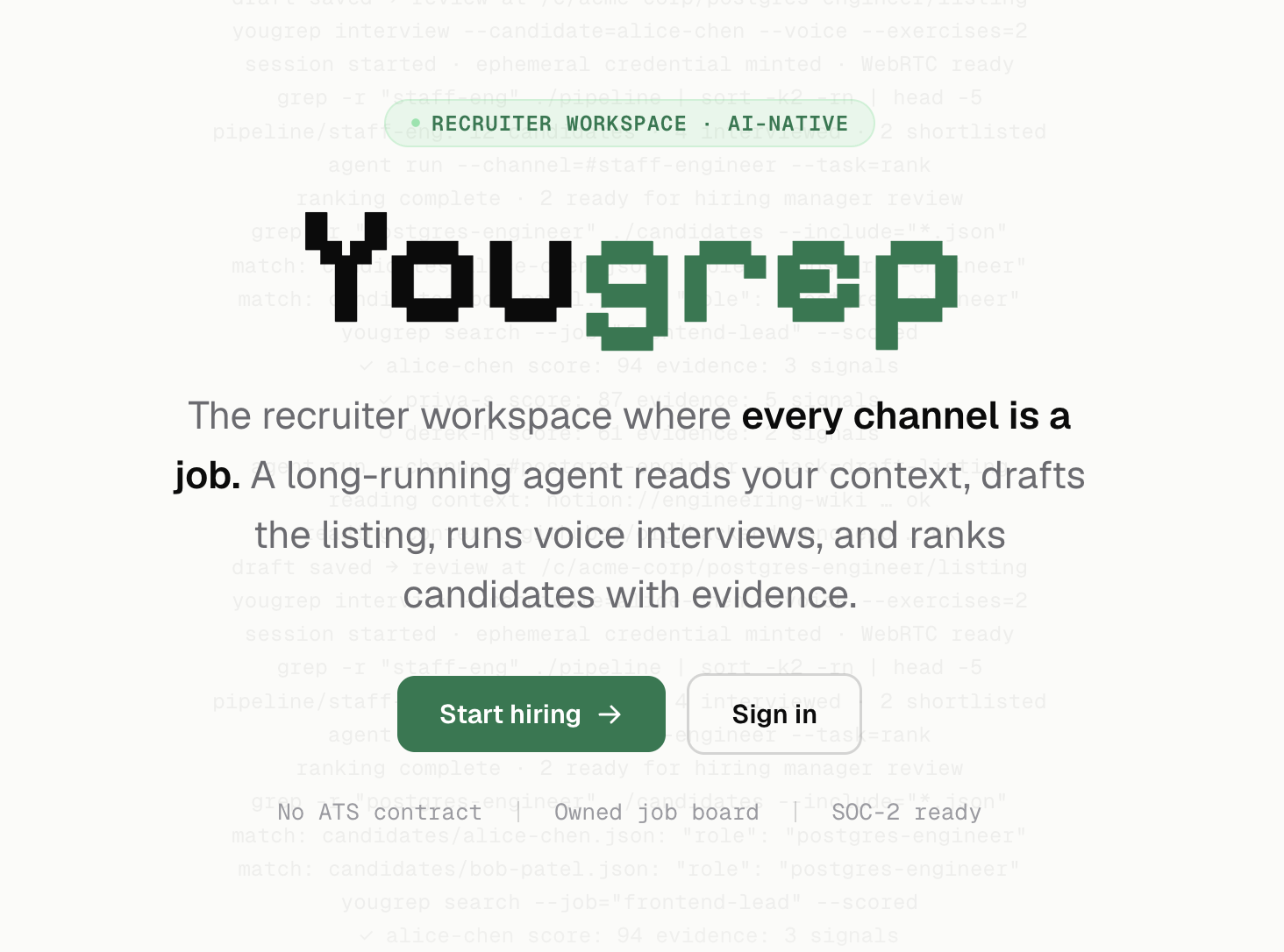
Yougrep is a Slack-style recruiting workspace where every job opening is its own channel with a dedicated AI agent.
Recruiters can create job channels, draft job listings, publish them to the company’s own job board, review candidates, and talk to the role-specific agent. Candidates can apply from the public job board and enter a live AI-led technical voice interview that understands the role, the company context, and the evaluation rubric.
Instead of generic resumes, generic take-homes, and scattered hiring notes, Yougrep keeps the role, candidates, interviews, and hiring context in one place.
How we built it
We built Yougrep as a TypeScript/Next.js app with a recruiter workspace, public job board, and candidate interview flow. The backend uses Postgres-style data modeling with PGlite for local development, Better Auth for organization-based tenancy, and a clean separation between recruiter data and candidate interview data.
For the AI system, we designed job-specific agents that can help with role creation, candidate review, and interview handoff. Text-based agent workflows are routed through Guild AI and a model gateway, while the candidate voice interview uses OpenAI Realtime over WebRTC with short-lived credentials minted by the backend.
We also designed the interview surface so generated UI exercises come from predefined components, keeping the experience interactive without allowing arbitrary model-generated code.
Challenges we ran into
The biggest challenge was making the product feel concrete instead of just being another chatbot inside an ATS. We wanted the mental model to be instantly clear: every job is a channel, and every channel has an agent that knows that role.
We also had to think carefully about data boundaries. The interview agent should understand the role and rubric, but it should not see raw recruiter conversations or unrestricted company connector data. Designing that handoff forced us to be deliberate about what context gets distilled and passed into interviews.
Another challenge was balancing speed with realism. For a hackathon, it is tempting to fake the recruiting workflow, but we wanted the architecture to match how a real multi-tenant hiring product would work.
Accomplishments that we're proud of
We are proud that Yougrep feels like a real workspace, not just a demo flow. The product connects the recruiter side, the public job board, and the candidate interview into one coherent loop.
We are also proud of the role-specific agent concept. Instead of having one generic hiring assistant, each job opening gets its own memory, context, candidates, and interview history. That makes the AI feel much closer to a teammate embedded in the hiring process.
What we learned
We learned that recruiting is mostly a context problem. Teams do not just need to screen faster; they need to preserve what they know about the role, the company, the codebase, and the candidates.
We also learned that AI hiring tools need strong boundaries. The more context an agent has, the more useful it becomes, but that context has to be controlled, scoped, and explainable.
What's next for Yougrep
Next, we want to make the interview experience richer with better technical exercises, stronger candidate scoring, and clearer recruiter review tools.
We also want to add more read-only connectors for company context, such as GitHub, Slack, and Notion, so each job agent can understand the actual team environment. Longer term, Yougrep could become the workspace where hiring teams create roles, evaluate candidates, preserve interview knowledge, and continuously improve how they hire.
Built With
- api
- drizzle
- geist
- motion
- next.js
- node.js
- openai
- openui
- openui-lang
- orm
- pglite
- phosphor
- postgresql
- render
- typescript
- webrtc

Log in or sign up for Devpost to join the conversation.