Inspiration
After watching a close friend struggle to process the loss of her dog—feeling isolated and unsure how to navigate her grief—I realized there was no accessible, judgment-free space for people to heal at their own pace. Grief is universal, yet so many suffer in silence, afraid to burden others. I wanted to build something that met people where they are, honoring their pain without pressure to "move on."
What it does
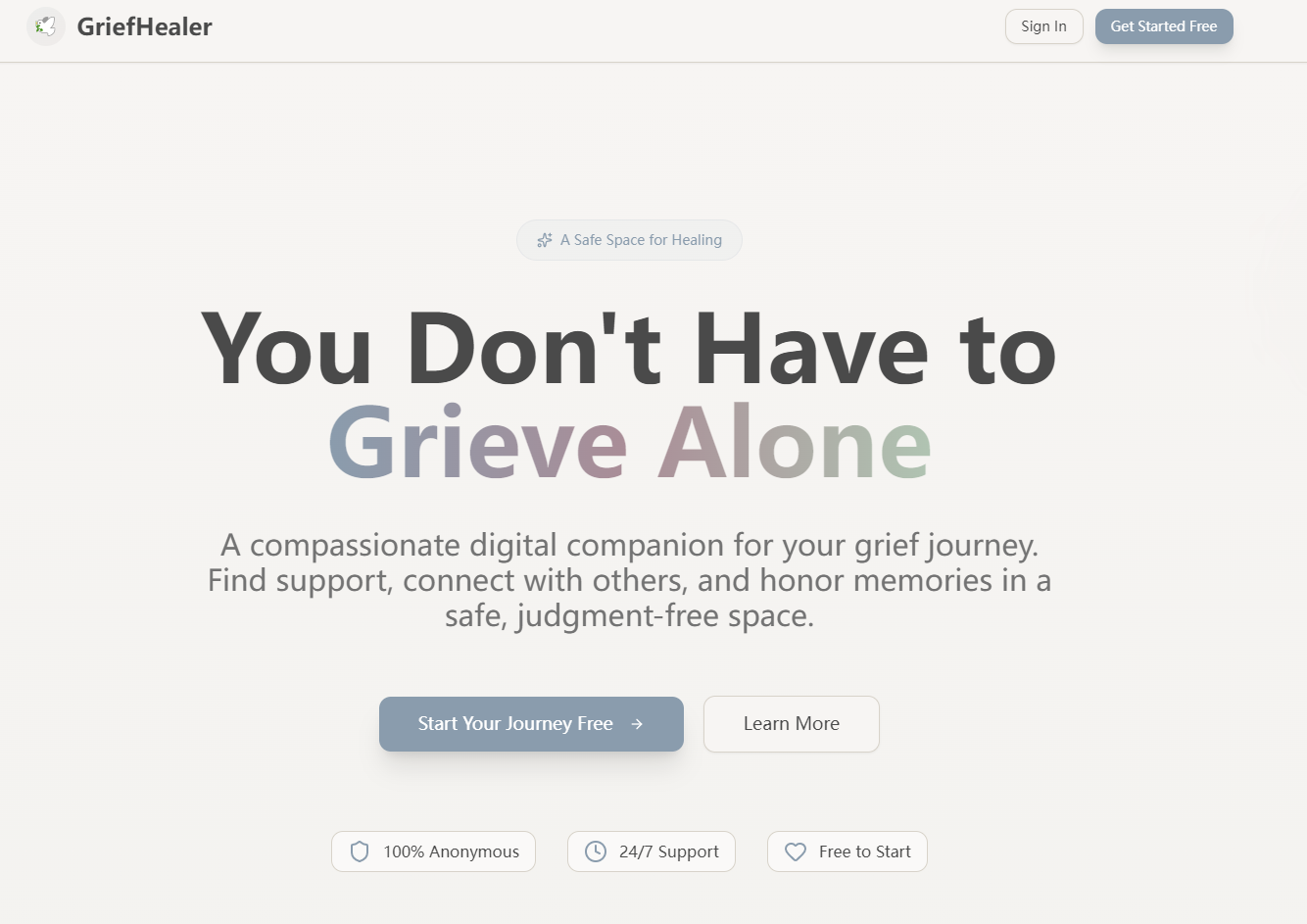
GriefHealer is a digital sanctuary for anyone grieving loss—whether of a loved one, relationship, or pet. It offers AI-guided emotional support, anonymous peer communities grouped by loss type, customizable digital memorials, and clear access to professional mental health resources when needed. The platform adapts to each user’s grief stage (rooted in the Kübler-Ross Model) and prioritizes privacy, calm, and validation above all.
How we built it
We started by mapping user journeys to center empathy—interviewing grief counselors to ensure the platform’s tone and structure felt safe. We built the frontend with React (mobile-first design) and the backend with Node.js/Express, using Firebase for anonymous authentication and MongoDB for secure data storage. The AI companion integrates OpenAI API, fine-tuned to avoid unsolicited advice and detect severe distress signals. Stripe handles subscription tiers, and Twilio API ensures crisis hotline info is accessible globally.
Challenges we ran into
The biggest challenge was balancing AI’s responsiveness with emotional safety—avoiding generic "comfort" messages that feel dismissive. We iterated extensively with grief experts to refine the AI’s tone (calm, slow-paced, validating) and built guardrails to trigger professional resource alerts only when severe symptoms (hopelessness, suicidal ideation) are detected. Another hurdle was community moderation: ensuring anonymity while preventing unkind behavior, so we built light, human-led moderation tools instead of over-reliant AI filters.
Accomplishments that we're proud of
We created a platform that centers the user’s autonomy—no pressure to "progress" through grief, no intrusive notifications, and full control over privacy (including anonymous sign-up and memorial customization). We also successfully integrated crisis detection that feels gentle, not alarmist—users report feeling seen, not policed, when the platform suggests professional support. The peer community has fostered genuine connection, with early users sharing how anonymous posts helped them feel less alone.
What we learned
Grief is deeply personal—one-size-fits-all tools don’t work. We learned to prioritize listening over solving: the AI chat was reimagined to hold space for emotions first, only offering advice when asked. We also gained a deeper understanding of privacy as an act of care—anonymous features aren’t just technical; they’re emotional lifelines for people who fear judgment. Most importantly, we learned that building for mental health requires humility: we partnered with grief counselors throughout, not just as "advisors," but as core collaborators.
What's next for this project
We plan to expand regional crisis hotline data to cover more European and U.S. states, and add gentle, optional guided reflections tailored to each grief stage (premium tier). We’re also exploring partnerships with grief support organizations to connect users to in-person resources, and testing a simplified mobile app for low-bandwidth access. Long-term, we hope to add optional, therapist-vetted journaling tools—always keeping the focus on safety, choice, and healing at the user’s pace.
