-
-

Upload video page
-
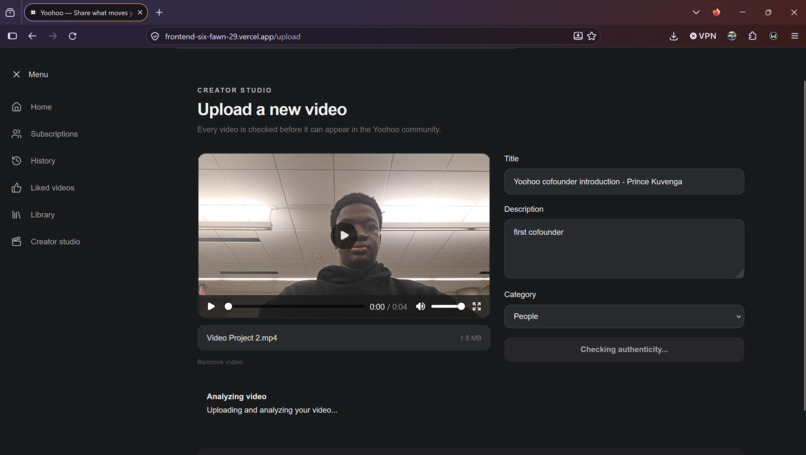
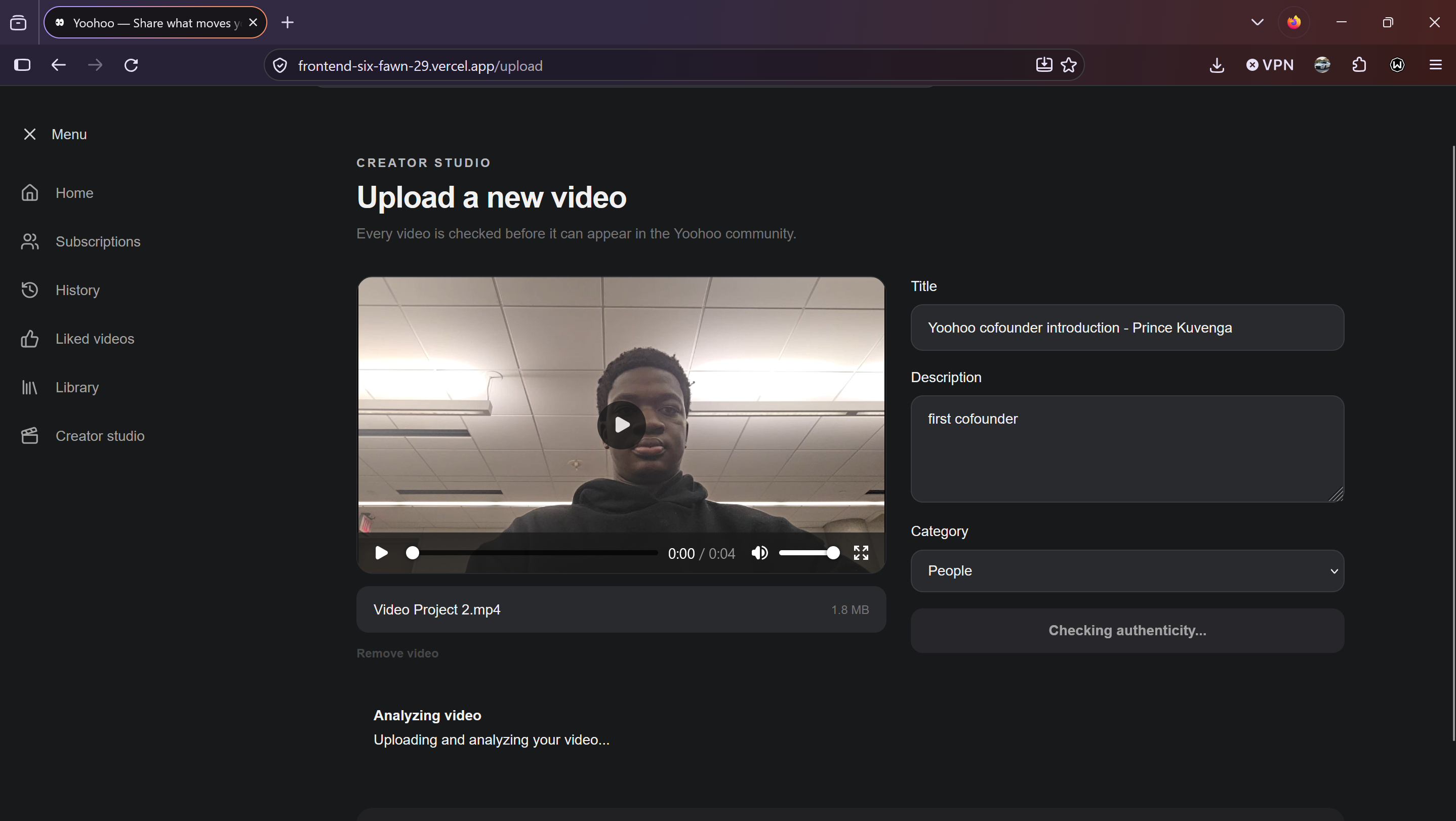
Video getting analyzed by the ai
-
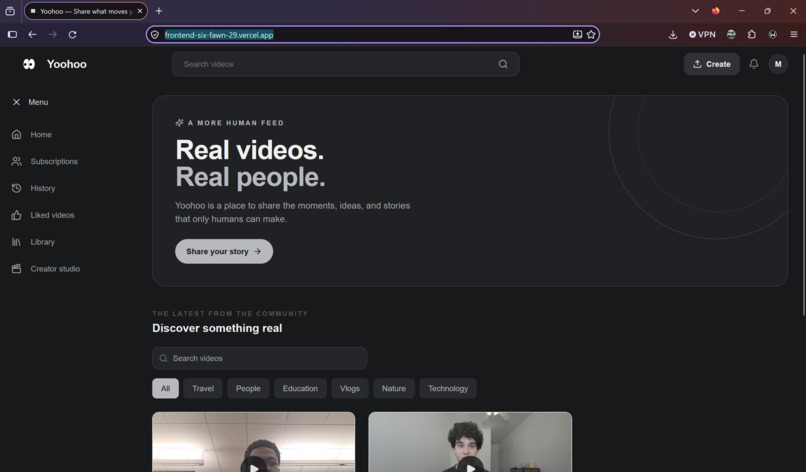
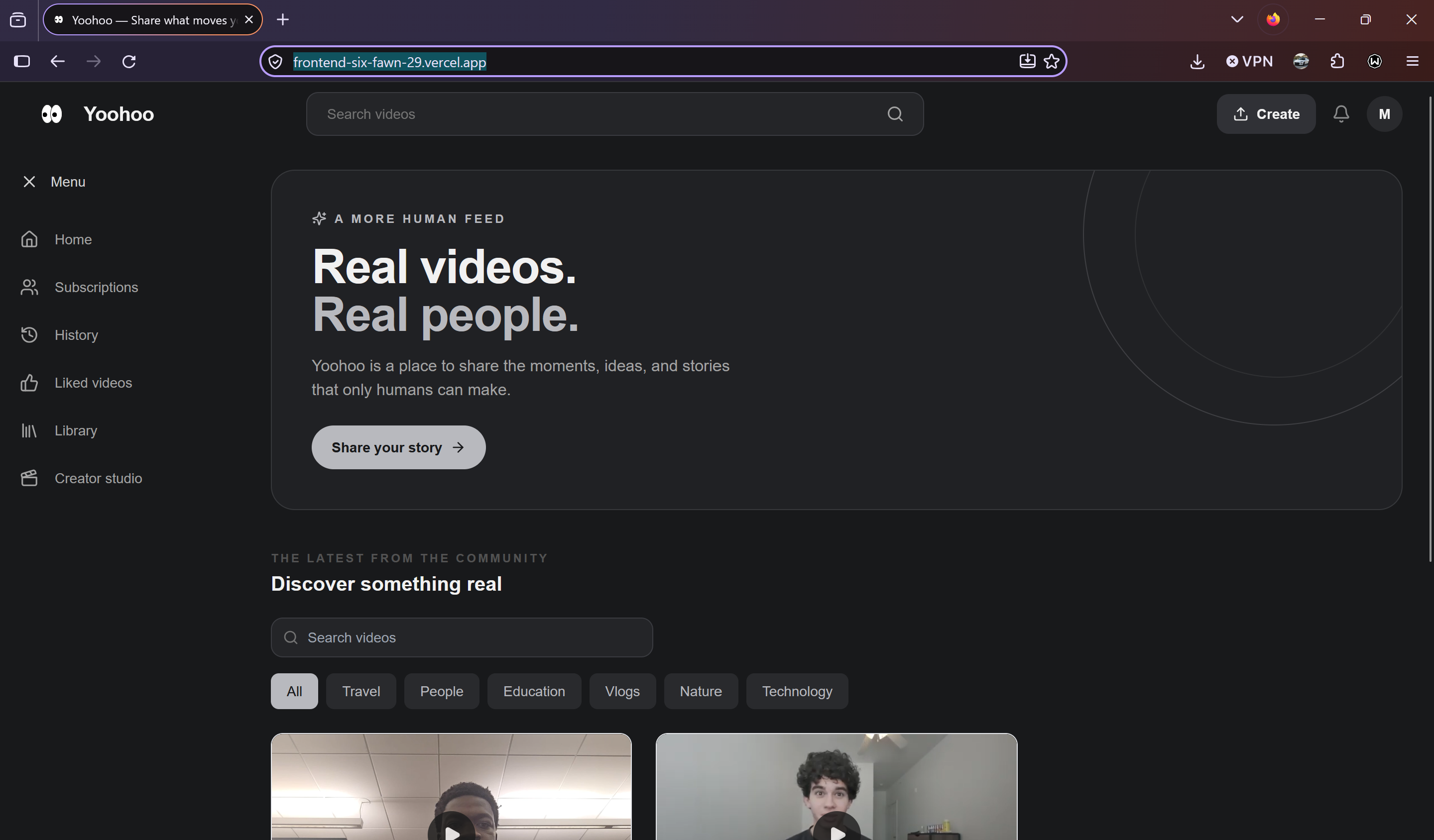
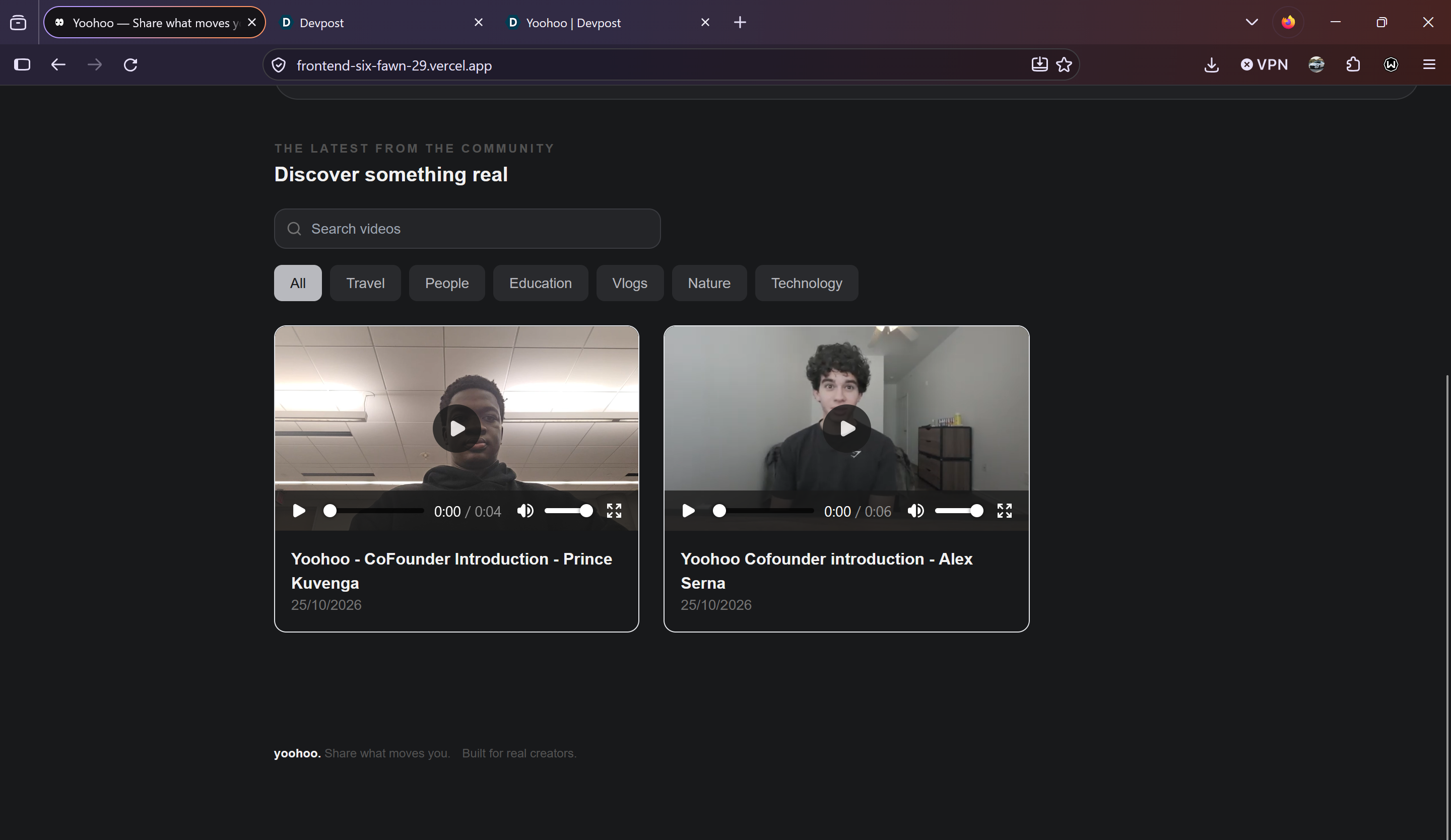
Home Page with accepted videos
-
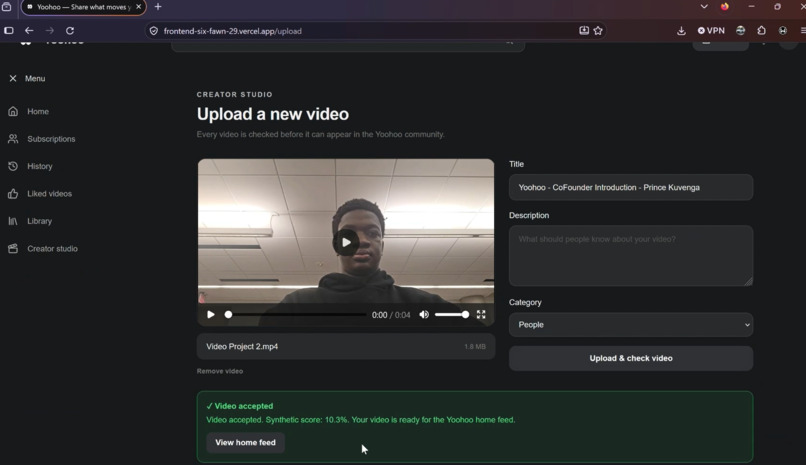
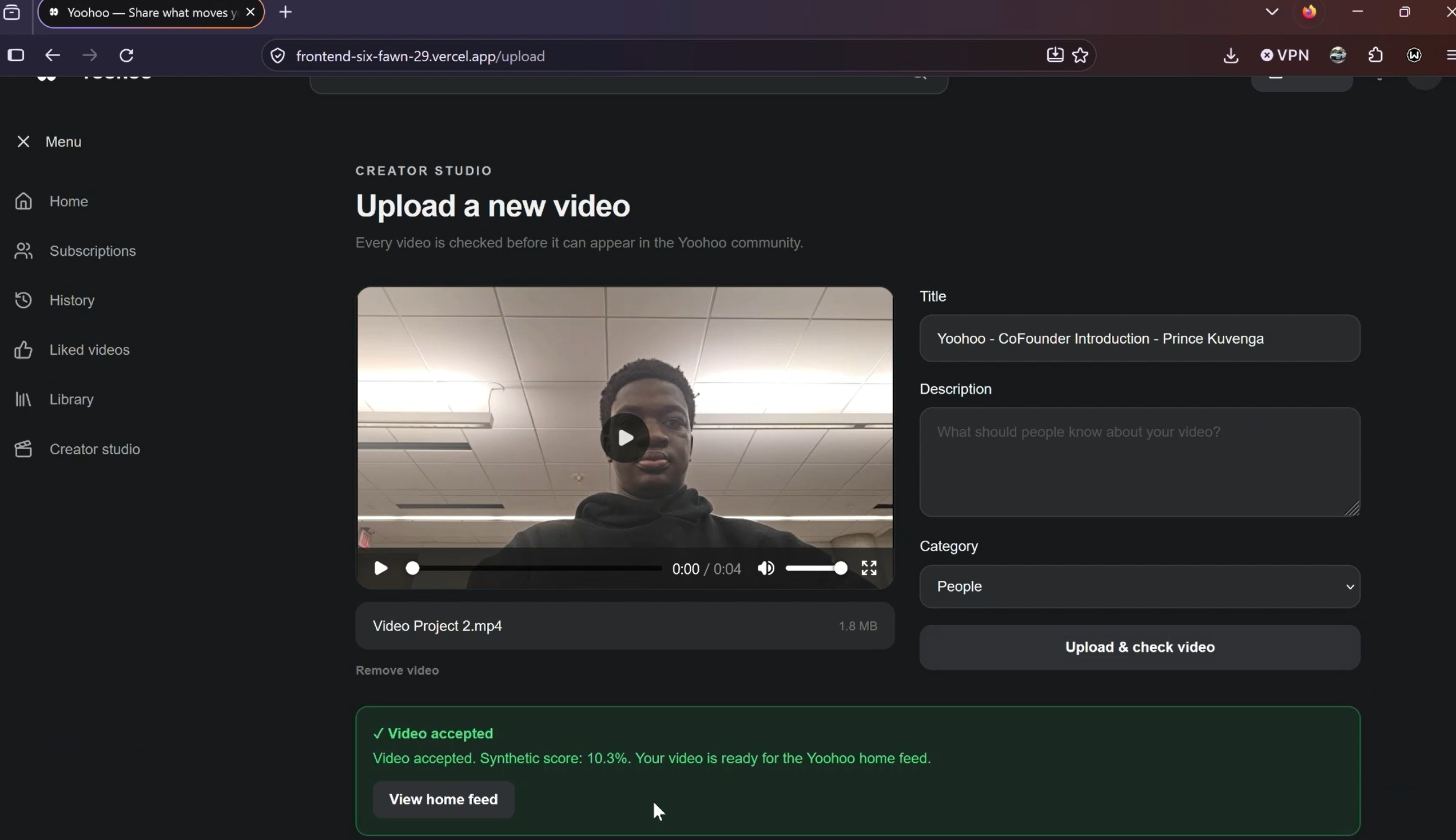
Real Video accepted
-
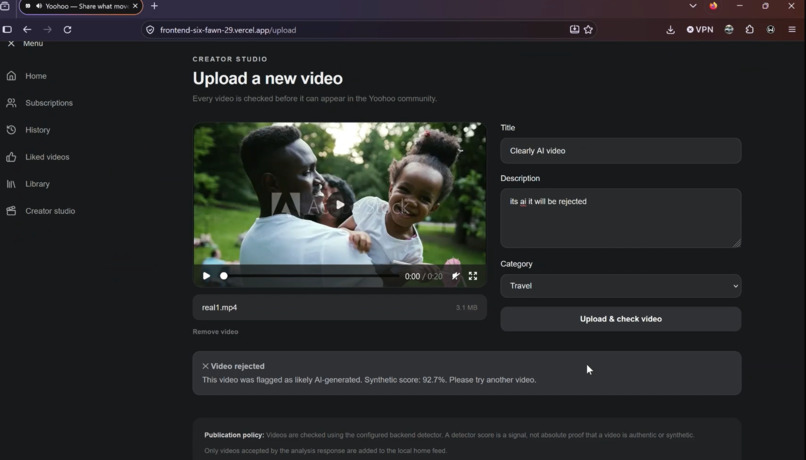
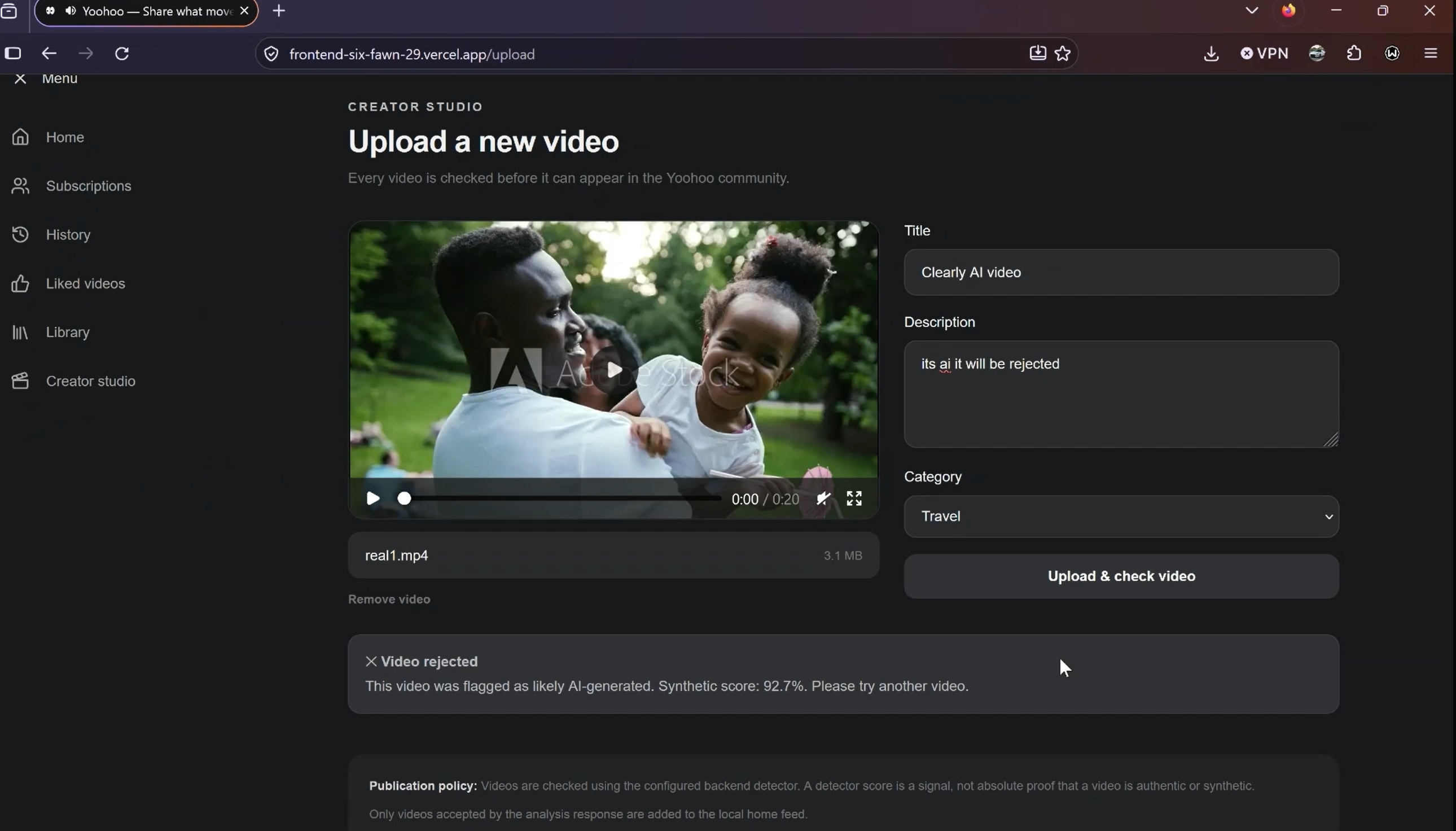
AI video rejected
-
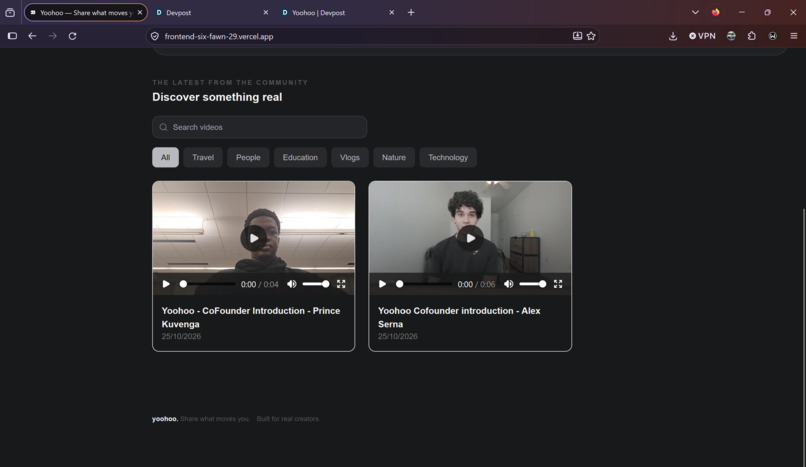
Home page showing titles of videos

Yoohoo — Real Videos. Real People.
Inspiration
We were tired of the AI slop flooding our social media feeds: AI-generated ads, artificial characters, cloned voices, and content that feels increasingly manufactured. Social media is becoming more artificial and, ironically, less social.
What makes a creator worth following isn't just the content they post. It's their personality, their story, their imperfections, and the feeling that there's a real person on the other side of the screen. We can connect with a creator's journey, become fans of their work, and feel inspired by their experiences. That connection is harder to replicate when everything is generated.
We wanted to build something that pushes back against this trend. Yoohoo is our attempt to bring the human element back to social media by creating a space where genuine creativity takes center stage.
What It Does
Yoohoo is a human-first video-sharing platform designed to cut through the AI noise and celebrate authentic human creativity.
Unlike traditional platforms that prioritize engagement regardless of how content is made, Yoohoo aims to make authenticity a core part of the upload experience. When a creator uploads a video, our backend analyzes it for signs of AI generation. Videos whose detection scores exceed our configured threshold are rejected, while videos that pass proceed through our publishing workflow.
Our goal isn't simply to build another place to watch videos. It's to build a community where people can connect with real creators, real experiences, and the stories that make us human.
How We Built It
We built Yoohoo with a Next.js and TypeScript frontend and a Python FastAPI backend.
When a video is uploaded, the backend validates the file, inspects its metadata, and samples frames for analysis. We integrated NVIDIA's synthetic video detection model to evaluate the video frame by frame and aggregate the resulting probability scores.
We use a mean probability threshold of 0.30 as our current decision boundary. Scores at or above the threshold result in rejection, while lower scores allow the video to proceed to storage and publication.
For persistence, we use Supabase Storage for video files and PostgreSQL through Supabase for video metadata and detection results. We deployed the frontend on Vercel and the backend on Render.
The result is a full-stack application that connects a modern video-sharing experience with an AI-powered authenticity screening workflow.
Challenges We Ran Into
One of our biggest challenges was connecting the different parts of the system into one working application. Building the frontend, integrating the detection model, processing uploaded video files, and persisting approved videos all required the components to work together reliably.
Deployment introduced another layer of complexity. Running the frontend on Vercel and the backend on Render meant configuring cross-origin resource sharing (CORS) so that browsers could safely communicate with our API. We also had to troubleshoot deployment-specific behavior that wasn't always apparent during local development.
Another challenge was translating a broad idea—preserving human creativity—into a concrete technical workflow. We needed a way to evaluate videos consistently and define a threshold that would determine what happens to each upload. Our current threshold is a starting point, not a perfect solution: detection models can make mistakes, and authentic content can sometimes be incorrectly flagged.
Accomplishments That We're Proud Of
We're proud to have turned an idea into a working full-stack prototype rather than stopping at a concept or a mockup.
- AI detection integration: We connected NVIDIA's synthetic video detector to an upload workflow that analyzes video content.
- End-to-end processing: We built a pipeline that validates uploads, analyzes videos, makes threshold-based decisions, and stores videos that pass.
- Full-stack deployment: We brought together Next.js, FastAPI, and Supabase, with the frontend and backend deployed separately.
- A mission-driven product: We designed Yoohoo around a clear question: what would social media look like if human creativity and genuine connection were the priority?
We're especially proud that Yoohoo explores authenticity as a foundational product principle, rather than treating it as an afterthought.
What We Learned
We learned that building an AI-powered product involves much more than integrating a model. The surrounding system—file validation, backend processing, database persistence, error handling, deployment, and frontend communication—is just as important.
We also learned to think critically about the limitations of AI detection. A probability score is not definitive proof of how a video was created. Choosing a threshold involves trade-offs between incorrectly rejecting authentic content and allowing synthetic content through. Building a trustworthy platform means acknowledging those limitations rather than claiming perfect detection.
Most importantly, we learned how to translate a social problem into a technical product. Yoohoo challenged us to think beyond whether we could build a feature and ask what kind of online experience we actually want to create.
What's Next for Yoohoo?
Yoohoo is a starting point, and there is much more we want to build.
- Improve detection reliability: Evaluate the model against diverse real-world videos, measure false positives and false negatives, and refine our threshold.
- Strengthen authenticity signals: Explore content provenance and additional verification methods rather than relying on a single detection score.
- Build a richer creator experience: Add user profiles, follows, likes, comments, and better video discovery.
- Improve moderation and appeals: Give creators a way to challenge incorrect rejections and introduce human review for uncertain cases.
- Scale the platform: Improve video processing, upload progress, performance, and reliability as usage grows.
Our long-term vision is simple: a social platform where technology helps people discover human creativity instead of making it harder to find.
Yoohoo — Real videos. Real people.
Built With
- fastapi
- nextjs
- postgresql
- python
- supabase
- typescript

Log in or sign up for Devpost to join the conversation.