Inspiration In professional esports, data overload is a real problem. Coaches have access to millions of data points but struggle to synthesise them into actionable advice in the heat of a match. We asked ourselves, "What if a coach had a supercomputer assistant that watched every frame, tracked every stat, and whispered strategic insights in real time?"
That was the birth of Assistant Coach AI. We wanted to move beyond simple dashboards and create a system that understands the game.
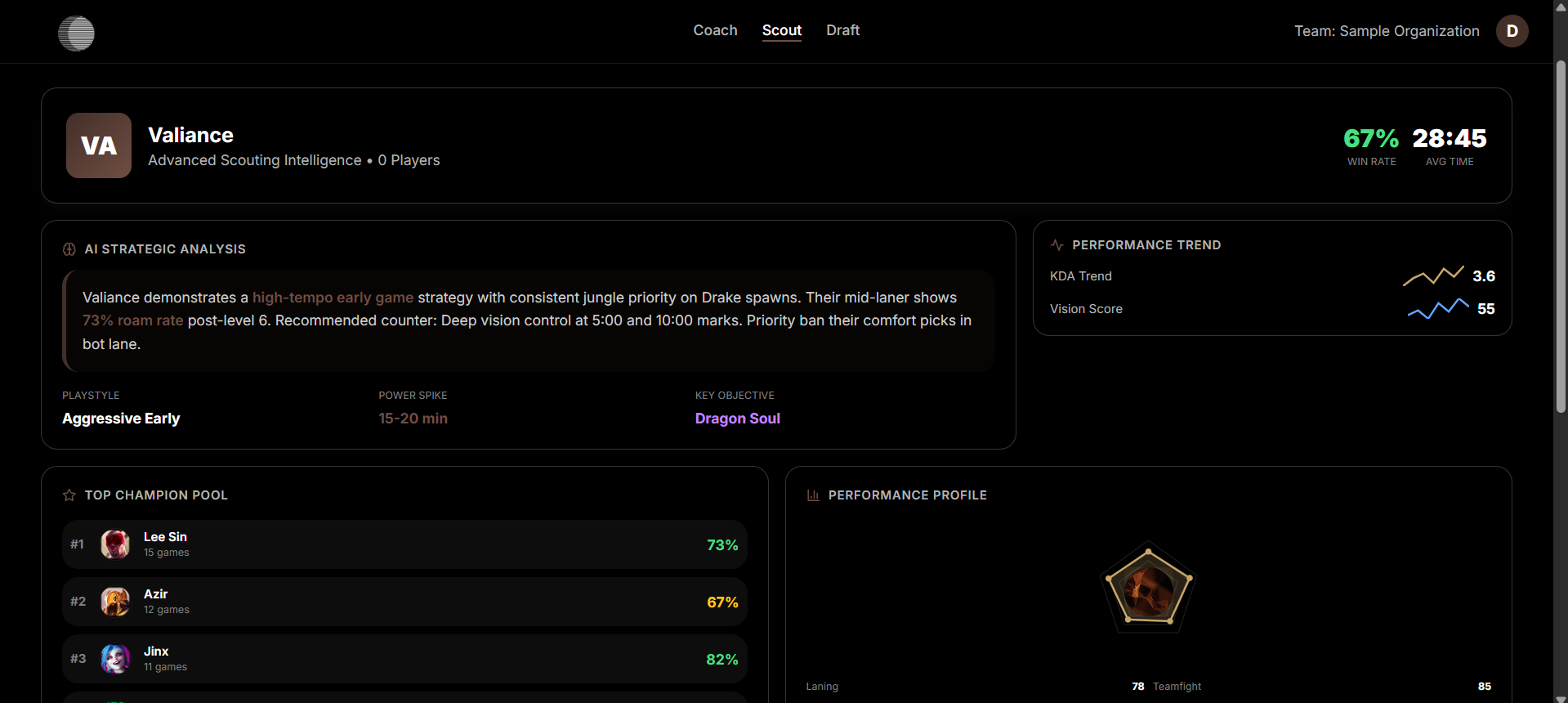
What it does The Scout: Automates the hours of research required before a match. It pulls historical data, analyzes champion pools, and generates a natural language profile of the enemy team with specific tactical recommendations.
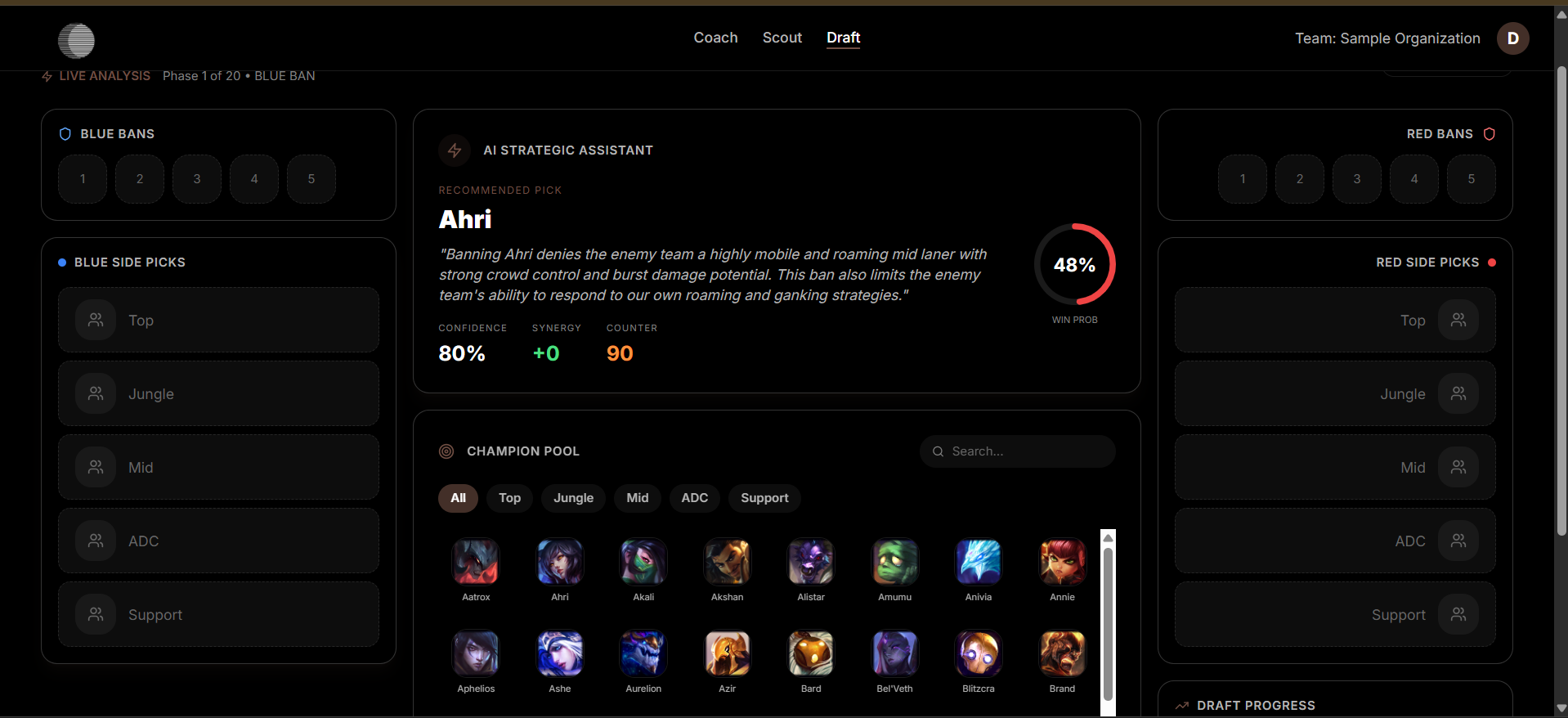
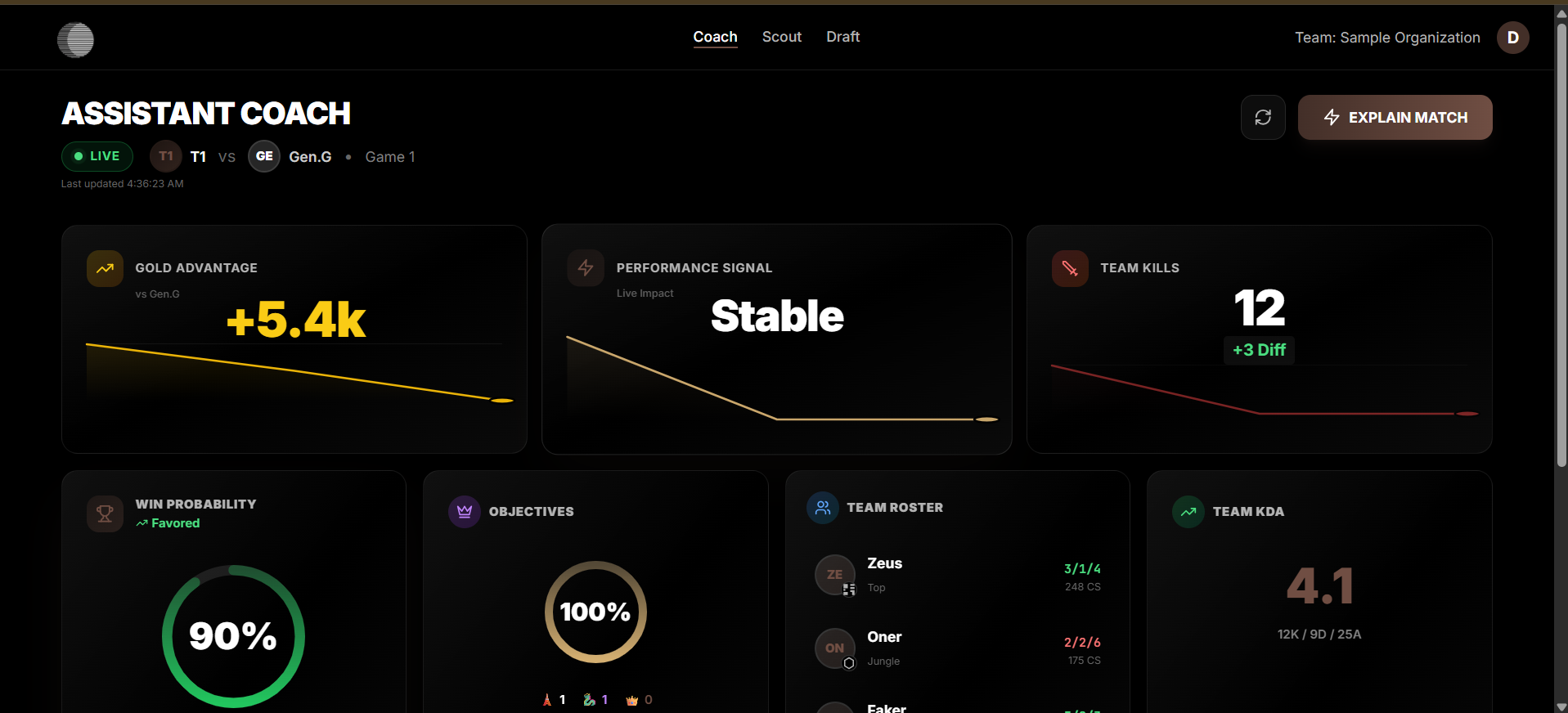
The Draft Room: A live companion during the pick/ban phase. It predicts enemy picks, suggests counter-picks based on win rates and synergy, and flags "strategic deviations" when the opponent does something unexpected. The Live Dashboard: During the game, it visualizes "invisible" advantages like momentum, gold efficiency, and map pressure. The "Explain Match" button uses LLMs to provide a narrative analysis of why the game is flowing a certain way—perfect for post-game reviews or quick checks.
How we built it We built the application on a modern Next.js stack for speed and responsiveness.
Data Layer: We integrated the GRID Data API to fetch high-fidelity match history and live game telemetry. This gives us the "ground truth" of what's happening on the rift. Intelligence Layer: We used Groq's LPU inference engine to power our AI features. The speed of Groq allows us to send complex game states to Llama 3 and get detailed strategic analysis back in milliseconds, making "real-time AI coaching" actually viable. UI/UX: We used Tailwind CSS and Framer Motion to create a "glassmorphism" aesthetic that feels right at home in a high-tech esports facility. The Bento Grid layout ensures that critical information is always high visibility.
Challenges we ran into LLM Hallucinations in Stats: Initially, the AI would invent stats. We solved this by providing structured JSON contexts and forcing the LLM to act as an "analyst" interpreting provided data, rather than a knowledge base recalling facts.
Visualising Abstract Concepts: Representing "momentum" or "pressure" is hard. We developed custom sparkline algorithms that combine Gold, XP, and Objective control into single "Signal" metrics.
Accomplishments that we're proud of Sub-second Analysis: The "Explain Match" feature feels magical because it's so fast.
The UI Polish: We managed to create a dashboard that looks professional enough to be on screen at a major tournament. Signal Detection: Our custom algorithms for detecting "Performance Spikes" turned out to be surprisingly accurate at predicting game outcomes.
What we learned Speed is a Feature: In esports, "real-time" isn't a buzzword; it's a requirement. Moving inference to Groq's LPU radically changed the UX, making AI feel like a teammate rather than a tool.
Context is King: LLMs are brilliant at reasoning but terrible at facts. We learned that the quality of the "Assistant Coach" depends entirely on the structured data context we feed it from GRID, not the model size. Visual Balance: Designing for high-density information without overwhelming the user is an art. We learned to use "progressive disclosure"—showing broad signals first (Gold, Kills) and only revealing granular data (CS diff, Item spikes) on demand.
What's next for Yoe Voice Interface: Allowing coaches to ask "What's our win condition?" and get a spoken answer.
Computer Vision Integration: analyzing the mini-map video feed for vision control patterns. Multi-Game Support: Expanding the framework to Valorant and CS2.
Built With
- api
- framer
- grid
- groq
- motion
- next.js
- postgresql
- tailwindcss
- typescript

Log in or sign up for Devpost to join the conversation.